Sample Category Title
USD/CAD Could Resume Upside Unless 1.2765 Fails
Key Highlights
- USD/CAD started a downside correction from the 1.2965 zone.
- A major bearish trend line is forming with resistance near 1.2820 on the 4-hours chart.
- EUR/USD is facing a major hurdle near the 1.1350 resistance zone.
- Gold price failed to surpass $1,815 and started a downside correction.
USD/CAD Technical Analysis
The US Dollar failed to clear the 1.3000 zone against the Canadian Dollar. USD/CAD started a downside correction and traded below 1.2900.
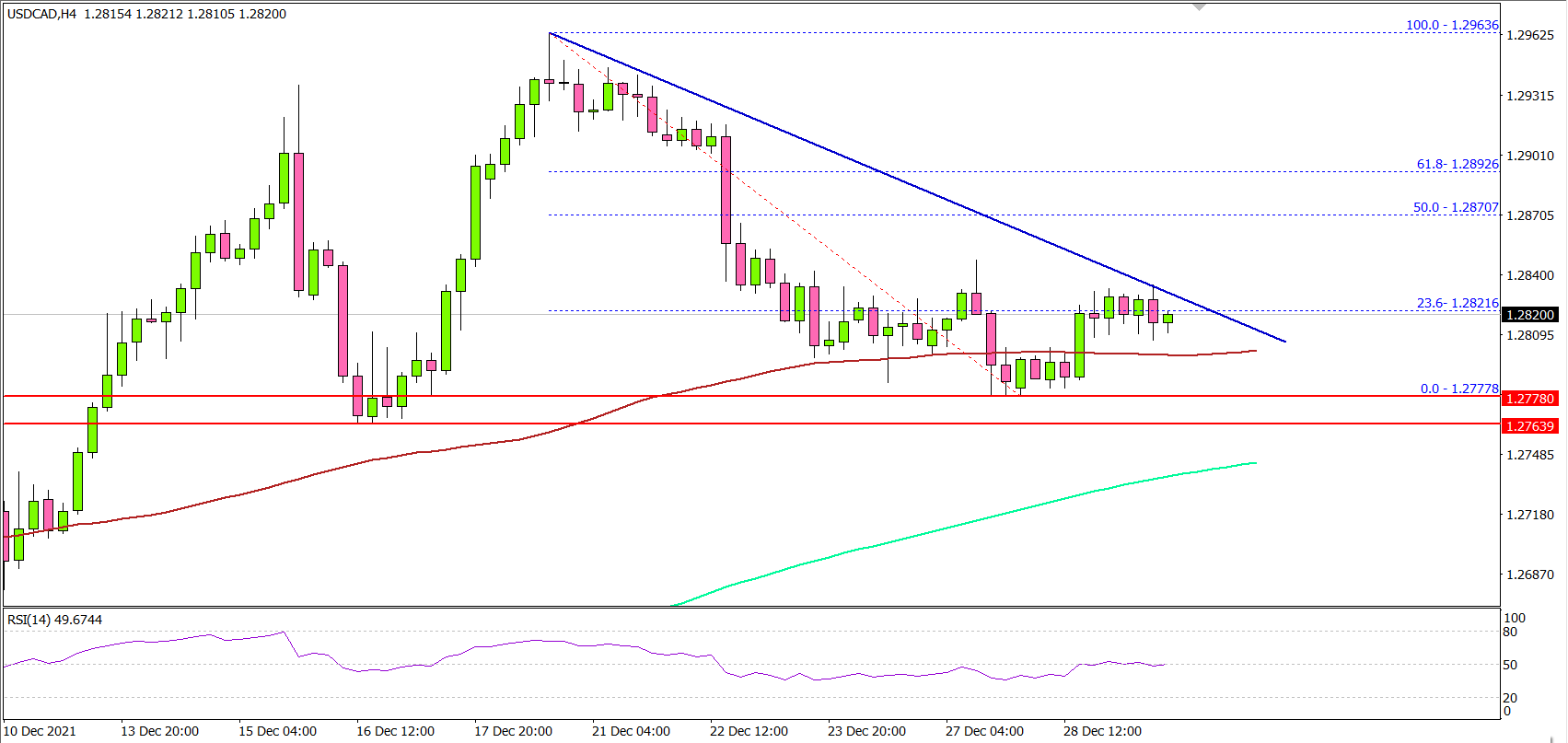
Looking at the 4-hours chart, the pair failed to stay above the key 1.2880 support level. It even spiked below the 100 simple moving average (red, 4-hours) but stayed well above the 200 simple moving average (green, 4-hours).
The pair is now consolidating above 1.2780 and is facing resistance near 1.2820. There is also a major bearish trend line forming with resistance near 1.2820 on the same chart.
The next major resistance is near the 1.2870 level. It is near the 50% Fib retracement level of the downward move from the 1.2963 swing high to 1.2777 low. A clear move above 1.2870 could start a fresh increase towards the 1.3000 level.
On the downside, an immediate support is near the 1.2780 level. A downside break below the 1.2780 support could spark a move below 1.2765. Any more losses might send the pair towards the 1.2680 level.
Looking at EUR/USD, the pair is still facing a strong resistance near the 1.1350 zone. A clear move above 1.1350 could start a major increase.
Economic Releases
- US Initial Jobless Claims - Forecast 205K, versus 205K previous.
Eco Data 12/30/21
[php_everywhere instance="1"]
US Crude Oil and Petroleum Inventory Fell Across the Board
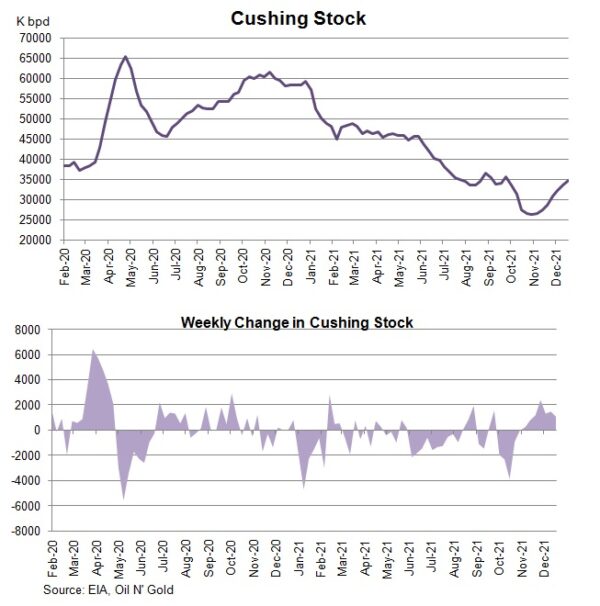
The report from the US Energy Information Administration (EIA) shows that total crude oil and petroleum products (ex. SPR) stocks slumped -1891 mmb to 1184.59 mmb in the week ended December 24. Crude oil inventory dropped -3.58 mmb to 420 mmb, compared with consensus of a +3.09 mmb increase. Inventory decreased in 3 out of 5 PADDs. PADD 3 (Gulf Coast) alone saw inventory draw of -4.3 mmb. Cushing stock added +1.06 mmb to 34.73. Utilization rate stayed added +0.1 ppt to 89.7% while crude production added +0.2 mmb to 11.8M bpd for the week. Crude oil imports increased +0.57M bpd to 6.76M bpd in the week.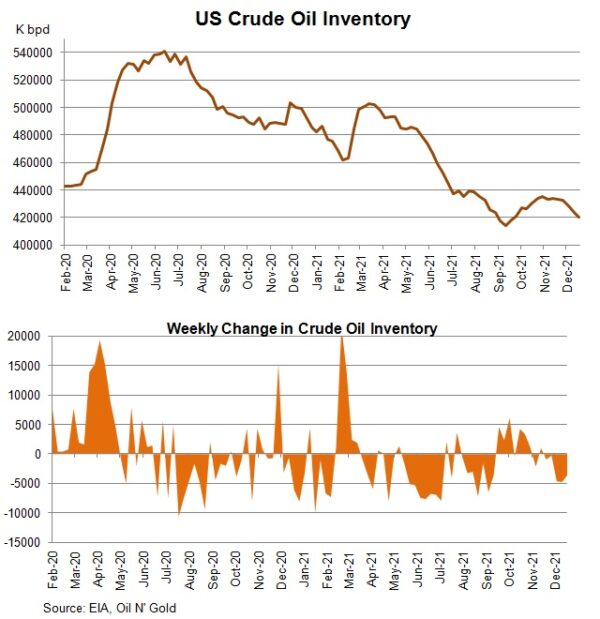
 Concerning refined oil product inventories, gasoline inventory dropped -1.46 mmb to 222.66 mmb while demand gained +8.21% to 9.72M bpd. The market had anticipated a +0.49 mmb growth in stockpile. Production added +1.72% to 10.11M bpd while imports plunged -37.21 % to 0.43M bpd during the week. Distillate stockpile fell -1.73 mmb to 122.43 mmb. The market had anticipated a +0.18 mmb increase. Demand rose +5.99% to 4.05M bpd. Imports dropped -20.2% to 0.16 mmb while production added +1.71% to 4.94M bpd during the week.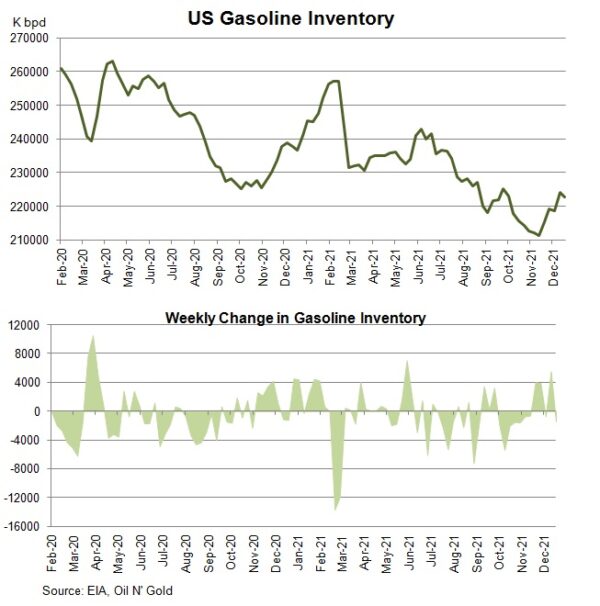
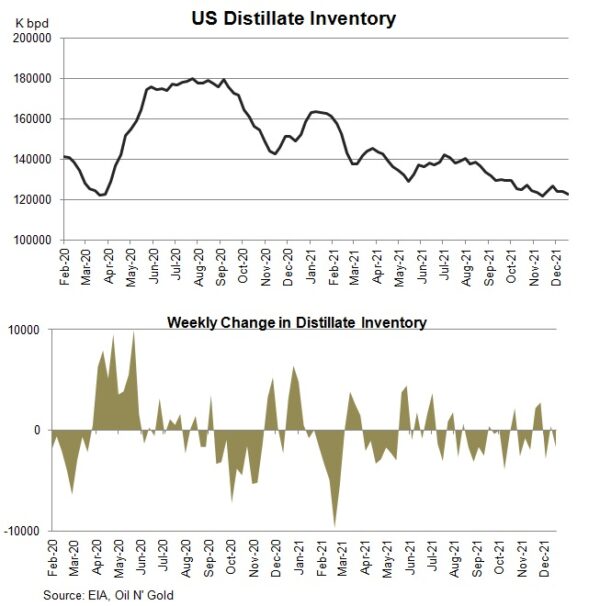
A day earlier, the industry-sponsored API estimated that crude oil inventory fell -3.09 mmb. Gasoline stockpile slipped -0.32 mmb, while that for distillate was down -0.72 mmb.
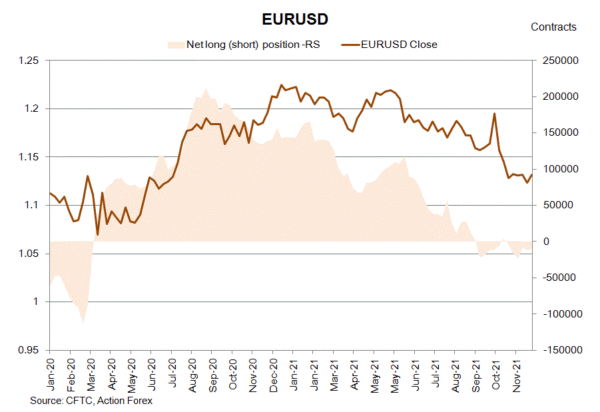
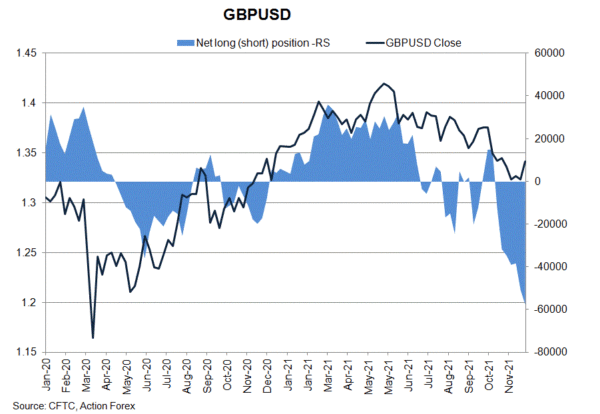
CFTC Commitments of Traders – Net Short of British Pound Futures Increased Further Despite Price Rebound
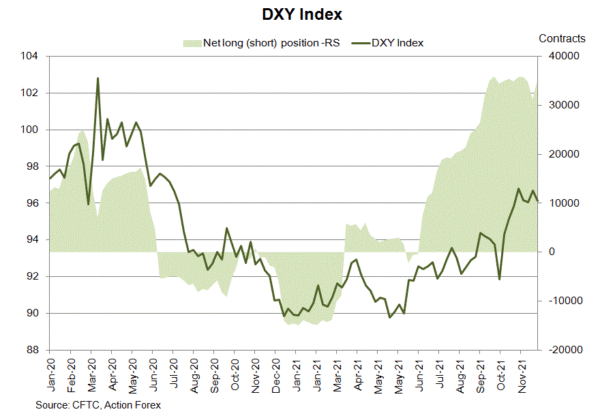
As suggested in the CFTC Commitments of Traders report in the week ended December 21, NET LENGTH of USD index futures gained +3 874 contracts to 35 115. Speculative long positions rose +3 959 contracts but shorts added +85 contracts. NET SHORT of EUR futures dropped -1 717 contracts to 10 162 while that of GBP futures jumped +6 938 contracts to 57 686.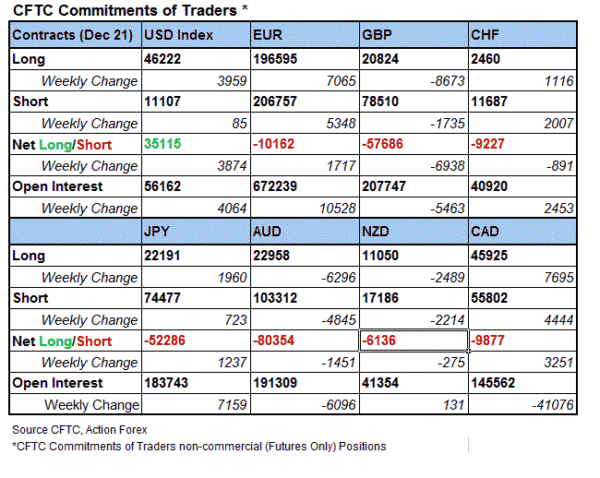
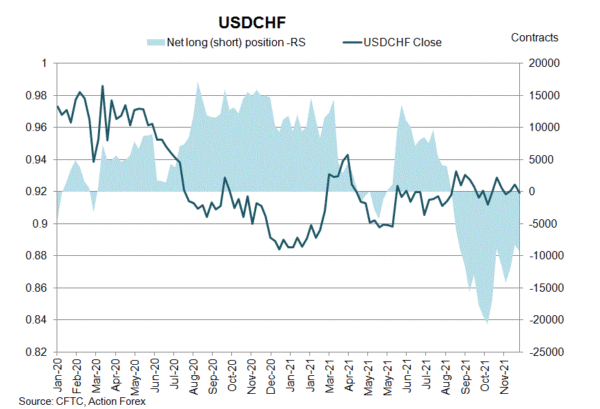
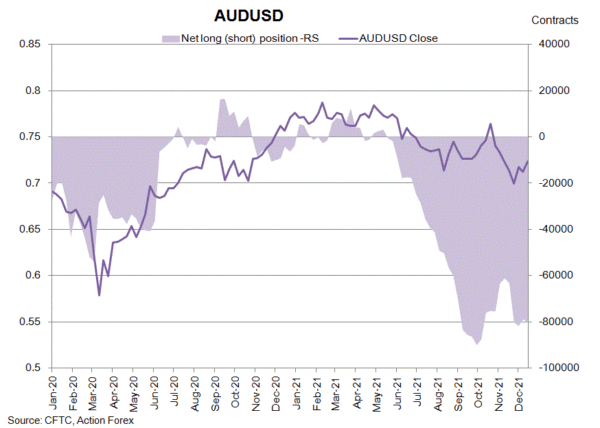
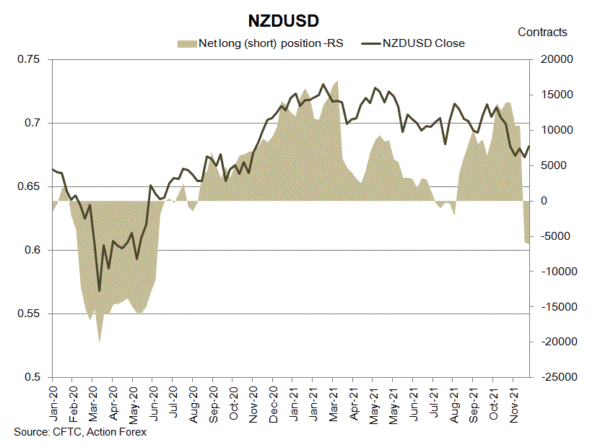
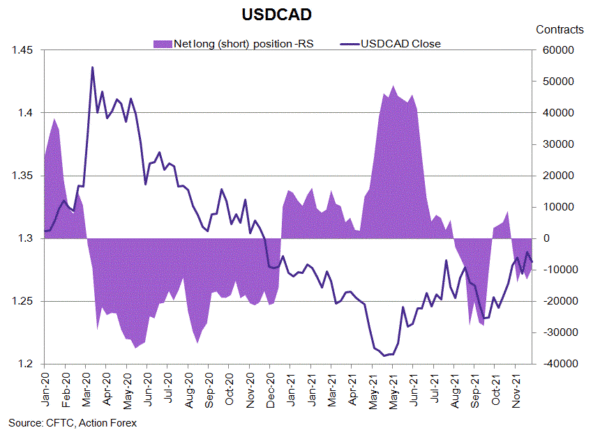
 On safe-haven currencies, NET SHORT of CHF futures added +891 contracts to 9 227 while that of JPY futures dipped -1 237 contracts to 52 286. Concerning commodity currencies, NET SHORT of AUD futures rose +1 451 contracts to 80 354. NZD futures' NET SHORT added +275 contracts to 6 136 during the week. NET SHORT of CAD futures decreased -3 251 contracts to 9 877.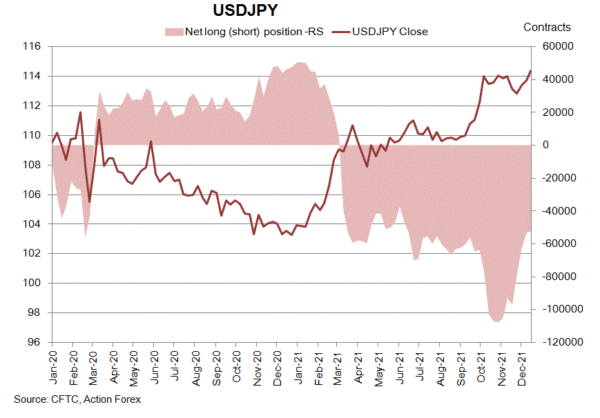
CFTC Commitments of Traders – Long Bets of Crude Oil Futures Reduced on Profit-Taking
According to the CFTC Commitments of Traders report for the week ended December 21, NET LENGTH of crude oil futures sank -6 882 contracts to 340 255. Speculative longs dropped -4 957 contracts while shorts added +1 925 contracts. For refined oil products, NET LENGTH for heating oil added +174 contracts to 4 897, while that for gasoline gained +3 719 contracts to 60 153. NET SHORT of natural gas futures rose +10 986 contracts to 141 212 during the week.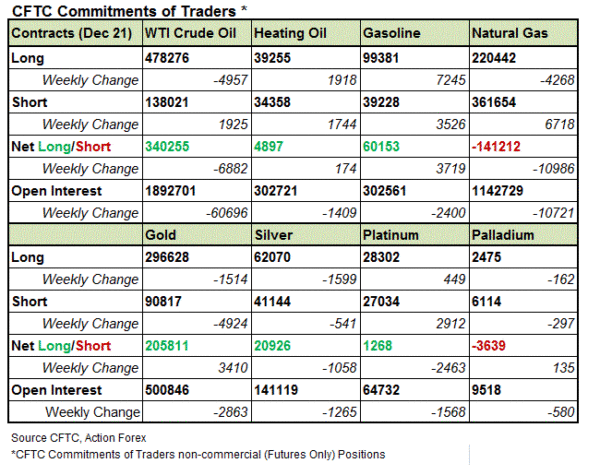
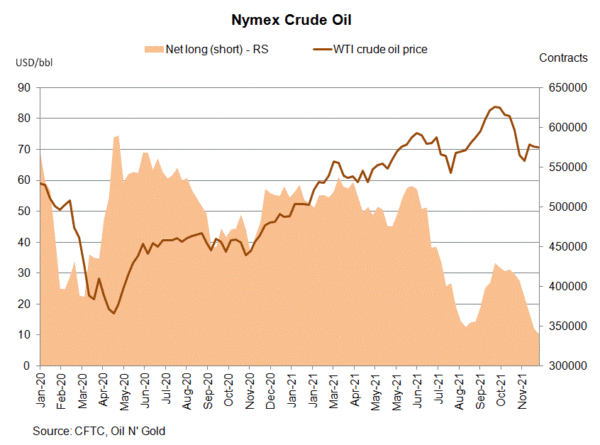
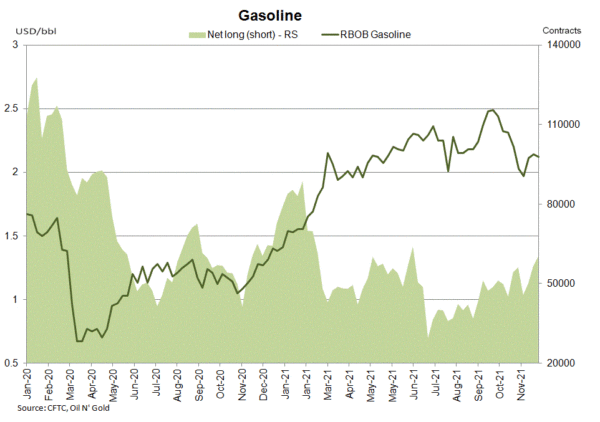
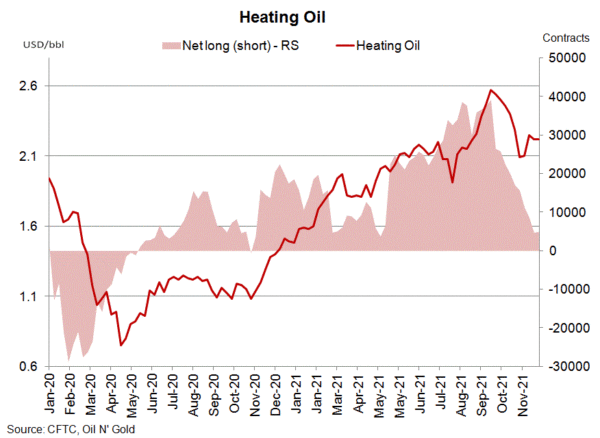
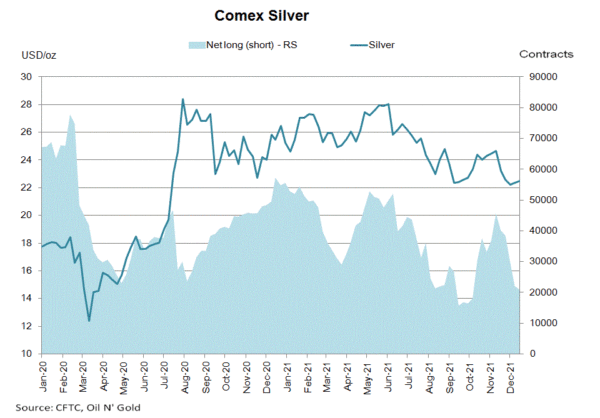
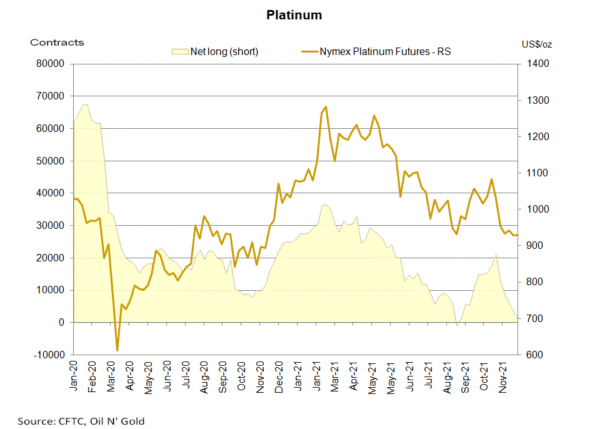
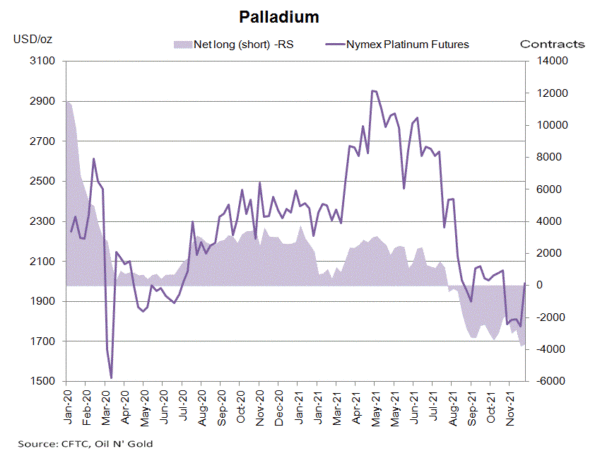
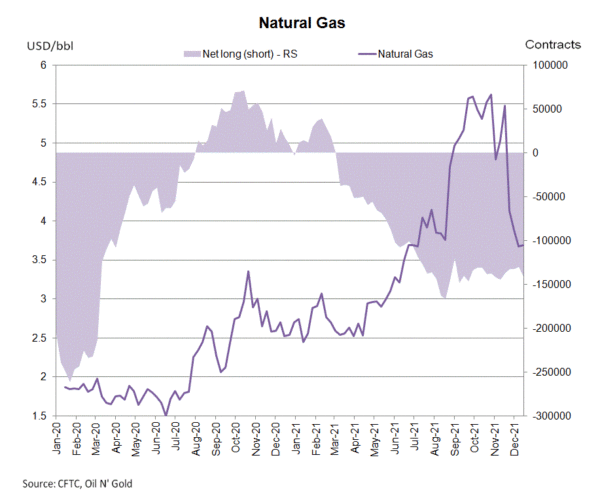 Gold futures’ NET LENGTH gained +3 410 contracts to 205 811. Silver futures’ NET LENGTH decreased -1 058 contracts to 20 926. For PGMs, NET LENGTH of Nymex platinum futures slipped -2 463 contracts to 1 268, while NET SHORT for palladium futures dipped -135 contracts to 3 639.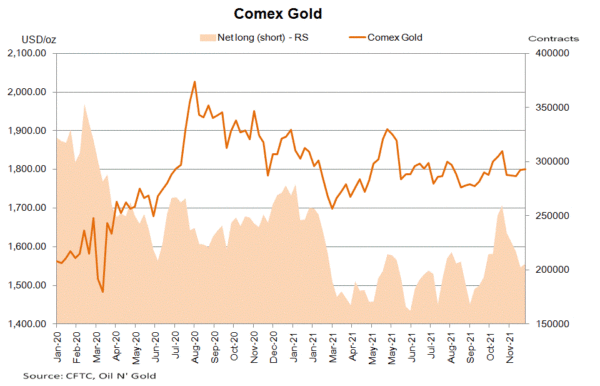
Pound Rises to 5-Week High
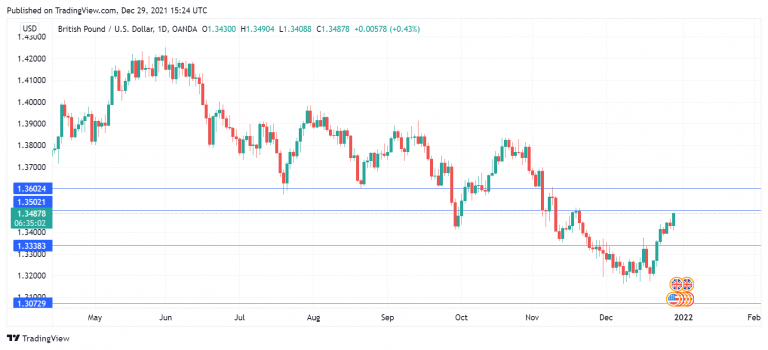
The British pound has posted gains on Wednesday. Earlier in the day, GBP/USD touched 1.3480, its highest level since November 19th. This date was the last time that the pound was at the 1.35 line, a psychologically significant level.
The pound looked good last week, rising 1.18% and the upward trend has continued into Christmas week. Sterling has benefited from stronger risk sentiment, which has led to a move away from the safe-haven US dollar. The dollar index has dipped to 96.11, down 0.09% on the day, marking the fourth day of sideways trading. The index faces resistance at 96.30 and has support at 95.80.
Omicron rages but risk appetite remains intact
When Omicron first appeared on the scene several weeks ago, there were dire predictions about the damage another wave of Covid would cause to the global economy. Omicron has spread very quickly across Europe and the US, but investors remain optimistic that although Omicron is much more contagious than Delta, the symptoms are milder. Still, with infection rates skyrocketing in the US and Europe, there are fears that an Omicron wave could overwhelm hospitals, mostly with unvaccinated patients.
The World Health Organization has warned that Omicron could overload health systems, and France reported a new daily record of 180 thousand newly confirmed cases. In the meantime, the markets are ignoring the explosion in Omicron cases, preferring to focus on the low hospitalization numbers. Still, in a week of illiquid markets, one negative headline about Omicron could put risk sentiment in the freezer and boost investor appetite for the safe-haven greenback.
GBP/USD Technical Analysis
- GBP/USD has support at 1.3349 and 1.3261
- There is resistance at 1.3462 and 1.3550
Stocks 2022 Outlook: Will Bulls Dominate or Bumpier Times Ahead?
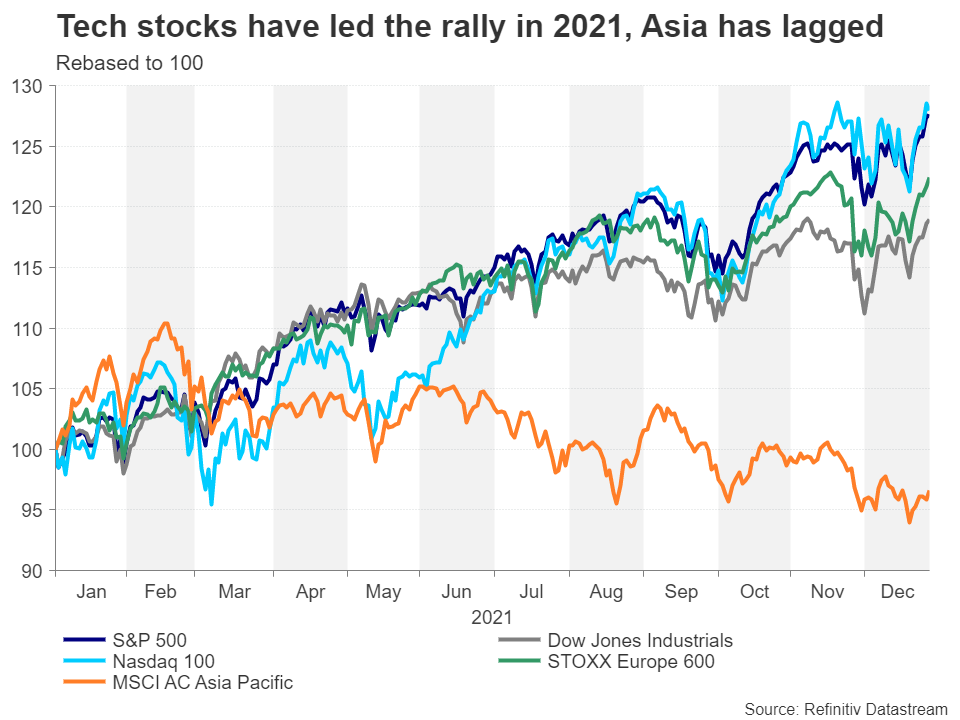
It’s been another spectacular year for equity markets as the pandemic-induced stimulus has kept the rally on Wall Street alive even as the virus threat has yet to recede. The picture has been a little more mixed in some other parts of the world like Asia, but overall, 2021 has been fantastic for most risk assets. So what were the driving forces behind these moves and can the positive trend be sustained in 2022 when most central banks have begun to withdraw stimulus and high inflation is becoming bothersome?
From first dose to boosters
Let’s rewind back 12 months. Covid-19 vaccines were all the rage as everyone was betting that they would bring an end to the pandemic. Those hopes were destroyed when the Delta strain came along. Investors have yet to fully make their minds up about the Omicron variant and this will likely be the biggest test for equities at the beginning of 2022.
Markets have been quick to dismiss the risks from Omicron due to all the initial findings suggesting that this new strain is not as dangerous as previous ones. Yet, these early studies also show that Omicron may be up to four times more transmissible than Delta. The White House’s chief medical advisor, Dr Anthony Fauci, best highlighted this when he said: “when you have such a high volume of new infections, it might override a real diminution in severity”.
Traders have tried to remain optimistic, hoping that vaccines will do the job in keeping the major economies relatively open through this latest wave. If the start of 2021 was marked by the race to get everyone a first dose, the final weeks of the year will surely be remembered by the race to deliver booster jabs, which have proven to provide substantial protection against the new variant.
But the problem isn’t just about whether Omicron will mean fresh lockdowns. When so many people are getting infected and having to self-isolate, then that would inevitably result in large-scale business disruptions, as was the case over the Christmas weekend in America with the airline industry. And that takes us to the other big headache of 2021 that looks set to drag into 2022: supply-chain bottlenecks.
The supply chain chaos rumbles on
When corporate America reported its Q3 earnings, there was wide-spread relief amongst investors that most companies had managed to contain the costs driven by supply and worker shortages, posting stellar quarterly results. Some firms, mainly retailers, were of course impacted more than others and their stocks therefore took a bigger hit, while others warned of more difficult quarters ahead.
Policymakers are counting on the supply constraints resolving themselves in 2022. However, there’s little sign so far that the global bottlenecks will ease up anytime soon. Omicron has complicated the picture even further. But even before that, it’s predecessor Delta was making inroads in new regions, with some Chinese cities being the latest to face snap lockdowns.
The supply-chain issues pose a two-fold risk for businesses. Not only do they hinder production and raise input costs, but the sustained price increases, if passed onto consumers, eventually lead to higher borrowing costs as well. This is probably the greatest threat for equities in 2022, particularly for Wall Street, which has been relaxed about the prospect of the Fed raising interest rates in the next few months.
The stimulus taps are being turned off
The plentiful stimulus that was flooding the markets up until recently was shoring up stocks when negative Covid headlines struck during the pandemic. But one of the biggest turning points in 2021 was when central banks decided to step away from their extremely accommodative stance and started to wind down their pandemic-era stimulus.
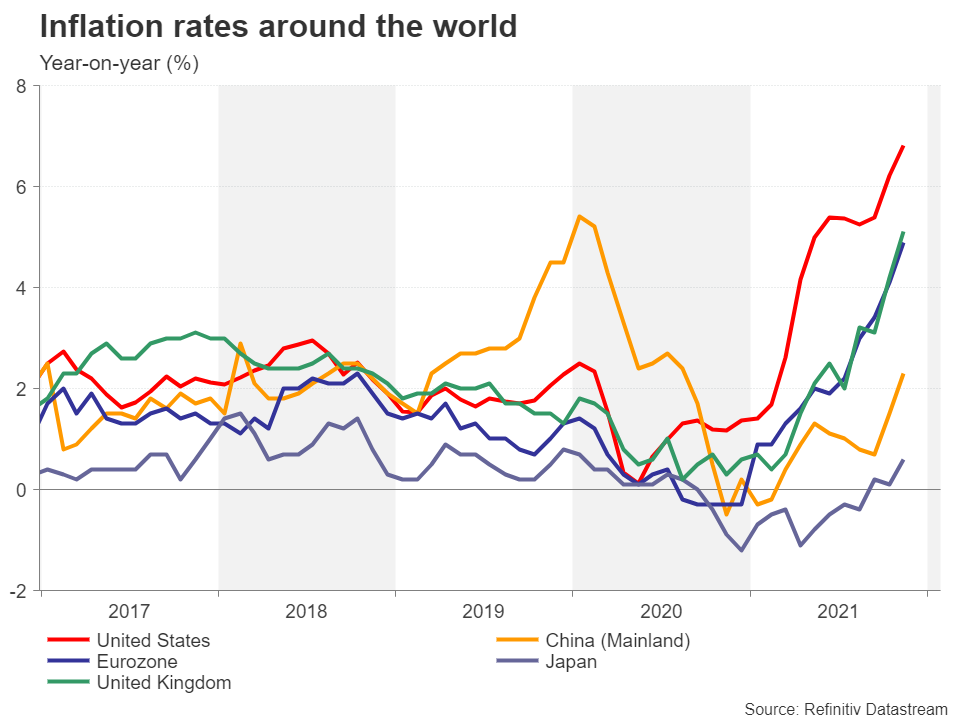
With the narrative about high inflation being transitory now dead, policymakers are keen to put the brakes on spiralling prices. The Fed raised its projections for the federal funds rate in December, pencilling in three quarter basis points increases in 2022, in line with market expectations.
Are rate hikes no longer dreaded?
So why aren’t markets panicking? Wall Street’s three leading indices are on the cusp of closing the year at fresh all-time highs, including the tech-heavy Nasdaq, which had a harder time bouncing back from the November/December selloff than the S&P 500 did. European stocks are a little more way off their yearly peaks but are rebounding quickly.
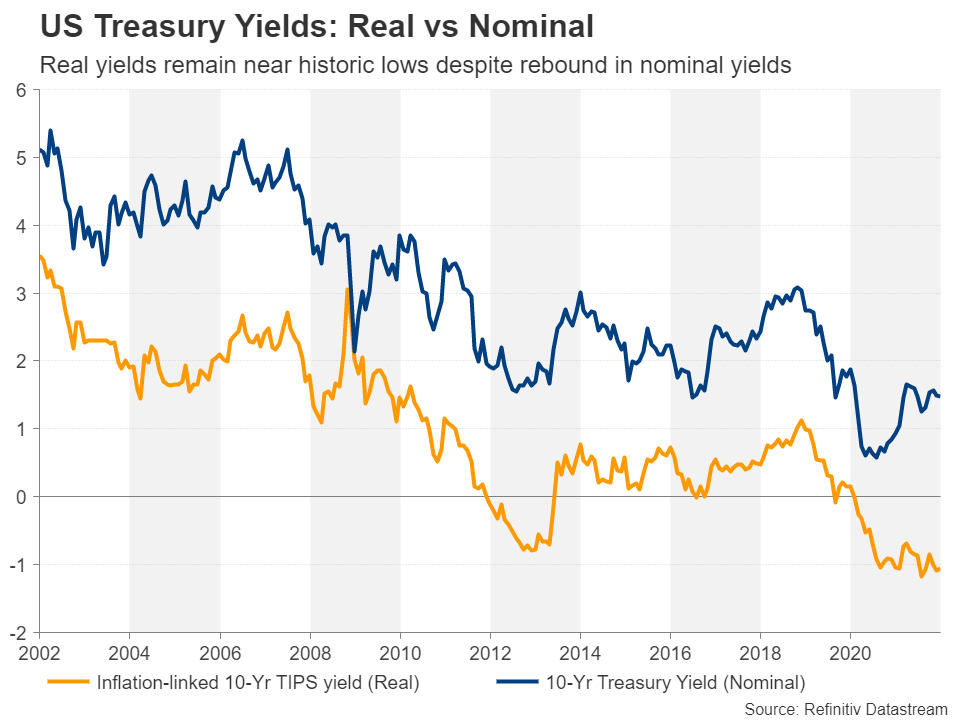
One reason why investors remain bullish is that financial conditions have not tightened significantly after the Fed’s hawkish pivot. The yield on 10-year Treasury notes has not scaled a new post-pandemic high since March, seesawing around 1.45% during December. Wall Street seems comfortable with that level. Moreover, it suggests markets think interest rates won’t peak very high because the Fed’s early action will succeed in curbing inflation.
Real yields in the US have also not spiked much despite the consumer price index approaching 7%. In fact, real yields have remained near historically low levels as 2021 draws to a close. Until yields start climbing substantially higher, markets will not be spooked by the Fed’s current ‘modest’ tightening plans.
Is 5,000 on the cards for the S&P 500?
If inflation does indeed level off at some point in the first half of 2022 and there are no further setbacks with the coronavirus such as more worrisome mutations, US and global equity markets would be poised to extend their gains for a fourth straight year.
The S&P 500 is on the verge of cracking the 4,800 level and the next major target after that is the 5,000 milestone. However, the latest upswing might first stall around 4,810, which is a natural point for the rally to take a breather as this is close to the 200% Fibonacci extension of the September pullback.
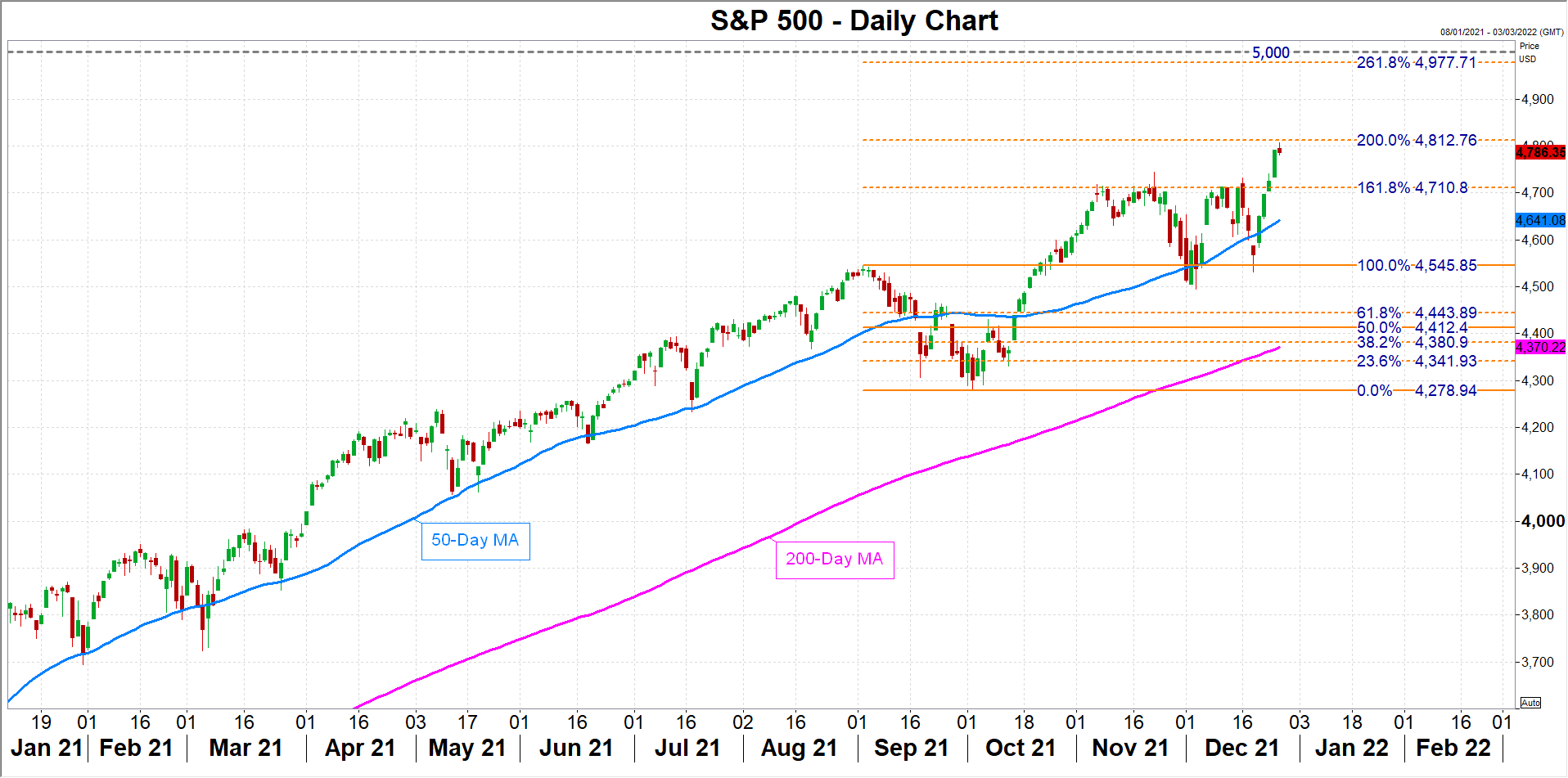
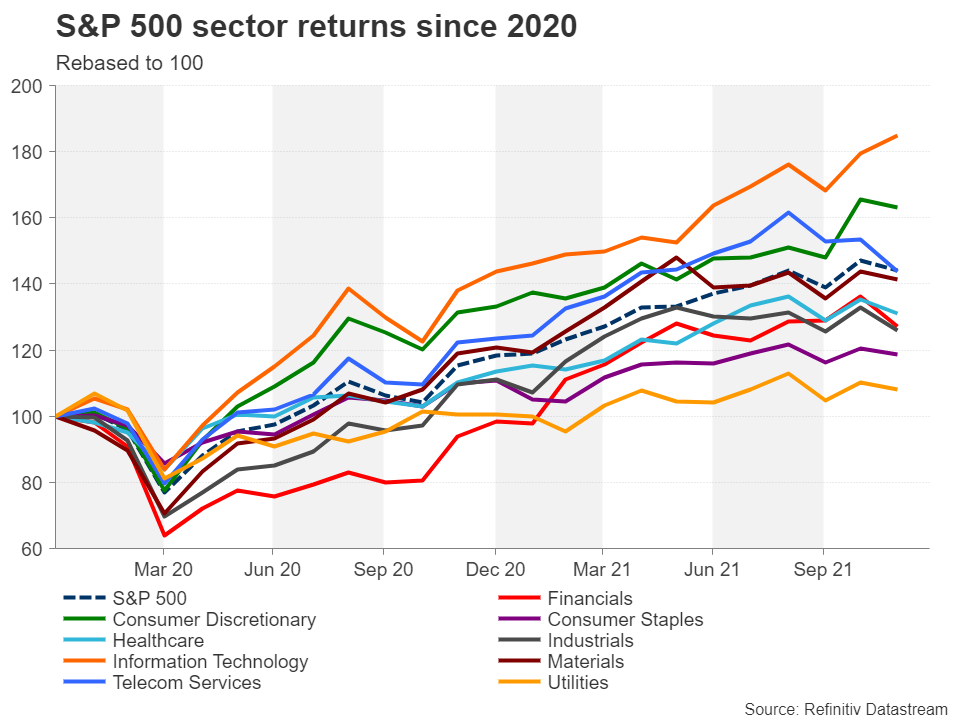
Growth stocks are likely to thrive the most if inflation risks start to subside and financial conditions remain accommodative. Big tech names should also continue to do well, especially high-dividend paying ones. Health care, energy and communication services are a few other potential winning sectors.
Plenty of risks lurking in 2022
The Fed could of course turn more aggressive if Omicron really does turn out to be less severe than feared, and in addition, Senate Democrats give the green light to President Biden’s $1.75 trillion spending plan, which is at the moment hanging in the balance.
Looking further out into the future, the US midterm elections in November 2022 could produce some shocks as Democrats are in danger of losing both chambers of Congress if they and President Biden continue to see their popularity waning.
In the immediate horizon, however, the main focus is on the Omicron impact and how soon inflation will peak. In the worst case scenario, further supply disruptions from Covid could elevate prices even higher, adding more pressure on central banks to act, reviving fears of stagflation, which fortunately did not materialize in 2021.
Value stocks such as financials, energy and some industrials are more likely to perform better in such an environment, whereas growth stocks as well as consumer discretionary and small-cap tech companies could be riskier investments.
Growth stocks tend to have higher valuations and the tech sector is awash with astronomically high price/earnings multiples. Excluding the mega-cap tech companies that have some defensive characteristics, overvalued tech stocks are most at risk from sticky inflation that fuels a rally in long-dated yields and forces the Fed’s hand to hike more aggressively.
European and Chinese policymakers headed in different directions
In Europe, the continent’s generally more stringent response to surging Covid cases is likely to weigh on the growth outlook for another year. However, just as it was the case in 2021, the European Central Bank’s ultra-dovish policy should keep the positive momentum going. The ECB is now alone in continuing to believe that inflation will come down on its own accord and a rate hike next year is highly improbable.
At the other end of the monetary policy spectrum, China’s central bank is on an easing path as the jump in inflation there has been more modest and manageable, and this should be supportive of equities in the region, which have been underperforming lately. China’s regulatory onslaught has been weighing on the domestic tech sector and the crackdowns could broaden in 2022. But an even bigger worry is the country’s embattled real estate sector, which is sinking in debt.
So far, authorities seem to have a grip on the fallout that was triggered by fears of property giant Evergrande defaulting on its debt. However, the property woes are far from over and could yet spark jitters for equity markets in the next 12 months.
Will buy-the-dip mentality endure in 2022?
After a very bumpy year that saw investors buying into every dip, overall financial market volatility has been dwindling during the holiday-thinned trading. Don’t let this fool you, though, into thinking that 2022 will be quieter. If anything, the coming year could be even more volatile given the unpredictability of how far inflation rises and for how long, and how soon the pandemic becomes endemic.
But if 2021 has proven anything it is that there’s not much of an alternative to stocks for investors seeking decent returns, especially now that inflation is on the rise, making low-yielding bonds even less attractive than they already are.
A lot will also be riding on how strong Q4 earnings are. The last three months of the year will probably provide the strongest indication yet as to how badly the supply shortages and labour dislocation are hurting profit margins and the extent to which the Omicron outbreak has dented companies’ earnings forecasts for the upcoming quarters.
AUDJPY’s Growing Bullish Bias is Under Microscope
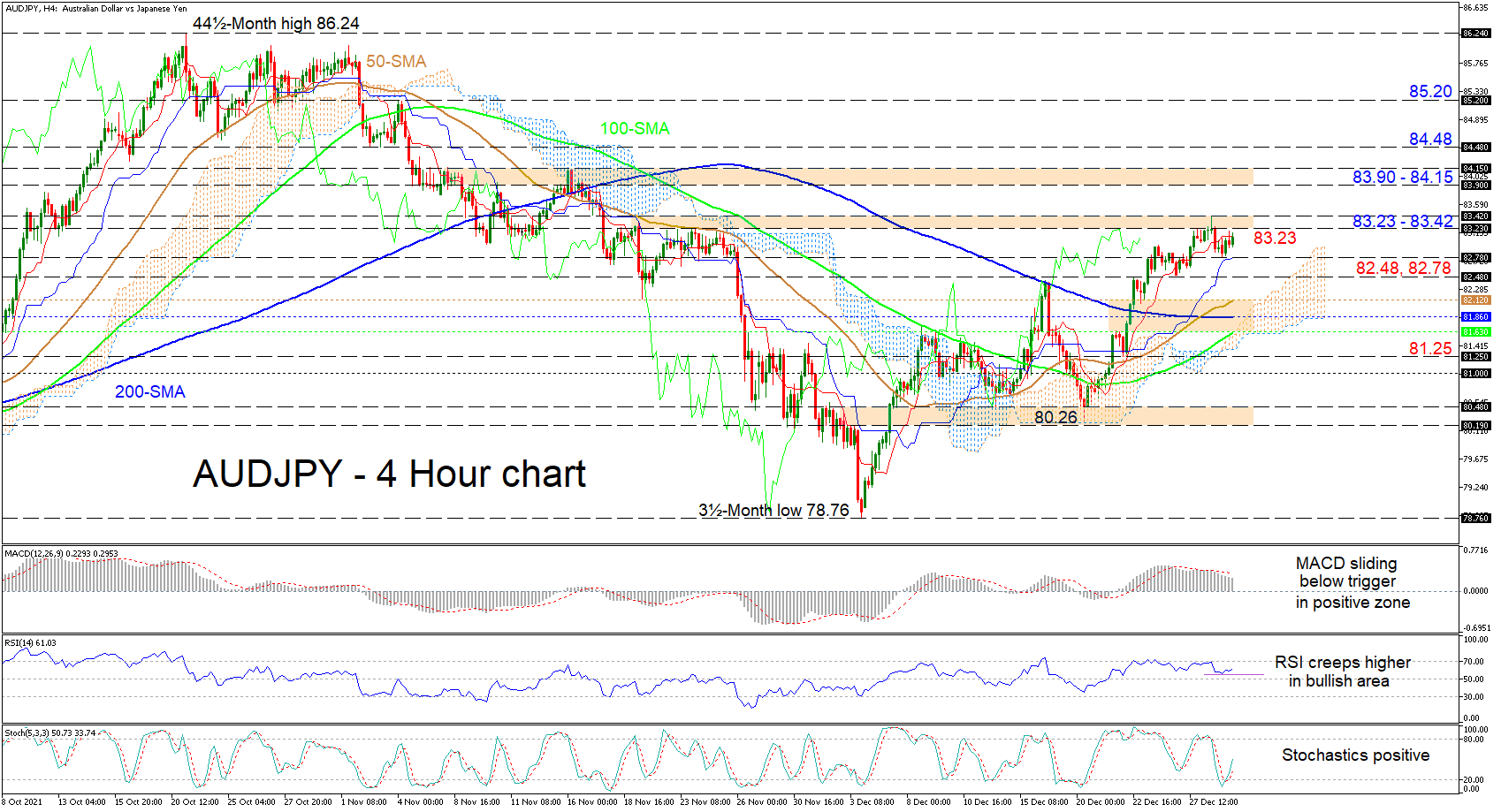
AUDJPY’s fresh minor pullback from 83.42 has found some footing off the blue Kijun-sen line at 82.78 keeping the latest outlook bullish as the pair continues to plot higher highs and lows. The rising 50- and 100-period simple moving averages (SMAs) are backing the one-month uptrend from 78.76. Furthermore, the 100-period SMA at 81.63 looks set to complete a bullish crossover of the flattened 200-period SMA at 81.86, which would add credibility to the rally.
The Ichimoku lines are indicating a slight pause in the upward drive, while the short-term oscillators are reflecting that buyers are slowly regaining their feet. The MACD is showing some waning in positive momentum but remains some distance above zero. The RSI is crawling back up in the bullish region and the stochastic oscillator’s positive charge is promoting more positive price action.
To the upside, buyers need to overstep the immediate resistance band of 83.23-83.42 to reinstate upward impetus. Successfully doing so, the bulls could pursue the 83.90-84.15 resistance area, containing multiple highs from November. Should additional gains unfold, the bulls may then confront the 84.48 barrier before piloting towards the 85.20 high, achieved on November 4.
Otherwise, if the immediate resistance obstacle curbs the rally’s progress, prompt support could emanate from the nearby 82.78 and 82.48 lows respectively. Now, in the event a deeper retracement develops, a critical section between the 50-period SMA at 82.12 and the 100-period SMA at 81.63 could prove hard to dive past. That said, if negative pressures triumph, sellers may aim for the 81.25 trough and the 81.00 handle.
Summarizing, AUDJPY’s bullish tone remains intact as long as the price persists above the 82.48 low and the SMAs.
Euro Trades Quietly in Thin Holiday Trade
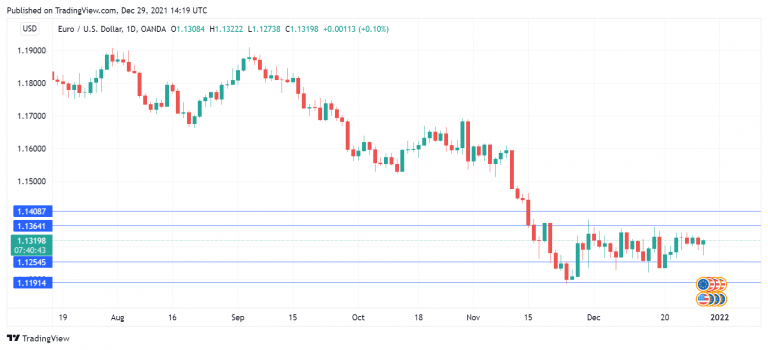
The euro continues to have a quiet week and is drifting on Wednesday. EUR/USD is currently trading around 1.1310.
There are no tier-1 events out of the eurozone or the US today. Investors will be keeping an eye on US Pending Home Sales, but these are unlikely to cause much of a reaction in the currency markets. The dollar index has dipped to 96.11, down 0.09% on the day, marking a fourth day of sideways trading. The index faces resistance at 96.30 and has support at 95.80.
With a light economic calendar this week, investors are keeping an eye on the spread of the Omicron variant. Omicron is much more contagious than Delta but most reports indicate that it is less severe. This has given a boost to risk sentiment, but one negative headline about Omicron, especially with the illiquid markets during the holidays, could quickly dampen risk appetite.
ECB to remain dovish
The ECB has pledged to continue its dovish monetary policy and the Omicron outbreak will only reinforce this stance. The Federal Reserve and the Bank of England are moving in the opposite direction and are tightening policy. One of the key reasons for the divergence of policy is that inflation is red-hot in the US and UK, but has risen more moderately in Europe. We are seeing inflation figures of 6% in the US and 5% in the UK, which has forced the central banks to acknowledge that high inflation is not temporary – the Fed recently abandoned this stance and ‘retired’ the term “transitory inflation”. With inflation running at around 3% in the eurozone, the ECB can afford to continue its loose monetary policy as we move into 2022.
EUR/USD Technical
- EUR/USD has support at 1.1255. Below, there is support at 1.1190
- There is resistance at 1.1364 and 1.1408
USD/JPY Mid-Day Outlook
Daily Pivots: (S1) 114.70; (P) 114.83; (R1) 114.94; More...
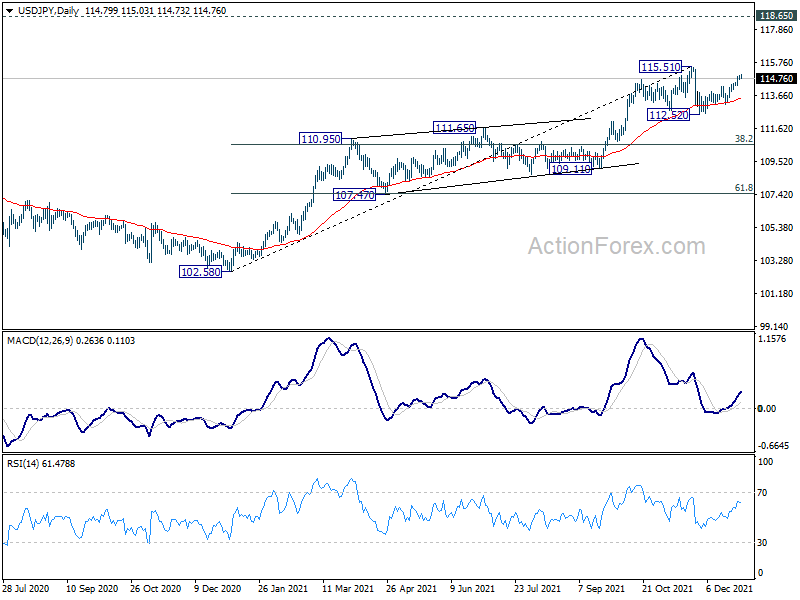
USD/JPY's rally is still in progress and intraday bias stays on the upside. Rise from 112.52 should target a test on 115.51 high first. Firm break there will resume larger up trend to 118.65 long term resistance next. On the downside, however, break of 114.30 will turn bias to the downside, and extend the corrective pattern from 115.51 with another falling leg back to 112.52 support.
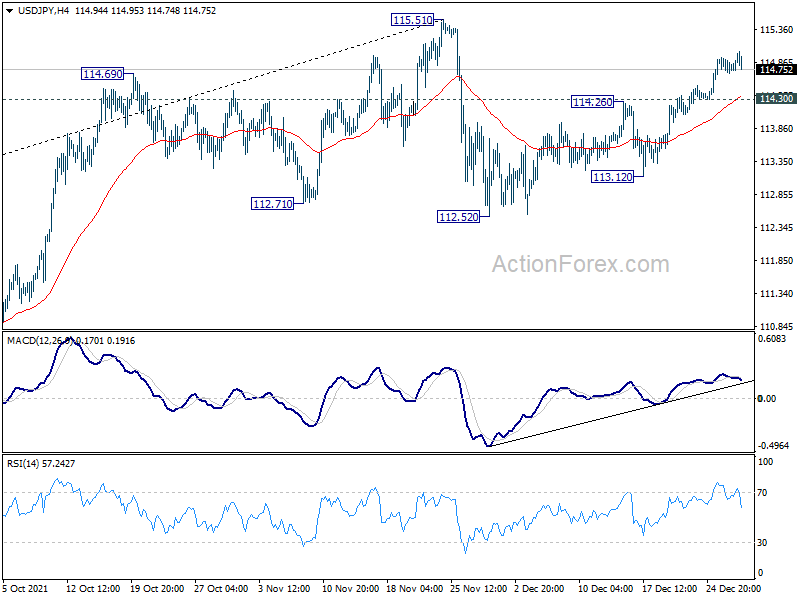
In the bigger picture, no change in the view that rise from 102.58 is the third leg of the up trend from 101.18 (2020 low). Such rally should target a test on 118.65 (2016 high) on resumption. However, firm break of 109.11 structural support will argue that the trend might have reversed and bring deeper fall to 107.47 support and possibly below.