

Sample Category Title
GBP/JPY Weekly Outlook
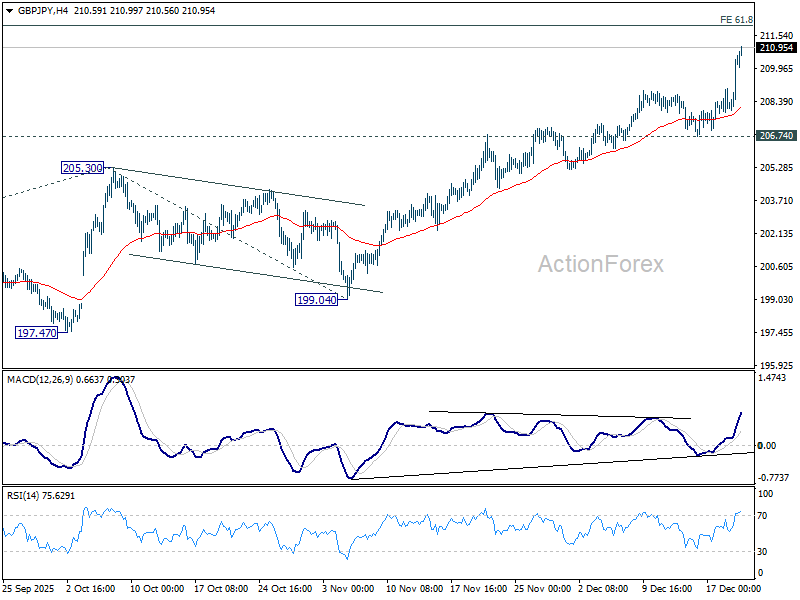
GBP/JPY's up trend continued last week and there is no sign of topping yet. Initial bias stays on the upside this week for 61.8% projection of 184.35 to 205.30 from 199.04 at 211.98. Firm break there will target 100% projection at 219.99 next. Outlook will stay bullish as long as 206.74 support holds, in case of retreat.
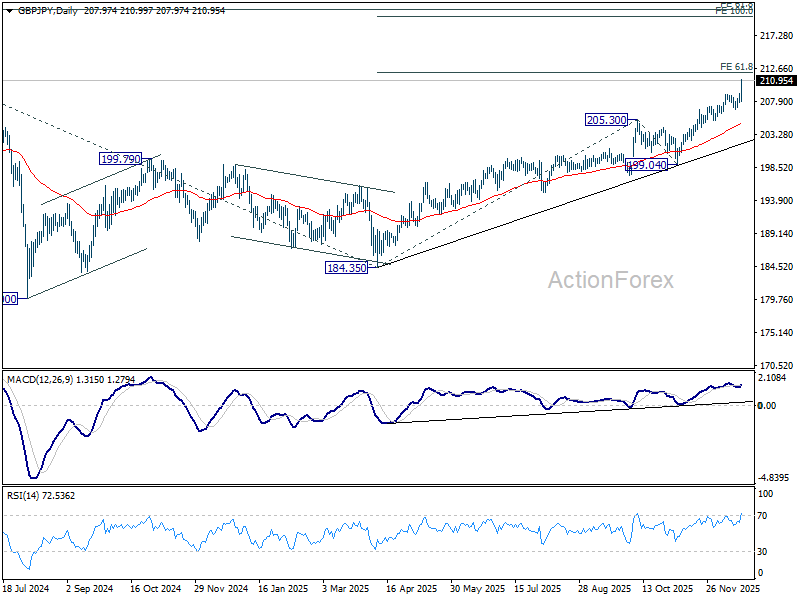
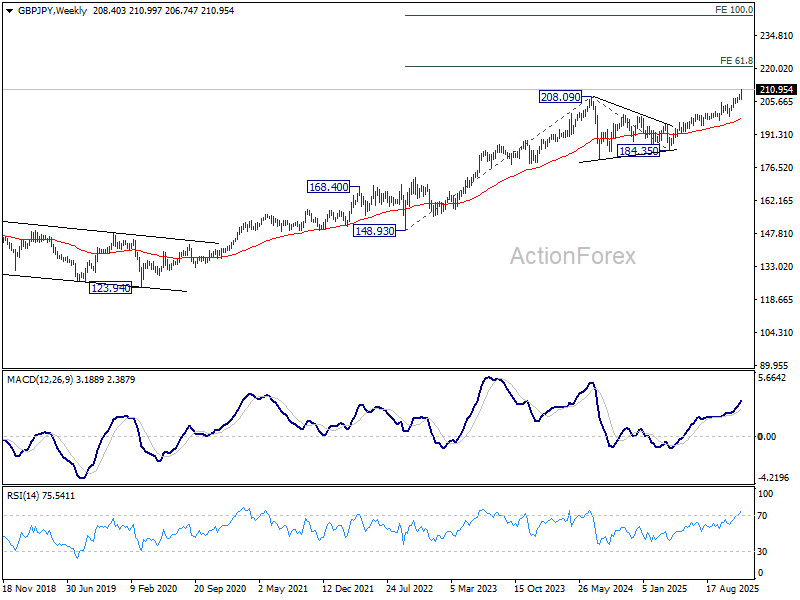
In the bigger picture, up trend from 123.94 (2020 low) is in progress. Next target is 61.8% projection of 148.93 to 208.09 from 184.35 at 220.90. On the downside, break of 199.04 support is needed to indicate medium term topping. Otherwise, outlook will stay bullish even in case of deep pullback.
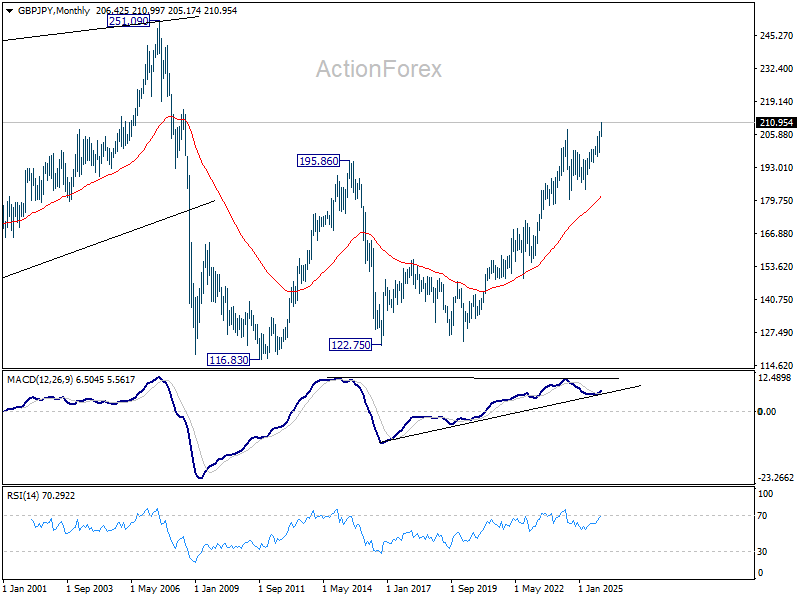
In the long term picture, up trend from 116.83 (2011 low) is resuming. Next target is 251.09 (2007 high). This will remain the favored case as long as 55 M EMA (now at 181.84) holds.
EUR/JPY Weekly Outlook
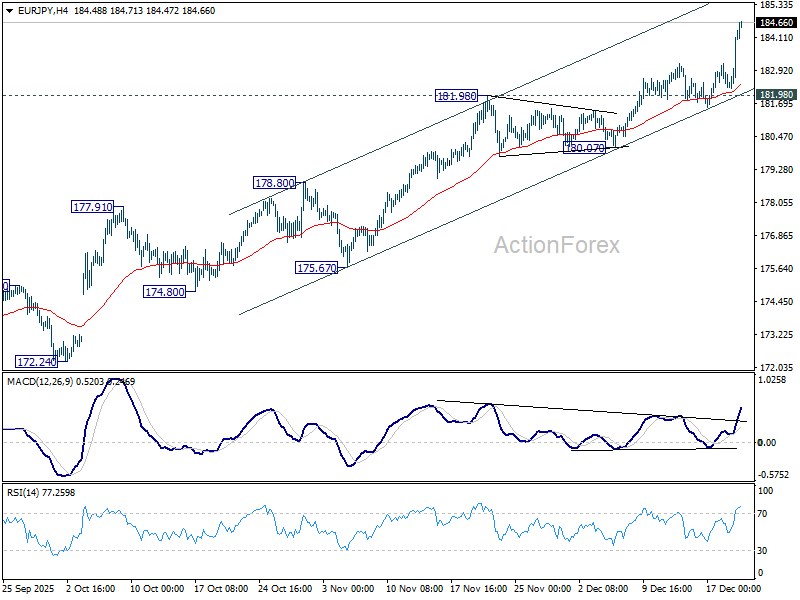
EUR/JPY's up trend continued last week and 4H MACD's break of falling trend line indicates upside re-acceleration. Initial bias stays on the upside this week for 186.31 long term projection level next. For now, outlook will stay bullish as long as 181.98 resistance turned support holds, in case of retreat.
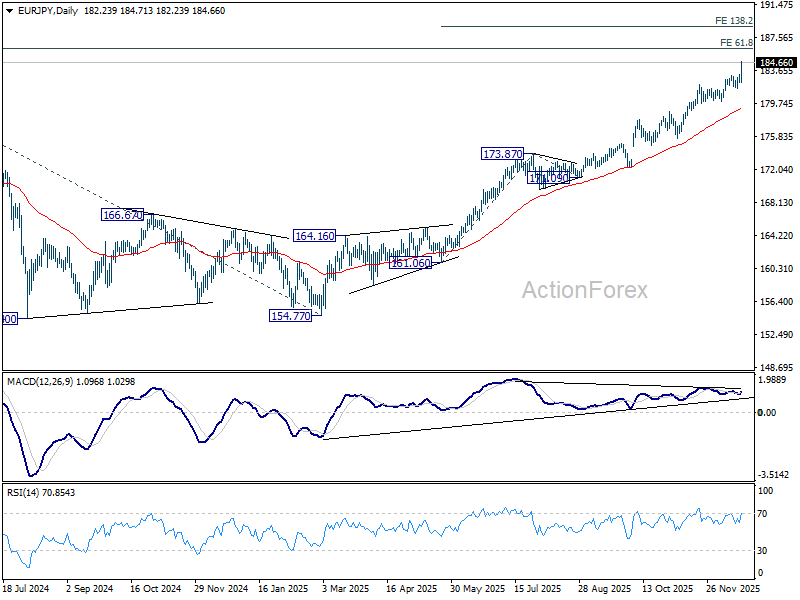
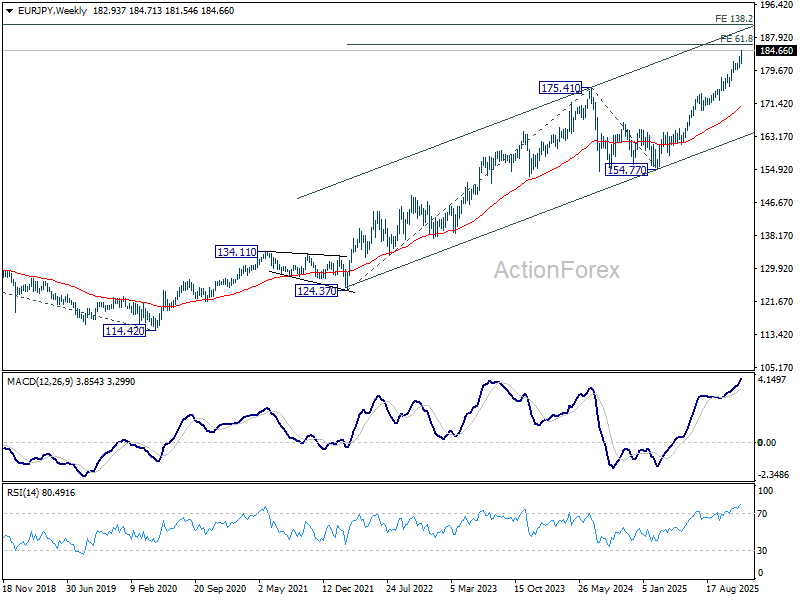
In the bigger picture, up trend from 114.42 (2020 low) is in progress and should target 61.8% projection of 124.37 to 175.41 from 154.77 at 186.31. Considering bearish divergence condition in D MACD, upside could be capped by 186.31 on first attempt. Still, outlook will stay bullish as long as 55 W EMA (now at 170.73) holds, even in case of deep pullback. Sustained break of 186.31 will pave the way to 100% projection at 205.81 next.
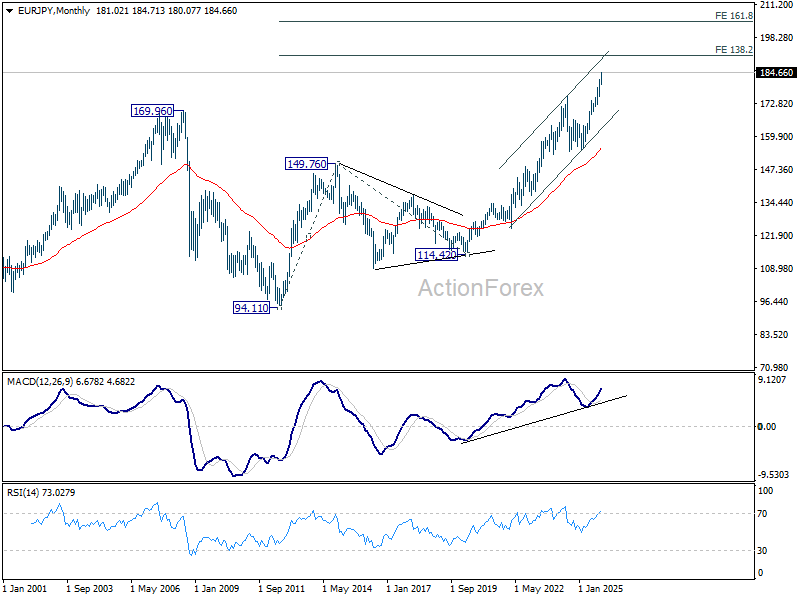
In the long term picture, up trend from 94.11 (2021 low) is in progress. Next target is 138.2% projection of 94.11 to 149.76 (2014 high) from 114.42 (2020 low) at 191.32. This will remain the favored case as long as 154.77 support holds.
EUR/GBP Weekly Outlook
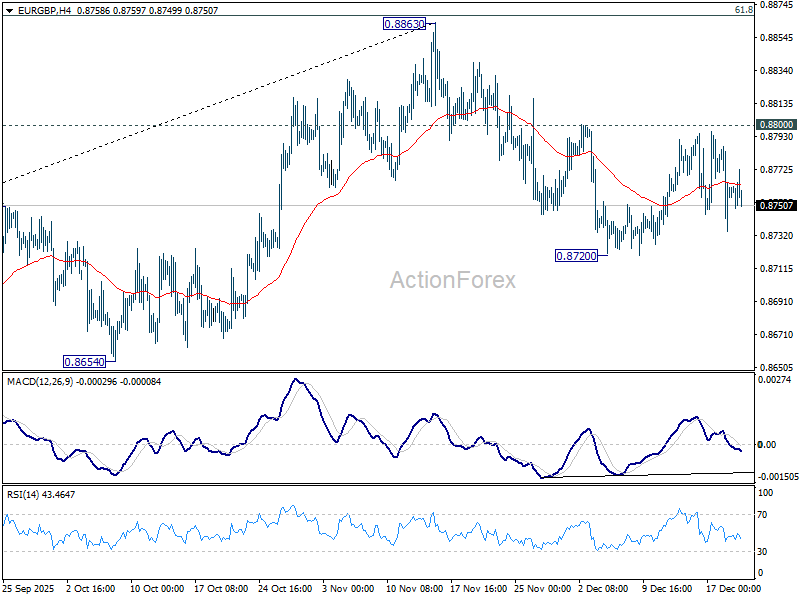
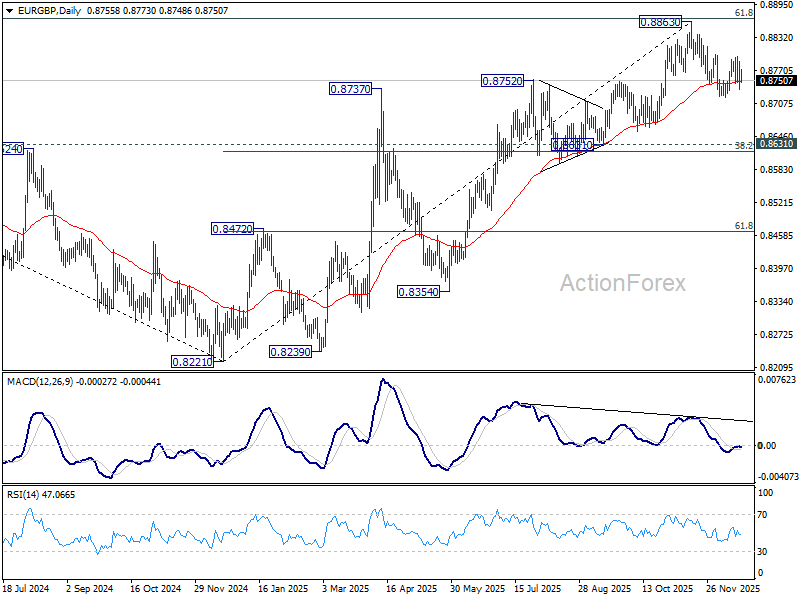
EUR/GBP's recovery was limited below 0.8800 resistance last week and outlook is unchanged. Initial bias remains neutral this week and fall form 0.8863 short term top is in favor to continue. Break of 0.8720 will bring deeper fall to 0.8631 cluster support (38.2% retracement of 0.8221 to 0.8663 at 0.8618). However, on the upside, break of 0.8800 will argue that the fall has completed as a correction, and turn bias back to the upside for retesting 0.8863.
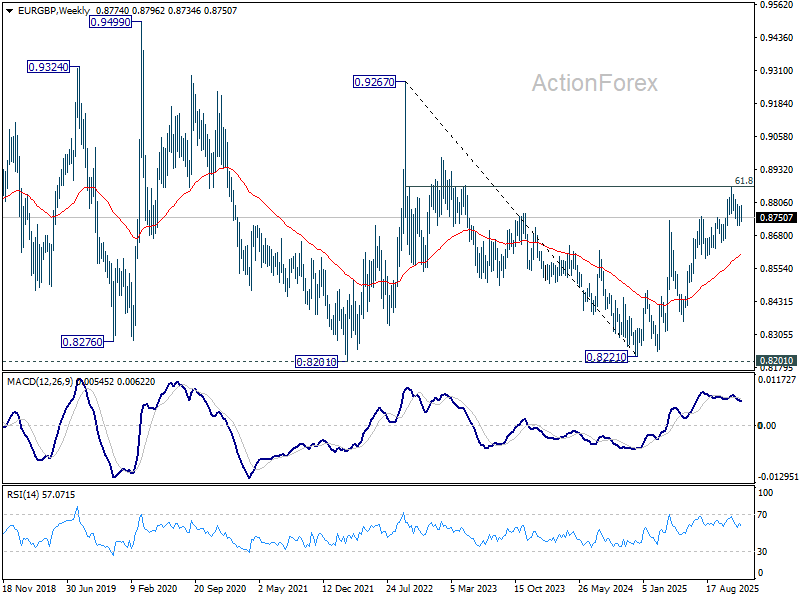
In the bigger picture, rise from 0.8221 medium term bottom is still seen as a corrective move. Upside should be limited by 61.8% retracement of 0.9267 to 0.8221 at 0.8867. Sustained trading below 55 W EMA (now at 0.8610) should confirm that this corrective bounce has completed. However, decisive break of 0.8867 will suggest that EUR/GBP is already reversing whole decline from 0.9267 (2022 high). That should pave the way back to 0.9267.
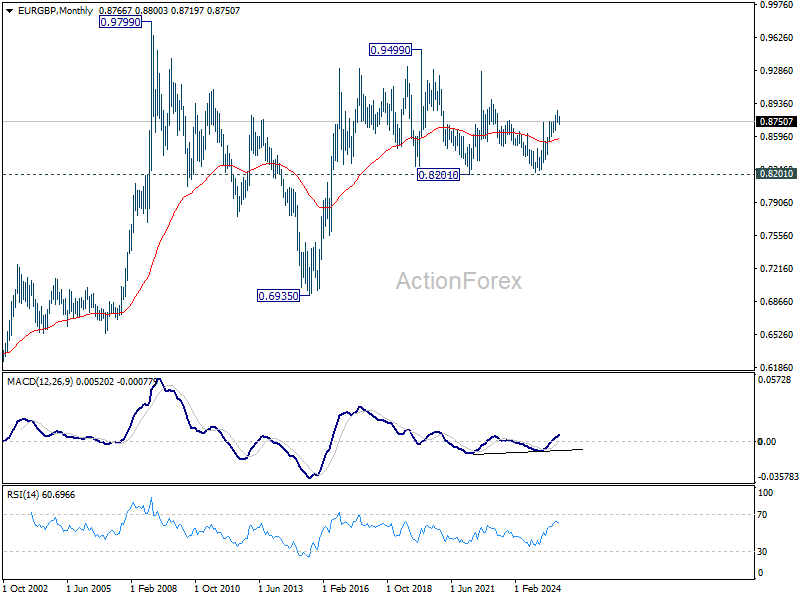
In the long term picture, price action from 0.9499 (2020 high) is seen as part of the long term range pattern from 0.9799 (2008 high). Range trading should continue between 0.8201 and 0.9499, until there is clear signal of imminent breakout.
EUR/AUD Weekly Outlook
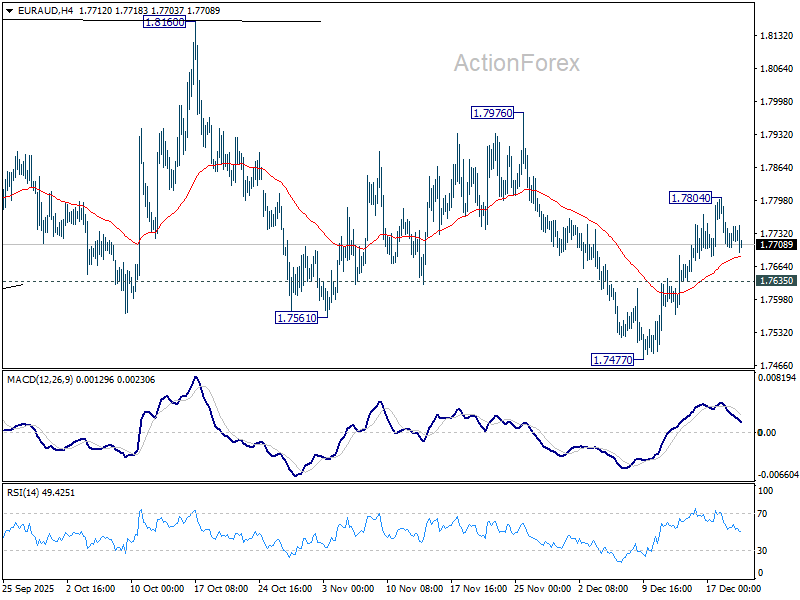
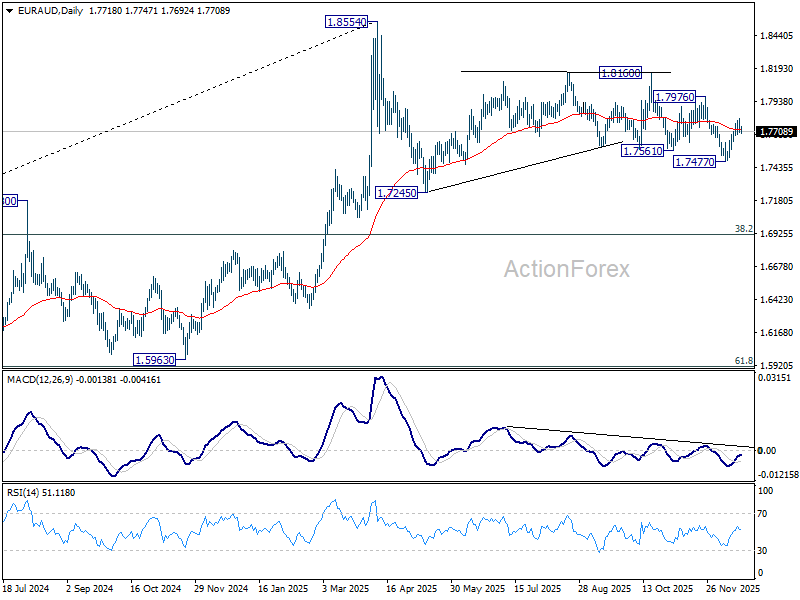
EUR/AUD's strong rebound and breach of 55 D EMA (now at 1.7726) last week argues that fall from 1.8160 might have completed. But as a temporary top was formed at 1.7804, initial bias stays neutral first. On the upside, above 1.7804 will solidify this case and target 1.7976 resistance next. However, break of 1.7635 minor support will bring retest of 1.7477 low instead. Overall, corrective pattern from 1.8554 could extend further.
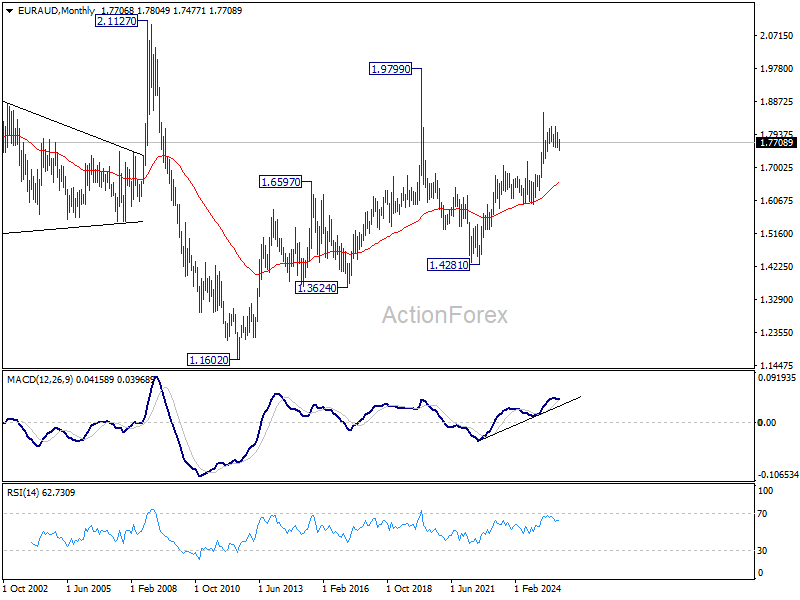
In the bigger picture, as long as 55 W EMA (now at 1.7468) holds, price actions from 1.8554 could still be a correction to rise from 1.5963 only. However, sustained break of the EMA will argue that it's already correcting the whole up trend from 1.4281 (2022 low). In this case, deeper decline would be seen to 38.2% retracement of 1.4281 to 1.8554 at 1.6922.
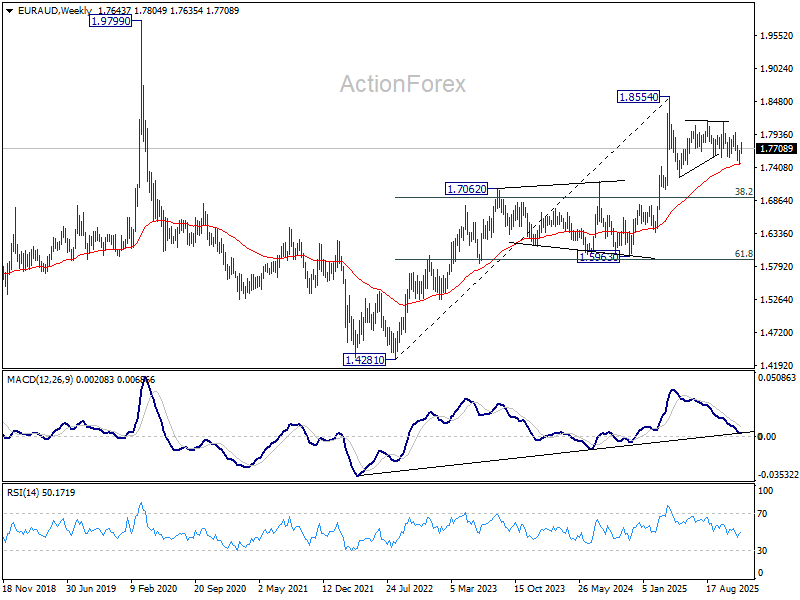
In the longer term picture, rise from 1.4281 is seen as the second leg of the pattern from 1.9799 (2020 high), which is part of the pattern from 2.1127 (2008 high). As long as 55 M EMA (now at 1.6585) holds, this second leg could still extend higher.
EUR/CHF Weekly Outlook
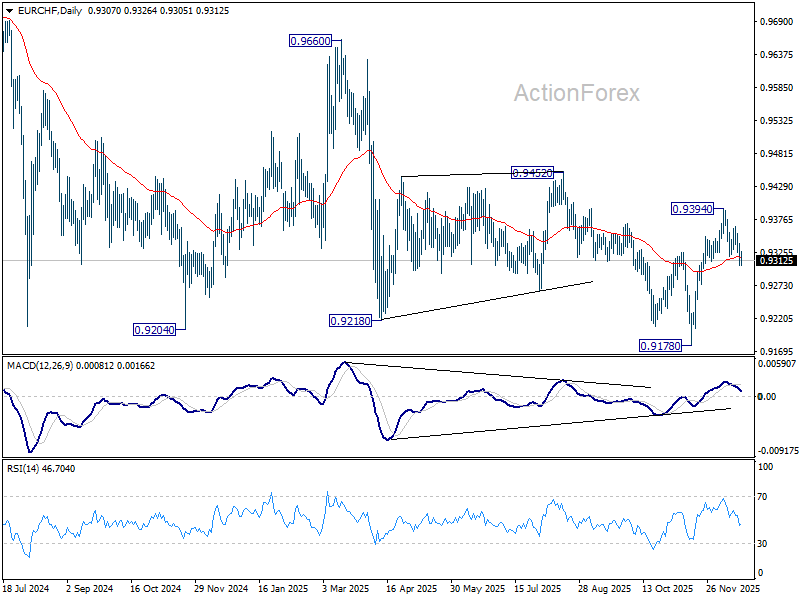
EUR/CHF gyrated lower last week and as fall from 0.9394 short term extended. Further decline is in favor this week. Sustained trading below 55 D EMA (now at 0.9317) will argue that rebound from 0.9178 has already completed. Deeper fall should then be seen back to retest this low. On the upside, however, break of 0.9366 resistance will resume the rebound through 0.9394 to 0.9452 structural resistance.
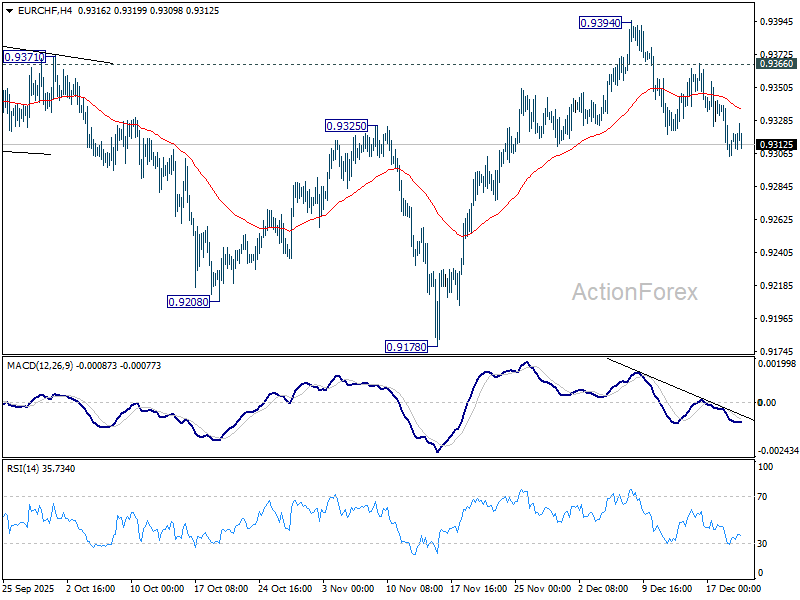
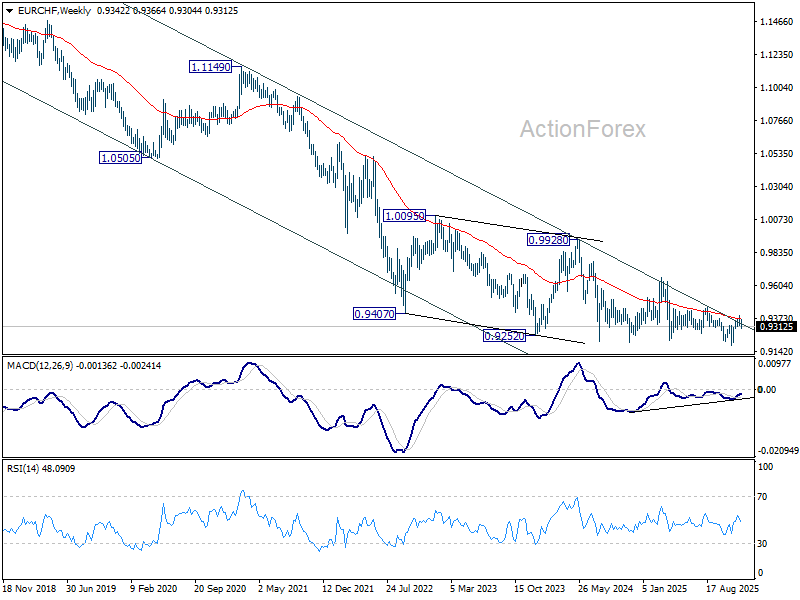
In the bigger picture, EUR/CHF has breached long term falling channel resistance as the rebound from 0.9278 extends. Considering bullish convergence condition in W MACD, sustained trading above 55 W EMA (now at 0.9317) will indicate medium term bottoming at 0.9178, and suggests that it's already in larger scale rebound. Further break of 0.9452 resistance will bring stronger medium term rally towards 0.9928 resistance next. Nevertheless, rejection by 55 W EMA will retain bearishness for another fall through 0.9178 at a later stage.
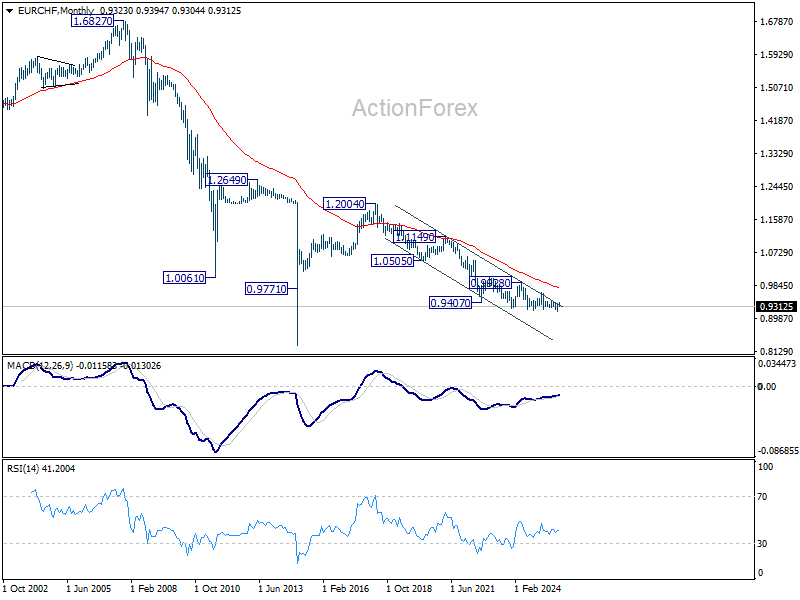
In the long term picture, overall long term down trend from 1.2004 (2018 high) is still in progress in EUR/CHF. Outlook will continue to stay bearish as long as falling 55 M EMA (now at 0.9785) holds.
Markets Weekly Outlook – GDP Data, US/Asia Events, and Silver’s Breakout
Week in review
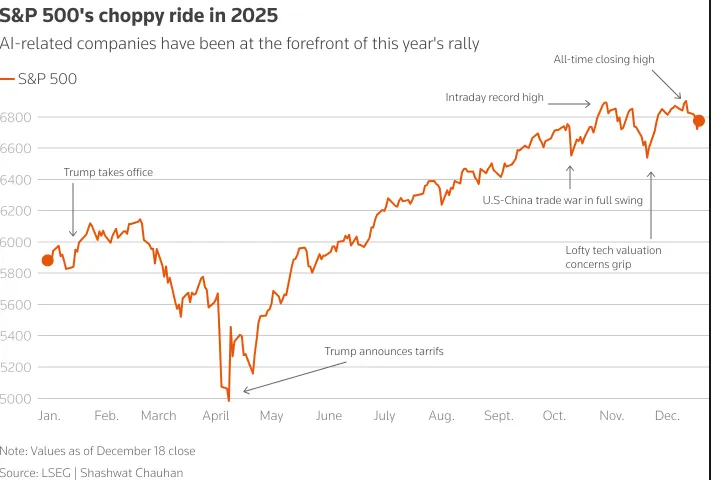
US stocks finished the week strong on Friday, recovering from a rocky start earlier in the week.
The rise was driven mostly by technology companies, which performed well enough to outweigh heavy losses in consumer stocks like Nike.
Big tech companies continued to gain value, following a surge of optimism sparked on Thursday when chipmaker Micron Technology released a very positive financial forecast. This renewed investor confidence in Artificial Intelligence (AI) stocks, which had recently been struggling due to worries that they were becoming too expensive.
Several specific companies saw major gains. Micron shares hit an all-time high, while Nvidia stock rose after news broke that the US government might allow the company to ship its advanced AI chips to China.
Oracle also saw its stock price jump after the owner of TikTok, ByteDance, signed a deal to hand over control of the app's U.S. operations to a group of investors that includes Oracle.
Source: LSEG
On the economic front, investors were relieved to see that consumer prices in November did not rise as much as feared. However, some experts warned that these numbers might be inaccurate because a 43-day government shutdown prevented the proper collection of data in October.
Despite this uncertainty, traders are betting that the Federal Reserve will cut interest rates at least twice next year, with a 20% chance that the first cut could happen as early as January.
The Bank of Japan (BoJ) hiked interest rates to 0.75%, the highest in three decades. This sets the stage for an interesting week ahead as Japanese traders will still be at their desks next week.
Wrapping Up 2025
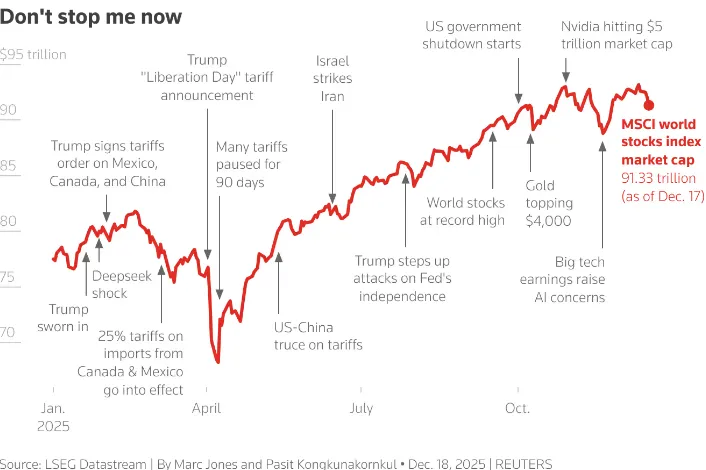
Market participants may be looking forward to relax after a very chaotic year that began with Donald Trump returning to the White House.
Over the last twelve months, global politics have become unstable and a trade war has officially started. While the US dollar lost 9% of its value, gold prices had their best performance since 1979, and European weapons companies saw their value jump by 65%.
Global stock markets grew by $14 trillion, driven by an obsession with Artificial Intelligence and risky debt, even though government bond markets are nervous about budget issues.
At the same time, oil prices are near a ten-year low, Bitcoin has lost one-third of its value in the last three months, and cocoa is having its worst year ever.
After all this drama, it is definitely time for Market participants to take a break.
Source: LSEG
However, next week still brings some key events even if liquidity may prove thin. Let us take a look at what we can expect.
The Week Ahead - Shortened Week & Low Liquidity Environment
Even though the holiday season is approaching, the coming week will still be very busy for market participants. There are several major events to watch, ranging from the first report on how the US economy performed in the third quarter to new updates regarding the ongoing political conflict between the United States and Venezuela.
Asia Pacific Markets
In Japan, factory production is expected to drop, which will undo some of the progress made over the last two months. However, retail sales are still growing because people are earning higher wages. Experts believe that the data for November will not yet show any major damage caused by the recent decrease in tourists visiting from China.
After the Bank of Japan rate hike, on December 24, the BoJ will release minutes for its October meeting, at which it kept rates on hold shortly after new Prime Minister Sanae Takaichi took office. On December 25, BOJ Governor Kazuo Ueda will speak to Japan's business lobby, the Keidanren. He is expected to give clues on the path of interest rates during 2026.
Meanwhile, in China, most of the big economic reports for the year are already finished, so attention is turning to Saturday's decision on interest rates. I expect this to be uneventful, with the key lending rates likely remaining exactly where they are at 3.0% for one-year loans and 3.5% for five-year loans.
US Markets - Will GDP Data Validate the Fed Outlook?
Although the upcoming third-quarter economic growth report might not shake up the financial markets due to delays caused by the government shutdown, it raises some interesting questions.
If the report shows the economy grew by more than 3% for the second time in a row, many will wonder why the Federal Reserve cut interest rates three times in 2025. It seems unusual to cut rates when inflation is still higher than the 2% target, unemployment is low, and the stock market is at an all-time high.
The Federal Reserve defends these cuts as a safety measure to manage future risks. They argue that interest rates are still high enough to control the economy, and since recent taxes on imports didn't raise prices as much as feared, they are now more worried about protecting jobs.
Therefore, moving interest rates down toward 3% is seen as a smart move. The report is expected to show that investment in technology and spending by wealthy households are currently driving growth.
However, the economy is expected to slow down significantly to around 1% growth in the next quarter, largely due to the disruptions caused by the government shutdown.
For all market-moving economic releases and events, see the MarketPulse Economic Calendar. (click to enlarge)
Chart of the Week - Silver (XAGUSD)
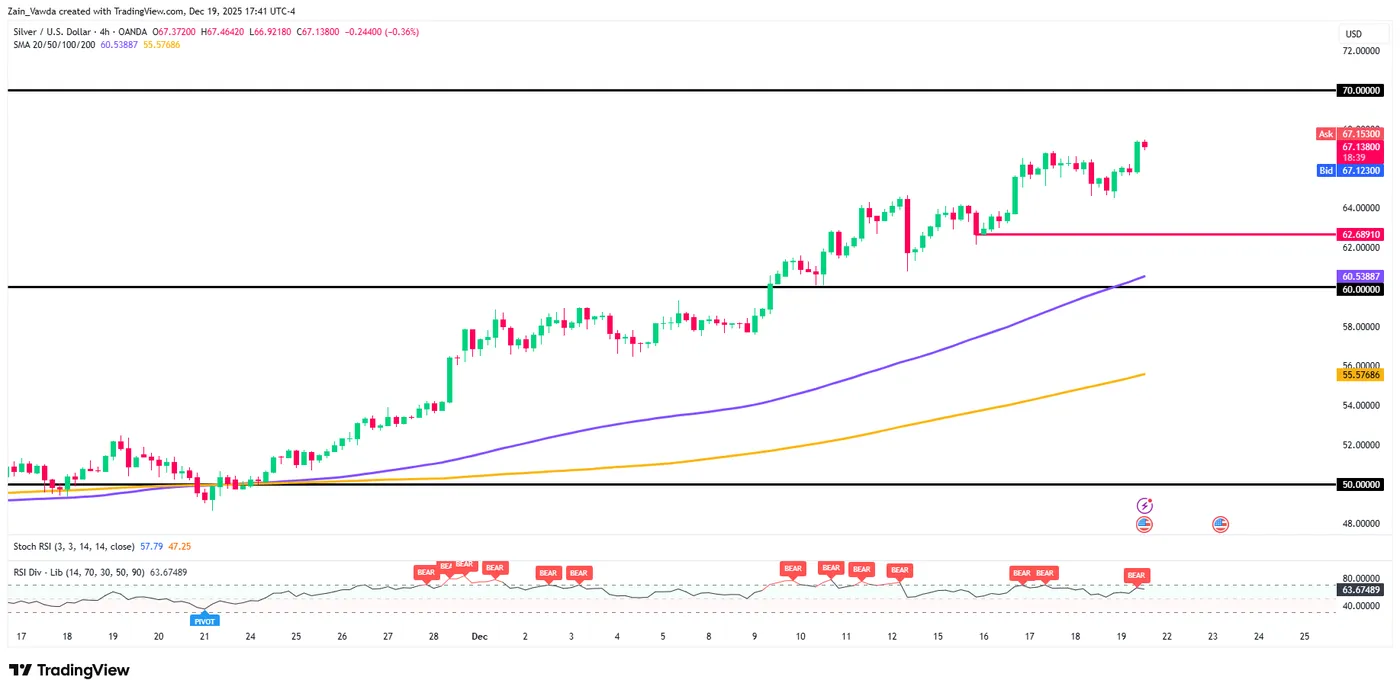
Silver has been on a tear with a breach of the $67/oz handle taking place on Friday.
This leaves Silver with a weekly gain of around the 8.5% mark and the rally just continues to gather pace.
It is very difficult to look at silver from a technical point of view given the lack of historical price action at these levels.
Optimism surrounding AI and electronics (where silver is used) contributes to the momentum while the soft US inflation data this week further fueled rate cut hopes for 2026.
Next to the upside the 70.00 handle may be a point to watch.
In terms of support, any pullback may find support at $64.50 (Previous breakout level) and $62.00.
Silver (XAG/USD) Four-Hour Chart, December 19, 2025
Source: TradingView.Com (click to enlarge)
Summary 12/22 – 12/26
Monday, Dec 22, 2025
| GMT | Ccy | Events | Consensus | Previous |
|---|---|---|---|---|
| 01:00 | CNY | 1-Y Loan Prime Rate | 3.00% | 3.00% |
| 01:00 | CNY | 5-Y Loan Prime Rate | 3.50% | 3.50% |
| 07:00 | GBP | GDP Q/Q Q3 F | 0.10% | 0.10% |
| 07:00 | GBP | Current Account (GBP) Q3 | -19.1B | -28.9B |
| 13:30 | CAD | Industrial Product Price M/M Nov | 0.30% | 1.50% |
| 13:30 | CAD | Raw Material Price Index Nov | 0.60% | 1.60% |
| GMT | Ccy | Events | |
|---|---|---|---|
| 01:00 | CNY | 1-Y Loan Prime Rate | |
| Forecast: 3.00% | Previous: 3.00% | ||
| 01:00 | CNY | 5-Y Loan Prime Rate | |
| Forecast: 3.50% | Previous: 3.50% | ||
| 07:00 | GBP | GDP Q/Q Q3 F | |
| Forecast: 0.10% | Previous: 0.10% | ||
| 07:00 | GBP | Current Account (GBP) Q3 | |
| Forecast: -19.1B | Previous: -28.9B | ||
| 13:30 | CAD | Industrial Product Price M/M Nov | |
| Forecast: 0.30% | Previous: 1.50% | ||
| 13:30 | CAD | Raw Material Price Index Nov | |
| Forecast: 0.60% | Previous: 1.60% | ||
Tuesday, Dec 23, 2025
| GMT | Ccy | Events | Consensus | Previous |
|---|---|---|---|---|
| 00:30 | AUD | RBA Meeting Minutes | ||
| 07:00 | EUR | Germany Import Price M/M Nov | 0.10% | 0.20% |
| 09:00 | CHF | UBS Economic Expectations Dec | 12.2 | |
| 13:30 | CAD | GDP M/M Oct | -0.30% | 0.20% |
| 13:30 | USD | GDP Annualized Q3 P | 3.20% | 3.80% |
| 13:30 | USD | GDP Price Index Q3 P | 2.60% | 2.10% |
| 13:30 | USD | Durable Goods Orders Oct | 0.20% | 0.50% |
| 13:30 | USD | Durable Goods Orders ex Transport Oct | -1.50% | 0.60% |
| 14:15 | USD | Industrial Production M/M Oct | 0.10% | |
| 14:15 | USD | Industrial Production M/M Nov | 0.10% | |
| 14:15 | USD | Capacity Utilization Oct | 75.90% | |
| 14:15 | USD | Capacity Utilization Nov | 75.90% | |
| 15:00 | USD | Consumer Confidence Dec | 91.7 | 88.7 |
| 18:30 | CAD | BoC Summary of Deliberations | ||
| 23:50 | JPY | BoJ Minutes | ||
| 23:50 | JPY | Corporate Service Price Index Y/Y Nov | 2.60% | 2.70% |
| GMT | Ccy | Events | |
|---|---|---|---|
| 00:30 | AUD | RBA Meeting Minutes | |
| Forecast: | Previous: | ||
| 07:00 | EUR | Germany Import Price M/M Nov | |
| Forecast: 0.10% | Previous: 0.20% | ||
| 09:00 | CHF | UBS Economic Expectations Dec | |
| Forecast: | Previous: 12.2 | ||
| 13:30 | CAD | GDP M/M Oct | |
| Forecast: -0.30% | Previous: 0.20% | ||
| 13:30 | USD | GDP Annualized Q3 P | |
| Forecast: 3.20% | Previous: 3.80% | ||
| 13:30 | USD | GDP Price Index Q3 P | |
| Forecast: 2.60% | Previous: 2.10% | ||
| 13:30 | USD | Durable Goods Orders Oct | |
| Forecast: 0.20% | Previous: 0.50% | ||
| 13:30 | USD | Durable Goods Orders ex Transport Oct | |
| Forecast: -1.50% | Previous: 0.60% | ||
| 14:15 | USD | Industrial Production M/M Oct | |
| Forecast: | Previous: 0.10% | ||
| 14:15 | USD | Industrial Production M/M Nov | |
| Forecast: 0.10% | Previous: | ||
| 14:15 | USD | Capacity Utilization Oct | |
| Forecast: | Previous: 75.90% | ||
| 14:15 | USD | Capacity Utilization Nov | |
| Forecast: 75.90% | Previous: | ||
| 15:00 | USD | Consumer Confidence Dec | |
| Forecast: 91.7 | Previous: 88.7 | ||
| 18:30 | CAD | BoC Summary of Deliberations | |
| Forecast: | Previous: | ||
| 23:50 | JPY | BoJ Minutes | |
| Forecast: | Previous: | ||
| 23:50 | JPY | Corporate Service Price Index Y/Y Nov | |
| Forecast: 2.60% | Previous: 2.70% | ||
Wednesday, Dec 24, 2025
| GMT | Ccy | Events | Consensus | Previous |
|---|---|---|---|---|
| 13:30 | USD | Initial Jobless Claims (Dec 19) | 225K | 224K |
| 15:30 | USD | Crude Oil Inventories (Dec 19) | -1.3M | |
| 17:00 | USD | Natural Gas Storage (Dec 19) | -167B |
| GMT | Ccy | Events | |
|---|---|---|---|
| 13:30 | USD | Initial Jobless Claims (Dec 19) | |
| Forecast: 225K | Previous: 224K | ||
| 15:30 | USD | Crude Oil Inventories (Dec 19) | |
| Forecast: | Previous: -1.3M | ||
| 17:00 | USD | Natural Gas Storage (Dec 19) | |
| Forecast: | Previous: -167B | ||
Thursday, Dec 25, 2025
| GMT | Ccy | Events | Consensus | Previous |
|---|---|---|---|---|
| 05:00 | JPY | Housing Starts Y/Y Nov | 0.70% | 3.20% |
| 23:30 | JPY | Tokyo CPI Y/Y Dec | 2.70% | |
| 23:30 | JPY | Tokyo CPI Core Y/Y Dec | 2.50% | 2.80% |
| 23:30 | JPY | Tokyo CPI Core-Core Y/Y Dec | 2.80% | |
| 23:50 | JPY | Industrial Production M/M Nov P | -2.00% | 1.50% |
| 23:50 | JPY | Retail Trade Y/Y Nov | 0.90% | 1.70% |
| GMT | Ccy | Events | |
|---|---|---|---|
| 05:00 | JPY | Housing Starts Y/Y Nov | |
| Forecast: 0.70% | Previous: 3.20% | ||
| 23:30 | JPY | Tokyo CPI Y/Y Dec | |
| Forecast: | Previous: 2.70% | ||
| 23:30 | JPY | Tokyo CPI Core Y/Y Dec | |
| Forecast: 2.50% | Previous: 2.80% | ||
| 23:30 | JPY | Tokyo CPI Core-Core Y/Y Dec | |
| Forecast: | Previous: 2.80% | ||
| 23:50 | JPY | Industrial Production M/M Nov P | |
| Forecast: -2.00% | Previous: 1.50% | ||
| 23:50 | JPY | Retail Trade Y/Y Nov | |
| Forecast: 0.90% | Previous: 1.70% | ||
Friday, Dec 26, 2025
-----
The Weekly Bottom Line: Data with A Grain of Salt
Canadian Highlights
- Canada’s data deluge showed a cooling trend in November core inflation, which reinforces the Bank of Canada’s shift to a hold stance.
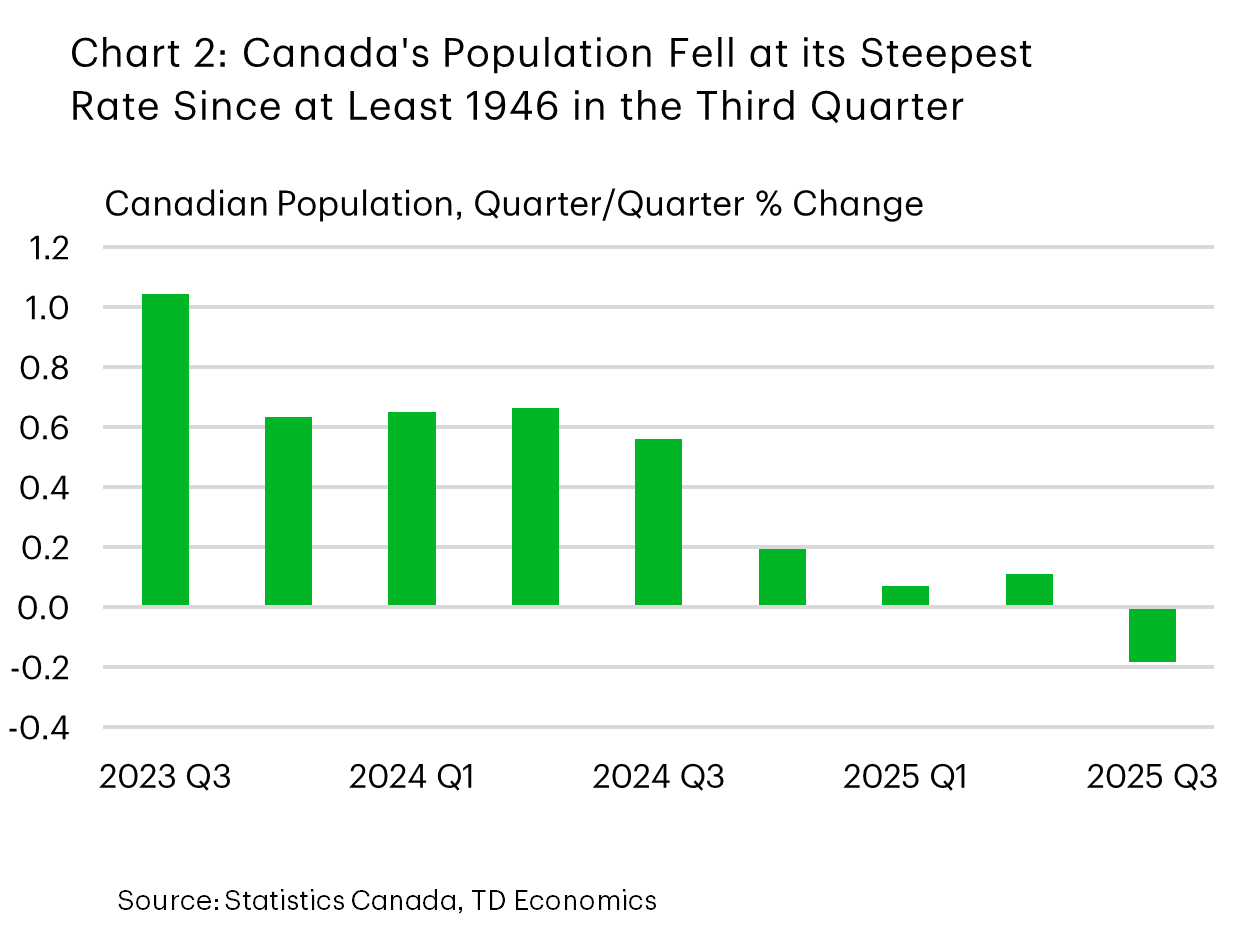
- Canada’s population saw its steepest decline on record in the third quarter. Weak go-forward population gains should weigh on economic activity and maintain downward pressure on the unemployment rate.
- Canadian home sales and prices had a weak November, but we think 2026 should bring improved fortunes.
U.S. Highlights
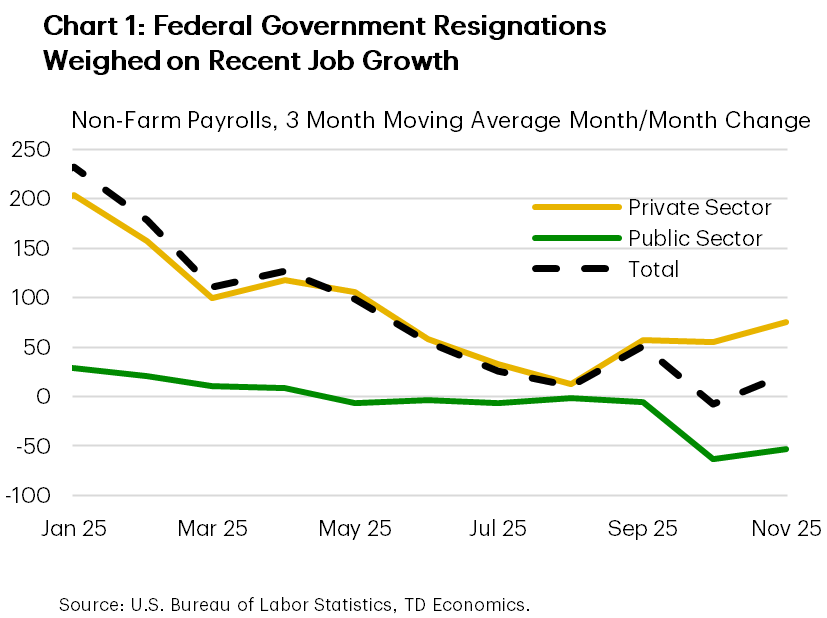
- Employment growth slowed in the first two months of the fourth quarter, owing to the impact of deferred resignations on federal government employment.
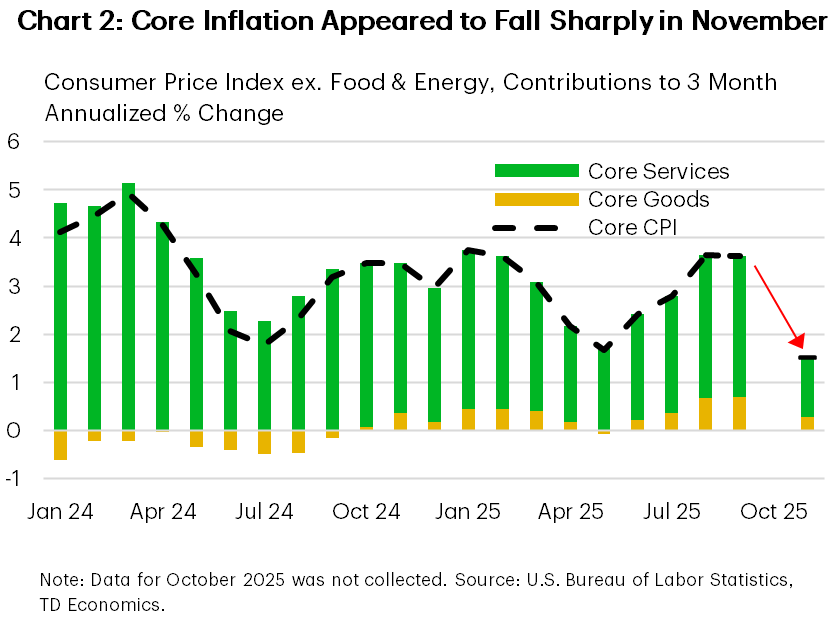
- Inflation fell sharply in November, but the degree of the descent and the condensed nature of the data collection period warrants caution in interpreting the data.
- Federal Reserve officials continued to voice a spectrum of opinions on the outlook for monetary policy that on aggregate spoke to a cautious approach moving forward.
Canada – A Chilly End to 2025
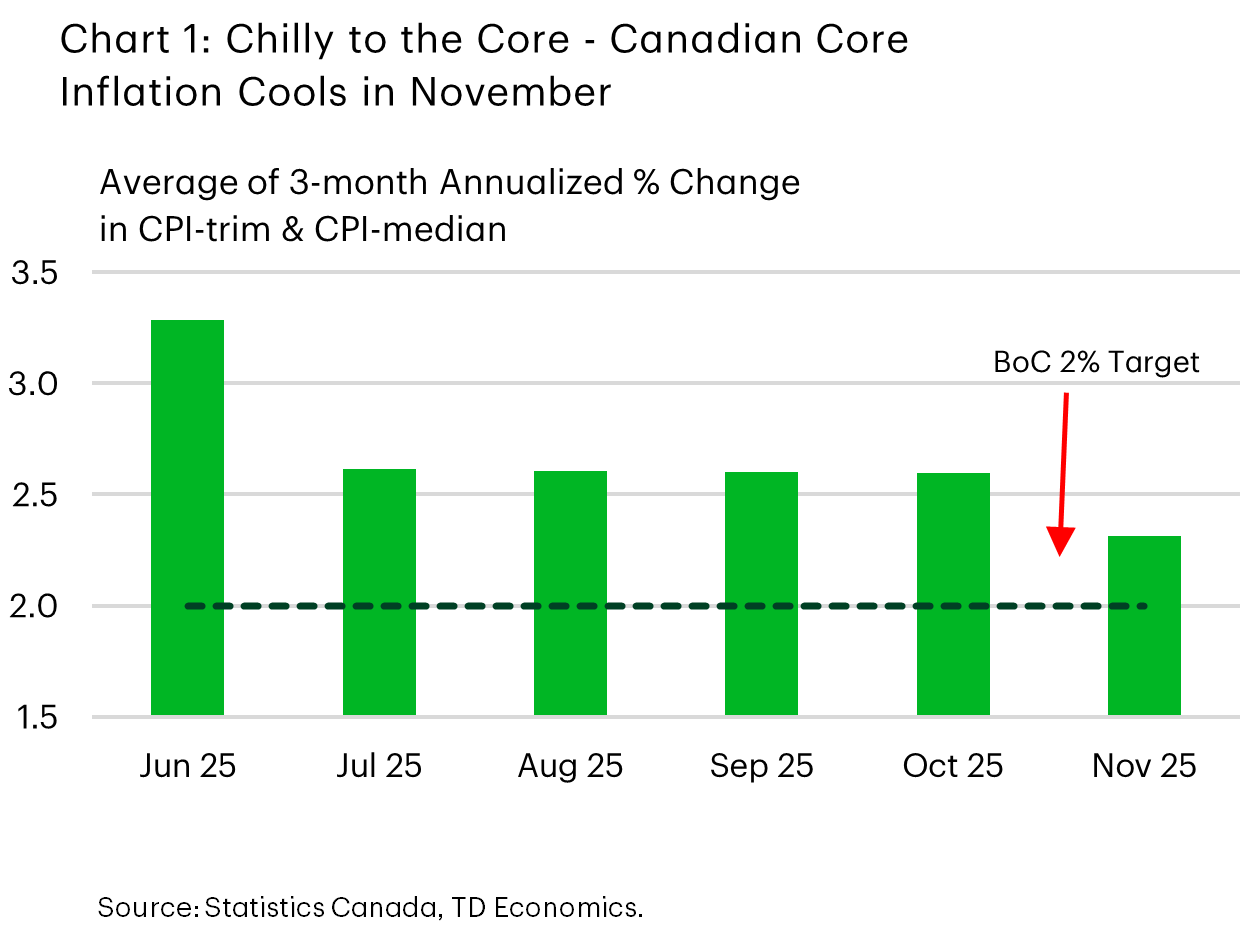
While the U.S. had a cornucopia of data to whet the appetite, Canada had its own data buffet heading into the holidays. Most important for the Bank of Canada was the inflation report for November which showed a notable cooling in core inflation. Today’s retail spending report was also frosty, confirming a slowing trend in spending volumes. Alongside this, updates on the freeze in population growth, and a chill in housing construction all point to the Bank of Canada staying on the sidelines heading into 2026.
It seems a chilly winter breeze swept through key inflation metrics, as the Bank’s preferred core measures (median and trim) cooled to 2.8% year-on-year (y/y), while the three-month trends were even snowier (Chart 1). Headline inflation, meanwhile, was unchanged with some choppiness on deck for December, as last year’s GST holiday muddies comparisons. However, falling oil prices could offer some offset. Oil slipped again this week, greased by oversupply concerns. However, on-going tensions between the U.S. and oil producer Venezuela limited the extent of the decline.
The inflation report wasn’t all merry, with food prices playing the proverbial grinch. Grocery store prices climbed 4.7% (y/y), harkening back to the bad old days of pandemic inflation. This is something that will catch the eye of policymakers, as higher food prices can impact inflation expectations.
A key piece from the inflation report for the outlook was that rent growth continued to moderate. This is partially a function of the steep slowdown in Canada’s population growth, and this week featured a stark reminder of this trend. Canada’s population growth was downright frosty in the third quarter, slipping 0.2% quarter-on-quarter (Chart 2). This marked the largest decline on record! We anticipate 2026 to be another year of frigid population gains, which should restrain the pace of economic growth. Weak population growth will also weigh on the labour force, which should keep downward pressure on the unemployment rate.
Muted population gains will also drag on housing demand. In this vein, we received November data on Canadian home sales and average home prices this week. Overall, trends were cool, with home sales, average and benchmark prices all slipping a touch. We do, however, expect some improvement in both measures moving forward, benefiting from pent-up demand and amelioration in the Canadian jobs market. In contrast, housing starts popped higher in November but are on a downtrend which should extend into 2026, bogged down by a tepid pace of population gains.
Investors certainly had a lot of data to chew on this week and, all things considered, it was on the cooler end of the spectrum. However, it certainly wasn’t wintry enough to shake the Bank from their current hold stance. Indeed, we think the Bank will keep any changes to its policy rate on ice for the foreseeable future.
U.S. – Data with A Grain of Salt
This was arguably the biggest week for U.S. economic data in several months, as highly anticipated employment and inflation data delayed by the government shutdown was finally released. Financial markets largely took the data in stride, with U.S. Treasury yields falling slightly on the week, while equity markets were roughly unchanged as of the time of writing.
On the data front, the employment report showed that the economy continued to add jobs in the fourth quarter. However, headline job growth was weighed down by a large decrease in federal government jobs in October (Chart 1) - a byproduct of the deferred resignation offers sent out earlier in the year. Despite the near-term distortions, job growth has decelerated through the second half of the year, which has led to an uptick in the unemployment rate and motivated the 75 basis-point reduction in interest rates implemented by the Federal Reserve since September.
The pace of monetary policy easing has been deliberately gradual though, as inflation risks have been rising at the same time. However, November CPI data showed that there may have been a break in this trend in recent months, with the annual percentage change in core inflation falling to 2.6% - the lowest level since March 2021. Given the shorter collection period for this data owing to the government shutdown and the sharp drops recorded in several index categories (Chart 2), this data should be taken with a grain of salt. Market pricing for the Federal Reserve’s January meeting was largely unchanged, with only a 25% chance for a fourth consecutive cut.
The handful of Federal Reserve officials we heard from this week offered notably different assessments on the policy rate outlook. Miran made the case for aggressive rate cuts, positing that inflation metrics were anomalously high, while Waller also took a dovish tone but noted a gradual pace of rate cuts would be warranted going forward. On the other end of the spectrum was Bostic, who voiced greater concern for inflation risks and stated he did not currently see the need for rate cuts in 2026. Other speakers, including Vice Chair Williams, echoed Powell’s comments from his press conference last month that monetary policy was in a good place heading into 2026. Despite growing dissent among FOMC members, the balance of opinion is one of relative caution heading into the new year. Market pricing has followed suit, with another rate cut not expected until the Fed’s meeting in late April next year at the earliest.
Looking ahead to next week, there will be few items on the economic agenda during the holiday shortened week, but the preliminary estimate for third quarter GDP on Tuesday will be a highlight. A strong reading for annualized growth of roughly 3% is expected, which will likely be followed by a deceleration in the fourth quarter owing to the government shutdown. Nevertheless, we expect the economy to grow by 2.2% in 2026, aided by fiscal and monetary policy support.
Weekly Economic & Financial Commentary: More Data, More Questions
Summary
United States: More Data, More Questions
- The latest employment and inflation data don't materially change the economic narrative, though they do bring some questions on data quality. Ultimately, the jobs market continues to steadily moderate, and consumer inflation is softening, just not to the degree that the November data suggest. We continue to expect the Fed will hold in January.
- Next week: GDP (Dec 23), Productivity (Jan 8), Employment (Jan 9)
International: Global Central Banks Make Final Rate Calls of 2025
- As 2025 winds down, global central banks remain far from idle. This week, the Bank of Japan raised rates, while the Bank of England and Banxico cut theirs. Most others—including the European Central Bank, Riksbank and Norges Bank—kept rates unchanged.
- Next week: Canada GDP (Dec 23), China PMIs (Dec 31)
Topic of the Week: Federal Employment Nosedives in 2025
- Coming into 2025, there were major questions about how much the incoming Trump administration would reduce the federal workforce. Through November, federal civilian employment has shrunk by 271K since the start of the year, a 10% decline. This represents one of the largest reductions in federal employment in recent memory, and it has reduced nonfarm payroll growth by roughly 23K per month this year.
Week Ahead – Key Risks to Watch in Last Days of 2025 and Early 2026
- Light agenda in the next couple of weeks before 2026 begins with a bang.
- US data to dominate: ISM PMIs, GDP and NFP reports, plus Fed minutes.
- UK GDP, Tokyo CPI and Eurozone and Australian CPI also on tap.
- But caution likely ahead of Supreme Court tariff ruling and Trump’s Fed pick.
Markets to go into hibernation
The festive period officially starts next week, with many traders vacating their desks until the first full week of January, making way for thin trading volumes and very few top-tier releases. However, plenty of action is expected in the first full week of January 2026 when the US jobs report returns to its usual schedule.
But what are the risks of volatility episodes such as flash crashes or geopolitical flare-ups during these quiet days when any sudden moves could be amplified due to extremely low liquidity?
Holiday lull or a new crisis?
With tensions elevated between the US and Venezuela, further escalation is possible. President Trump could decide to take more action over the country by expanding the military strikes on drug traffickers at sea to Venezuelan land – something he’s already warned about. The US this week imposed a blockade of all sanctioned oil tankers from entering or leaving Venezuela and Trump could well decide to pile yet more pressure on President Madura.
Fresh tensions would probably boost oil prices and to a lesser extent Gold.
There’s also a danger of panic selling on Wall Street if AI jitters persist. Equity markets haven’t staged much of a Santa rally this year despite expectations of more Fed rate cuts. But whilst some valuations are clearly overstretched, the AI revolution is only beginning, hence, new winners could enter the scene just as others unexpectedly become losers in the race.
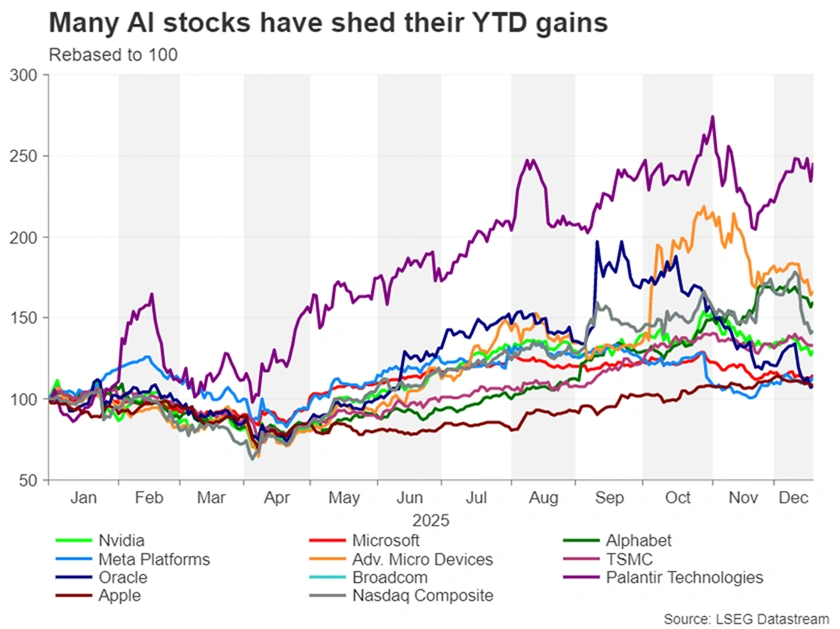
Still, this year’s slightly prolonged duration of holiday-thin liquidity increases the risk of a negative AI-related headline triggering a new round of selloff in tech stocks if fresh doubt is cast on valuations.
Major decisions awaited at start of 2026
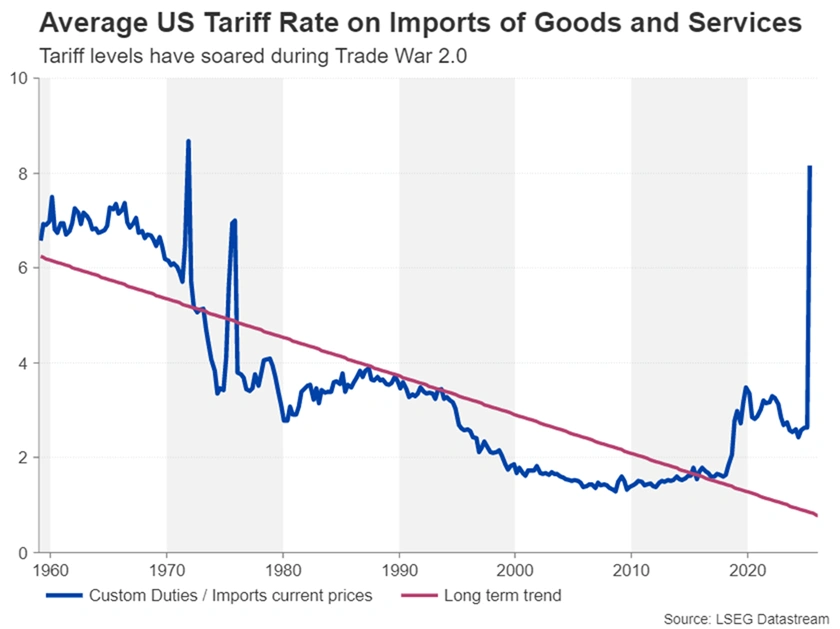
However, investors on the whole will probably prefer to stay on the sidelines, as they await two key decisions in early January. First, the US Supreme Court will deliver its ruling on Trump’s tariffs, ending months of uncertainty about whether most of the levies announced since April are legal or not. However, a ruling against the tariffs may not necessarily be the best outcome, as this could worsen the uncertainty and potentially cost the US government billions if it’s forced to refund the tariff revenue to businesses.
The other big decision is who President Trump will nominate to head the Federal Reserve when Jerome Powell’s term ends in May 2026. Given that Trump keeps changing his mind and there’s a new favourite on a weekly basis, a surprise choice cannot be ruled out. Moreover, picking someone who can achieve consensus within a split FOMC will be crucial. Nevertheless, whoever Trump selects, the new Fed chair will almost certainly be more dovish than Powell, so the announcement is possibly a low-risk event for the markets.
US data to keep markets on edge
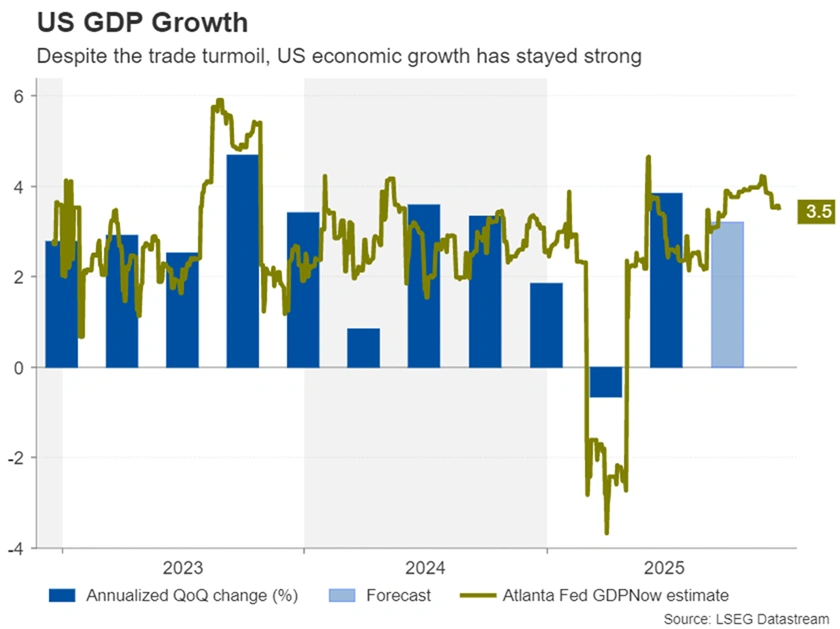
Switching the focus to economic data now, the US agenda is by far the busiest. The advance GDP reading for Q3 is the first highlight next week. Due on Tuesday, the report is expected to show that the US economy grew by a solid annualized rate of 3.2% in the third quarter, somewhat slower than the 3.8% seen in Q2. Durable goods orders for October and the latest consumer confidence index are also out the same day.
On Tuesday, December 30, the Fed will publish the minutes of its December policy meeting. With not a whole lot of Fed speakers out and about during the Christmas and New Year period, the minutes will be scrutinized for any clues on the timing of the next Fed rate cut, as well as to see how strong the inflation concerns still run among the policymakers that voted to keep rates on hold.
Moving into January, things will begin to heat up as the ISM manufacturing PMI for December is out on Monday, January 5, followed by the JOLTS job openings, the ADP employment report and ISM services PMI on Wednesday.
NFP report to kickstart the new year
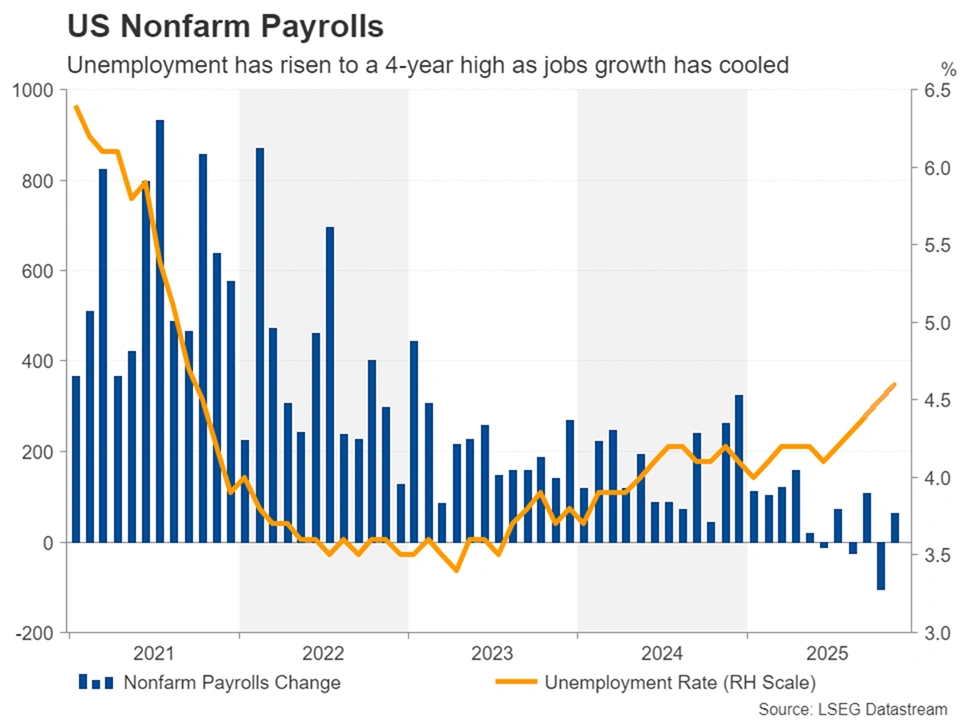
Most important of all, the December jobs report will be released without any delay on Friday, January 9. After the mixed payrolls figures and the much softer-than-expected CPI report for November, any further weakness in the labour market in December would fuel expectations of a January rate cut.
In particular, if the unemployment rate, which hit a four-year high of 4.6% in November, continues to rise, the Fed hawks will find it increasingly tough to defend their stance.
Finally, the University of Michigan’s preliminary consumer sentiment survey for December will also get published on Friday.
For the US dollar, the ISM PMIs and NFP data are likely to have the biggest impact. The risks for the greenback are currently tilted to the downside so a bad set of prints could exacerbate any selling pressure.
Employment numbers are also due in Canada on January 9. The Canadian dollar’s mini rally versus the greenback paused for breath during the past week after the weak November CPI prints. But an upbeat labour market report could recharge the bulls.
Will Tokyo CPI matter after BoJ’s latest move?
As most traders wind down over the long Christmas weekend, it will be business as usual in Japan. December CPI data for the Tokyo region is out on Friday, December 26, along with the November readings for industrial production, retail sales and unemployment.
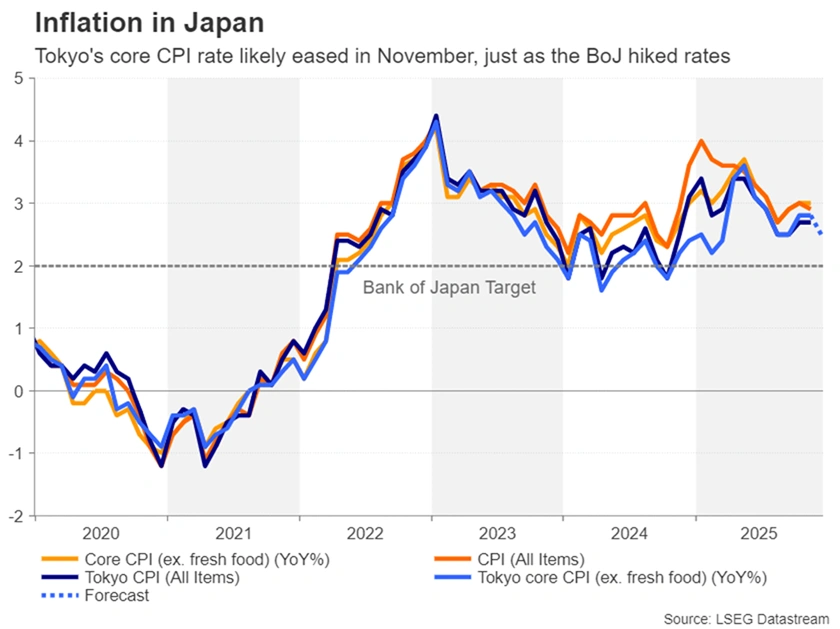
Following the Bank of Japan’s rate hike in December, the focus is now on how soon the next increase will come. The BoJ will publish the Summary of Opinions of that meeting on Monday, December 29, but before that, any uptick in inflationary pressures could lift BoJ rate hike odds, boosting the yen.
Similarly, investors may want to watch wage growth and household spending numbers that are scheduled for January 8 and 9, respectively.
Australian CPI eyed for RBA clues
Elsewhere in Asia, Chinese manufacturing PMIs out on New Year’s Eve and January 2 might attract some attention for the Australian dollar. But aussie traders will mainly be keeping their eyes on domestic November CPI data due on Wednesday, January 7.
Although the Reserve Bank of Australia is unlikely to announce any changes in policy at its next meeting in February, any fallback in monthly CPI, which unexpectedly jumped to 3.8% y/y in October, could push back the timing of a potential rate hike, weighing on the aussie.
Euro and Pound might shrug off the data
In Europe, it will be extremely quiet apart from Q3 GDP figures out of the UK this Monday, and the Eurozone’s flash CPI estimate for December on Wednesday, January 7.
With both the Bank of England and European Central Bank having just held their last policy decisions of the year, neither release is likely to move the euro and pound.
The ECB is firmly on pause at least until the middle of 2026, while any disappointing growth numbers for the UK may not be enough to significantly alter the BoE rate outlook after the Bank delivered a surprise hawkish cut.