

Sample Category Title
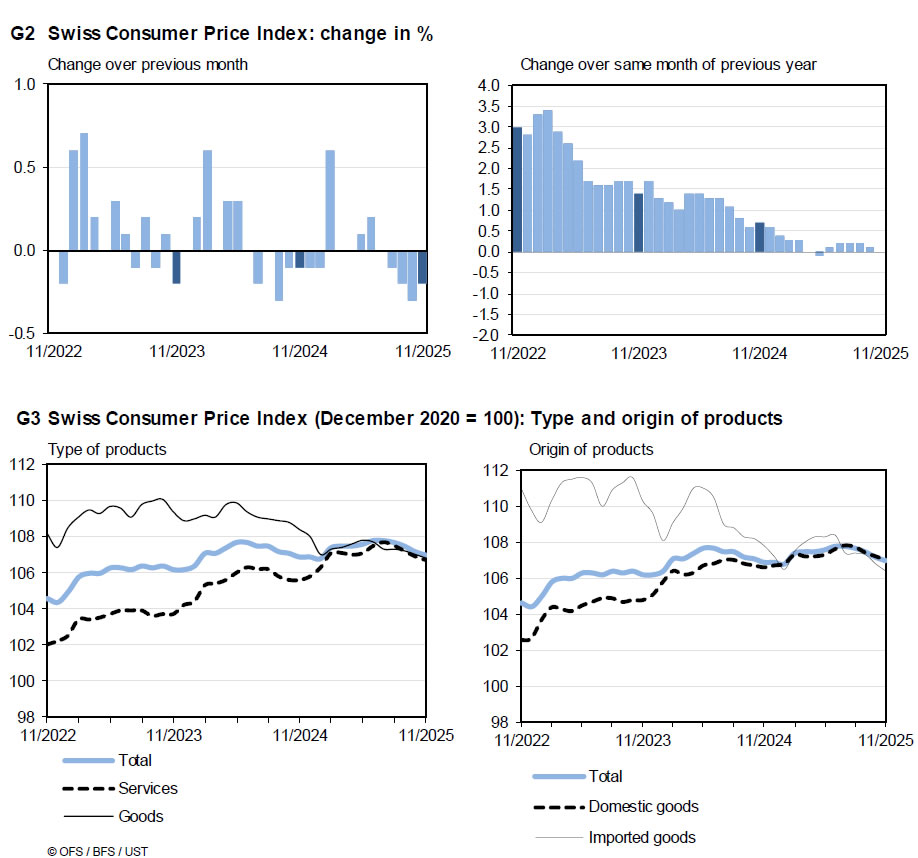
Swiss CPI back at 0.0% as broad price declines in November
Swiss inflation softened in November, with headline CPI falling -0.2% mom, in line with expectations, while annual inflation slowed from 0.1% yoy to 0.0%, undershooting forecasts of 0.1%. Core CPI also dipped, falling -0.1% yoy, with the annual rate easing from 0.5% yoy to 0.4%. The data highlight Switzerland’s continued weak inflation, keeping price growth far below levels seen elsewhere in Europe.
Both domestic and imported prices contributed to the decline. Domestic products fell -0.2% mom, while imported goods dropped a sharper -0.4% mom. On a yearly basis, domestic inflation cooled from 0.5% yoy to 0.4%, and imported prices remained deeply negative at -1.3% yoy. The persistent weakness in imported goods continues to anchor Swiss inflation near zero.
The Next Fed Chair Becoming Ever More Certain
Markets
The Japanese-inspired core bond selloff eased yesterday. An unconvincing attempt to eke out a few more bps during European dealings was more or less killed off in the US session. Net daily changes for US Treasury yields eventually varied between -2.1 bps to +0.9 bps in technical trading. The German curve shifted similarly by shedding 1.4 bps at the front. Even UK yields swapped earlier gains for minor declines across the curve. We wouldn’t call it a day on the underlying forces though. Japanese yields this morning are again headed north with new highs for the (ultra) long maturities including the 30-year ahead of a closely watched auction tomorrow. News in any case was scarce yesterday and that seemed to suffice for riskier assets to recover some ground. European and US equities inched 0.3-0.6% higher and crypto markets rebounded in a daily perspective after the violent selloff in recent weeks. The likes of Bitcoin extend gains to almost 94k, the strongest level since mid-November. The meeting between US envoy Witkoff and Russian president Putin and his entourage was called constructive by the Kremlin but no compromise was reached yet. Sticking to event risks, French politics reared its head again with local newspaper Le Figaro reporting that Horizons won’t back premier Lecornu’s social security budget bill in the upcoming vote December 9. Being part of the coalition government, Horizons’ lack of support is a reminder of how fragile and perhaps deceiving the current French calm is. OATs underperformed compared to European peers. The euro ignores the matter for now. After an uninspiring session yesterday, EUR/USD is gently trending north this morning towards first resistance around 1.165-1.167 (short term highs). The trade-weighted dollar index depreciates back to the 99 area. The economic agenda has things in store that could spice up the session today. ECB president Lagarde appears before parliament. The ADP job report and services ISM are to further shape Fed expectations for December. A rate cut is priced for 95% now. At this stage it would take blow-out numbers to flip the balance again by December 10. The next Fed chair meanwhile is becoming ever more certain. Hassett emerges as the frontrunner and favours a growth-supporting policy – perhaps the most compared to the other contestants. President Trump will officially announce Powell’s successor early 2026. Barring renewed risk aversion for whatever reason (France, public finances, equity valuation … ) we’d expect the dollar to remain on the backfoot. Were EUR/USD to take out the recent highs, the 1.1728 October top – 1.1747 61.2% recovery on the Sep-Nov decline emerges as the next reference. EUR/GBP’s three-day win streak ran into resistance around 0.88. We hold our negative bias for sterling though and assume EUR/GBP’s fundamental level to be 0.90+.
News & Views
Australian GDP growth slowed from an upwardly revised 0.7% Q/Q in in Q2 to 0.4% in Q3 (vs +0.7% consensus), the average quarterly growth pace since the end of the COVID-19 pandemic. Annual growth ticked up from 2% to 2.1%. Details showed final consumption rising by 0.6% Q/Q with both household (+0.5%) and government (+0.8%) spending contributing to growth. The household saving ratio rose from 6% in Q2 to 6.4% in Q3 with gross disposable income (+1.7%) rising faster than nominal household spending (+1.4%). Total gross fixed capital formation rose a strong 3% Q/Q mainly due to a rebound in public investments (+3% Q/Q after -3.5% Q/Q in Q2). Net trade detracted 0.1 ppt from GDP growth, with imports up 1.5%, and exports up 1%. Today’s numbers strengthen market belief that the next move by the Reserve Bank of Australia will a rate hike next year. AUD/USD builds on its recent comeback, eyeing first resistance around 0.66. The Aussie yield curve bear flattens this morning with yields rising by 5.8 bps (2-yr) to 3.2 bps (30-yr).
The EU agreed to gradually prohibit Russian LNG gas import by the end of 2026, one year faster than originally planned. Russia is still the second-largest LNG-provider (15% of total) to Europe after the US. The deadline now matches with the ban of seaborne deliveries which is already part of EU sanctions against Russia. The EU’s RePowerEU plan also targets halting to pipeline gas imports under long-term deals by the end of Q3 2027. The commission also plans to put forward a legislative proposal on phasing out Russian oil imports no later than the end of 2027.
Not While JGBs Keep Pressuring
Bitcoin has become the first thing I look at when I turn my computer on since Monday, since it tells about the risk appetite for the riskiest and most speculative pockets of the market. Unsurprisingly, its correlation to the USDJPY has been notably close in the two sessions that followed Bank of Japan (BoJ) Governor Ueda’s hint that the BoJ was cooking a rate hike for the December dinner.
This morning, Bitcoin looks better, the Nikkei returned above the 50K psychological level and the US and European futures are pointing at a positive start, yet the pressure from the JGBs remains firm. The Japanese 10-year yield is up to a fresh multi-decade high, at 1.88% this morning. And that’s no good news: these levels mark the end of the Japanese free liquidity that has been propping the markets over the past decade, as Japanese investors put trillions of dollars of funds into US Treasuries among other assets to get better returns. Above the 1.71% level for the 10-year JGB, the math doesn’t work: the Japanese don’t get a better return outside when you take the currency hedging costs into account. The risk is another episode of reversal of carry positions in the yen – where investors will sell their foreign assets and return to yen – strengthening the yen and triggering a fresh selloff across global financial markets, including US Treasuries. And US Treasuries are the basis of valuation. This is what we use as the risk-free rate in pricing models.
So the chain goes like this: the BoJ hikes rates, the Japanese yields climb further, the Japanese sell their foreign assets and repatriate their funds, the yen appreciates and the global financial assets depreciate. This is what happened on Monday. On Tuesday, a strong 10-year JGB auction gave relief, allowing the Bitcoin rebound. Today, we’re back to square one. The Japanese yields are pushing higher again. If we follow the reasoning, we should see cautious risk taking and perhaps a bearish session-
I come to believe that the biggest driver of the year-end sentiment may not be the Federal Reserve (Fed), but rather the BoJ – or the cocktail of Fed/BoJ. The Fed is widely expected to announce a 25bp cut when it meets next week. The ADP report due today is expected to print 5’000 new private-sector job additions in the US during last month – a number small enough to back a December Fed cut. But Friday’s PCE data will hint at what will happen next. And given that it’s still well above the Fed’s inflation target, we could hear a hawkish cut from the Fed next week that could reshuffle expectations for next year – toward a more cautious path of easing. Right now, the expectation is 2–4 rate cuts next year. The risks are skewed toward fewer, not more.
Then, the BoJ will announce its decision a week after the Fed, and markets assign roughly an 80% probability to a hike. Mr. Ueda has made it clear he sees more room to go in terms of policy normalization. I mean, look, the BoJ’s policy rate sits at 0.50% while Japanese inflation sits around 3%. You bet, there is room to normalize. It’s the end of Japanese deflation, and it’s the end of the Japanese free cash – for good.
The S&P 500 was slightly up yesterday. Nvidia made a positive attempt, though most of the session gains were quickly given back, perhaps on fresh news that Amazon also started selling its own AI chip – the Trainium 3 – to compete with Nvidia and Google in the hardware segment. Interestingly, the market reaction to Amazon’s Trainium has been much more muted compared to the reaction to Google’s TPUs. But wait until a big name inks a deal with Amazon for their chips. Amazon – like Google – has the data centers and the chips. They don’t have a Gemini-like chat buddy, but AWS supports training and deployment of AI models on its custom AI chips. So keep an eye on Amazon.
I stumbled on an interesting Bloomberg piece — and separately a Visual Capitalist chart — that are worth commenting. The Bloomberg report highlights how the winning tech business models of companies like Meta and Amazon were historically capital-light, which helped deliver the kind of juicy profit margins investors love. The Visual Capitalist chart then compares profit margins to revenue — and you'd expect higher margins to neatly align with higher revenues, but the relationship is not diagonal. Some companies scale revenue with big margins; others don’t. And unsurprisingly, your capital-light tech buddies sit among the most profitable companies in the world precisely because they’ve been capital-light.
But that’s changing with AI. These companies are now pouring billions into data centres and chips just to stay in the game. And that capex has already been eating into free cash flow — and may soon start nibbling at their margins. Margins won’t collapse overnight, but the direction is clear: AI is rewriting the cost structure of Big Tech, and investors will eventually have to price that in.
And the size of the repricing will ultimately depend on yields — because yields are the backbone of every major valuation model. Lower yields mechanically lift valuations; higher yields compress them. And right now, yields are under upward pressure.
So, all eyes turn to the Fed, and to the inflation data that will dictate how fast — and how deep — the Fed can realistically cut.
Euro Area Inflation Shows Minor Upside Surprise
In focus today
In the euro area, focus turns to the final services and composite PMI data for November. The final manufacturing PMI on Monday came in at 49.6 like the flash release of 49.7, so we expect the final composite PMI to be almost as the flash release.
In Switzerland, November inflation is released this morning at 8:30 CET. Deflationary concerns have recently resurfaced in Switzerland, but the bar remains high for a cut into negative territory by the SNB. We expect no further cuts and would expect the first course of action to be FX intervention.
In the afternoon, both ISM Services index and the ADP private sector employment report for November are due for release from the US. For the former, the flash PMI released earlier signalled steady activity growth. For the latter, the weekly employment estimates have signalled weakening growth momentum around late October and early November, and hence consensus expects muted growth at only +10k.
This morning, we have published our Nordic Outlook - Cruising at modest speed, 3 December, with new economic forecasts globally and for the Nordic countries. In the Nordics, we have upgraded the outlook for growth in Sweden and now expect a rate hike in late 2026 and one more in 2027. Danish GDP is also upgraded, but that is more of a technical change. In Norway, we expect growth and inflation to decline, and a string of rate cuts. Finnish growth has disappointed but there are signs of a modest turnaround. For the major economies, we maintain our view of a stable euro area, the US converging to structural levels of growth and inflation amid high uncertainty, and China continuing with strong export growth but struggling to raise domestic demand growth.
Economic and market news
What happened overnight
In China, RatingDog services PMI fell to 52.1 in November (prev: 52.6), marking the slowest pace of expansion since June. Growth in new orders softened despite a rebound in export business amid easing US-China trade tensions. Employment continued to decline for the fourth consecutive month, while rising input costs pressured profit margins. Business sentiment weakened further, reflecting the broader challenges facing the services sector.
What happened yesterday
In the euro area, November inflation came in slightly higher than expected at 2.2% y/y (cons: 2.1% y/y) from 2.1% y/y in October. It was a "low" 2.2% at 2.15%, so a very minor upside surprise. Core inflation remained unchanged at 2.4% y/y as expected due to services inflation rising to 3.5% y/y from 3.4% y/y and goods inflation falling slightly. The momentum in services inflation was similar to recent months, so the uptick is mainly due to base effects and thereby not particularly hawkish.
The EU has agreed on a deal to phase out all imports of Russian gas by 2027, aiming to fully end reliance on its former main energy supplier.
In Denmark, Nationalbanken's press release on the November FX reserve revealed that they did not intervene in the foreign exchange market in November, in line with our expectations. November marks the 34th consecutive month without interventions.
In geopolitics, President Vladimir Putin held a five-hour meeting at the Kremlin with US President Donald Trump's envoys, Steve Witkoff and Jared Kushner, to discuss a possible peace deal to end the war in Ukraine. While the Kremlin described the talks as constructive, no compromises were reached, particularly on territorial issues, and details remain undisclosed. Concerns persist among European powers and Ukraine over the potential for US concessions to Russia.
Equities: Global equities traded broadly higher yesterday. The cyclical bid remained dominant, most notably in the US, where defensive sectors were lower and small-cap underperformed with large-cap growth regained some momentum. But the real story was the continued strength in cyclicals. European banks delivered yet another strong session following the euro-area inflation data, which in effect validated the ECB's comfortable policy stance. Banks continue to benefit from this backdrop, and the sector's 12-month performance stands at +77%, far ahead of the next-best of the 25 STOXX 600 industry, Capital Goods (+34%). Even that 34% looks modest compared with the bank rally, which has been exceptional both on relative and absolute terms. In the US yesterday Dow +0.4%, S&P 500 +0.3%, Nasdaq +0.6%, Russell 2000 -0.2%. Overnight, Asia traded higher as Japan retraced part of Monday's declines. US and European equity futures are marginally in the green this morning.
FI and FX: After an eventful start to the week, yesterday proved quieter for fixed income markets. Rates edged marginally lower in a reversal of Monday's move with US swap rates ending the day 2bp lower across the curve and similarly, European swap rates 1bp lower across the curve. However, movements in the very front end have gained traction with short-term repo rates in the euro area rising over month-end with GC repo rates rising roughly 4bp. Today, focus turns to auctions in Norway and Denmark. JPY eased off recent highs with USD/JPY breaking back below 156. EUR/USD regained some tailwind back to the 1.1650 mark.
EUR/USD Daily Outlook
Daily Pivots: (S1) 1.1602; (P) 1.1615; (R1) 1.1638; More….
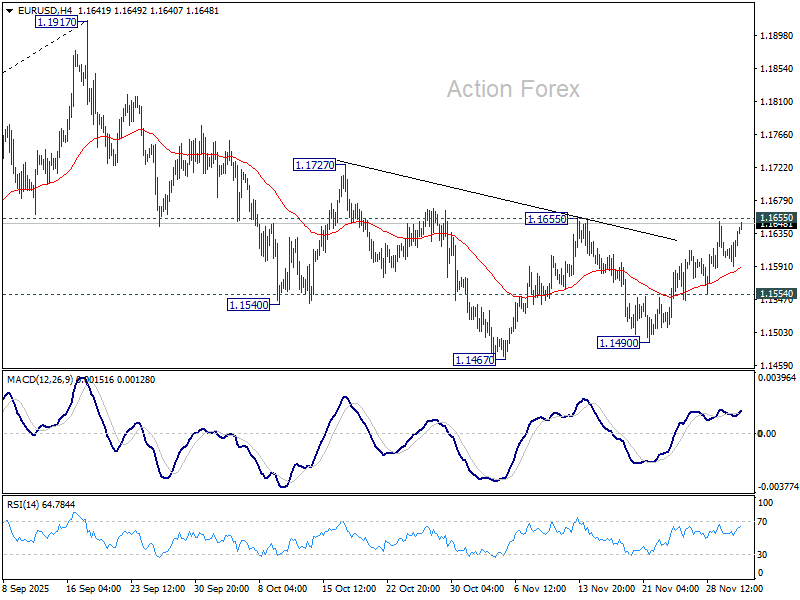
EIUR/USD rises slightly today but stays below 1.1655 resistance. Intraday bias remains neutral. On the upside, decisive break of 1.1655 will complete a head and should bottom pattern (ls: 1.1540, h: 1.1467, rs: 1.1490). That would argue that whole fall from 1.1917 has completed as a correction. Further rise should then be seen to 1.1727 resistance first. On the downside, though, below 1.1554 will turn bias to the downside for 1.1490 support first.
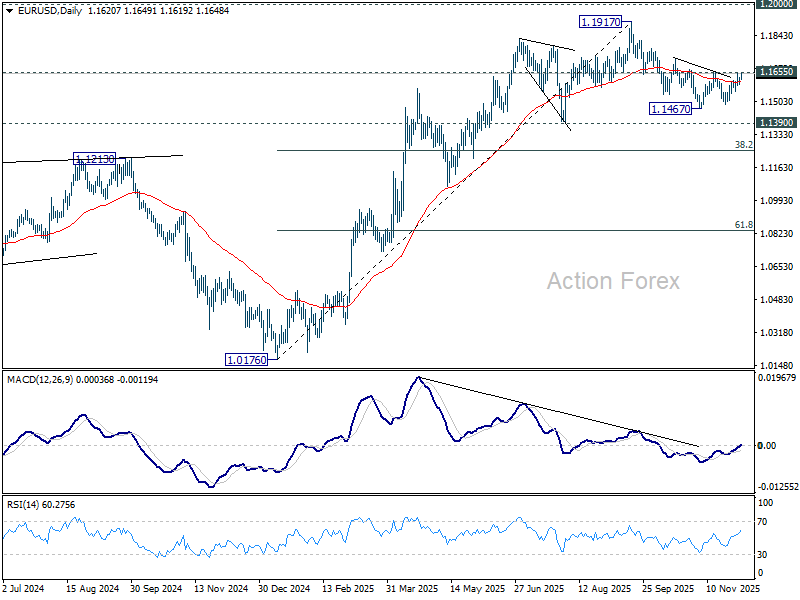
In the bigger picture, considering bearish divergence condition in D MACD, a medium term top is likely in place at 1.1917, just ahead of 1.2 key psychological level. As long as 55 W EMA (now at 1.1345) holds, the up trend from 0.9534 (2022 low) is still in favor to continue. Decisive break of 1.2000 will carry larger bullish implications. However, sustained trading below 55 W EMA will argue that rise from 0.9534 has completed as a three wave corrective bounce, and keep long term outlook bearish.
Markets Await US ADP and ISM Services as Dollar Drops Further
Risk sentiment was mixed in Asian trading today. The Nikkei outperformed thanks to a rebound in SoftBank and renewed enthusiasm for tech and AI names, but the index failed to break back above 50,000 psychological level—highlighting lingering hesitation among investors despite the intraday gains. Outside Japan, the tone was considerably weaker, particularly in Hong Kong, where declines in property and China-linked names weighed on the broader market. Regional divergence highlights an indecisive backdrop. Clarity may emerge later in the day as US markets react to the ADP employment report and ISM services data.
In the currency markets, Dollar is back under selling pressure through the session, extending a soft patch that some expect to persist into year-end. The gradual release of delayed US economic data is expected to show a softer underlying growth profile—especially in the job market—which could reinforce expectations for additional Fed easing next year. Additionally, a stable global risk environment only deepens headwinds for the greenback.
Fed rate-cut expectations continue to build as investors look for data confirming the slowdown in consumption and hiring. Combined with an improving risk backdrop globally, the Dollar is increasingly vulnerable to further downside, particularly if today’s ISM services numbers reinforce the softer tone seen in this week's manufacturing data.
In the meantime, Aussie leads the days' performance board, buoyed by hawkish comments from RBA Governor Michele Bullock that overshadowed the softer-than-expected Q3 GDP figures. Kiwi follows as the second-strongest, while Sterling also trades firmer on cross-flow demand. At the weaker end of the board, Dollar is the day’s worst performer so far, followed by Loonie and Swiss Franc. Euro and Yen sit mid-table.
In Asia, Nikkei closed up 1.14%. Hong Kong HSI is down -1.30%. China Shanghai SSE is down -0.54%. Singapore Strait Times is up 0.23%. Japan 10-year JGB yield rose 0.029 to 1.892, edging closer to 1.9 handle. Overnight, DOW rose 0.39%. S&P 500 rose 0.25%. NASDAQ rose 0.59%. 10-year yield fell -0.010 to 4.860.
RBA’s Bullock warns inflation persistence may require renewed tightening
RBA Governor Michele Bullock told the Senate Economics Legislation Committee that the bank remains on high alert for renewed inflation pressure and is prepared to act if price gains prove "more persistent" than expected. She noted that upcoming data in the next few months will be crucial in determining whether demand pressures are easing, adding that officials may still have to pivot back toward tightening if inflation shows signs of regaining strength.
Facing questions on past budget and inflation mis-projections, Bullock conceded the RBA “hasn’t done it yet” in bringing inflation sustainably back to target, and must continue working toward that objective. She stressed that the board must “keep working on this”.
With national debt set to exceed AUD 1 trillion and a deficit of AUD 42 billion projected, she noted that lower public and private savings—if paired with unchanged investment—could "put upward pressure on the neutral rate,” she said."
But she added that that such an outcome is possible but contingent on both domestic and global forces. She emphasized that while the RBA can respond to domestic dynamics, but we don’t control global factors."
Australia Q3 GDP misses forecast at 0.4%, per capita output stagnates
Australia’s economy expanded 0.4% qoq in Q3, below expectations for 0.7% and marking a softer outcome despite a 2.1% yoy rise from a year earlier. The headline result reflected steady domestic activity supported by private investment and household consumption. However, GDP per capita was flat, suggesting growth is tracking population gains rather than delivering broad-based improvement in living standards.
A key drag came from external accounts. Inventory rundown—used to support export volumes—subtracted meaningfully from growth, while net trade also weighed as imports rose faster than exports. The pattern highlights ongoing pressure on Australia’s trade balance even as domestic demand remains resilient.
Grace Kim, ABS head of National Accounts, described Q3 performance as “steady,” noting growth matched the post-pandemic quarterly average. Kim added that per capita GDP stagnation reflected population dynamics rather than outright weakness in activity, with the measure still 0.4% above its level a year earlier.
AUD/USD and AUD/JPY both eye breakouts after hawkish RBA remarks
Australian Dollar rallied sharply today after RBA Governor Michele Bullock signaled to Parliament that policymakers remain ready to tighten policy if inflation shows renewed persistence. Markets took her remarks as a clear indication that a rate hike in 2026 is possible—and that easing is firmly off the table for now. .
Soft Q3 GDP numbers briefly tempered expectations, but failed to stall Aussie’s advance. While quarterly growth undershot forecasts at 0.4% qoq, the 2.1% yoy expansion was still the strongest pace in two years, keeping concerns alive that domestic demand may be too resilient for inflation to retreat as quickly as hoped.
Markets now largely agree that rate cuts are off the table for an extended period, and a pre-emptive hike cannot be ruled out if upcoming data surprise on the upside.
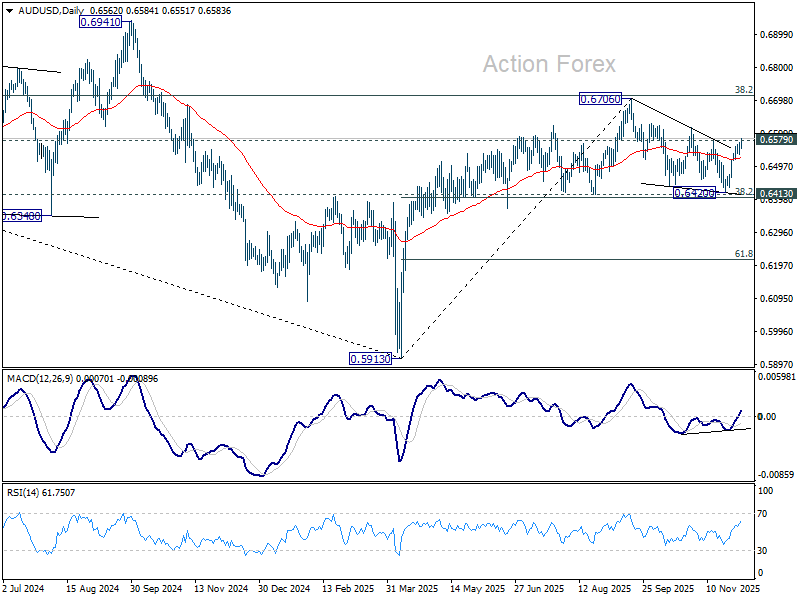
Technically, AUD/USD’s break above 0.6579 reinforces that the correction from 0.6706 likely ended at 0.6420. The uptrend from the 2025 trough at 0.5913 may now be resuming, setting up a retest of 0.6706 peak. The key question is whether bullish momentum can build into that level or whether upside energy fades on approach.
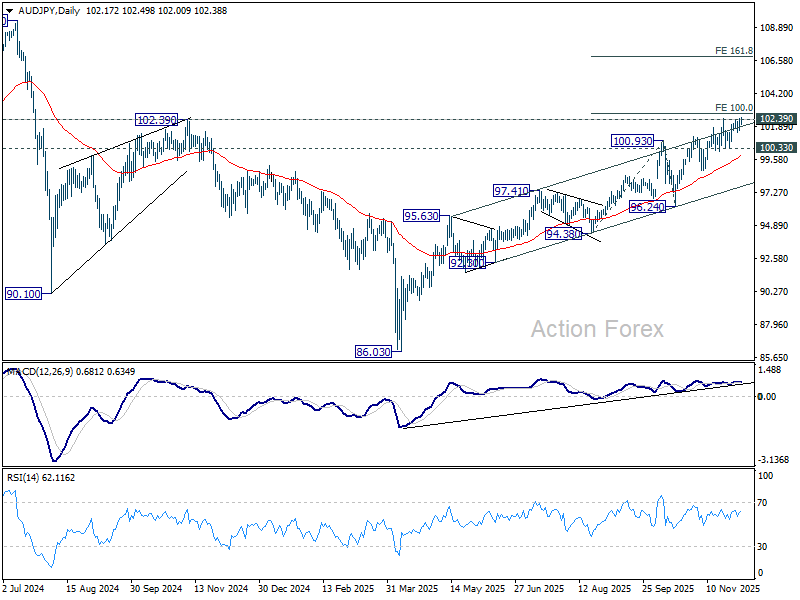
AUD/JPY is also attempting a significant breakout as it challenges a dense cluster of resistance around 102. This zone includes the medium-term rising channel ceiling and the key 102.39 structural pivot. A clean break would represent an important bullish confirmation for longer-term AUD strength.
As long as 100.33 support holds, outlook for AUD/JPY stays bullish. Decisive break above 100% Projection of 94.38 to 100.93 from 96.24 at 102.79 should trigger upside acceleration towards 161.8% projection at 106.83.
Japan PMI services holds strong at 53.2, optimism hits year high
Japan’s Services PMI was finalized at 53.2 in November, edging up from 53.1 in October. Composite PMI also improved, rising to 52.0 from 51.5. S&P Global’s Annabel Fiddes noted “a number of positive developments,” with the sector consistently driving overall activity since mid-year.
Forward-looking indicators strengthened notably. Business optimism and hiring intentions both climbed to their highest levels since early 2025. New orders also accelerated modestly, the first pickup in three months, signaling a gradual improvement in underlying demand even if the pace remains mild. However, the positive momentum was accompanied by firmer inflation pressures. Input costs rose at the fastest rate since May, prompting another solid increase in selling prices as firms sought to protect margins.
With Japan’s new stimulus package now approved—aimed at supporting growth and offsetting rising costs—markets will be watching closely to see whether demand and output continue to improve in the coming months.
China's RatingDog PMI services falls to 52.1, expansion loses pace, employment and margins under pressure
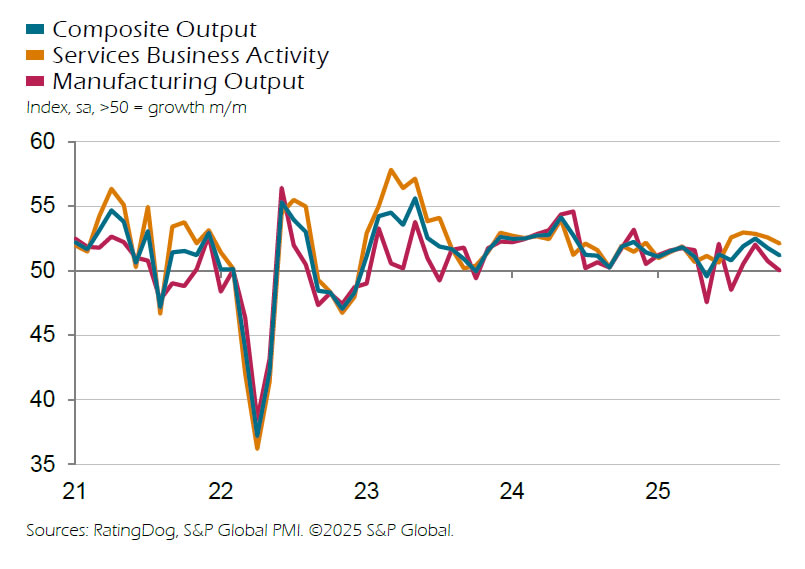
China’s RatingDog Services PMI eased in November, slipping from 52.6 to 52.1, while Composite PMI fell from 51.8 to 51.2. Both measures remained in expansionary territory, but the decline signaled moderation in growth momentum heading into year-end.
Yao Yu, Founder of RatingDog, said the services sector remained “relatively stable,” though November’s reading marked the weakest level since Q2. External demand showed mild improvement and offered “marginal support,” but domestic conditions were less encouraging.
Employment contracted again, profit margins came under pressure, and business expectations weakened—factors Yao described as the “main constraints” on the sector.
EUR/USD Daily Outlook
Daily Pivots: (S1) 1.1602; (P) 1.1615; (R1) 1.1638; More….
EIUR/USD rises slightly today but stays below 1.1655 resistance. Intraday bias remains neutral. On the upside, decisive break of 1.1655 will complete a head and should bottom pattern (ls: 1.1540, h: 1.1467, rs: 1.1490). That would argue that whole fall from 1.1917 has completed as a correction. Further rise should then be seen to 1.1727 resistance first. On the downside, though, below 1.1554 will turn bias to the downside for 1.1490 support first.
In the bigger picture, considering bearish divergence condition in D MACD, a medium term top is likely in place at 1.1917, just ahead of 1.2 key psychological level. As long as 55 W EMA (now at 1.1345) holds, the up trend from 0.9534 (2022 low) is still in favor to continue. Decisive break of 1.2000 will carry larger bullish implications. However, sustained trading below 55 W EMA will argue that rise from 0.9534 has completed as a three wave corrective bounce, and keep long term outlook bearish.
AUD/USD and AUD/JPY both eye breakouts after hawkish RBA remarks
Australian Dollar rallied sharply today after RBA Governor Michele Bullock signaled to Parliament that policymakers remain ready to tighten policy if inflation shows renewed persistence. Markets took her remarks as a clear indication that a rate hike in 2026 is possible—and that easing is firmly off the table for now. .
Soft Q3 GDP numbers briefly tempered expectations, but failed to stall Aussie’s advance. While quarterly growth undershot forecasts at 0.4% qoq, the 2.1% yoy expansion was still the strongest pace in two years, keeping concerns alive that domestic demand may be too resilient for inflation to retreat as quickly as hoped.
Markets now largely agree that rate cuts are off the table for an extended period, and a pre-emptive hike cannot be ruled out if upcoming data surprise on the upside.
Technically, AUD/USD’s break above 0.6579 reinforces that the correction from 0.6706 likely ended at 0.6420. The uptrend from the 2025 trough at 0.5913 may now be resuming, setting up a retest of 0.6706 peak. The key question is whether bullish momentum can build into that level or whether upside energy fades on approach.
AUD/JPY is also attempting a significant breakout as it challenges a dense cluster of resistance around 102. This zone includes the medium-term rising channel ceiling and the key 102.39 structural pivot. A clean break would represent an important bullish confirmation for longer-term AUD strength.
As long as 100.33 support holds, outlook for AUD/JPY stays bullish. Decisive break above 100% Projection of 94.38 to 100.93 from 96.24 at 102.79 should trigger upside acceleration towards 161.8% projection at 106.83.
China’s RatingDog PMI services falls to 52.1, expansion loses pace, employment and margins under pressure
China’s RatingDog Services PMI eased in November, slipping from 52.6 to 52.1, while Composite PMI fell from 51.8 to 51.2. Both measures remained in expansionary territory, but the decline signaled moderation in growth momentum heading into year-end.
Yao Yu, Founder of RatingDog, said the services sector remained “relatively stable,” though November’s reading marked the weakest level since Q2. External demand showed mild improvement and offered “marginal support,” but domestic conditions were less encouraging.
Employment contracted again, profit margins came under pressure, and business expectations weakened—factors Yao described as the “main constraints” on the sector.
Japan PMI services holds strong at 53.2, optimism hits year high
Japan’s Services PMI was finalized at 53.2 in November, edging up from 53.1 in October. Composite PMI also improved, rising to 52.0 from 51.5. S&P Global’s Annabel Fiddes noted “a number of positive developments,” with the sector consistently driving overall activity since mid-year.
Forward-looking indicators strengthened notably. Business optimism and hiring intentions both climbed to their highest levels since early 2025. New orders also accelerated modestly, the first pickup in three months, signaling a gradual improvement in underlying demand even if the pace remains mild. However, the positive momentum was accompanied by firmer inflation pressures. Input costs rose at the fastest rate since May, prompting another solid increase in selling prices as firms sought to protect margins.
With Japan’s new stimulus package now approved—aimed at supporting growth and offsetting rising costs—markets will be watching closely to see whether demand and output continue to improve in the coming months.
RBA’s Bullock warns inflation persistence may require renewed tightening
RBA Governor Michele Bullock told the Senate Economics Legislation Committee that the bank remains on high alert for renewed inflation pressure and is prepared to act if price gains prove "more persistent" than expected. She noted that upcoming data in the next few months will be crucial in determining whether demand pressures are easing, adding that officials may still have to pivot back toward tightening if inflation shows signs of regaining strength.
Facing questions on past budget and inflation mis-projections, Bullock conceded the RBA “hasn’t done it yet” in bringing inflation sustainably back to target, and must continue working toward that objective. She stressed that the board must “keep working on this”.
With national debt set to exceed AUD 1 trillion and a deficit of AUD 42 billion projected, she noted that lower public and private savings—if paired with unchanged investment—could "put upward pressure on the neutral rate,” she said."
But she added that that such an outcome is possible but contingent on both domestic and global forces. She emphasized that while the RBA can respond to domestic dynamics, but we don’t control global factors."