

Sample Category Title
USD/CAD Daily Outlook
Daily Pivots: (S1) 1.4078; (P) 1.4105; (R1) 1.4127; More...
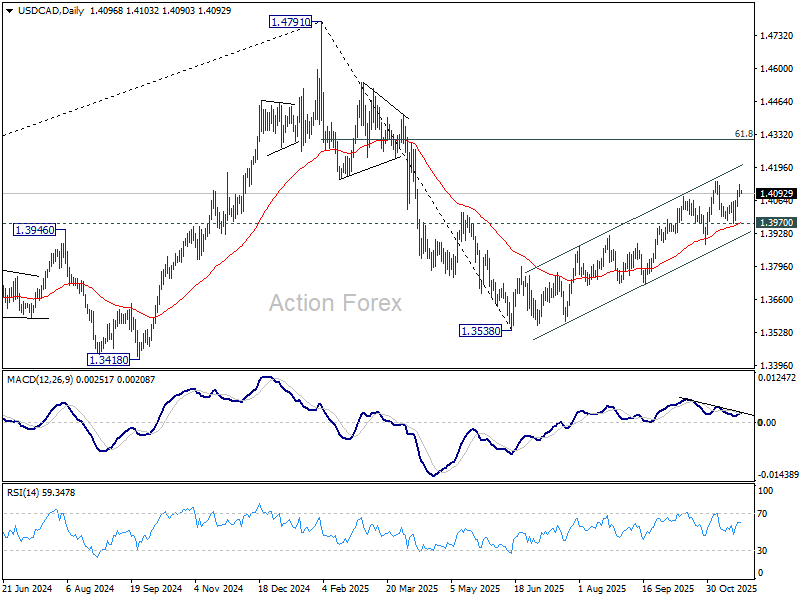
Intraday bias in USD/CAD stays neutral first. On the upside decisive break of 1.4139 will resume larger rally from 1.3538 and target 61.8% retracement of 1.4791 to 1.3538 at 1.4312. Risk will stay on the upside as long as 1.3970 support holds, in case of retreat.
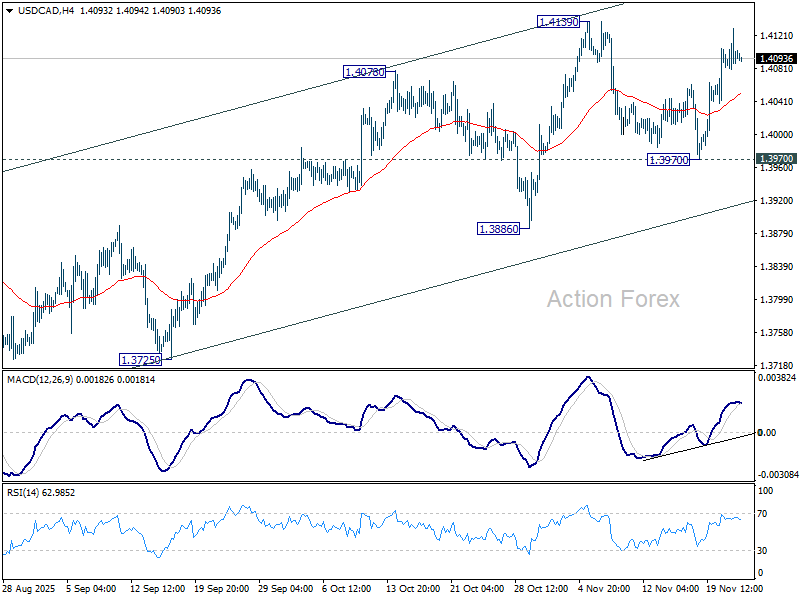
In the bigger picture, price actions from 1.4791 medium term top is likely just unfolding as a correction to up trend from 1.2005 (2021 low), with rise from 1.3538 as the second leg. A third leg should follow before up trend resumption. That is, range trading is set to extend for the medium term. For now, this will remain the favored case as long as 1.3886 support holds. However, firm break of 1.3886 will revive the case that fall from 1.4791 is indeed a larger scale correction.
EUR/CHF Daily Outlook
Daily Pivots: (S1) 0.9286; (P) 0.9299; (R1) 0.9321; More....
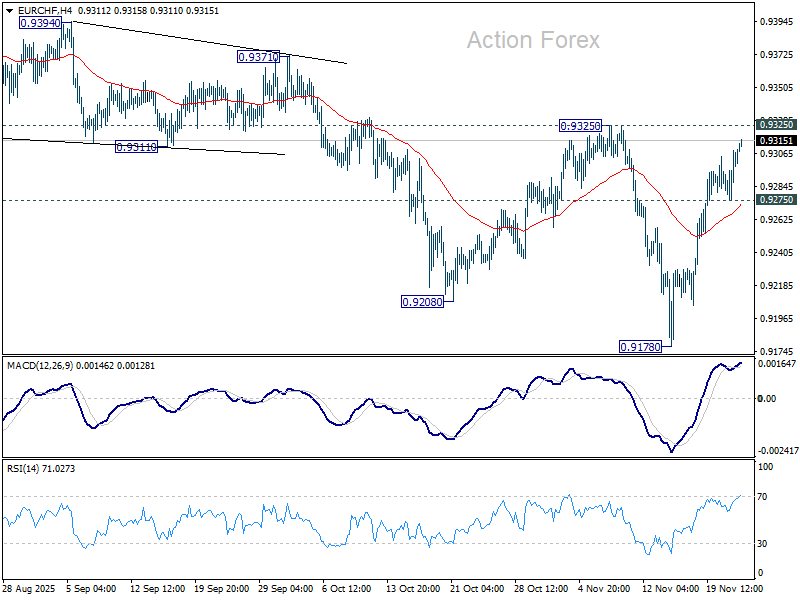
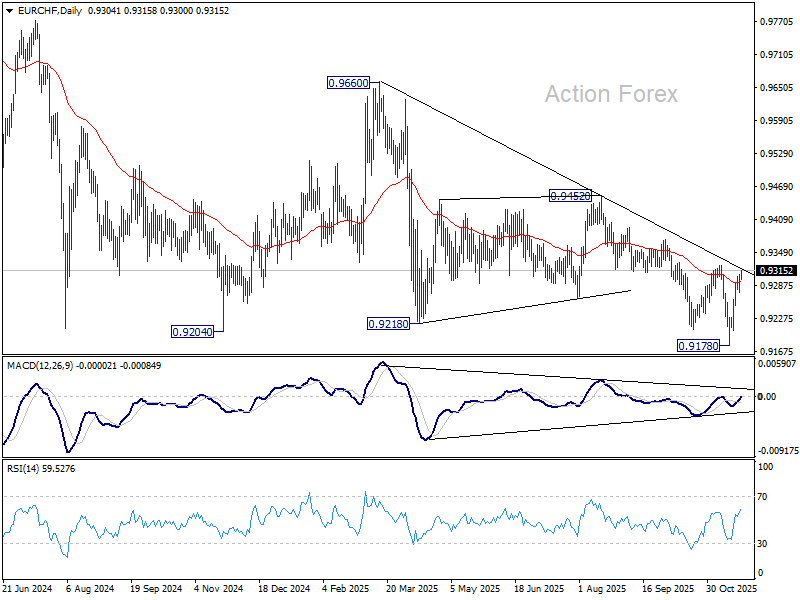
EUR/CHF's rebound from 0.9178 extends higher today and focus is now on 0.9325 resistance. Considering bullish convergence condition in D MACD, decisive break of 0.9325 will argue that whole fall from 0.9660 has completed. Strong rally should then be seen towards 0.9452 resistance. Nevertheless, rejection by 0.9325 will retain near term bearishness. Break of 0.9275 minor support will turn bias back to the downside for 0.9178 low.
In the bigger picture, outlook remains bearish with EUR/CHF staying well inside long term falling channel after multiple rejection by 55 W EMA (now at 0.9377). Next target is 61.8% projection of 1.1149 to 0.9407 from 0.9928 at 0.8851. Break of 0.9452 resistance is needed to be the first sign of medium term bottoming. Otherwise, outlook will stay bearish in case of strong rebound.
EUR/GBP Daily Outlook
Daily Pivots: (S1) 0.8770; (P) 0.8800; (R1) 0.8821; More…
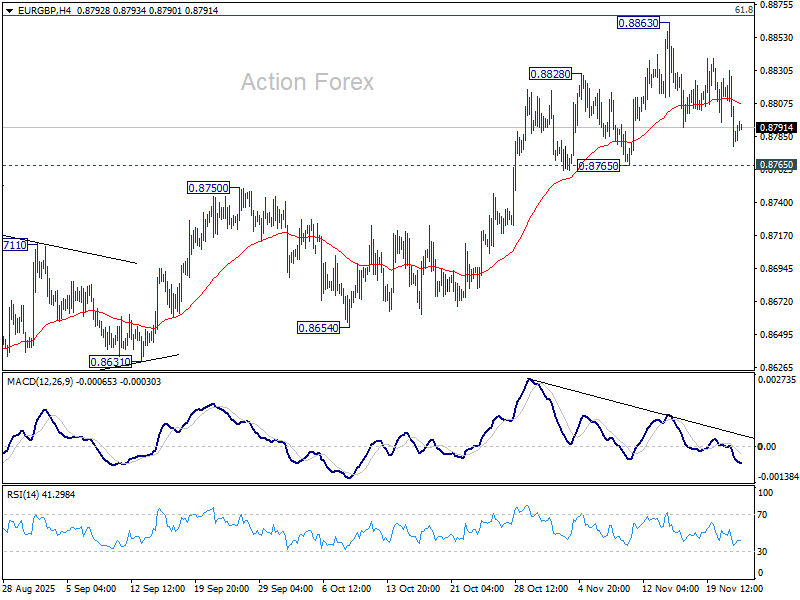
Range trading continues in EUR/GBP and intraday bias stays neutral. Considering bearish divergence condition in 4H MACD, firm break of 0.8765 support will confirm short term topping. Intraday bias will be back to the downside for 55 D EMA (now at 0.8741). Sustained break there will be an early sign of bearish trend reversal. Nevertheless, decisive break of 0.8867 fibonacci level will carry larger bullish implications.
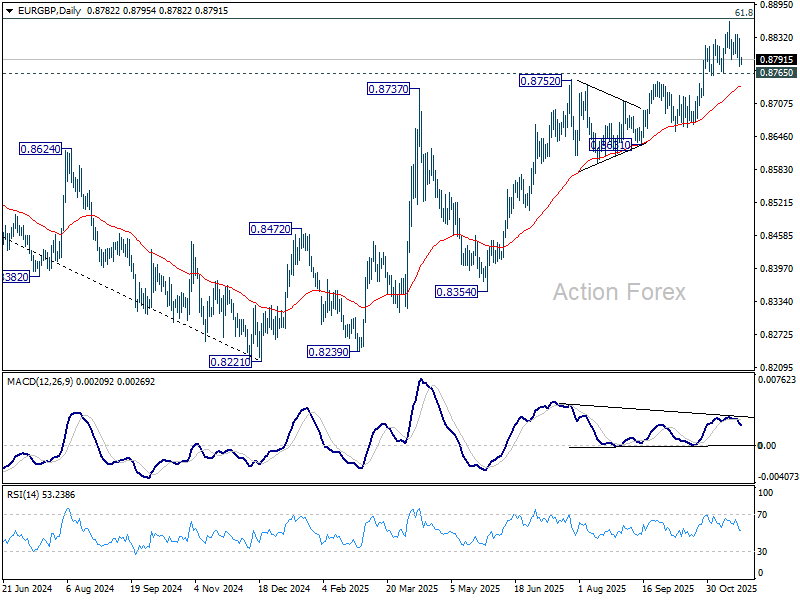
In the bigger picture, rise from 0.8221 medium term bottom is still seen as a corrective move. Upside should be limited by 61.8% retracement of 0.9267 to 0.8221 at 0.8867. Sustained trading below 55 W EMA (now at 0.8588) should confirm that this corrective bounce has completed. However, decisive break of 0.8867 will suggest that EUR/GBP is already reversing whole decline from 0.9267 (2022 high). That should pave the way back to 0.9267.
EUR/AUD Daily Outlook
Daily Pivots: (S1) 1.7784; (P) 1.7859; (R1) 1.7910; More...
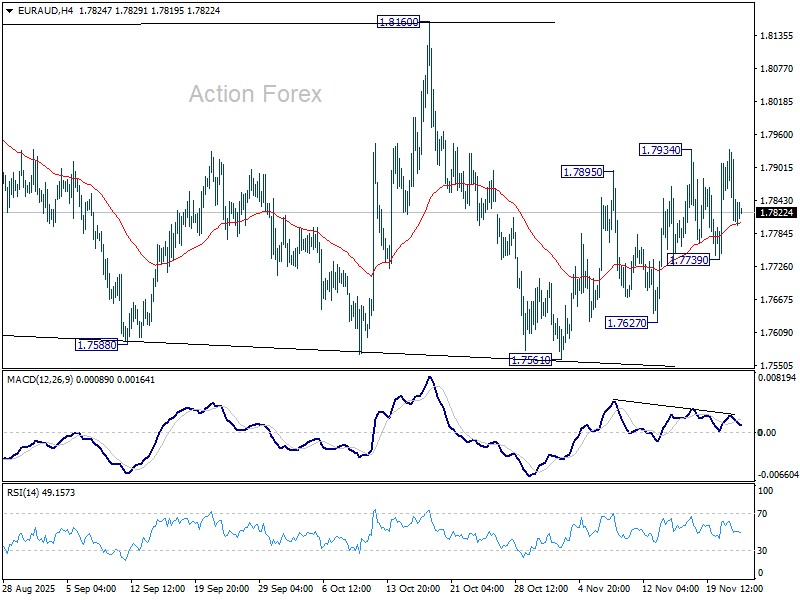
Intraday bias in EUR/AUD remains neutral for the moment. On the upside, above 1.7934 will resume the rebound from 1.7561 towards 0.8160 resistance. On the downside, however, break of 1.7739 support will argue that the rebound has completed and turn bias back to the downside for 1.756.
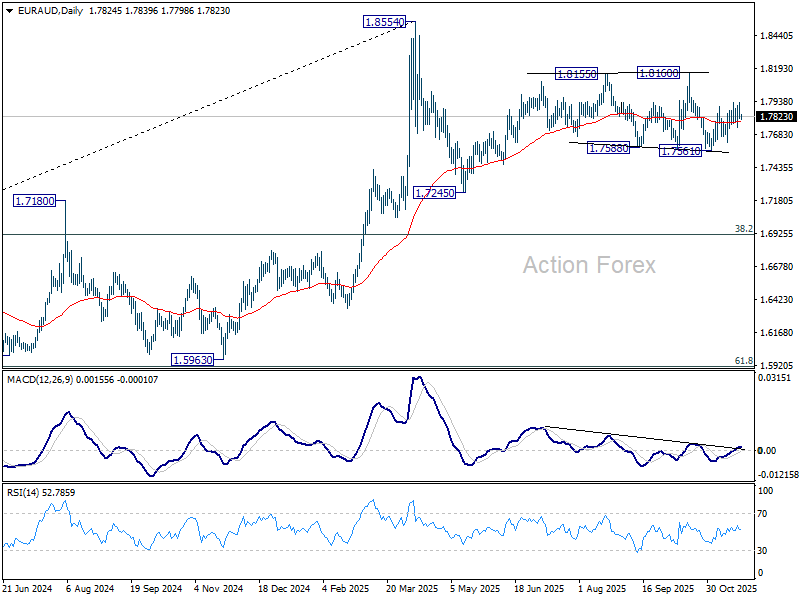
In the bigger picture, price actions from 1.8554 medium term top are seen as a corrective pattern. Sustained break of 55 W EMA (now at 1.7426) will suggest that it's correcting the whole rally from 1.4281 (2022 low). In this case, deeper decline would be seen to 38.2% retracement of 1.4281 to 1.8554 at 1.6922. Nevertheless, strong rebound from 55 W EMA will likely bring resumption of the up trend sooner.
EUR/JPY Daily Outlook
Daily Pivots: (S1) 179.36; (P) 180.51; (R1) 181.25; More...
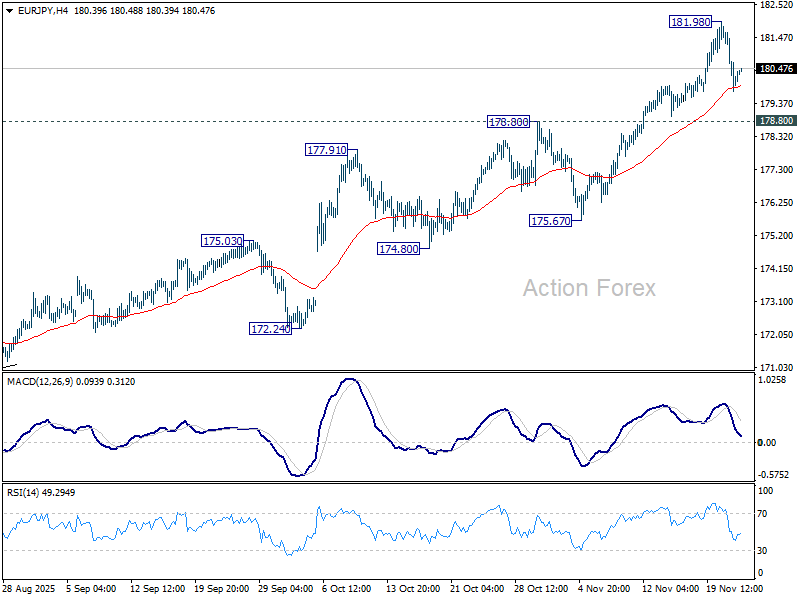
EUR/JPY recovered after hitting 55 4H EMA and outlook is unchanged. Intraday bias remains neutral and more consolidations could be seen below 181.98. Deeper retreat cannot be ruled out, but downside should be contained by 178.80 resistance turned support to bring another rally. On the upside, break of 181.98 will target 100% projection of 161.06 to 173.87 from 171.09 at 183.90 next. However, firm break of 178.80 will argue that deeper correction is already underway towards 55 D EMA (now at 176.63).
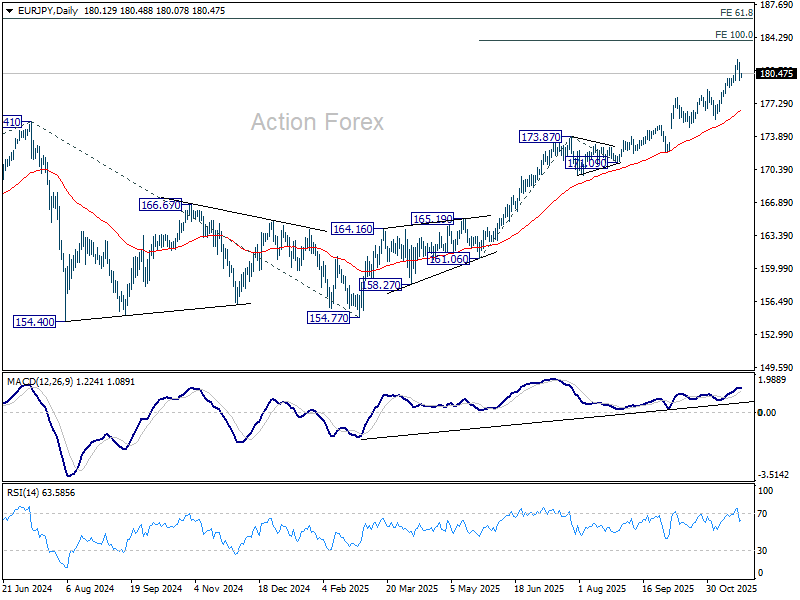
In the bigger picture, up trend from 114.42 (2020 low) is in progress and should target 61.8% projection of 124.37 to 175.41 from 154.77 at 186.31. Outlook will continue to stay bullish as long as 55 W EMA (now at 169.42) holds, even in case of deep pullback.
GBP/JPY Daily Outlook
Daily Pivots: (S1) 204.11; (P) 205.09; (R1) 205.88; More...
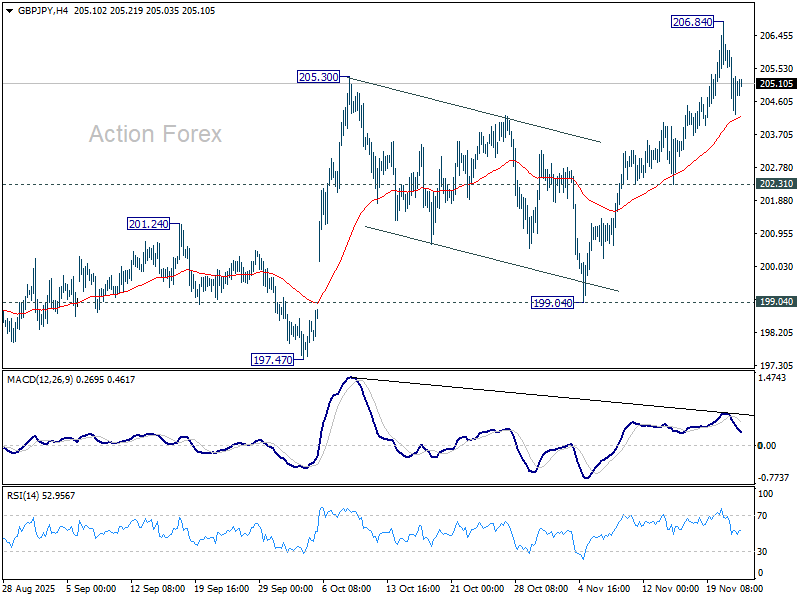
GBP/JPY recovered mildly ahead of 55 4H EMA and outlook is unchanged. Intraday bias remains neutral, and consolidations could continue below 206.84. Deeper retreat might be seen but downside be contained by 202.31 support to bring another rise. Break of 206..84 will target 208.09 high. Decisive break there will confirm long term up trend resumption.
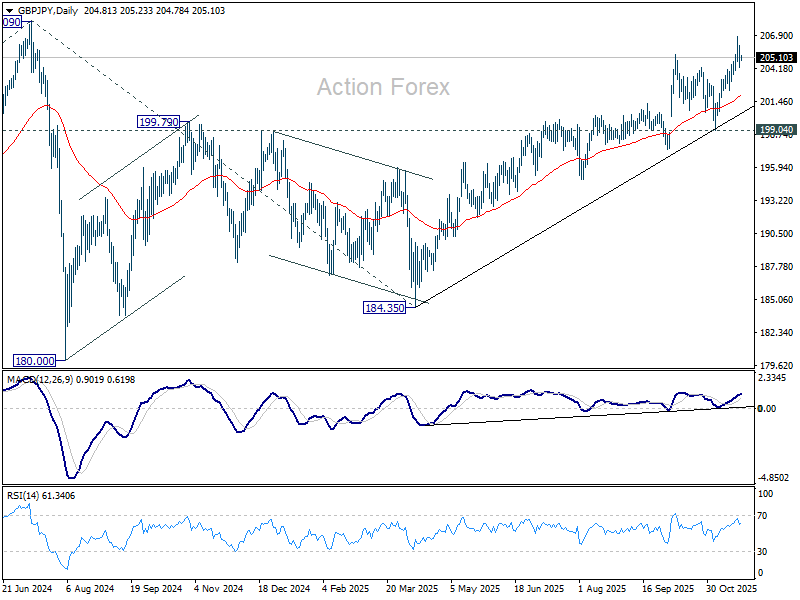
In the bigger picture, price actions from 208.09 (2024 high) are seen as a corrective pattern which might have completed at 184.35. Firm break of 208.09 high will resume the up trend from 123.94 (2020 low). Next target is 61.8% projection of 148.93 to 208.09 from 184.35 at 220.90. However, decisive break of 199.04 support will dampen this view and extend the corrective pattern with another fall.
Yen Falters After Friday Rebound; UK Budget, RBNZ Cut, U.S. Data Catch-Up
Asian trading has been subdued with Japan on holiday. Yen’s sharp rebound at the end of last week has failed to extend, with the currency losing energy amid a lack of fresh catalysts. The pause reflects an uneasy balance. While some investors expect further corrective strength, broader policy expectations continue to lean against the Yen. One of the major headwinds remains the view that BoJ could delay its next rate hike into early 2026, driven increasingly by political pressure rather than macro fundamentals.
Early signals from the next Shunto round show Rengo pushing again for 5%-plus pay hikes in 2026—mirroring the demand that produced the biggest wage increase in 34 years. While companies may not fully comply, manufacturers are already benefiting from the U.S. tariff deal and a competitive Yen. Tight labor conditions further raise the likelihood of continued wage strength.
Despite this structural wage pressure—one of BoJ’s key conditions for tightening—the government is uneasy about premature rate hikes that could undermine last week’s JPY 17.7T stimulus package. That political dimension has become increasingly influential in shaping expectations for the next move, particularly given Prime Minister Sanae Takaichi's strong approval ratings.
Looking ahead, the UK’s Autumn Budget stands out as a major test for domestic assets. Gilt markets, equities and Sterling all depend on whether Finance Minister Rachel Reeves can deliver credible fiscal consolidation while still supporting growth. A misstep could expose UK bond markets to a confidence shock. Beyond the UK, the U.S. will release more delayed data following the government reopening, and RBNZ is expected to cut rates again.
In the currency markets, Euro is currently the strongest performer, followed by Aussie and Sterling, while Yen sits at the bottom alongside Kiwi and Dollar. Swiss Franc and Loonie sit in the middle of the pack. However, these rankings are almost certain to shift as the week unfolds.
In Asia, at the time of writing, Hong Kong HSI is up 1.80%. China Shanghai SSE is down -0.10%. Singapore Strait Times is up 0.46%. Japan is on holiday.
Fed’s Collins signals hesitation on December rate cut
Boston Fed President Susan Collins signaled a clear preference for caution ahead of the December 9–10 FOMC meeting, saying she sees “reasons to be hesitant” about lowering borrowing costs again. After the 50bps of easing delivered in September and October, Collins argued on Saturday that policy is now “mildly restrictive” and appropriately calibrated to current conditions.
Collins stressed that the Fed faces a difficult balance: inflation remains above target while the job market shows visible signs of softening. She said risks exist “on both sides of the mandate,” and emphasized that more persistent weakness in employment could change her stance. “If I saw more evidence of softening and weakness, I would take that seriously,” she noted.
She also highlighted the unusually wide set of views emerging inside the Committee. “We’re in a complex period” for setting policy, Collins said, adding that a range of perspectives is healthy at a time when the economic outlook is highly uncertain.
SNB’s Schlegel says negative rates possible but bar remains high
SNB Chairman Martin Schlegel signaled over the weekend that the central bank remains willing to reintroduce negative interest rates if mid-term price stability were threatened. However, he emphasized that "the bar is high”.
Schlegel also addressed the recent deal to cut U.S. tariffs on Swiss goods to 15% from 39%, describing it as helpful but far from being a "game changer". The duties only affected roughly 4% of Swiss exports.
He said U.S. trade policy remains the biggest source of uncertainty for Swiss companies, noting that exporters will likely pause U.S.-bound shipments until the lower tariff rate is fully implemented.
RBNZ to cut 25bps, yet surprise can't be dismissed; US data catch-up continues
RBNZ is widely expected to lower OCR by another 25bps to 2.25%, extending the easing cycle to cushion the deteriorating domestic economy. But the picture is more complicated than the market-implied consensus suggests, with policymakers confronting a deeper slowdown, a long gap until the next meeting, and a looming change in leadership.
The key question is whether taking OCR to 2.25% is sufficient to stabilize activity. Even if the Committee believes this level provides adequate support, it is highly unlikely for RBNZ to shut the door on further easing given how fragile the outlook remains.
A deeper challenge is whether the Board believes another forceful step is justified. The next policy meeting is not until February—nearly three months away. That creates an unusually long gap and raises the prospect that the Bank may consider front-loading, leaving open the possibility—however slim—of a larger 50bps cut to avoid being behind the curve.
Meanwhile, this will be the final meeting overseen by acting Governor Christian Hawkesby before Anna Breman formally takes the helm on December 1. Some argue Hawkesby may prefer to “finish the job” by delivering a decisive step, clearing the decks for Breman. Others see value in holding fire and leaving major decisions to the incoming Governor.
Even if the base case remains a 25bps cut for the RBNZ, markets should brace for surprise potential.
This week’s central-bank calendar is not limited to RBNZ. ECB meeting accounts should reaffirm officials’ repeated message that inflation and policy rates are essentially in the right place, with little urgency to adjust stance again soon. Fed’s Beige Book will be scrutinised for clues on how tariffs are feeding through to pricing behavior and regional labour markets—particularly important given data release delays during the government shutdown.
On the data front, the U.S. will release a heavy slate of catch-up indicators including retail sales, PCE inflation and durable goods orders. Globally, markets will sift through Germany’s Ifo business climate, Canada and Switzerland GDP, Japan Tokyo CPI, and Australia’s monthly CPI.
Here are some highlights for the week:
- Monday: Germany Ifo business climate.
- Tuesday: Germany GDP final; US retail sales, PPI, house price index, pending home sales, consumer confidence.
- Wednesday: Japan corporate service prices; Australia monthly CPI; RBNZ rate decision; US jobless claims, durable goods orders, Chicago PMI, personal income and spending, PCE inflation, Fed's Beige Book.
- Thursday: New Zealand retail sales, ANZ business confidence; Germany Gfk consumer sentiment; Eurozone M3; ECB meeting accounts.
- Friday: Japan Tokyo CPI, industrial production, retail sales; Germany retail sales, CPI flash, unemployment; Swiss GDP, KOF economic barometer, Canada GDP.
GBP/JPY Daily Outlook
Daily Pivots: (S1) 204.11; (P) 205.09; (R1) 205.88; More...
GBP/JPY recovered mildly ahead of 55 4H EMA and outlook is unchanged. Intraday bias remains neutral, and consolidations could continue below 206.84. Deeper retreat might be seen but downside be contained by 202.31 support to bring another rise. Break of 206..84 will target 208.09 high. Decisive break there will confirm long term up trend resumption.
In the bigger picture, price actions from 208.09 (2024 high) are seen as a corrective pattern which might have completed at 184.35. Firm break of 208.09 high will resume the up trend from 123.94 (2020 low). Next target is 61.8% projection of 148.93 to 208.09 from 184.35 at 220.90. However, decisive break of 199.04 support will dampen this view and extend the corrective pattern with another fall.
EUR/USD Dips Further as Sellers Maintain Control Over Short-Term Trend
Key Highlights
- EUR/USD started a fresh decline and traded below 1.1550.
- A bearish trend line is forming with resistance at 1.1530 on the 4-hour chart.
- GBP/USD started a consolidation phase below 1.3150.
- Gold is struggling to clear the $4,100 and $4,120 resistance levels.
EUR/USD Technical Analysis
The Euro failed to continue higher above 1.1620 against the US Dollar. EUR/USD formed a short-term top and started a fresh decline below 1.1575.
Looking at the 4-hour chart, the pair settled below 1.1550, the 100 simple moving average (red, 4-hour), and the 200 simple moving average (green, 4-hour). The pair even spiked below 1.1520 and tested the 1.1490 zone.
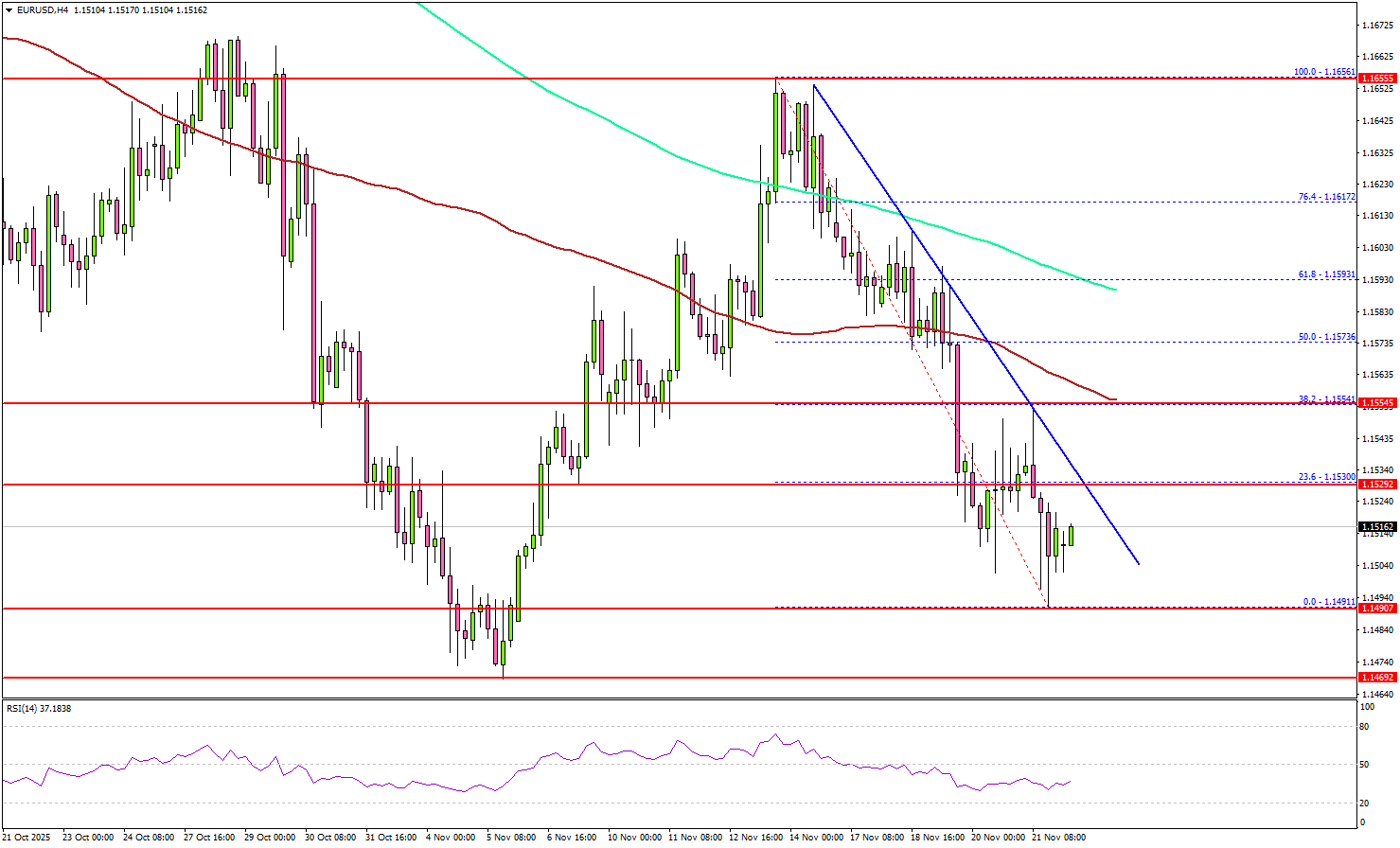
A low was formed at 1.1491 and the pair is now consolidating losses. On the upside, the pair faces resistance near the 1.1530 zone. There is also a bearish trend line forming with resistance at 1.1530.
The first key hurdle sits at 1.1550. A close above 1.1550 might send the pair higher toward 1.1620. The next resistance could be 1.1650. Any more gains could set the pace for a steady increase toward 1.1720.
On the downside, there is a key support at 1.1500. The next support is 1.1465, below which the pair could start a steady decline to 1.1420. A close below 1.1420 could start a pullback toward 1.1350.
Looking at GBP/USD, the pair failed to recover steadily and is now at risk of another decline, possibly below the 1.3050 support.
Upcoming Key Economic Events:
- ECB's President Lagarde speech
- ECB's Cipollone speech.
- ECB's Elderson speech.
SNB’s Schlegel says negative rates possible but bar remains high
SNB Chairman Martin Schlegel signaled over the weekend that the central bank remains willing to reintroduce negative interest rates if mid-term price stability were threatened. However, he emphasized that "the bar is high”.
Schlegel also addressed the recent deal to cut U.S. tariffs on Swiss goods to 15% from 39%, describing it as helpful but far from being a "game changer". The duties only affected roughly 4% of Swiss exports.
He said U.S. trade policy remains the biggest source of uncertainty for Swiss companies, noting that exporters will likely pause U.S.-bound shipments until the lower tariff rate is fully implemented.
Fed’s Collins signals hesitation on December rate cut
Boston Fed President Susan Collins signaled a clear preference for caution ahead of the December 9–10 FOMC meeting, saying she sees “reasons to be hesitant” about lowering borrowing costs again. After the 50bps of easing delivered in September and October, Collins argued on Saturday that policy is now “mildly restrictive” and appropriately calibrated to current conditions.
Collins stressed that the Fed faces a difficult balance: inflation remains above target while the job market shows visible signs of softening. She said risks exist “on both sides of the mandate,” and emphasized that more persistent weakness in employment could change her stance. “If I saw more evidence of softening and weakness, I would take that seriously,” she noted.
She also highlighted the unusually wide set of views emerging inside the Committee. “We’re in a complex period” for setting policy, Collins said, adding that a range of perspectives is healthy at a time when the economic outlook is highly uncertain.