




One BoJ member suggests gradual rate hike to above 1% neutral rate

    BoJ’s Summary of Opinions from the July 30-31 meeting reveals that board members discussed further rate hikes after implementing the second interest rate increase this year at the meeting.

    One member’s opinion stood out, suggesting that, assuming the price stability target is achieved in the second half of fiscal 2025, BoJ should raise the policy interest rate to the level of the “neutral interest rate.” This neutral rate is estimated to be “at least around 1 percent.” To avoid rapid hikes, BoJ should increase the policy interest rate in a “timely and gradual manner.”

    The consensus among members is that economic activity and prices have been developing generally “in line with the Bank’s outlook.” Consequently, it is deemed appropriate for to raise the policy interest rate and adjust the degree of monetary accommodation.

    One opinion highlighted that raising interest rates at a “moderate pace” aligns the adjustment in monetary accommodation with underlying inflation. Such moves “will not have monetary tightening effects.”

    Full BoJ summary of opinions here.

    BoC minutes reveal clear consensus for further rate cuts

      BoC’s Summary of Deliberations from its July meeting indicates a “clear consensus” on the need for more rate cuts if inflation continues to ease. With inflation “closer to target” and “downside risks” becoming “more prominent,” members agreed that it would be appropriate to “lower the policy rate further” if inflation follows the projected path.

      During the meeting, members discussed various risks to the inflation outlook. The focus was on “downside risks” more than in previous meetings. Members acknowledged that weak consumer sentiment is likely to persist, posing a risk that consumer spending could be “significantly weaker” than expected in 2025 and 2026. Additionally, further labor market weakness could “delay the rebound” in consumption, exerting “downward pressure on growth and inflation.”

      Conversely, some members highlighted the “stickiness of services price inflation,” which could keep inflation elevated. They noted that price pressures in services, which are “more closely affected by wages,” are unlikely to be offset by the disinflation seen in goods and other services in recent months.
      Full BoC Summary of Deliberations here.

      BoJ’s Uchida: To keep interest rate for the time being due to extreme global market volatility

        In a speech today, BoJ Deputy Governor Shinichi Uchida emphasized the necessity of maintaining monetary easing with the current policy interest rate “for the time being”, citing “extremely volatile” recent developments in both Japanese and global financial and capital markets. Uchida assured that BoJ is monitoring these developments with “utmost vigilance” and will adjust monetary policy as appropriate.

        Uchida reiterated that if the outlook for economic activity and prices is realized, BoJ would “continue to raise the policy interest rate.” Howeer, he noted that “significant movements in stock prices and foreign exchange rates since last week” are particularly relevant in shaping this outlook.

        Furthermore, Uchida pointed out that the recent correction in Yen’s depreciation has reduced the “upside risk to prices arising from higher import prices.” This adjustment in Yen’s value “affects the conduct of monetary policy.”

        Full speech of BoJ’s Uchida here.

        China’s exports grow 7.0% yoy in Jul, imports rises 7.2% yoy

          China’s export growth for July came in at 7.0% yoy, falling short of the expected 9.7% yoy increase. Exports to the US and EU each grew by about 8% yoy, while exports to ASEAN countries surged by 12% yoy.

          Imports, on the other hand, rose by 7.2% yoy, exceeding the expected 3.5% growth. Notably, imports from the US surged by 24% yoy, imports from ASEAN countries increased by 11% yoy, and imports from the EU climbed by 7% yoy.

          As a result, China’s trade surplus narrowed from USD 99.1B to USD 84.6B, which was smaller than the expected USD 99.2B.


          New Zealand employment grows 0.4% in Q2, above expectations

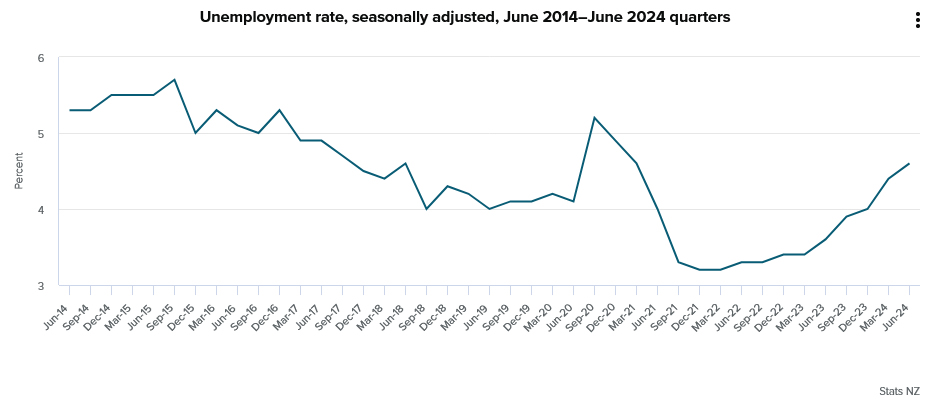
            New Zealand’s employment data for Q2 showed unexpected strength, with employment growing by 0.4%, defying expectations of a -0.3% contraction. However, the unemployment rate increased from 4.4% to 4.6%, which was still better than the anticipated 4.7%. The labor force participation rate also saw a modest rise of 0.2% to 71.7%, while the employment rate remained steady at 68.4%.

            All sector wage inflation was recorded at 1.2% qoq and 4.3% yoy. Private sector wage inflation stood at 0.9% qoq and 3.6% yoy. The public sector saw higher wage inflation at 1.8% qoq and 6.9% yoy, with the annual rate hitting a series high.

            Full NZ employment release here.

            Eurozone retail sales falls -0.3% mom in June, EU down -0.1% mom

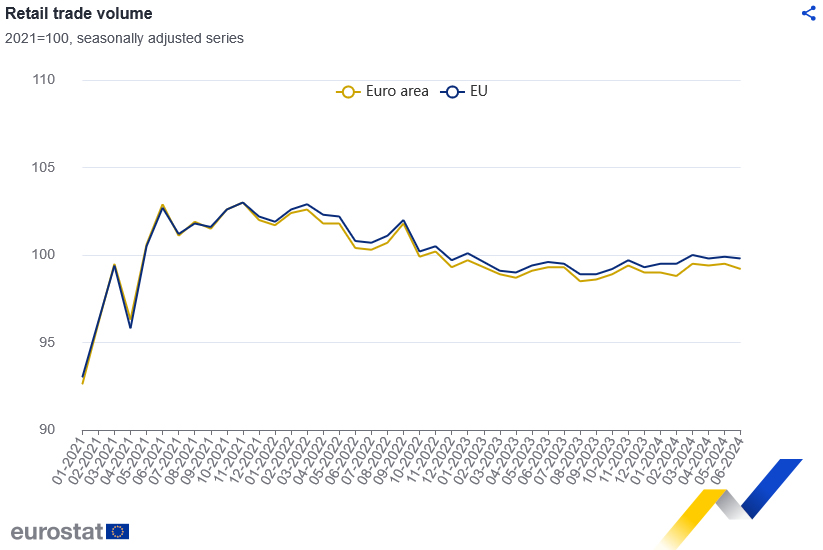
              Eurozone retail sales volume fell -0.3% mom in June, worse than expectation of -0.2% mom. Retail trade decreased for food, drinks, tobacco by -0.7%, and for non-food products (except automotive fuel) by – 0.1%. Retail trade increased increased for automotive fuel in specialised stores by 0.5%.

              EU retail sales volume fell -0.1% mom. Among Member States for which data are available, the largest monthly decreases in the total retail trade volume were recorded in Croatia (-2.7%), Austria (-2.3%), Latvia and Lithuania (both -1.7%). The highest increases were observed in Romania (+1.8%), Bulgaria (+1.4%) and Denmark (+1.0%).

              Full Eurozone retail sales release here.

              UK PMI construction jumps to 55.3, paused projects released

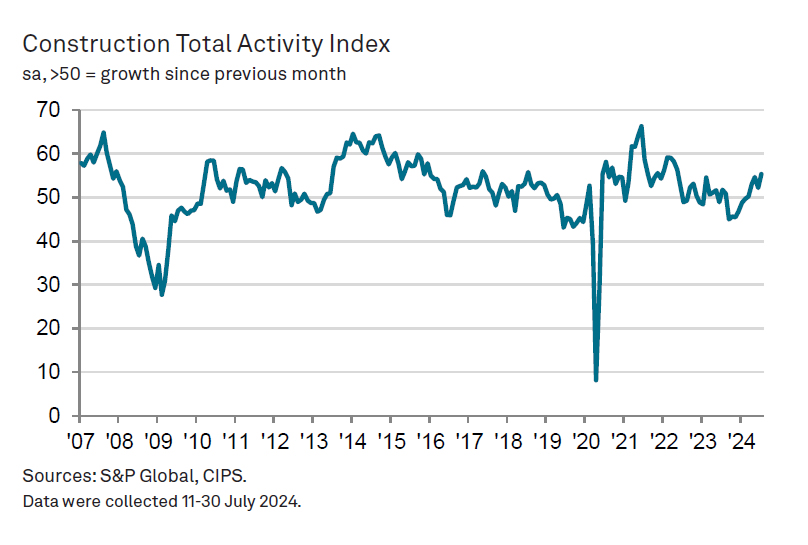
                UK PMI Construction rose from 52.2 to 55.3 in June, highest reading since May 2022. S&P Global noted that activity rose amid much faster increase in new orders. Employment increased for the third month running. Emerging pressure on supply chains signaled.

                Andrew Harker, Economics Director at S&P Global Market Intelligence, said: “The election-related slowdown in growth seen in June proved to be temporary, with the pace of expansion roaring ahead in July. Firms saw the strongest increases in new orders and activity since 2022 as paused projects were released amid reports of improved customer confidence.”

                Full UK PMI construction release here.

                RBA maintains cash rate, anticipates inflation resurgence post-mid-2025

                  RBA kept its cash rate target unchanged at 4.35%, as widely expected. Maintaining its stance of “not ruling anything in or out,” the highlighted that underlying inflation “remains too high” and stated it will be “some time yet” before inflation sustainably returns to the target range. The central bank emphasized that monetary policy will need to be “sufficiently restrictive” until the Board is confident that inflation is moving sustainably towards the target range.

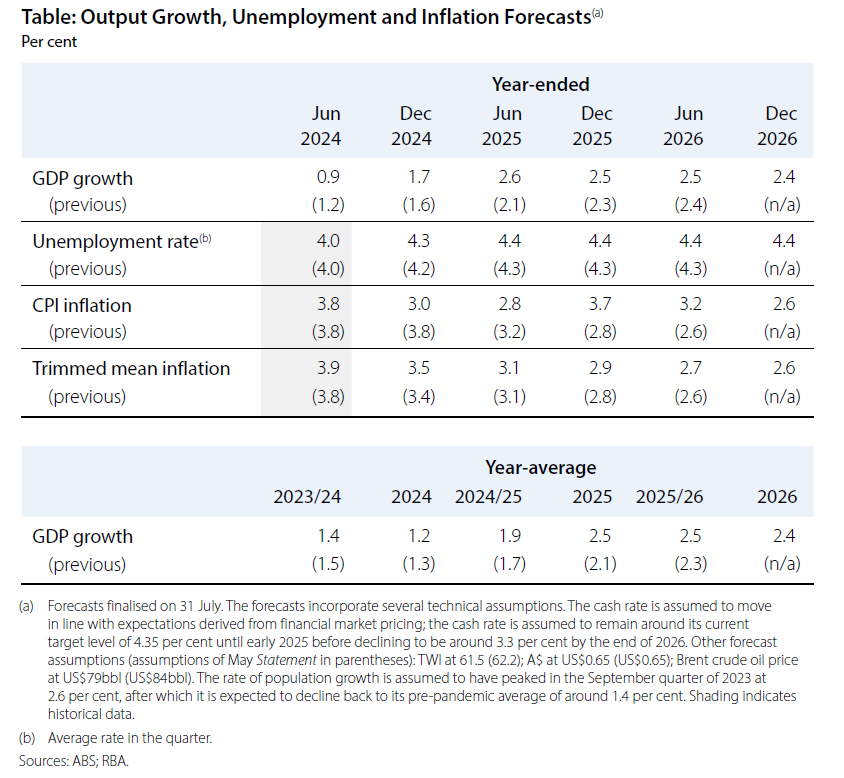
                  In its new economic projections, RBA forecasts headline inflation to briefly dip to 2.8% in June 2025, back in the target range, but expects it to surge above the target in subsequent quarters before falling back to 2.6% by the end of 2026. Meanwhile, growth projections have been generally upgraded.

                  Details of the new economic projections include:

                  CPI at:

                  • 3.0% by the end of 2024, downgraded from the prior 3.8%.
                  • 3.7% by the end of 2025, upgraded from the previous 2.8%.
                  • 2.6% by the end of 2026 (new projection).

                  Trimmed mean CPI at:

                  • 3.5% by the end of 2024, up from 3.4%.
                  • 2.9% by the end of 2025, up from 2.8%.
                  • 2.6% by the end of 2026 (new projection).

                  Year-average GDP growth in:

                  • 2024 downgraded from 1.3% to 1.2%.
                  • 2025 upgraded from 2.1% to 2.5%.
                  • 2026 projected to be 2.4% (new).

                  Unemployment rate at:

                  • 4.3% by the end of 2024, up from the prior 4.2%.
                  • 4.4% by the end of 2025, up from 4.3%.
                  • be 4.4% by the end of 2026 (new projection).


                  Full RBA statement here.

                  Full RBA SoMP here.

                  Japan’s nominal wages surge 4.5% yoy in Jun, outpacing inflation for first time in 27 months

                    Japan’s nominal wages, or average monthly cash earnings, rose by 4.5% yoy in June, significantly exceeding expectations of a 2.3% yoy increase. This marks the 30th consecutive month of wage growth. More importantly, with CPI rising 3.3% yoy in the same month, real wages increased by 1.1% yoy, marking the first gain in 27 months as wage growth finally outpaced inflation.

                    A Ministry of Health, Labor and Welfare official commented, “We will monitor incoming data closely to see if the trend has really changed as there is a possibility that those firms that paid bonuses in July might have just moved up the timing this year.”

                    Excluding bonuses and non-scheduled payments, average wages climbed 2.3% yoy, while overtime and other allowances rose by 1.3% yoy.

                    Also released, household spending in June fell by -1.4% yoy, worse than the expected -0.9% yoy decline, marking the second consecutive month of decline following a -1.8% drop yoy in May.

                    Fed’s Daly raises alarm over “real weakness” in slowing labor market

                      San Francisco Fed President Mary Daly commented in a forum overnight, stating that “we’ve now confirmed that the labor market is slowing”. She emphasized the importance of ensuring that this slowdown does not turn into a downturn.

                      However, she expressed her concern that “it’s too early to tell” whether the labor market is “slowing to a sustainable pace which allows the economy to continue to grow” or if it is approaching a point of “real weakness.”

                      Daly also mentioned that she expects interest rates to eventually come down “to preserve the balance” of full employment and price stability. However, she cautioned that she is not prepared to specify when or by how much, as she plans to review more data before the next Fed policy meeting in September.

                      Fed’s Goolsbee: Jobs data weak, but recession not imminent

                        Chicago Federal Reserve President Austan Goolsbee addressed the recent economic concerns in an interview with CNBC, noting that last Friday’s jobs numbers were “weaker than expected” but not yet indicative of a recession.

                        He emphasized the Fed’s commitment to its core mandates: “The Fed’s job is very straightforward: maximize employment, stabilize prices and maintain financial stability. That’s what we’re going to do.”

                        Goolsbee highlighted the Fed’s forward-looking approach, stating, “If the conditions collectively start coming in like that on the through line, there’s deterioration on any of those parts, we’re going to fix it.”

                        US ISM services rises to 51.4, corresponds to 0.8% annualized GDP growth

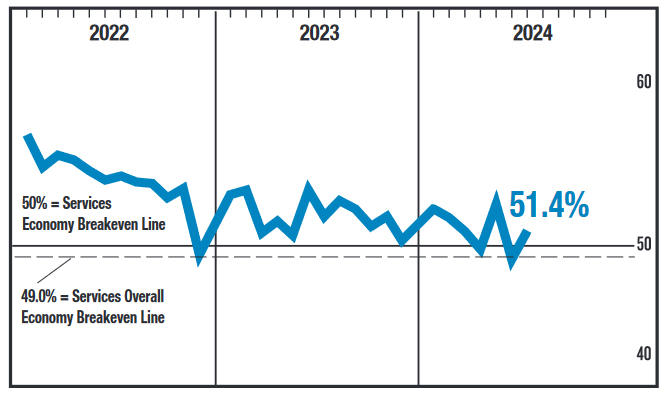
                          US ISM Services PMI rose from 48.8 to 51.4 in July, matched expectations. Looking at some details, business activity/production rose from 49.6 to 54.5. New orders rose from 47.3 to 52.4. Employment jumped from 46.1 to 51.1. Prices rose from 56.3 to 57.0.

                          ISM said: “The past relationship between the Services PMI® and the overall economy indicates that the Services PMI® for July (51.4 percent) corresponds to a 0.8-percentage point increase in real gross domestic product (GDP) on an annualized basis.”

                          Full ISM services release here.

                          Eurozone PPI at 0.5% mom, -3.2% yoy in Jun

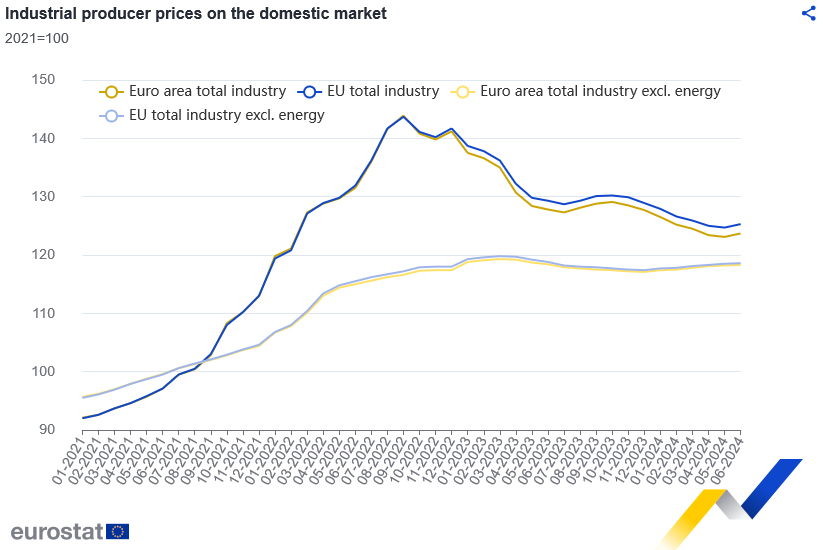
                            Eurozone PPI rose 0.5% mom in June, but down -3.2% yoy, comparing to expectation of 0.3% mom, -3.2% yoy. For the month. Industrial producer prices increased by 0.1% for intermediate goods,1.6% for energy, 0.1% for capital goods, and 0.1% for non-durable consumer goods. Prices remained stable for durable consumer goods

                            EU PPI was up 0.5% mom, down -3.1% yoy. The highest monthly increases in industrial producer prices were recorded in Estonia (+2.2%), Spain and Romania (both +1.9%) and Greece (+1.8%). The largest decreases were observed in Bulgaria (-1.0%), Czechia, France and Finland (each -0.3%).

                            Full Eurozone PPI release here.

                            Eurozone Sentix falls to -13.8, ECB under pressure to cut further and faster

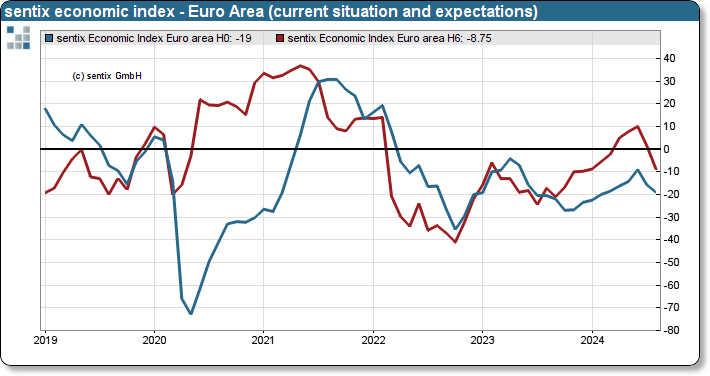
                              Eurozone Sentix Investor Confidence fell sharply from -7.3 to -13.8 in August, marking its lowest level since January. Current Situation Index dropped from -15.8 to -19.0, the lowest since February, while Expectations Index declined from 1.5 to -8.8, the lowest since last December.

                              Globally, Sentix Investor Confidence Index also tumbled, falling from 5.9 to -1.5, its lowest level since December. Current Situation Index decreased from 6.0 to -0.6, the lowest since January, and Expectations Index dropped from 5.7 to -2.4, the lowest since November.

                              Sentix commented on the data, stating that “Following the severe setback of the ‘first mover’ in the previous month, there is now another, more pronounced economic slump in August. The global recovery comes to a halt.”

                              They added that the economic downturn in Eurozone should put ECB under pressure to “cut interest rates further and faster”. Investors are now expecting ECB to address the economic weakness more aggressively, even though the Sentix Inflation Barometer is not indicating any sustained easing in the inflation environment.

                              Full Eurozone Sentix release here.

                              UK PMI services finalized at 52.5, composite at 52.8

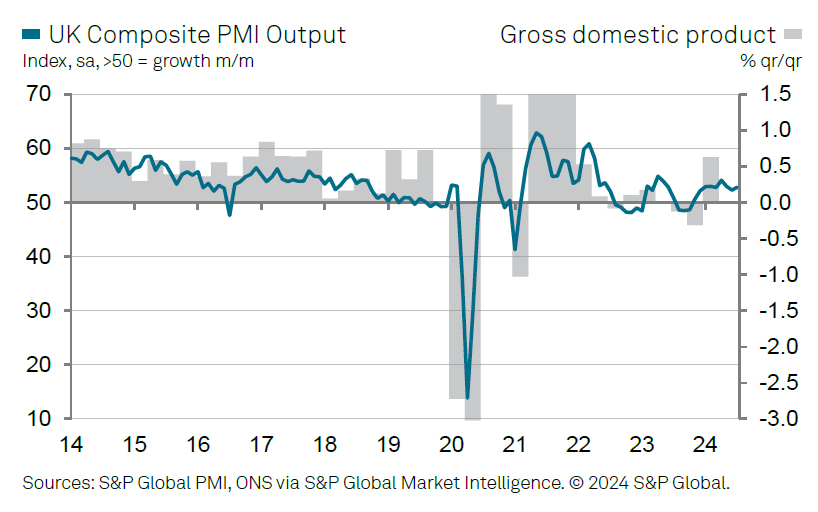
                                UK PMI Services was finalized at 52.5 in July, up from June’s 52.1. PMI Composite was finalized at 52.8, up from June’s 52.3.

                                Joe Hayes, Principal Economist at S&P Global Market Intelligence, noted that the UK service sector saw a “modest rebound” following a subdued end to Q2. Business Activity Index saw a slight uptick, but New Business Index jumped by over three points to its highest level in 14 months, reflecting an influx of new clients and contracts. Hayes pointed out that the accelerated expansion in sales activity indicates improved business and consumer confidence, suggesting a positive outlook for GDP growth in Q3.

                                Hayes highlighted ongoing issues with “sluggish progress on inflation.” While price pressures on input costs and output prices are at their lowest since early 2021, the respective PMIs remain above pre-pandemic levels. These benchmarks are critical for BoE to hit before it can declare success in combating inflation.

                                Full UK PMI services final release here.

                                Eurozone PMI composite finalized at 50.2, growing at snail’s pace

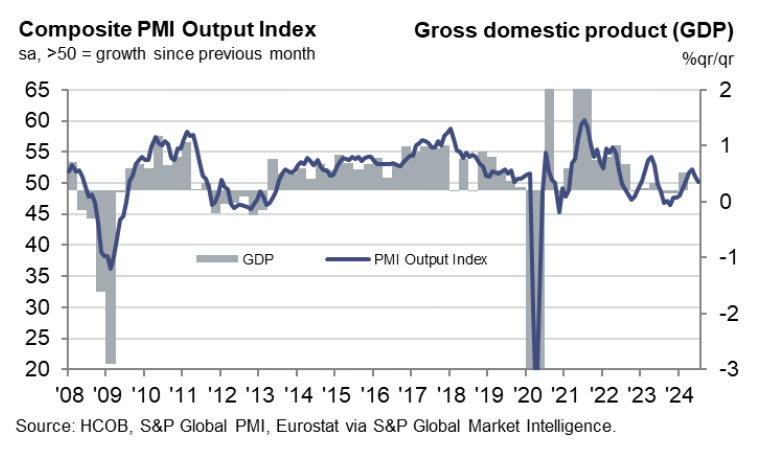
                                  Eurozone PMI Services was finalized at 51.9 in July, down from June’s 52.8, a 4-month low. PMI Composite was finalized at 50.2, down from June’s 50.9, a 5-month low. These figures indicate a slowing economy as the services sector loses momentum and the industrial sector continues its decline.

                                  Cyrus de la Rubia, Chief Economist at Hamburg Commercial Bank, stated, “The eurozone’s economy is growing at a snail’s pace.” He noted that while the services sector isn’t picking up speed as it did earlier in the year, the industrial slump persists. The HCOB Composite Output PMI barely stays above the expansion line, signaling a weak start to H2 despite surprisingly strong economic growth in the second quarter. De la Rubia added, “Given this situation, our 0.7% growth forecast for the year is still conservative.”

                                  Inflation remains a significant concern. Although sales prices are increasing at their slowest rate in 38 months and input costs are generally following suit, inflation is still high relative to the weak economy. Historically, when PMI activity index was at 52.0 or lower, selling prices typically stayed flat, and input prices rose much more slowly than they are now. De la Rubia attributes this to wage pressure caused by demographic shifts, which complicates ECB’s efforts to achieve its 2% inflation target.

                                  Full Eurozone PMI services final release here.

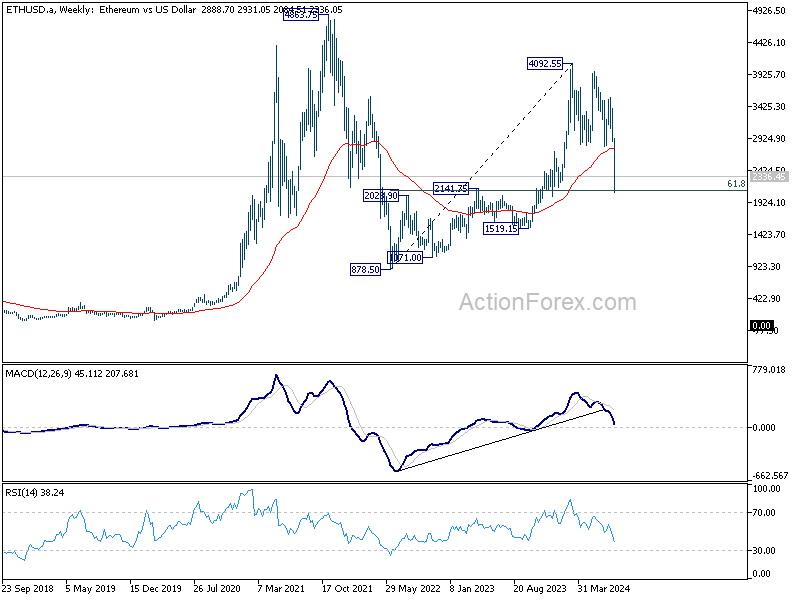
                                  Ethereum may find temporary support at 2100 after freefall, but threat lingers below 2800

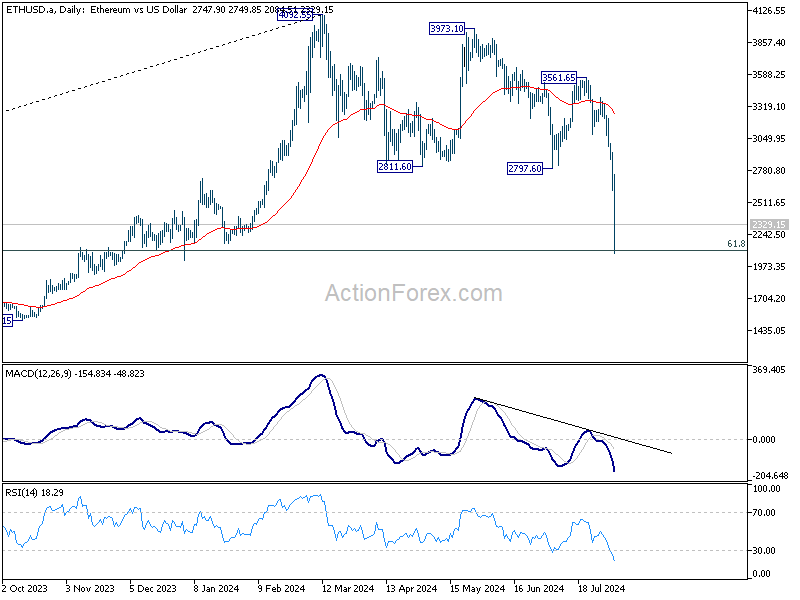
                                    Ethereum has taken a severe hit in the past few days, plunging over 20% since Friday as the global market downturn extends its reach into the cryptocurrency space. This steep decline is fueled by a combination of broad-based risk aversion and specific pressures within the crypto market. Notably, Jump Crypto has been liquidating approximately USD 300m from a single wallet over the past two weeks, exacerbating the sell-off.

                                    ETH is clearly reversing whole up trend from 878.50 (2022 low). Technically, there is prospect for a bounce at current levels, which is close to 61.8% retracement of 878.50 to 4092.55 at 2106.26, to bring near term consolidations. But risk will stay on the downside as long as 2797.60 support turned resistance holds. Sustained break of 2106.26 will pave the way to 1519.15 support next.

                                    In summary, while Ethereum may find some temporary support around 2100 level, the overall risk remains skewed to the downside as long as it remains below 2800 resistance.

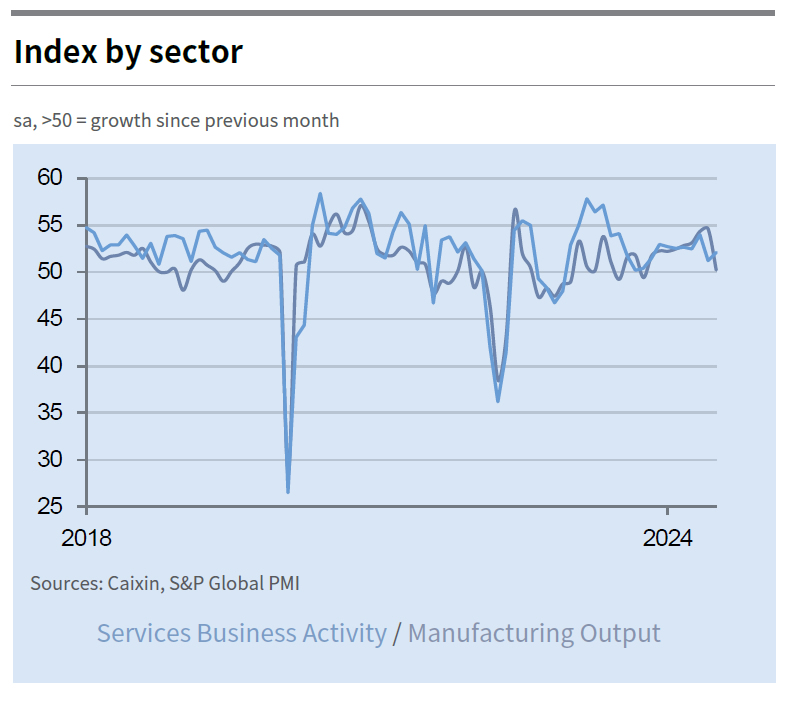
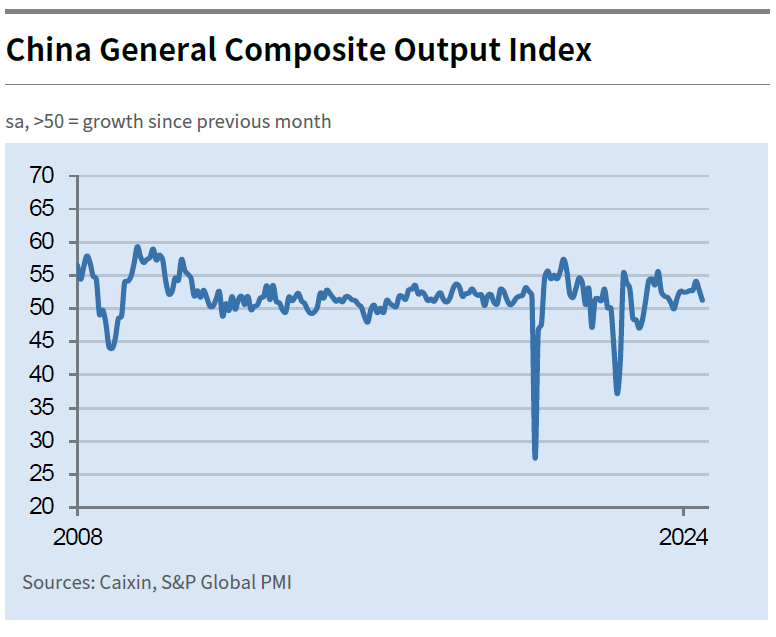
                                    China’s Caixin PMI services rises to 52.1, composite falls to 51.2

                                      China’s Caixin PMI Services increased from 51.2 to 52.1 in July, surpassing the expected 51.4 and remaining in expansionary territory for the 19th consecutive month. Meanwhile, PMI Composite fell from 52.8 to 51.2, but still marking the ninth consecutive month of expansion.

                                      Wang Zhe, Senior Economist at Caixin Insight Group, noted that while the services sector saw improvement, manufacturing faced greater pressure. “The former outperformed the latter in terms of supply, demand and employment,” Wang said. Despite this, composite prices remained weak, especially on the sales front, which further squeezed company profit margins. Market optimism improved, although it remained at a low level.

                                      The latest data revealed that China’s real GDP growth in Q2 slowed to 4.7% yoy, significantly lower than market expectations. This slowdown suggests that it will be challenging for the country to meet its annual growth target of around 5%. Wang said the primary issues remain insufficient effective domestic demand and weak market optimism.

                                      Full China Caixin PMI services release here.

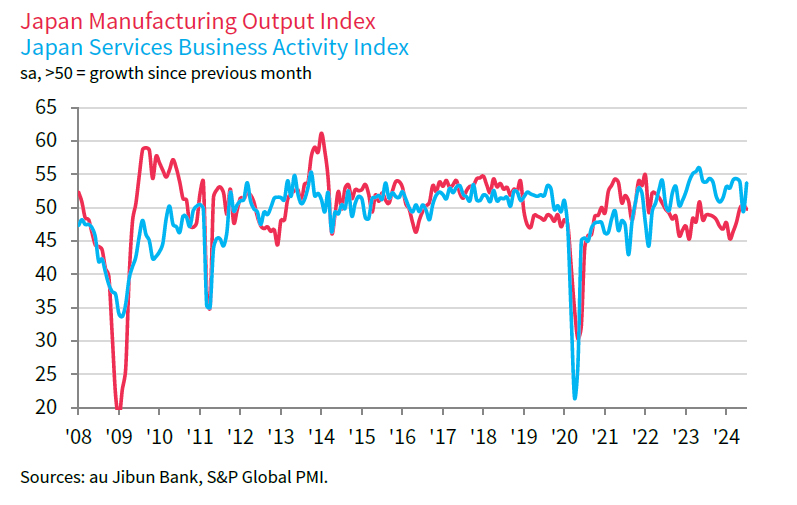
                                      Japan’s PMI services finalized at 53.7, concerns on sustained inflationary pressure

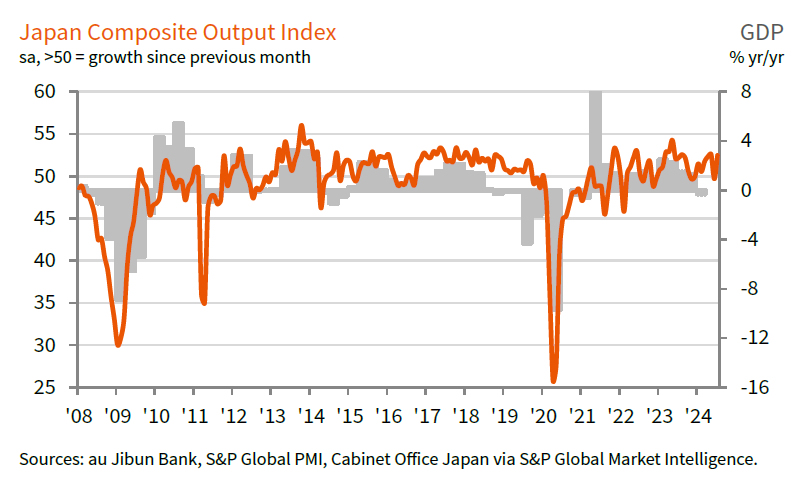
                                        Japan’s PMI Services was finalized at 53.7 in July, up from June’s 49.4. PMI Composite was finalized at 52.5, up from June’s 49.7.

                                        Usamah Bhatti, Economist at S&P Global Market Intelligence, highlighted a “renewed upswing” in the services sector at the start of Q3, driven by “improved demand conditions and stronger customer numbers.” This growth was largely domestic, as new export business declined for the first time this year. The outlook for the service sector remains positive, with outstanding business levels increasing and strong confidence in the 12-month outlook.

                                        While the combined output of the manufacturing and services sectors expanded at a “moderate pace,” the growth was primarily driven by the service sector, with manufacturing experiencing a slight contraction. Private sector companies reported that input price inflation remained “stubbornly high,” affecting total output. There are concerns that “sustained inflationary pressure” could pose a downside risk to the economy in the coming months.

                                        Full Japan PMI services final release here.

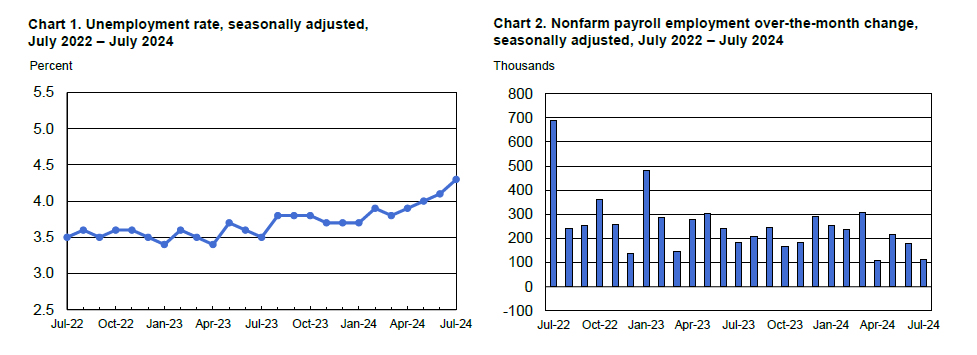
                                        US non-farm payrolls grow 114k in Jul, unemployment rate rises to 4.3%

                                          US non-farm payroll employment grew only 114k in July, well below expectation of 176k. That’s all well below average monthly gain of 215k over the prior 12 months.

                                          Unemployment rate jumped from 4.1% to 4.3%, above expectation of 4.1%. Participation rate ticked up by 0.1% to 62.7%.

                                          Average hourly earnings rose 0.2% mom, below expectation of 0.3% mom. Annual wages growth slowed from 3.8% yoy to 3.6% yoy, below expectation of 3.7% yoy.

                                          Full US non-farm payroll release here.