




NZ employment grow 0.1% in Q1, wages growth cool

    New Zealand’s employment grew just 0.1% qoq as expected, while the unemployment rate held steady at 5.1%, better than forecast of 5.3%.

    However, the quality of employment deteriorated, with a notable shift from full-time to part-time roles. Over the year, full-time employment dropped by -45k while part-time roles increased by 25k.

    Participation rate edged down to 70.8% and the employment rate slipped to 67.2%, both suggesting a gradual loss in labor market momentum.

    Wage growth also moderated, with the labour cost index rising 2.9% annually, down from 3.3% in the previous quarter.

    Full NZ employment release here.

    Japan’s PMI composite finalized at 51.2, input inflation jumps to 2-year high

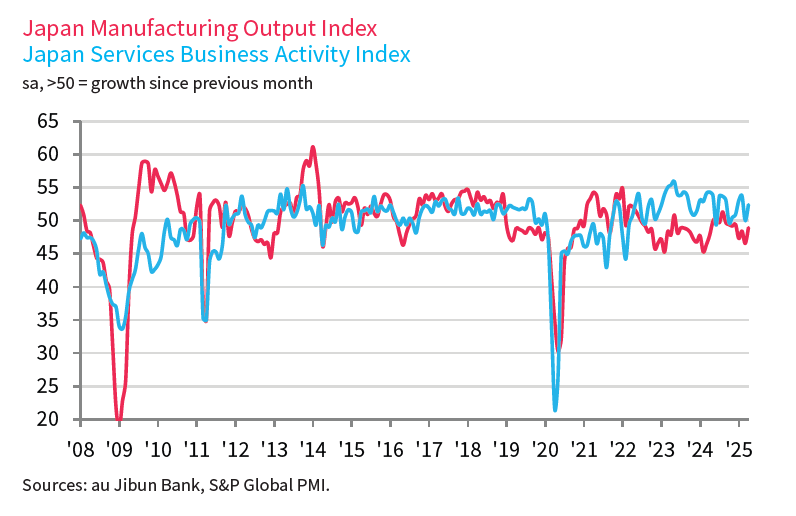
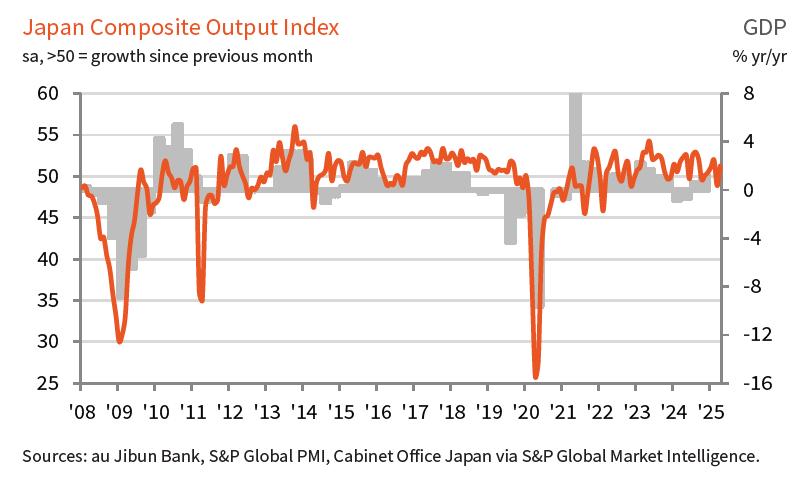
      Japan’s private sector returned to expansion in April, as the final PMI Composite rose to 51.2 from March’s 48.9. The improvement was driven entirely by the services sector, with its PMI climbing to 52.4, while manufacturing remained in contraction.

      According to S&P Global’s Annabel Fiddes, stronger services activity helped offset the drag from factories, where new orders fell sharply in response to the global tariff environment.

      While services firms reported stronger demand, confidence among both services and manufacturing sectors deteriorated. Businesses expressed concern about the broader global outlook and the negative implications of recent US tariff moves on growth potential.

      Adding to the pressure, input price inflation accelerated to a two-year high, prompting firms to raise selling prices to protect margins.
      Full Japan PMI services final release here.

      SNB’ Schlegel signals willingness to revisit negative rates

        SNB Chairman Martin Schlegel said that while the central bank does not favor negative interest rates, it remains fully prepared to reintroduce them if necessary.

        Speaking at an event today, Schlegel said “if we have to do it, the negative interest rates, we’re certainly prepared to do it again”.

        “For the last couple of quarters, we have always said we are ready to intervene in the forex market if it’s necessary,” Schlegel said.

        The comments come just a day after Swiss CPI data revealed that inflation slowed to 0% in April — the lowest reading in four years. The data has triggered market expectations that SNB will cut its policy rate from the current 0.25% at its upcoming meeting on June 19. Expectations are also mounting that rates could eventually fall back below zero this year.


        Eurozone PPI falls -1.6% mom in March on steep energy decline

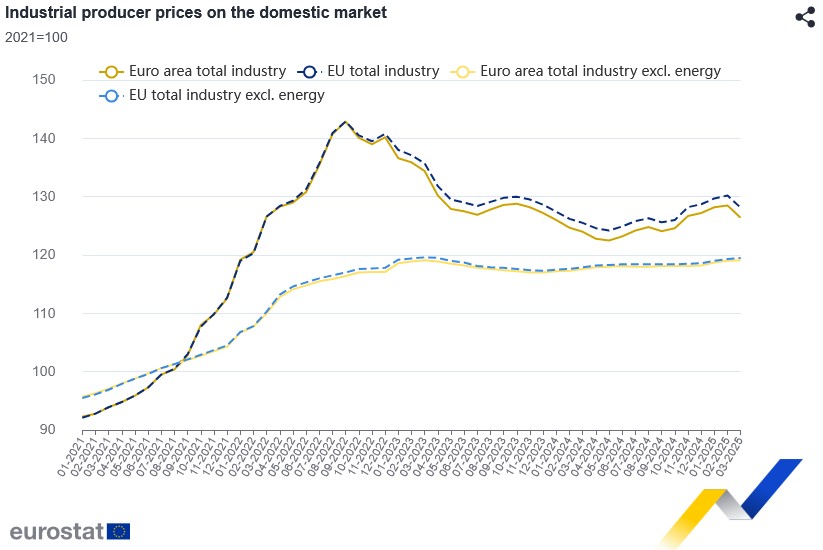
          Eurozone PPI fell -1.6% mom in March, dragged down by a steep -5.8% mom drop in energy costs. Excluding energy, however, PPI ticked up 0.1% mom. Annually, PPI stood at 1.9% yoy, down from prior month’s 3.0% yoy.

          Modest monthly gains was seen across most segments — 0.1% mom for capital goods, 0.2% mom for durable consumer goods, and 0.5% mom for non-durable goods. Intermediate goods were unchanged.

          In the broader EU, PPI also fell -1.6% m/m and rose 2.1% yoy. The largest monthly decreases in industrial producer prices were recorded in Estonia (-8.0%), Spain (-3.9%) and Italy (-3.3%). The highest increases were observed in Greece (+1.3%), Luxembourg (+0.9%) and Slovenia (+0.6%).

          Full Eurozone PPI release here.

          UK PMI services finalized at 49.0, tariffs and wage costs hit outlook

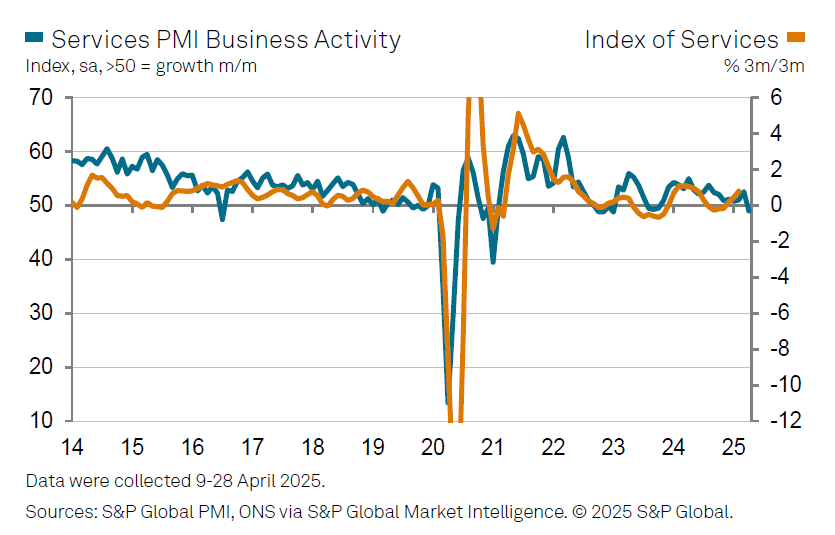
            UK PMI Services was finalized at 49.0 in April, down from 52.5 in March, its lowest level since January 2023. PMI Composite also dropped into contraction at 48.5, marking the first negative reading in 18 months.

            S&P Global’s Tim Moore pointed to heightened business uncertainty as a major drag on activity. Export conditions were the weakest since early 2021. Rising payroll costs linked to National Insurance hikes and increased National Living Wage rates contributed to the sharpest input cost growth since mid-2023. Service providers responded with their steepest price increases in nearly two years.

            Business confidence deteriorated significantly as “service sector firms braced for an extended period of global economic turbulence and heightened recession risks.” 22% of firms forecasted a decline in activity over the next 12 months—more than triple the level seen after the 2024 general election.

            Full UK PMI services final release here.

            Eurozone PMI services finalized at 50.1, cost pressure easing, hiring hesitant

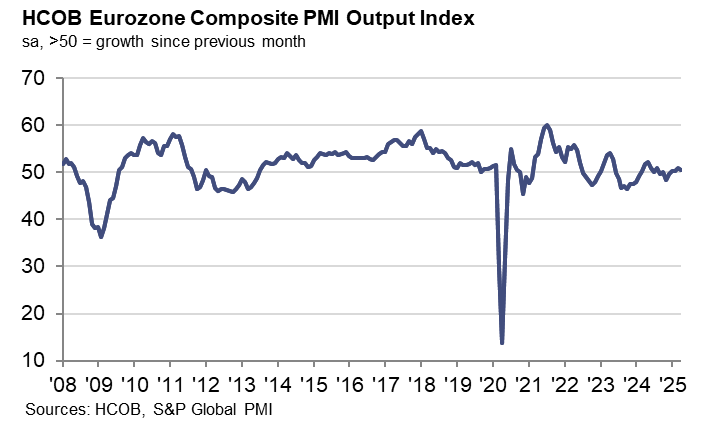
              Eurozone’s PMI Composite was finalized at 50.4 in April, down from 50.9 in March, confirming a sluggish start to Q2. The services sector, a critical growth engine, nearly stalled with a reading of 50.1, down from 51.0.

              Nationally, Ireland (54.0) led the bloc in growth, followed by Spain (52.5) and Italy (52.1). Germany (50.1) was in slight expansion, while France (47.8) fell deeper into contraction territory.

              Cyrus de la Rubia of Hamburg Commercial Bank noted that cost pressures in services remain “relatively high”, but easing price trends are adding weight to expectations for an ECB rate cut in June.

              Employment growth across the Eurozone has stabilized, though businesses remain hesitant to expand their workforce amid continued uncertainty.

              Country-level divergence is also growing more apparent. Germany’s growth is fragile but could improve in coming months, supported by its new fiscal stimulus measures.

              Full Eurozone PMI Services final release here.

              Gold breaks higher, eyes on 3500 and beyond

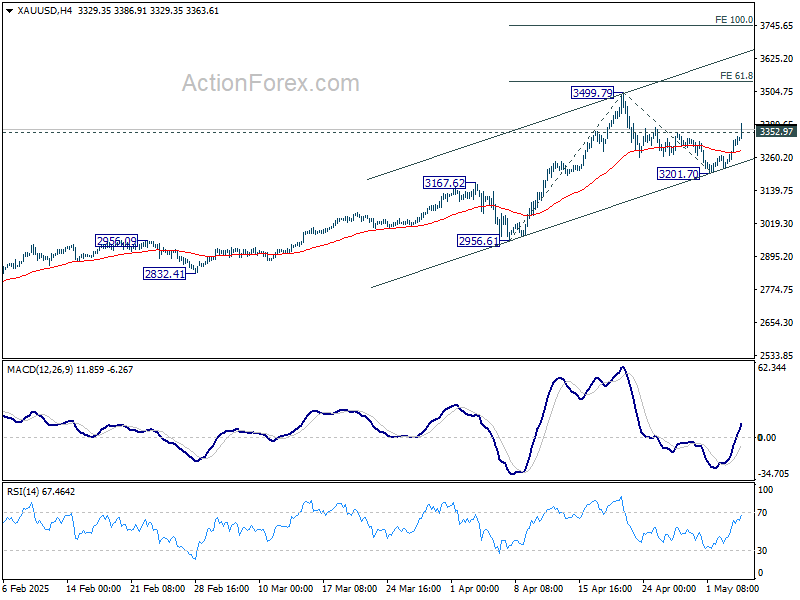
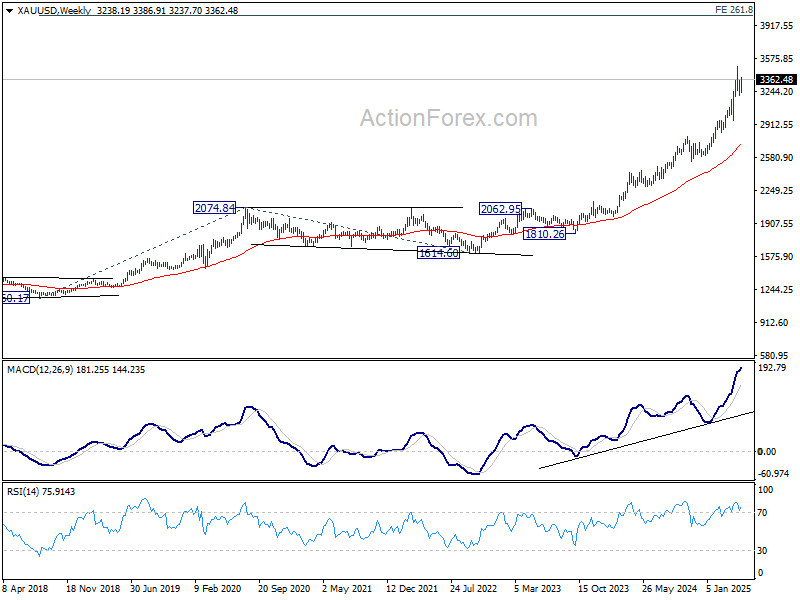
                Gold’s extended rebound and break of 3352.97 resistance argues that correction from 3449.79 has already completed at 3201.70. Further rise is now expected to 3499.79 and then 61.8% projection of 2956.61 to 3449.70 from 3201.70 at 3537.38. Decisive break of 3537.38 could prompt upside acceleration towards 100% projection at 3744.88. However, break of 55 4H EMA (now at 3287.46) will resume the corrective fall from 3499.79 with another downleg.

                In the bigger picture, the long term up trend remains intact and there is no sign of loss of momentum in W MACD, despite overbought condition in W RSI. Next medium term target remains at 261.8% projection of 1160.17 to 2074.84 from 1614.60 at 4009.20, which is close to 4000 psychological level.

                China’s Caixin PMI composite falls to 51.1, tariff impact to deepen in Q2–Q3

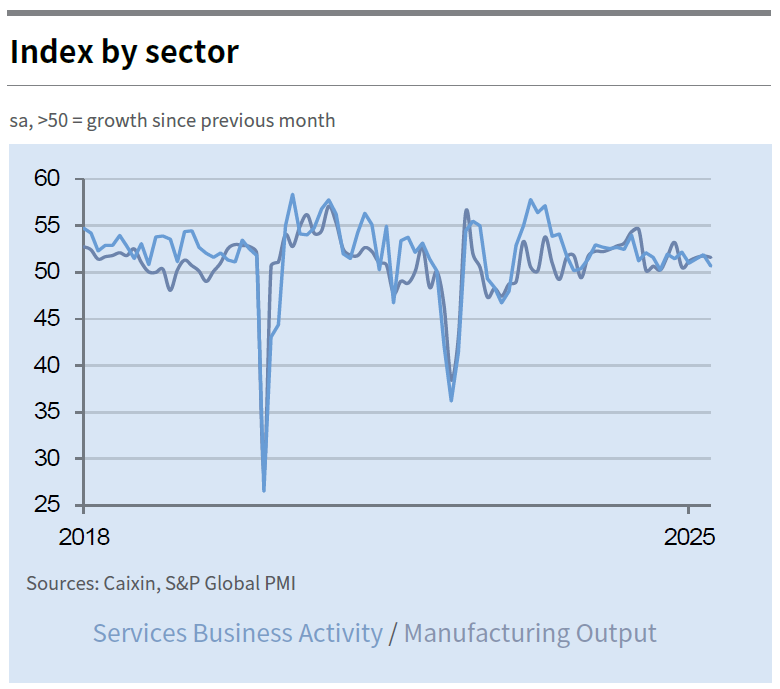
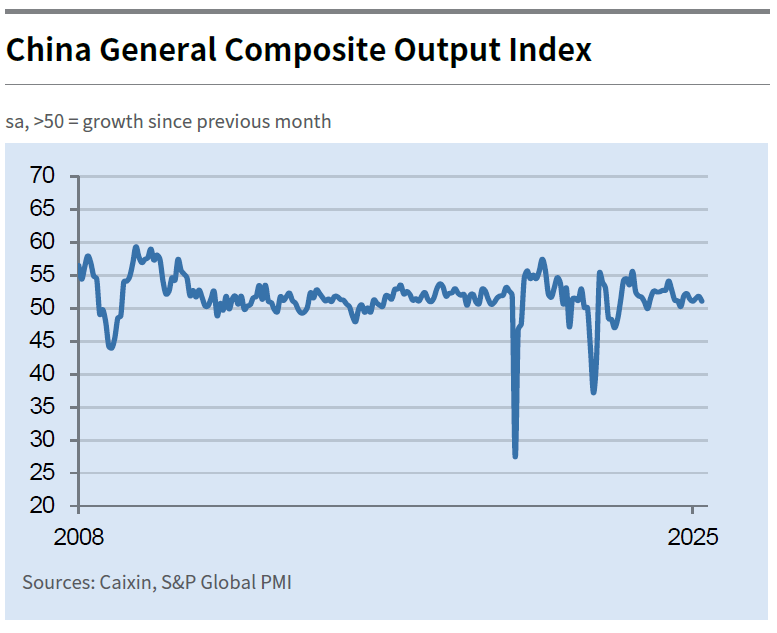
                  China’s Caixin PMI Services dropped to 50.7 in April, down from 51.9 and missing expectations of 51.7. PMI Composite also slipped from 51.8 to 51.1, signaling weaker momentum across both manufacturing and services.

                  According to Caixin’s Wang Zhe, the expansion in supply and demand has decelerated amid growing trade friction. Export-driven sectors remain under particular pressure, while job losses and muted pricing power continue to squeeze business margins. The employment component of the composite index also contracted.

                  Perhaps most concerning, expectations for future activity plunged to the lowest levels on record, reflecting rising uncertainty among firms. “The ripple effects of the ongoing China-U.S. tariff standoff will gradually be felt in the second and third quarter”, Wang added.

                  Full China Caixin PMI services release here.

                  US ISM services rises to 51.6, prices jumps to highest since Jan 2023

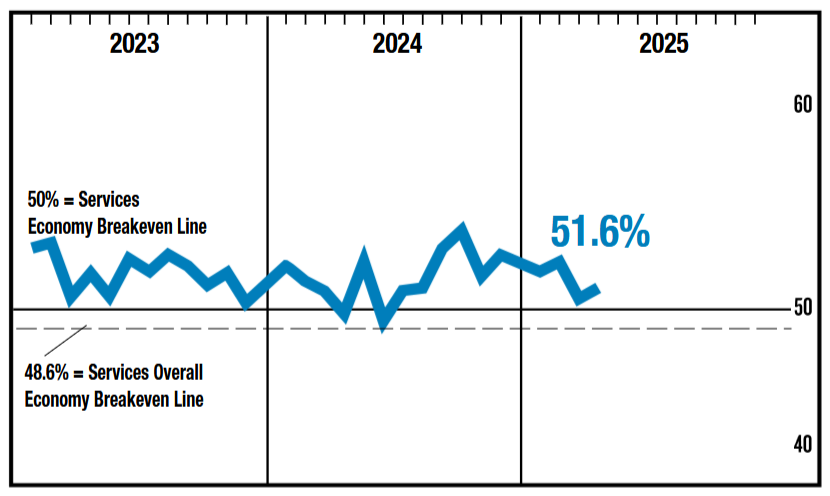
                    US ISM Services PMI from 50.8 rose to 51.6 in April, beating expectations of 50.6. The gain was driven by stronger new orders, which rose from 50.4 to 52.3.

                    However, business activity slipped to 53.7 from 55.9. Employment rebounded from 46.2 to 49.0, but stayed in contraction territory for the second consecutive month.

                    The most notable development was the sharp jump in the prices index—from 60.9 to 65.1—the highest since January 2023.

                    Overall, the data point to modest economic growth, with ISM estimating a 1% annualized GDP expansion based on the services reading.

                    Full US ISM services release here.

                    ECB’s Panetta warns protectionism threatens global prosperity

                      Italian ECB Governing Council member Fabio Panetta warned today that rising protectionism poses a serious threat to global economic stability

                      Speaking at an event, Panetta said, “Openness to trade has benefited both advanced and developing nations, reducing inequality and lifting hundreds of millions of people out of extreme poverty.”

                      However, “protectionism threatens to undo these achievements and to weaken the very fabric of global prosperity,” he added.

                      He emphasized that geopolitical tensions, alongside growing uncertainty in global trade, are becoming central considerations for policymakers.

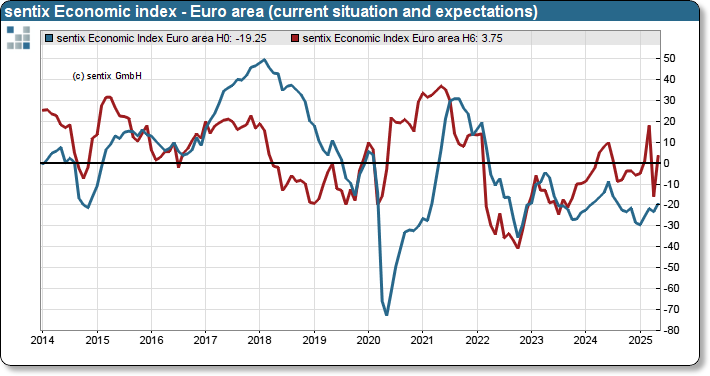
                      Eurozone Sentix confidence surges to -8.1 as investors cheer calm EU response to trade war

                        Eurozone Sentix Investor Confidence rose sharply from -19.5 to -8.1,well above expectations. Current Situation Index climbed from -23.3 to -19.3, the highest level since August 2024. Expectations Index turned positive, rising from -15.8 to 3.8.

                        Sentix credited the European Commission’s “level-headed response” toward escalating US trade actions for the improving sentiment. Additionally, a surprising improvement in inflation data has reinforced expectations that ECB will be able to continue its gradual rate-cutting cycle.

                        While investors are clearly more upbeat, Sentix noted the mood was “more subdued but basically ‘calm’”, comparing to March.

                        Full Eurozone Sentix release here.

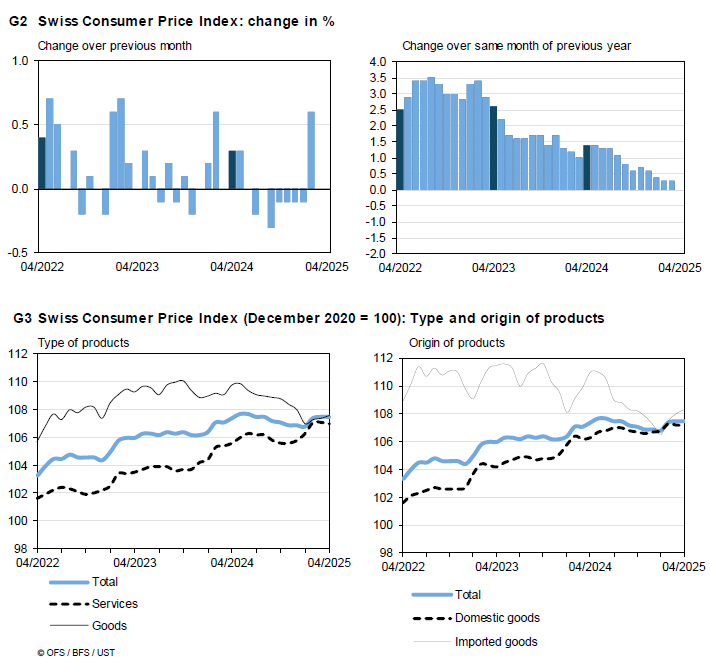
                        Swiss CPI drops to 0% as import deflation worsens

                          Swiss consumer price growth came to a standstill in April, with headline CPI unchanged month-on-month for a second consecutive month.

                          On an annual basis, inflation slowed sharply from 0.3% yoy to 0.0% yoy, marking a return to flat price levels not seen since the disinflationary spell of early 2021.

                          Core CPI (excluding fresh and seasonal products, energy and fuel) also lost momentum, easing from 0.9% yoy to 0.6% yoy.

                          The softness in inflation was driven by a decline in domestic product prices, which fell -0.1% mom and decelerated from 1.0% yoy to 0.8% yoy. Meanwhile, imported product prices offered a small offset, rising 0.3% mom but still contracting -2.5% yoy (prior -1.7% yoy).

                          Full Swiss CPI release here.

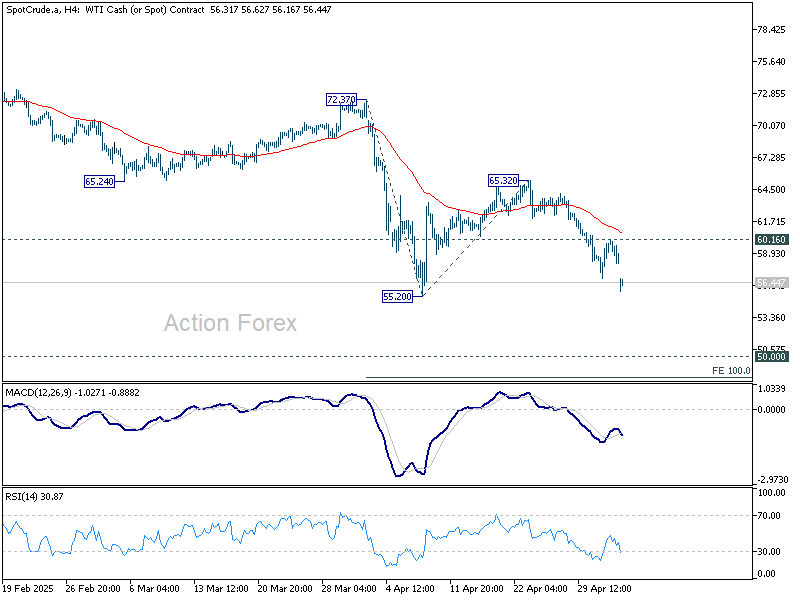
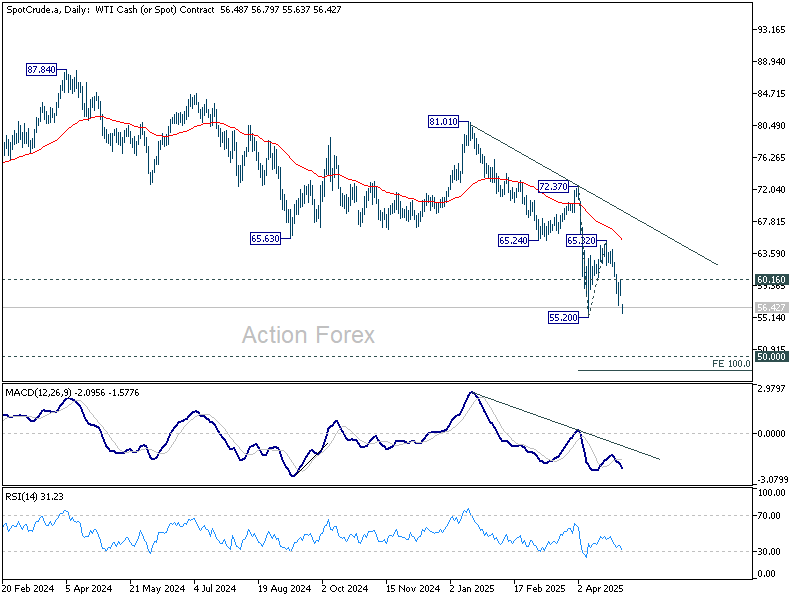
                          Oil sinks as OPEC+ ramps up output again, WTI heading back to 4-yr low

                            Oil prices opened the week with a sharp gap lower, as traders responded to OPEC+’s weekend agreement to accelerate output increases for a second straight month. WTI crude is now heading back toward the four-year low of $55.20 set in April.

                            OPEC+ will raise June production by 411k barrels per day. That brings the total additional supply from April to June to nearly one million barrels per day, representing 44% rollback of the group’s 2022-era production cuts.

                            This shift has stoked concerns that global oil markets may soon swing into surplus. The broader concern is that OPEC+ may fully unwind voluntary production cuts by October unless compliance among members improves. Such a move would flood the market with more supply just as global demand outlooks remain clouded by trade tensions.

                            Technically, prior rejection by 65.24 support turned resistance keeps WTI’s long term down trend intact. Further decline is now expected as long as 60.16 resistance holds. Firm break of 55.20 low will confirm down trend resumption. WTI could then decline through 50 psychological level to 100% projection of 72.37 to 55.20 from 65.32 at 48.20.

                            US NFP grows 177k in April, wage gains losing momentum

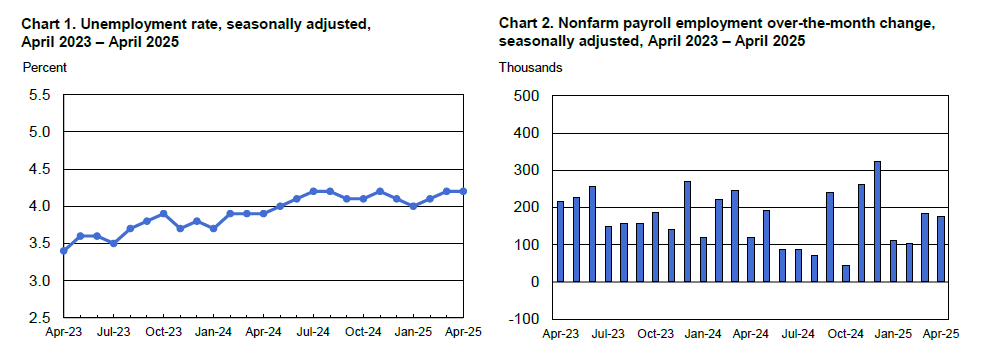
                              The US labor market delivered another month of solid job creation in April, with non-farm payrolls rising by 177k, beating forecast of 130k. However, the initial blowout March figure was revised down from 228k to 185k, tempering some of the headline strength.

                              Still, both readings came in above the 12-month average monthly gain of 152k, signaling continued resilience.

                              Unemployment rate held steady at 4.2%, in line with expectations, while labor force participation ticked up slightly to 62.6%.

                              Yet, wage pressures appear to be softening. Average hourly earnings rose just 0.2% mom, below the 0.3% mom forecast, bringing the year-over-year growth rate to 3.8%.

                              Full US non-farm payrolls release here.

                              Eurozone core CPI jumps to 2.7% as services inflation accelerates

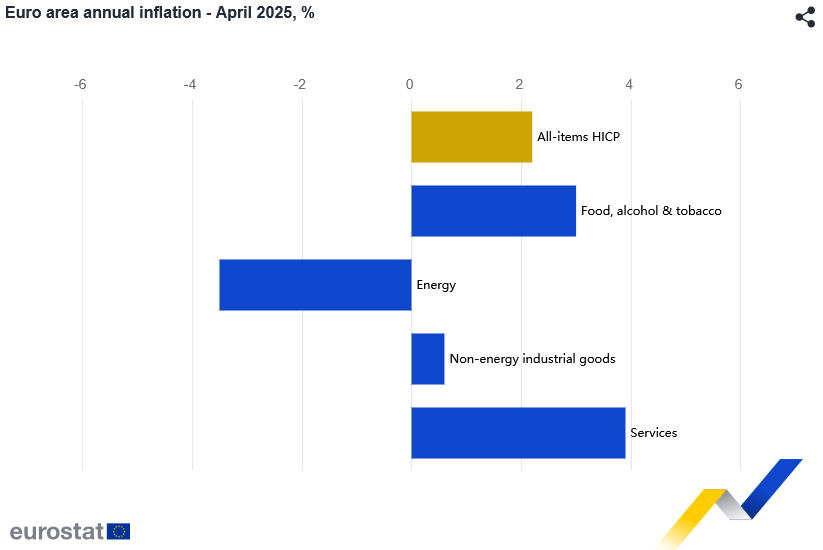
                                Eurozone headline CPI held steady at 2.2% yoy in April, slightly above expectations of 2.1% yoy. CPI core, which excludes energy, food, alcohol & tobacco, surged sharply from 2.4% yoy to 2.7% yoy, surpassing the forecast of 2.5%.

                                The acceleration in services inflation to 3.9% from 3.5% drove much of the upside surprise, highlighting persistent domestic price pressures. Meanwhile, energy prices fell more steeply at -3.5%, and non-energy industrial goods inflation was stable at 0.6%.

                                Full Eurozone CPI flash release here.

                                Eurozone PMI manufacturing finalized at 49.0, at risk if Chinese exports divert toward Europe

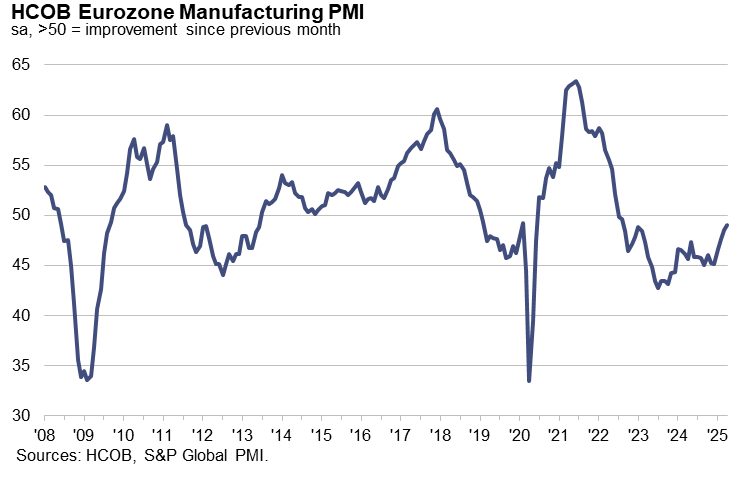
                                  Eurozone manufacturing sector showed further signs of stabilization in April, with PMI Manufacturing Index finalized at 49.0, its highest reading in 32 months. Output growth was a standout, reaching a 37-month high at 51.5, reflecting a modest but encouraging improvement in activity.

                                  Country-level data revealed a mixed picture, with Greece (53.2) and Ireland (53.0) leading the expansion, while Spain (48.1) and Austria (46.6) lagged behind. Notably, Germany (48.4) and France (48.2), two core economies, continued to show.

                                  According to Cyrus de la Rubia at Hamburg Commercial Bank, the stabilization is somewhat unexpected given recent shocks, but optimism is holding up, aided by prospects of ECB rate cuts and the announced increase in EU defense spending.

                                  Still, challenges remain. While manufacturers expanded margins in April, thanks to falling input costs and faster price hikes, this may not be sustainable. The risk of Chinese goods being redirected to Europe due to US tariffs could intensify competitive pressures, particularly on price.

                                  Full Eurozone PMI manufacturing final release here.

                                  Downside risks to NFP after ADP miss and rising Claims

                                    The US April non-farm payroll report today will serve as a critical barometer of the labor market’s resilience amid rising macroeconomic uncertainty. While the recent flip-flopping of reciprocal tariffs may not yet be fully reflected in the data, other indicators suggest growing fragility.

                                    A notable miss in today’s report could reignite concerns about recession, particularly following this week’s Q1 GDP data which showed unexpected contraction. For Fed, a disappointing jobs print would increase pressure to resume easing in June.

                                    Markets expect 130K jobs growth in April, following a much stronger-than-expected 228K gain in March. Average hourly earnings are seen rising 0.3% mom. Unemployment rate likely held steady at 4.2%.

                                    Recent labor market signals, however, lean toward downside risks. Initial jobless claims surged to 241K last week, pushing the 4-week average up to 226K. Meanwhile, ADP Employment report showed private payrolls rising by just 62K, a sharp deceleration from the revised 147K in March. The ISM Manufacturing PMI Employment sub-index also remained in contraction at 46.2, though it did tick up slightly from 44.7.

                                    Australian retail sales grow 0.3% mom in March, but volumes flat in Q1

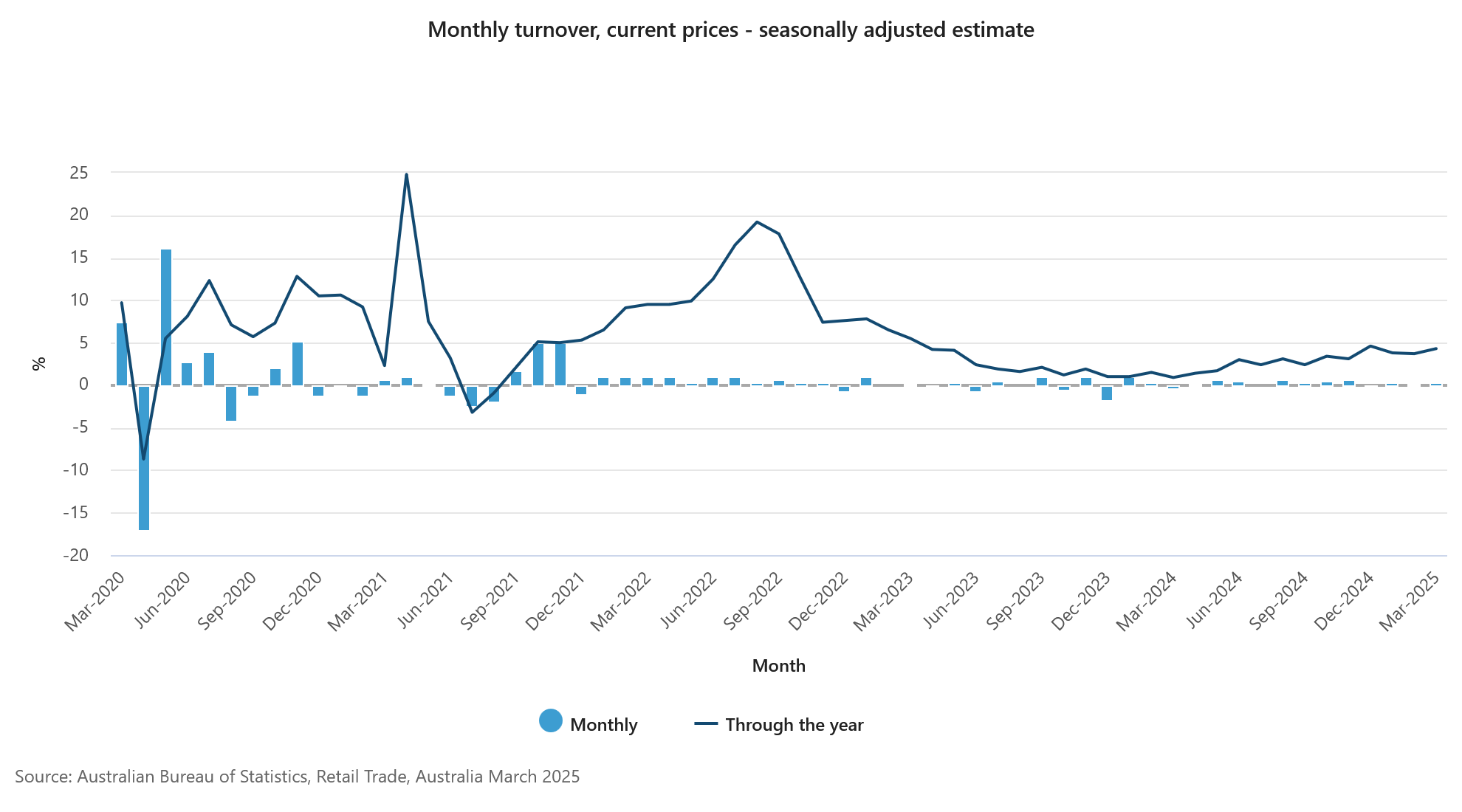
                                      Australian retail sales rose by 0.3% mom in March to AUD 37.28 billion, slightly below expectations of 0.4% growth.

                                      According to the ABS, food-related spending, particularly in supermarkets and grocery stores, was the main contributor to the uptick, with food and miscellaneous retailing both rising 0.7%. Clothing-related sales also edged higher, but household goods retailing was flat.

                                      However, the broader trend is subdued, with retail sales volumes—adjusted for inflation—essentially flat over Q1. ABS Head of Business Statistics Robert Ewing noted that the lack of growth reflects weaker household appetite for discretionary goods, following a boost in spending late last year due to heavy promotions.

                                      Full Australia retail sales release here.

                                      US ISM manufacturing falls less than expected to 48.7, output drops, prices climb further

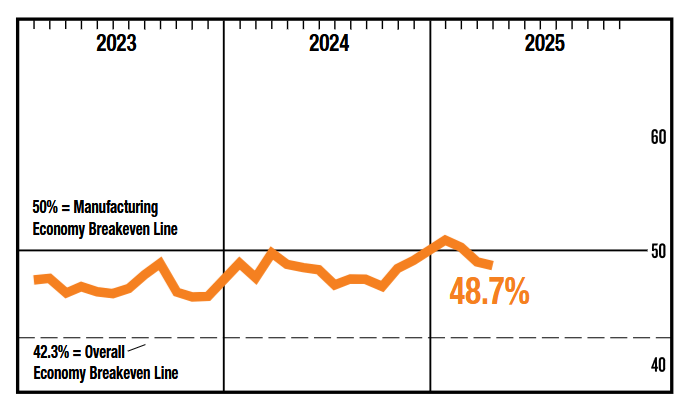
                                        US ISM Manufacturing PMI edged lower from 49.0 to 48.7 in April, slightly better than expectations of 47.9, but still firmly in contraction territory.

                                        The report paints a mixed picture beneath the headline: new orders improved modestly from 45.2 to 47.2, signaling tentative stabilization in demand. But production dropped sharply from 48.3 to 44.0, marking the eighth straight month of contraction. Employment remained weak, rising only slightly from 44.7 to 46.5, with job losses continuing across the sector.

                                        Export activity was a particular drag, with new export orders plunging from 49.6 to 43.1, reflecting growing external headwinds and perhaps early signs of tariff impacts. Imports also fell back into contraction, dipping from 50.1 to 47.1.

                                        The rise in the Prices Index—from 69.4 to 69.8—marks the highest level since mid-2022 and reflects growing cost pressures, especially from tariffs, which are now being passed through to buyers amid longer supplier delivery times and rising inventories.

                                        According to ISM, the overall backdrop suggests weakening demand and output amid rising input costs, “not considered positive for economic growth. ISM estimates the current PMI level aligns with a modest 1.8% annualized GDP growth rate.

                                        Full US ISM manufacturing release here.

                                        US initial jobless claims rise to 241k vs exp 221k

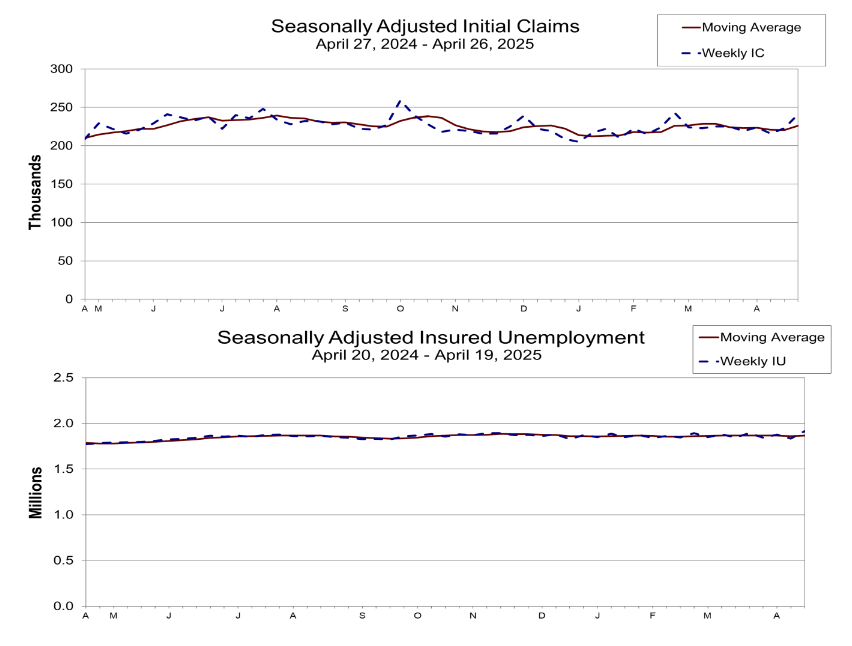
                                          US initial jobless claims rose 18k to 241k in the week ending April 26, above expectation of 221k. Four-week moving average of initial claims rose 5.5k to 226k.

                                          Continuing claims rose 83k to 1916k in the week ending April 19, highest since November 13, 2021. Four-week moving average of continuing claims rose 6k to 1868k.

                                          Full US jobless claims release here.