Sample Category Title
Elliott Wave Outlook: EURUSD 5‑Swing Structure from July 2 High Signals More Weakness
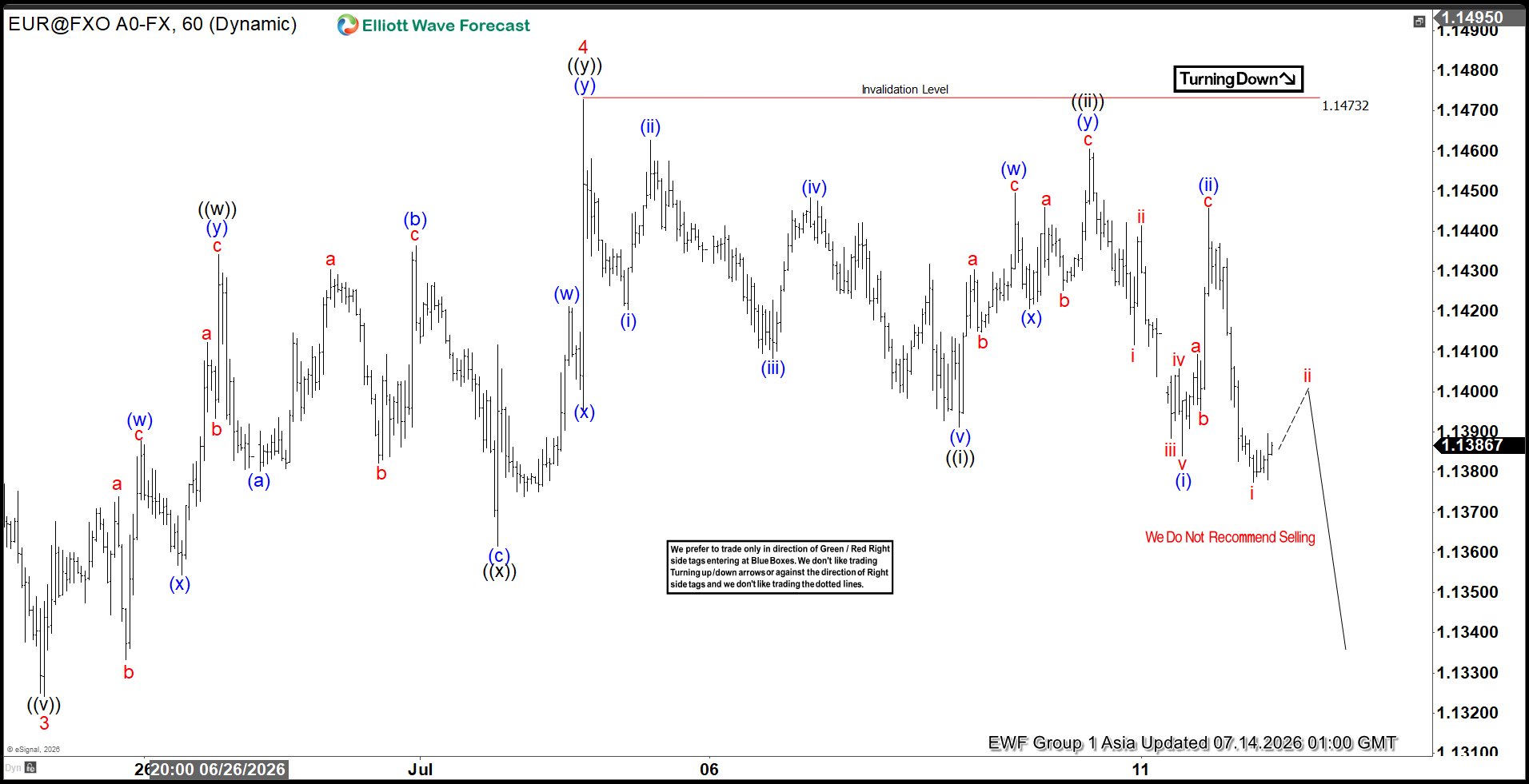
EURUSD maintains an incomplete bearish sequence from the January 27, 2026 peak, leaving room for further downside. The projected target zone is defined by the 100% to 161.8% Fibonacci extension from the January 27 high, which falls between 1.076 and 1.117. This extension range provides a precise technical framework for anticipating the next leg lower. In the near term, the cycle from the July 2, 2026 high has unfolded into a five‑swing decline, reinforcing the bearish bias and signaling additional weakness.
From the July 2 high, wave ((i)) concluded at 1.139 as a diagonal structure. A corrective rally in wave ((ii)) terminated at 1.146, after which the pair resumed its downward trajectory in wave ((iii)). The internal subdivision of wave ((iii)) is unfolding as another five‑wave impulse. Within this structure, wave (i) ended at 1.138, while wave (ii) retraced to 1.145. These developments confirm that the decline remains active and incomplete. As long as the pivot at 1.147 holds, rally should fail in 3 or 7 swing and EURUSD is expected to continue pressing lower. A decisive break below the June 24 low at 1.1324 is required to eliminate the possibility of a double correction.
EURUSD 60-Minute Elliott Wave Chart
EURUSD Elliott Wave Video:
https://www.youtube.com/watch?v=6FoDd-hTQvg
Gold Slides as Oil Surges and Fed Hike Bets Build, Leaving $4,000 Increasingly Vulnerable
Gold is finding itself squeezed by two markets moving in the same direction. Oil is rebuilding inflation fears, while the Federal Reserve is becoming more willing to tighten policy again if price pressures refuse to ease. Together, those forces have left the metal on the defensive, with the psychologically important $4,000 level looking increasingly fragile as investors await another pivotal US inflation report.
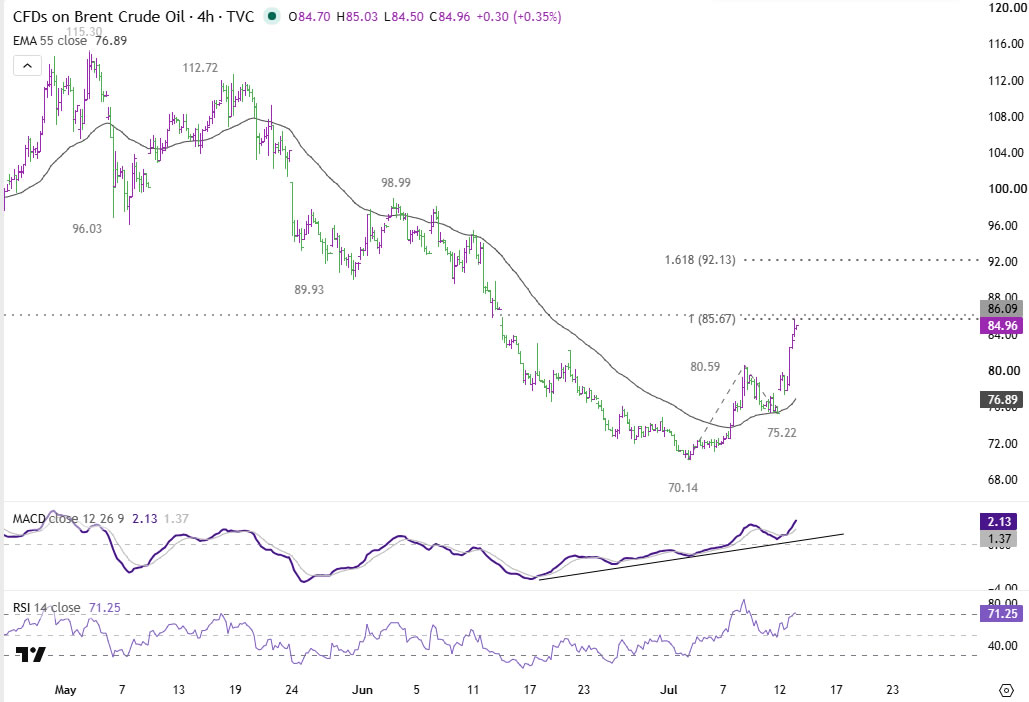
The latest catalyst came from both geopolitics and monetary policy. Brent crude briefly climbed above $85 after US President Donald Trump announced plans to impose shipping fees on cargo transiting the Strait of Hormuz and restore a blockade of Iranian ports, raising the prospect of higher energy costs and renewed supply disruptions. For Gold, the significance lies less in the conflict itself than in its impact on inflation expectations. Rising oil prices increase the risk that inflation remains elevated, making it harder for the Fed to justify keeping policy unchanged.
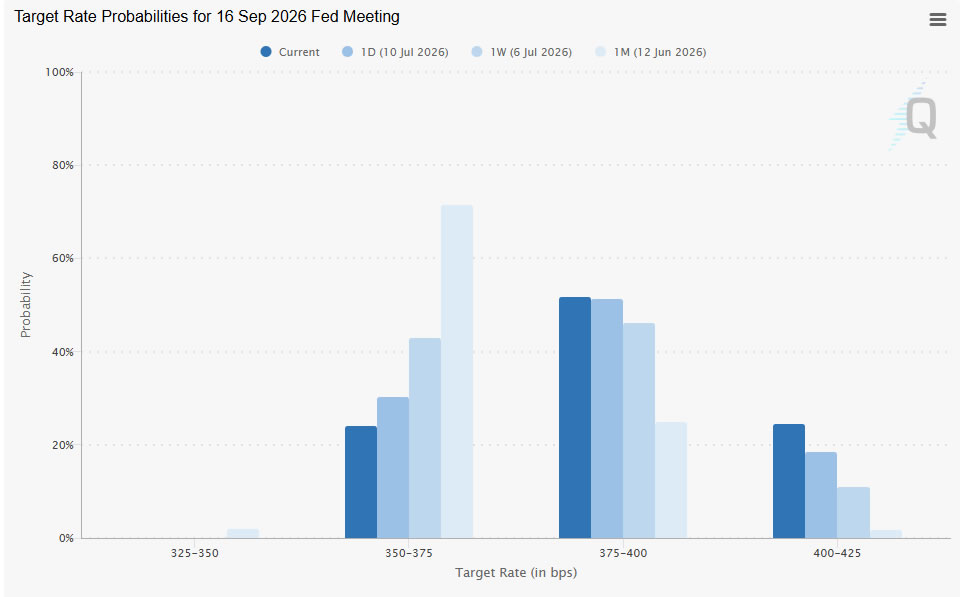
That concern was reinforced by Federal Reserve Governor Christopher Waller, whose comments represented a notable shift from one of the Committee's more dovish voices. Waller said that "if we get another hot reading on core inflation this week, then the FOMC will need to consider tightening monetary policy in the near term," adding that another strong inflation reading would be "signal, not noise." His remarks accelerated the repricing already underway in interest-rate markets. Fed funds futures now imply better than a 40% chance of a July rate hike, compared with roughly one-in-four a week ago, while the probability of a September increase has climbed to about 76%, up from 57%.
Even with those headwinds, Gold sellers have stopped short of forcing a decisive breakdown before today's key events. Markets remain focused on the June CPI report and Fed Chair Kevin Warsh's first congressional testimony, which together could either validate or challenge the increasingly hawkish policy outlook. If inflation again surprises on the upside, the combination of stronger oil prices and a more hawkish Fed would present an even more difficult backdrop for precious metals.
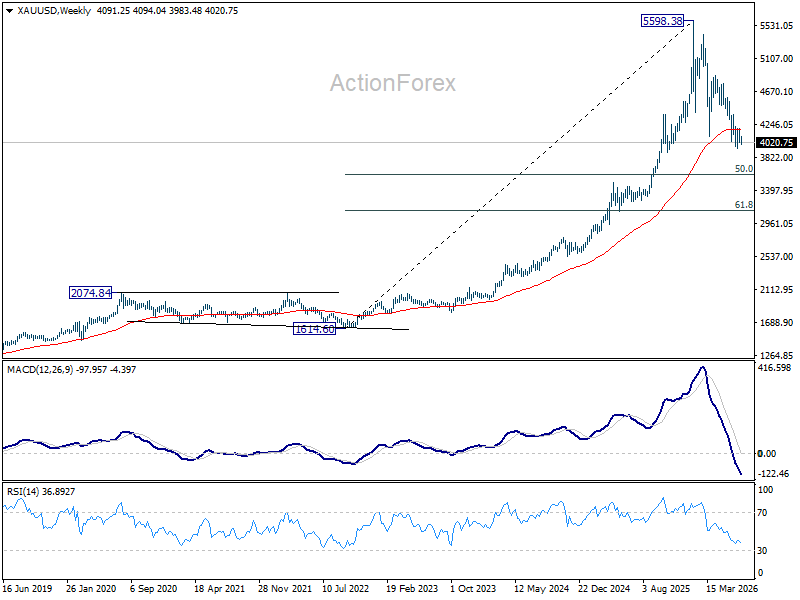
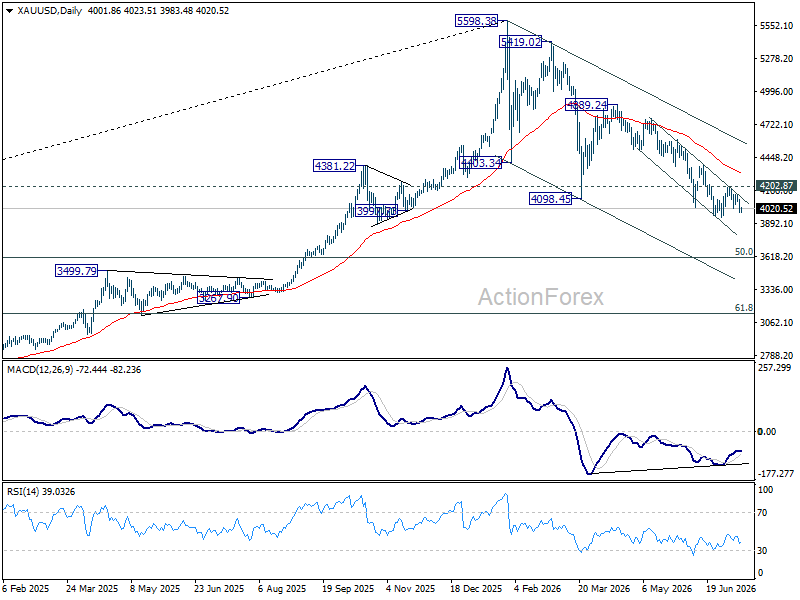
The technical picture reflects that growing pressure. Gold continues to trade comfortably within a well-defined near term falling channel, leaving the decline from the record high of 5,598.38 firmly intact. The 4,000 psychological level has become the market's immediate battleground.
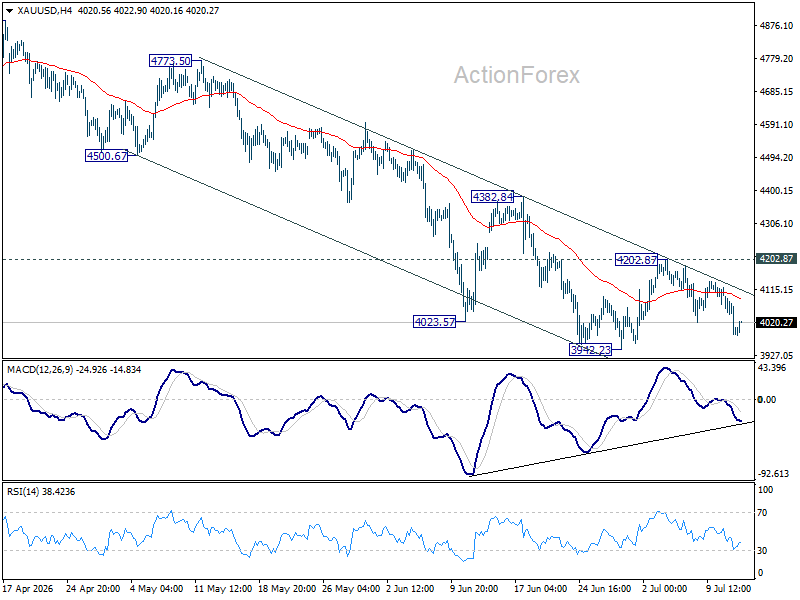
Firm break of 3,942.23 low would resume the whole down trend from 5,598.38 record high. Next target will be 50% retracement of 1,614.60 (2022 low) to 5,598.38 at 3,606.49. Any recovery, meanwhile, is likely to be viewed as corrective while prices remain below 4,202.87.
China Trade Data Crushes Forecasts as Exports and Imports Accelerate in June
China's trade growth accelerated sharply in June, with exports rising 27.0% year-on-year in US dollar terms, up from 19.4% in May and well above expectations of 18.2%. Imports also strengthened markedly, climbing 36.0% from 27.4% previously and beating forecasts of 24.0%. The stronger-than-expected performance lifted the trade surplus to USD 125.6B from USD 105.4B, underscoring resilient external demand despite an increasingly uncertain global environment.
The improvement was broad-based across major trading partners. Exports to the US rose around 14%, suggesting bilateral trade has remained resilient despite tariff headwinds. Shipments to Southeast Asia surged about 35%, reinforcing the region's importance as China's largest export destination, while exports to the European Union increased 18.5%. Technology was a standout driver, with exports of integrated circuits more than doubling from a year earlier to USD 38B, highlighting continued strength in global demand for semiconductors and AI-related supply chains.
One notable exception was energy. Crude oil imports fell -41% from a year earlier to 29.3 million tonnes, likely reflecting lower purchasing following the temporary easing in Middle East tensions during much of the survey period, as well as inventory management after earlier buying.
Economic Data
| Indicator | Actual | Expected | Previous |
|---|---|---|---|
| Exports (YoY) | 27.0% | 18.2% | 19.4% |
| Imports (YoY) | 36.0% | 24.0% | 27.4% |
| Trade Balance (USD) | 125.6B | USD 119.5B | 105.4B |
Market Takeaways
- Both exports and imports significantly exceeded expectations, pointing to stronger-than-expected trade momentum.
- Export growth accelerated to its fastest pace since October 2021, supported by broad-based demand across major trading partners.
- Technology remained a key driver, with integrated circuit exports more than doubling to USD 38B, highlighting continued AI and semiconductor demand.
- Trade with the US, ASEAN and the EU all strengthened, suggesting resilient external demand despite geopolitical and trade uncertainties.
- Crude oil imports fell sharply by 41%, contrasting with broader import strength and reflecting lower energy purchases during much of June.
- The strong trade report provides a positive contribution to China's near-term growth outlook, although renewed Middle East tensions and higher oil prices could alter the trade dynamics in coming months.
Bitcoin Looks Vulnerable as Downside Risks Continue to Mount
Key Highlights
- Bitcoin failed to surpass $65,000 and trimmed some gains.
- BTC/USD traded below a contracting triangle with support at $62,500 on the 4-hour chart.
- Ethereum also struggled above $1,800 and dipped from resistance.
- The US CPI could increase by 3.8% in June 2026 (YoY).
Bitcoin Price Technical Analysis
Bitcoin price attempted to gain pace for a move above $64,500 against the US Dollar but failed. BTC trimmed some gains and signaled a downside break.
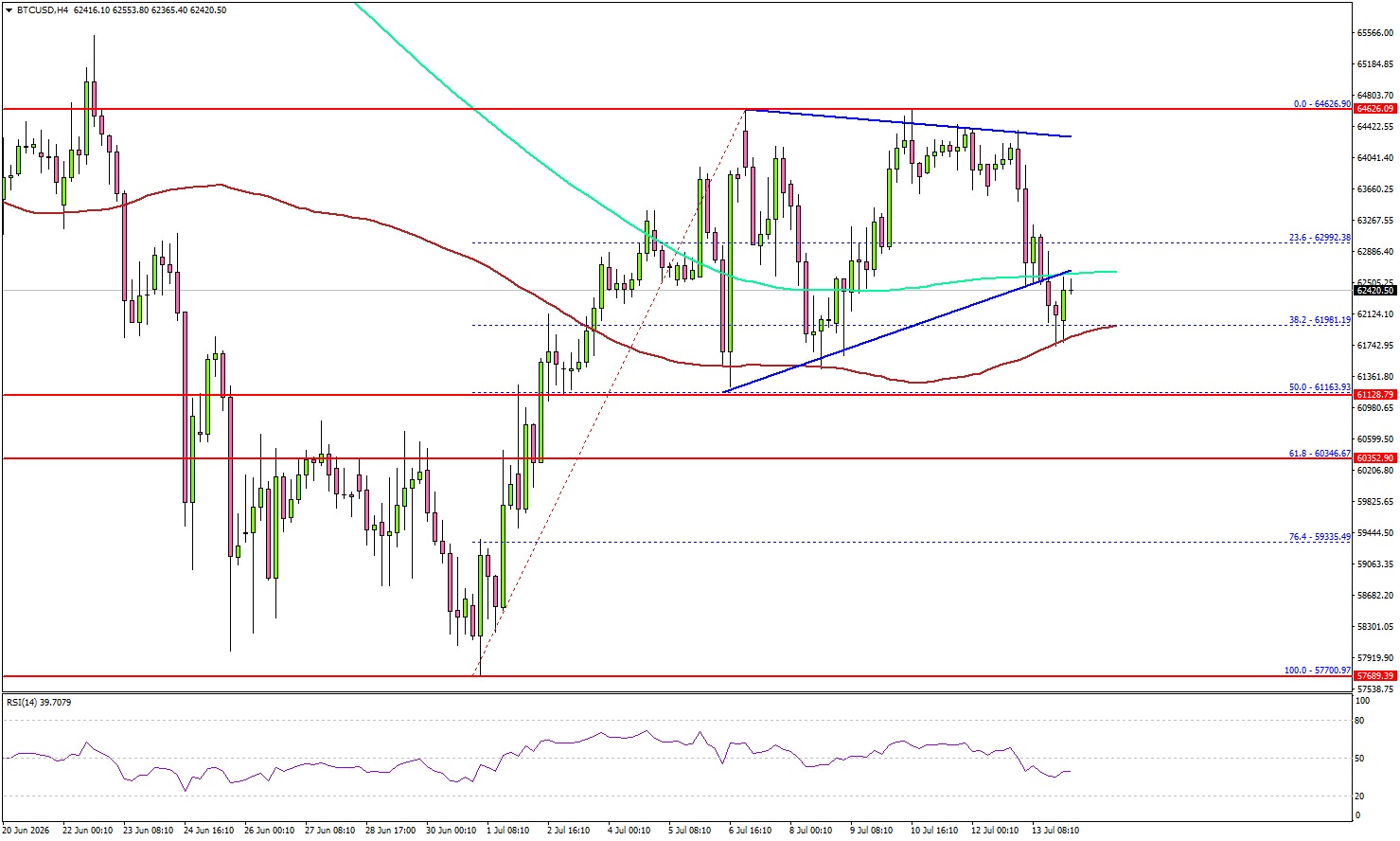
Looking at the 4-hour chart, the price formed a high near $64,626 and started a downside correction. There was a move below $63,500 and $63,200. The price traded below the 23.6% Fib retracement level of the upward move from the $57,700 swing low to the $64,626 high.
More importantly, BTC traded below a contracting triangle with support at $62,500 and the 200 simple moving average (green, 4-hour). If the bears remain in action, the price might find bids near the 50% Fib retracement level at $61,150.
A downside break and close below $61,150 could trigger a sharp decline. In the stated scenario, the price could test $60,350 or even $58,800.
On the upside, an immediate resistance could be $63,800. The first major resistance might be $64,500. The main resistance might be $65,000. A close above $65,000 could send the price toward $66,800. Any more gain might call for a test of $68,000.
Looking at Ethereum, the price seems to be facing a tough hurdle near $1,825 and might start a fresh decline in the near term.
Today’s Key Economic Releases
- US Consumer Price Index for June 2026 (MoM) – Forecast -0.1%, versus +0.5% previous.
- US Consumer Price Index for June 2026 (YoY) – Forecast +3.8%, versus +4.2% previous.
- US Consumer Price Index Ex Food & Energy for June 2026 (YoY) – Forecast +2.9%, versus +2.9% previous.
- Fed Chair Warsh testifies.
- Fed's Barr speech.
- Fed's Goolsbee speech.
- Fed's Cook speech.
Australia NAB Business Confidence Rebounds to -5 as Inflation Pressures Ease
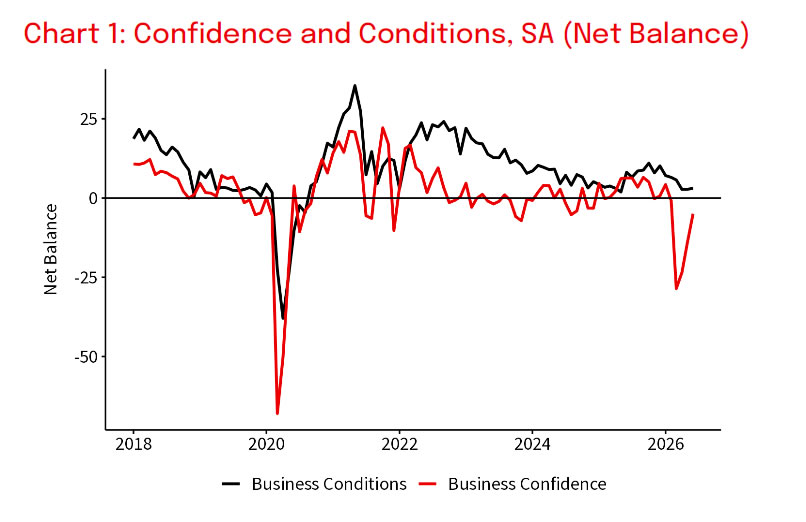
Australia's business confidence improved noticeably in June, with the NAB Business Confidence Index rising 9 points to -5, recovering much of the sharp deterioration seen in March. While confidence remained below zero, the survey suggests businesses became less concerned as the economic fallout from the Middle East conflict proved less severe than initially feared. Business conditions were unchanged at +3, still below the long-run average of +7, indicating activity has stabilized but remains softer than earlier in the year.
The survey paints a picture of an economy that is slowing rather than contracting. NAB Chief Economist Sally Auld said easing concerns over energy markets and broader geopolitical risks had helped restore confidence, while business conditions and capacity utilization suggest growth has moderated without falling away.
That interpretation is consistent with the survey's inflation indicators. Purchase cost growth slowed further from 2.5% to 2.0% on a quarterly basis, final product price growth eased from 0.9% to 0.6%, and retail prices fell 0.3%, the first decline in seven years. Labor cost growth accelerated from 1.5% to 2.0%, largely reflecting the increase in the minimum wage that took effect on July 1.
Survey Data
| Component | Current | Previous |
|---|---|---|
| Business Confidence | -5 | -14 |
| Business Conditions | +3 | +3 |
| Purchase Cost Growth (Quarterly) | 2.0% | 2.5% |
| Labour Cost Growth (Quarterly) | 2.0% | 1.5% |
| Final Product Price Growth | 0.6% | 0.9% |
| Retail Price Growth | -0.3% | 1.5% |
Market Takeaways
- Business confidence rebounded sharply, recovering much of the decline seen after the March Middle East conflict.
- Business conditions stabilized but remained below their long-run average, suggesting growth has slowed rather than contracted.
- Purchase cost growth and final selling price inflation both moderated, indicating the earlier energy shock had a smaller inflation impact than feared.
- Retail prices fell for the first time in seven years, reinforcing signs of easing pricing pressures in consumer-facing sectors.
- Labor cost growth accelerated following the July 1 minimum wage increase, highlighting continued wage pressures.
Australia Westpac Consumer Sentiment Rebounds to 83.9, but Pessimism Still Runs Deep
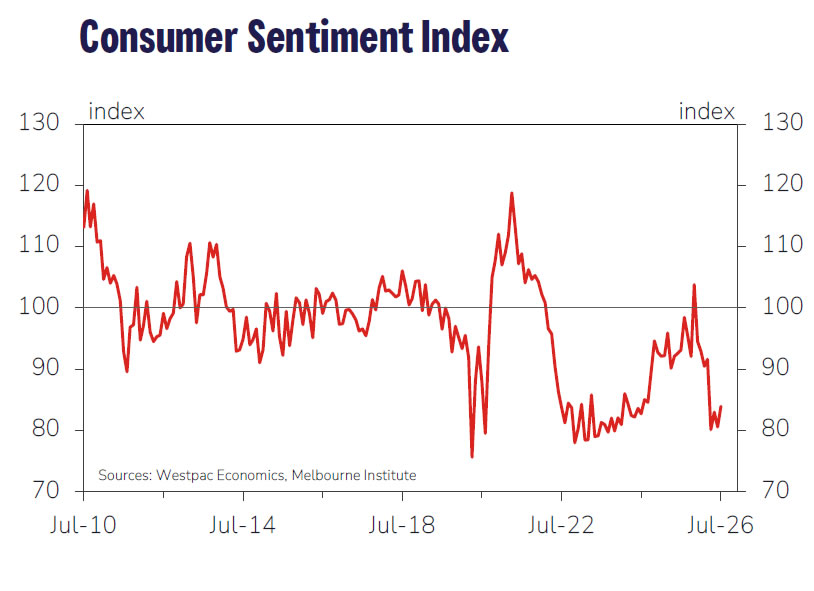
Australian consumer sentiment improved in July, with the Westpac–Melbourne Institute Consumer Sentiment Index rising 4.1% to 83.9. The increase suggests households have become less concerned that the Reserve Bank of Australia's June decision to leave the cash rate unchanged would be followed by another rapid sequence of rate hikes. Even so, confidence remains deeply depressed. At 83.9, the index still ranks among the weakest 10% of readings recorded over the survey's 50-year history.
The survey points to easing fears rather than renewed optimism. Expectations for the economy over the next 12 months and five years improved only marginally and remain well below long-run averages. Consumers were, however, more positive about the labor market, with the Unemployment Expectations Index falling -7.1% to 129.9, returning close to its historical norm. Uncertainty over the interest-rate outlook also remains elevated, with 17% of respondents saying they "don't know" where rates are headed—the highest proportion since March 2022—highlighting the lack of conviction surrounding the RBA's next move.
For policymakers, attention now shifts firmly to the June quarter CPI report due on July 29. Westpac argues the improvement in confidence partly reflects relief that worst-case scenarios for energy prices, interest rates and employment have not materialized. However, it also expects inflation to remain uncomfortably high, supporting another 25 basis point rate increase at the RBA's August meeting. Recent communication from senior RBA officials has emphasized that inflation persistence remains the Board's primary concern, suggesting stronger sentiment alone is unlikely to alter the central bank's readiness to tighten policy again if price pressures fail to ease.
Economic Data
| Indicator | Actual | Previous |
|---|---|---|
| Westpac–Melbourne Institute Consumer Sentiment Index | 83.9 | 80.6 |
| Consumer Sentiment (MoM) | +4.1% | — |
| Economy, Next 12 Months | 78.3 | 77.7 |
| Economy, Next 5 Years | 87.1 | 86.4 |
| Unemployment Expectations Index* | 129.9 | 139.9 |
| Consumers Unsure About Interest Rate Outlook | 17% | — |
Market Takeaways
- Consumer sentiment improved after the RBA paused in June, easing fears of a rapid succession of further rate hikes.
- Despite the rebound, confidence remains historically weak, with the index still in the lowest 10% of readings over the survey's 50-year history.
- Consumers became more optimistic about the labour market, while views on the broader economy improved only marginally.
- Uncertainty over the interest-rate outlook remains unusually high, with 17% of respondents unsure where rates are headed.
- The June quarter CPI report on July 29 is expected to be the decisive input for the RBA's August policy meeting.
- Improving confidence alone is unlikely to alter the RBA's inflation-focused stance if price pressures remain elevated.
NZIER QSBO Signals Improving Confidence but Sticky Inflation Risks
Business confidence in New Zealand improved in the June quarter, according to the latest NZIER Quarterly Survey of Business Opinion, with a seasonally adjusted net 12% of firms expecting economic conditions to improve over coming months, up from just 1% in the previous survey. The rebound came as global fuel prices eased following the US-Iran Memorandum of Understanding that guaranteed ship passage through the Strait of Hormuz, helping reverse some of the pessimism that followed the earlier Middle East conflict. However, demand remained subdued, with a net 1% of firms reporting stronger activity in their own businesses, highlighting that the improvement was driven more by sentiment than a broad-based pickup in economic conditions.
Despite stronger confidence, firms remained cautious about expanding capacity. A net 10% reduced staff numbers during the quarter, while a net 1% expect further declines in employment over the next three months. Investment intentions also stayed weak, with a net 3% planning to reduce spending on buildings, plant and machinery over the coming year. The survey period concluded before the latest escalation in US-Iran tensions and renewed surge in oil prices, suggesting hiring and investment plans could face additional pressure as geopolitical uncertainty intensifies ahead of New Zealand's general election in November.
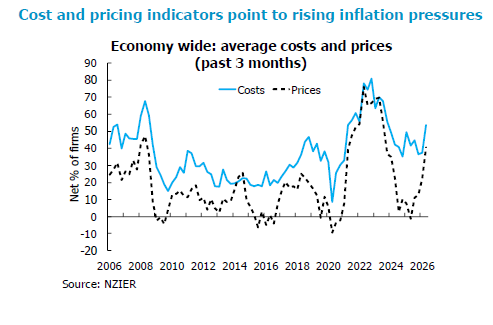
More concerning for the Reserve Bank of New Zealand, the survey pointed to a renewed build-up in inflation pressures. Firms reporting higher costs increased from a net 37% to more than half, while the proportion able to pass those costs through to customers rose to a net 41%. Cost pressures were particularly evident in the building and retail sectors, although weak construction demand continued to limit pricing power in parts of the economy.
Survey Data
| Component | Current | Trend |
|---|---|---|
| General Economic Outlook | +12% | Improving |
| Own Activity | +1% | Broadly Flat |
| Employment (Past Quarter) | -10% | Weaker |
| Employment Intentions (Next Quarter) | -1% | Slightly Weaker |
| Investment Intentions (Next 12 Months) | -3% | Weaker |
| Firms Reporting Higher Costs | >50% | Rising |
| Firms Raising Selling Prices | 41% | Rising |
Market Takeaways
- Business confidence improved markedly, with firms becoming more optimistic about the economic outlook.
- Demand remained subdued, indicating confidence has yet to translate into stronger business activity.
- Hiring and investment intentions stayed cautious, reflecting ongoing geopolitical and domestic political uncertainty.
- Cost pressures intensified significantly, with more firms reporting higher input costs and greater ability to pass them on to customers.
- The survey suggests New Zealand's recovery is continuing gradually, but inflation risks have become more persistent.
- For the RBNZ, the combination of improving confidence and firmer pricing power reinforces a cautious, data-dependent policy stance.
Fed’s Waller: Another Hot CPI Could Force Near-Term Rate Hike
Federal Reserve Governor Christopher Waller struck a markedly more hawkish tone on Monday, warning that another upside surprise in Tuesday's CPI report could force the FOMC to consider raising interest rates "in the near term." The shift is notable because Waller has generally been regarded as one of the more dovish members of the Committee. His remarks come as geopolitical tensions in the Middle East have driven Brent crude above $85, adding to concerns that higher energy prices could reinforce already persistent inflation pressures. Reflecting the changing backdrop, Fed funds futures now imply a 77% probability of a September rate hike, up sharply from around 58% just a week ago.
Describing monetary policy as being at a "crossroads," Waller made clear that upcoming inflation data will heavily influence his thinking. "If I get another higher one, I'm going to treat that as signal, not noise," he said, referring to the recent string of elevated inflation readings. He cautioned that "sternly staring at inflation until it melts before our withering gaze is not an option," underscoring his view that the Fed should not repeat the mistake of waiting too long to respond if inflation proves more persistent than expected.
Waller acknowledged there remains "a credible case" for inflation to gradually return to the Fed's 2% objective with policy left unchanged. However, he expressed growing concern that inflation is becoming more broad-based rather than being confined to tariffs and energy costs. Nearly 70% of core services categories are now recording both three-month and twelve-month inflation above 3%, suggesting underlying price pressures are spreading through the economy. Against a backdrop of a stable labor market and anchored inflation expectations, he argued that the Fed has room to tighten further if necessary without acting prematurely.
The immediate focus now turns to Tuesday's June CPI report, which Waller identified as the next major policy test. "If we get another hot reading on core inflation this week, then the FOMC will need to consider tightening monetary policy in the near term," he said. At the same time, he emphasized that it would take "several months of lower readings" before he would be convinced inflation is sustainably moving back toward target. His comments raise the stakes ahead of the inflation release and set the stage for Fed Chair Kevin Warsh's first congressional testimony later in the day, where markets will look for confirmation—or a different interpretation—of the inflation outlook.
First Impressions: NZIER Quarterly Survey of Business Opinion, June quarter 2026
Business confidence picked up a bit in the June quarter, but Middle East tensions and higher fuel prices remained on firms’ minds.
Key results (seasonally adjusted)
- General business situation: +12 (Prev: +1)
- Trading activity, past three months: +1 (Prev: 0)
- Trading activity, next three months: +10 (Prev: +13)
- Average selling prices, past three months: +37 (Prev: +23)
- Average selling prices, next three months: +52 (Prev: +43)
The NZIER’s June quarter survey of business opinion showed a modest lift in confidence as the tensions in the Middle East eased. Sentiment about the general business situation rose to a net 12% positive, compared to a net 1% in the March survey. However, the own-activity measures, which tend to have a closer correspondence with GDP growth, were little changed for the quarter.
As in the March quarter, the fast-moving events in the Middle East meant that the averages in this survey hide a lot. While the survey period ran from 10 June to 7 July, nearly all of the responses were received on two dates: on the 10th when the survey was sent out, and on the 17th after the signing of the Memorandum of Understanding between the US and Iran. For general business sentiment, early responses were a net 5% negative, while the second batch were a net 20% positive. With the renewed hostilities this month, the first batch of responses is probably more representative of where sentiment would stand if the survey was re-run today.
Other activity indicators were mixed. Investment and hiring intentions were less negative than in the March quarter, while profitability was expected to worsen further.
Conditions remain mixed across industries. Manufacturing remains relatively upbeat, buoyed by strong export sales, but respondents were more negative about the quarter ahead and noted a particularly large increases in their costs and sale prices. The building industry was a little more positive this quarter, but reported that they have continued to cut their prices despite soaring costs. Merchants (wholesalers and retailers) remained positive, but less so than last quarter.
The rise in fuel prices since March was clearly reflected in the pricing measures of the survey. A net 41% of firms reported raising their prices in the last quarter, up from 22% last quarter the highest reading since September 2023. In the next three months, a net 54% of firms intend to raise their prices, the highest since March 2023.
For the RBNZ, the implications of the survey are unclear. While it’s not surprising that a number of firms would be looking to pass on the rise in fuel and other costs, the short horizon for the survey questions (three months ahead) means that it doesn’t tell us a lot about the potential for second-round inflationary effects. And while the activity measures improved in some places, they don’t really seem to support the RBNZ’s assertion that the economy has been running stronger than they expected in their May MPS forecasts.
Dollar Index – Geopolitical Uncertainty and Inflation Concerns to Continue to Provide Support
The US dollar jumped on opening on Monday and quickly reversed gains but remained within approx. $50 range for the day.
Fresh escalation in the Middle East added to inflation concerns and expectations that the Fed would keep its hawkish stance for some time, with news that large pension funds are returning to dollar, after last year’s migration, added to supportive factors.
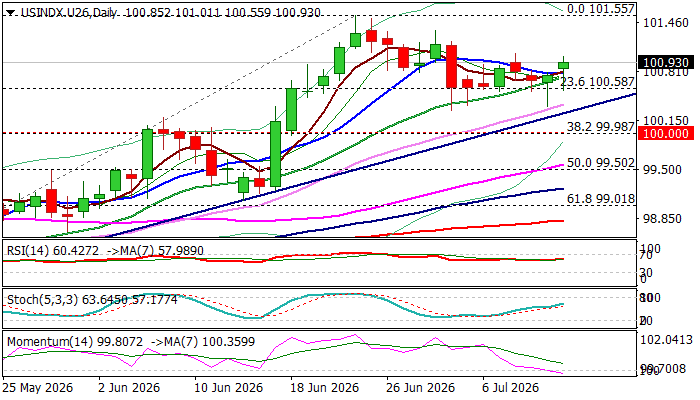
Larger picture shows the index trending higher off 2026 low (95.35) within a bull-channel, though, daily chart shows the action in a narrow-range sideways mode, capped by previously broken Fibo barrier at 100.94 (38.2% retracement of 110.00/95.35 descend) and supported by daily Kijun-sen (100.32).
Daily studies remain predominantly bullish, though 14-d momentum slipped into negative territory that may keep near-term action in directionless mode and keep the downside vulnerable.
However, bullish structure is expected to remain intact while the price holds above trendline support (100.29) and keep focus at 101.55 (new 2026 peak, the highest since early Nov 2025), break of which to signal continuation of an uptrend from 95.35 and expose targets at 101.80 (12 May 2025 peak) and 102.67 (50% retracement of 110.00/95.35).
Caution on break below 100 level (psychological / Fibo 38.2% of 97.44/101.55 upleg) that may sideline bulls for potential deeper pullback.
Res: 101.04; 101.55; 101.80; 102.67
Sup: 100.55; 100.29; 100.00; 99.50