

Sample Category Title
GBP/USD Mid-Day Outlook
Daily Pivots: (S1) 1.3188; (P) 1.3251; (R1) 1.3349; More...
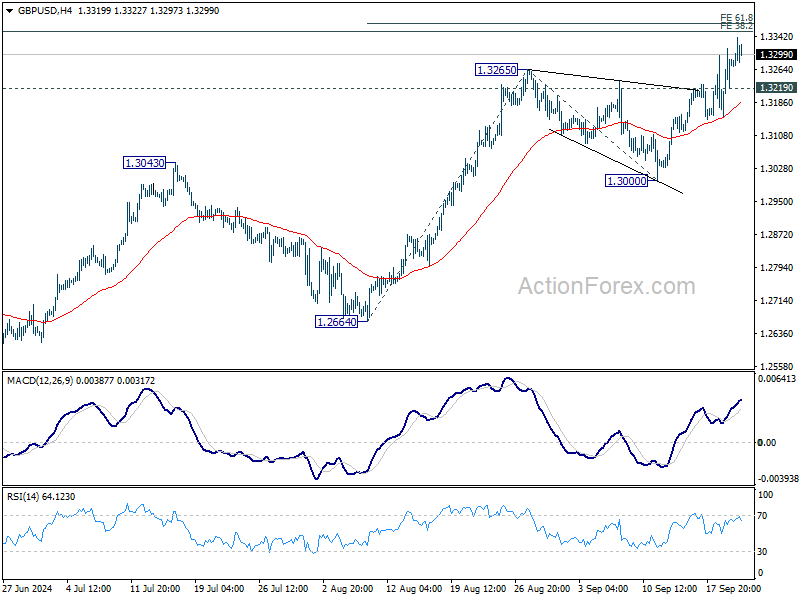
Intraday bias in GBP/USD remains on the upside for 61.8% projection of 1.2664 to 1.3265 from 1.3000 at 1.3371. Firm break there will pave the way to 100% projection at 1.3601 next. On the downside, below 1.3219 minor support will turn intraday bias neutral and bring consolidations first. But outlook will stay bullish as long as 1.3000 support holds.
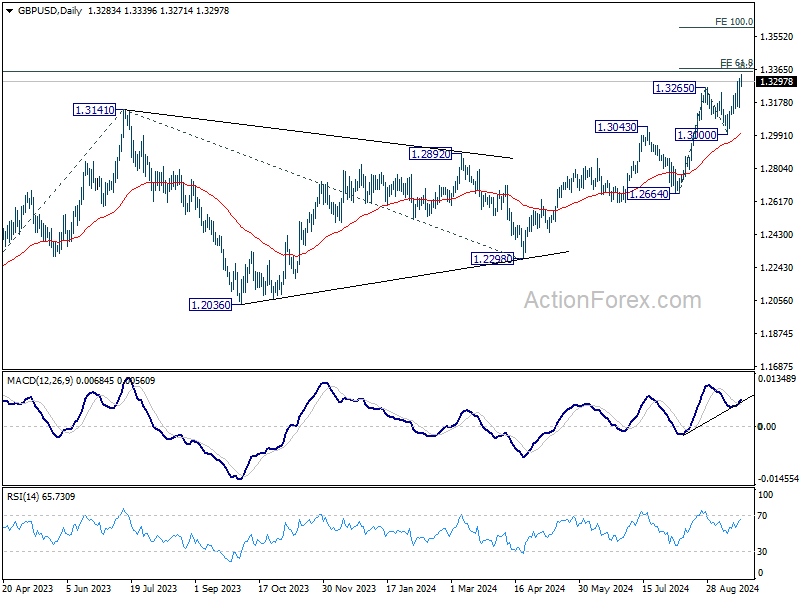
In the bigger picture, up trend from 1.0351 (2022 low) is in progress. Next target is 38.2% projection of 1.0351 to 1.3141 from 1.2298 at 1.3364. Sustained break there will target 61.8% projection at 1.4022. For now, outlook will stay bullish as long as 1.2664 support holds, even in case of deep pullback.
Sterling Rallies on Strong Retail Sales as Yen Struggles
Sterling climbed broadly today, fueled by unexpectedly strong UK retail sales data that more than compensated for the lackluster consumer confidence report. Despite ongoing high interest rates and persistent inflation, British consumers appear to be resilient, continuing to spend. This bolsters the position of hawkish members within the BoE's MPC, who may push harder for a measured, gradual approach to reducing interest rates.
Looking at the broader market, Australian Dollar has maintained its position as the top performer for the week, driven by post-FOMC risk-on sentiment. However, with risk appetite fading as the weekend approaches, Sterling, currently in second place, has a real chance of overtaking the Aussie. Meanwhile, New Zealand Dollar follows closely as the third strongest currency this week.
On the downside, Japanese Yen remains the weakest performer, extending its selloff after BoJ's decision to hold rates steady earlier today. The rise in US and European bond yields has further weighed on the Yen, as the growing yield differential makes it less attractive. Dollar and Swiss Franc are also under pressure, lacking the safe-haven appeal in the current risk-on environment. Euro and Canadian Dollar remain relatively mixed in the middle.
In Europe, at the time of writing, FTSE is down -0.85%. DAX is down -0.74%. CAC is down -0.77%. UK 10-year yield is up 0.0041 at 3.897. Germany 10-year yield is up 0.005 at 2.207. Earlier in Asia, Nikkei rose 1.53%. Hong Kong HSI rose 1.36%. China Shanghai SSE rose 0.03%. Singapore Strait Times fell -0.23%. Japan 10-year JGB yield rose 0.0106 to 0.864.
Canada's retail sales rises 0.9% mom, 7 of 9 subsectors grow
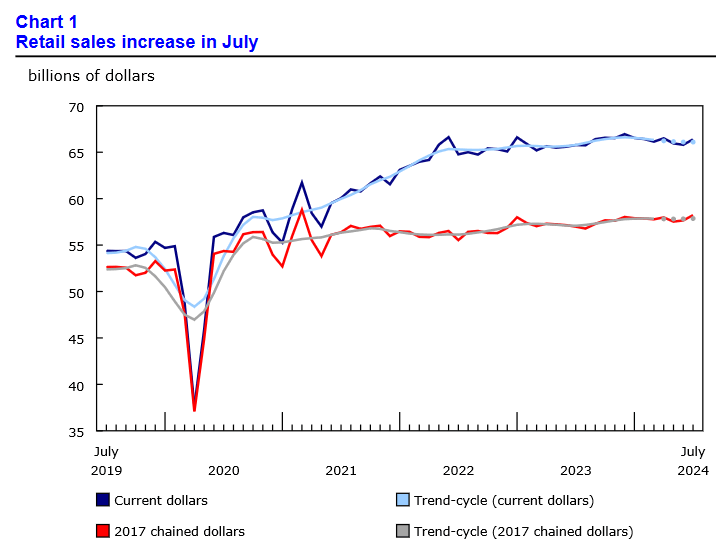
Canada's retail sales rose 0.9% mom to CAD 66.4B in July, well above expectation of 0.5% mom. Sales were up in seven of nine subsectors, led by increases at motor vehicle and parts dealers. In volume terms, sales were also up 1.0% mom.
Advance estimate suggests that sales increased 0.5% mom in August.
ECB's de Guindos keeps all option open data will drive future rate cuts
In an interview with Expresso, ECB Vice President Luis de Guindos reaffirmed the central bank's cautious approach regarding rate cuts in the upcoming meetings. He stressed that ECB remains "fully committed" to a data-dependent strategy, making decisions on a "meeting-by-meeting" basis.
While he acknowledged the possibility of cuts in both October and December, De Guindos highlighted that December would provide a clearer picture. "We will have more information and a new round of projections," he noted.
Nevertheless, he emphasized ECB plans to keep "all options open" to retain flexibility, with future moves hinging entirely on evolving economic data.
BoE's Mann favors extended tight policy before swift, aggressive cuts
In a speech today, BoE MPC member Catherine Mann emphasized the importance of a cautious approach to easing monetary policy, stating that it's preferable to remain restrictive longer amid inflation uncertainties.
She argued that "a risk management assessment implies it is better, under inflation uncertainty, to remain restrictive for longer, until right tail risks to the inflation process dissipate, and then to cut more aggressively."
This "more activist strategy", according to her, would allow for a sustainable inflation outcome with less impact on the economy, as she mentioned it helps achieve the target "at a lower sacrifice ratio."
Despite agreeing with the majority of the MPC members on holding rates steady in the latest meeting, Mann has expressed a "guarded view" on starting the cutting cycle. Having voted against the 25bps rate cut in August, Mann again voted to hold yesterday.
UK retail sales grows 1% mom in Aug, annual growth highest since Feb 2022
UK retail sales volumes surged 1.0% mom in August, significantly outpacing the expected 0.3% mom growth. This marked the highest sales index level since July 2022. Over the broader three-month period ending in August, sales volumes increased by 1.2% compared to the previous three months.
On an annual basis, sales volumes jumped 2.5% yoy, marking the largest annual rise since February 2022. However, despite these strong gains, retail sales volumes remain -0.4% below their pre-pandemic levels from February 2020.
UK Gfk consumer confidence plummets to -20 ahead of expected painful budget
UK GfK Consumer Confidence dropped sharply in September, falling from -13 to -20, marking the biggest decline since April 2022. The seven-point drop reflects growing concerns about the economic outlook and personal finances, with households bracing for a difficult budget next month.
Key forward-looking indicators worsened significantly. Expectations for the general economy over the next 12 months dropped by -12 points to -27, while personal finance expectations fell by -9 points to -3. The major purchase index, which gauges consumers' willingness to buy big-ticket items, also dropped -10 points to -23.
GfK noted, "Despite stable inflation and the prospect of further rate cuts, this is not encouraging news for the UK's new government." Neil Bellamy, Consumer Insights Director at GfK, linked the drop to concerns over Prime Minister Keir Starmer's warnings of a "painful" budget. Bellamy said, "Consumers are nervously awaiting the Budget decisions on Oct. 30 after the withdrawal of winter fuel payments and warnings of further difficult measures."
BoJ stands pat at 0.25%, sees gradual inflation rise and economic growth
BoJ left its uncollateralized overnight call rate unchanged at around 0.25% during today's meeting, as widely anticipated and decided by unanimously.
In the accompanying statement, BoJ maintained a positive outlook for the Japanese economy, projecting continued growth at a rate above its potential. The central bank expects "overseas economies will continue to grow moderately," further supporting Japan's economic expansion. Domestically, the "virtuous cycle from income to spending" will gradually intensify, aided by accommodating financial conditions.
On the inflation front, core CPI is forecast to rise through fiscal 2025. BoJ also noted that underlying inflation will "increase gradually" as output gap narrows and medium- to long-term inflation expectations firm up.
However, the central bank also outlined several risks to its outlook, including global economic developments, commodity prices, and the pace at which firms adjust wage and price setting.
Japan's CPI core rises to 2.8% in Aug, core-core up to 2.0%
Japan's core CPI, excluding fresh food, rose to 2.8% yoy in August, matching expectations and marking the fourth consecutive month of acceleration. This increase is up from 2.7% yoy in July and continues the upward trend from 2.2% yoy in April, keeping inflation above BoJ's 2% target since April 2022.
Core-core CPI, which strips out both fresh food and energy, also rose from 1.9% yoy to 2.0% yoy, highlighting broader inflationary pressures in Japan. Headline CPI, which includes all categories, increased from 2.8% yoy to 3.0% yoy.
Energy prices surged 12.0% yoy, while food prices increased by 2.9% yoy, and household durable goods saw a significant rise of 7.7% yoy. These numbers indicate persistent inflationary pressures across a wide range of goods and services.
GBP/USD Mid-Day Outlook
Daily Pivots: (S1) 1.3188; (P) 1.3251; (R1) 1.3349; More...
Intraday bias in GBP/USD remains on the upside for 61.8% projection of 1.2664 to 1.3265 from 1.3000 at 1.3371. Firm break there will pave the way to 100% projection at 1.3601 next. On the downside, below 1.3219 minor support will turn intraday bias neutral and bring consolidations first. But outlook will stay bullish as long as 1.3000 support holds.
In the bigger picture, up trend from 1.0351 (2022 low) is in progress. Next target is 38.2% projection of 1.0351 to 1.3141 from 1.2298 at 1.3364. Sustained break there will target 61.8% projection at 1.4022. For now, outlook will stay bullish as long as 1.2664 support holds, even in case of deep pullback.
Economic Indicators Update
| GMT | CCY | EVENTS | ACT | F/C | PP | REV |
|---|---|---|---|---|---|---|
| 23:01 | GBP | GfK Consumer Confidence Sep | -20 | -13 | -13 | |
| 23:30 | JPY | CPI Y/Y Aug | 3.00% | 2.80% | ||
| 23:30 | JPY | CPI Core Y/Y Aug | 2.80% | 2.80% | 2.70% | |
| 23:30 | JPY | CPI Core-Core Y/Y Aug | 2.00% | 1.90% | ||
| 01:00 | CNY | 1-Y Loan Prime Rate | 3.35% | 3.35% | 3.35% | |
| 01:00 | CNY | 5-Y Loan Prime Rate | 3.85% | 3.85% | 3.85% | |
| 02:52 | JPY | BoJ Interest Rate Decision | 0.25% | 0.25% | 0.25% | |
| 06:00 | EUR | GermanyPPI M/M Aug | 0.20% | 0.00% | 0.20% | |
| 06:00 | EUR | GermanyPPI Y/Y Aug | -0.80% | -1.00% | -0.80% | |
| 06:00 | GBP | Retail Sales M/M Aug | 1.00% | 0.30% | 0.50% | 0.70% |
| 06:00 | GBP | Public Sector Net Borrowing (GBP) Aug | 13.7B | 12.3B | 2.2B | 3.1B |
| 12:30 | CAD | Retail Sales M/M Jul | 0.90% | 0.50% | -0.30% | -0.20% |
| 12:30 | CAD | Retail Sales ex Autos M/M Jul | 0.40% | 0.20% | 0.30% | |
| 12:30 | CAD | Industrial Product Price M/M Aug | -0.80% | -0.30% | 0.00% | -0.10% |
| 12:30 | CAD | Raw Material Price Index Aug | -3.10% | -2.00% | 0.70% | |
| 14:00 | EUR | Eurozone Consumer Confidence Sep P | -13 | -13 |
Canada’s retail sales rises 0.9% mom, 7 of 9 subsectors grow
Canada's retail sales rose 0.9% mom to CAD 66.4B in July, well above expectation of 0.5% mom. Sales were up in seven of nine subsectors, led by increases at motor vehicle and parts dealers. In volume terms, sales were also up 1.0% mom.
Advance estimate suggests that sales increased 0.5% mom in August.
WTI Crude Oil Tries to Extend Its Bullish Correction
- WTI crude oil rebounds off 17-month low
- Technical oscillators are mixed
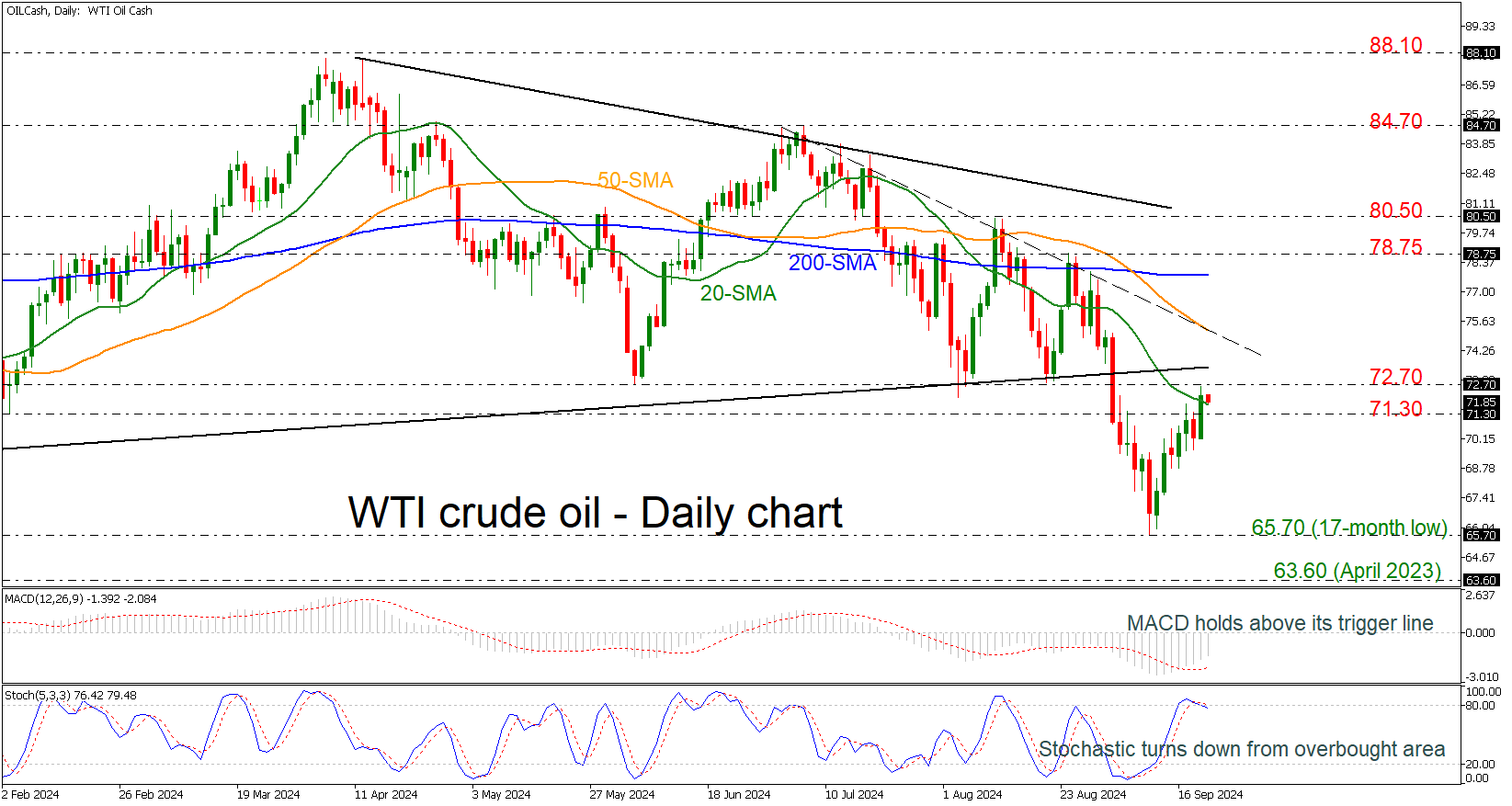
WTI crude oil prices have been creating a notable bullish correction after the significant bounce off the 17-month low of 65.70. Technically, the MACD oscillator is gaining some ground above its trigger line; however, the stochastic posted a bearish crossover within its %K and %D lines in the overbought region.
In case of more buying interest then the market may fight with the 72.70 resistance level ahead of the short-term descending trend line at 75.20, which overlaps with the 50-day simple moving average (SMA). Even higher, a strong obstacle could come from the 200-day SMA at 77.80.
On the flip side, a drop beneath the 71.30 support may drive the bears until the previous bottom of 65.70. Below that, the door could open for the April 2023 trough at 63.60.
All in all, WTI crude oil has been in a bearish tendency since it peaked at 84.70 on July and only a rally above the 200-day SMA may change the outlook to a more neutral one.
USD/JPY Outlook: Loses Ground as BoJ Keeps Rates on Hold and Says Not in Hurry for Further Tightening
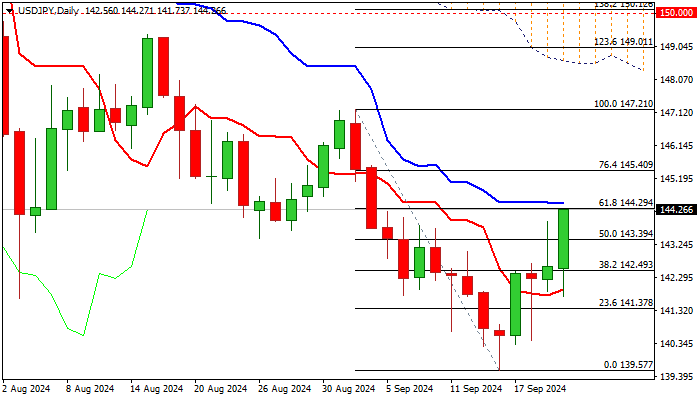
USDJPY jumped over two figures on Friday after Bank of Japan kept interest rates unchanged and signaled it was not in rush for further hikes, despite the borrowing cost is still very low.
Renewed attempt higher comes after Thursday’s rally of almost identical size stalled on approach to 144 barrier, with subsequent pullback contributing to daily candle with long upper shadow.
This could be a significant warning despite today’s renewed strength, as key barriers at 144.29/45 (Fibo 61.8% of 147.21/139.57/ daily Kijun-sen) need to be cleared to sideline persisting downside risk.
Daily studies point to bearish signals from still strong negative momentum, thickening descending daily cloud and overbought stochastic, partially offset by 10/20DMA’s now turning to bullish setup.
Fresh recovery is expected to keep in play while holding above broken 20DMA (143.42) though larger picture to remain biased lower as long as the price action holds below daily Kijun-sen.
Res: 144.45; 145.00; 145.40; 146.07.
Sup: 143.42; 142.49; 142.27; 142.00.
XAU/USD Outlook: Gold Surges to New All-Time High Above $2,600
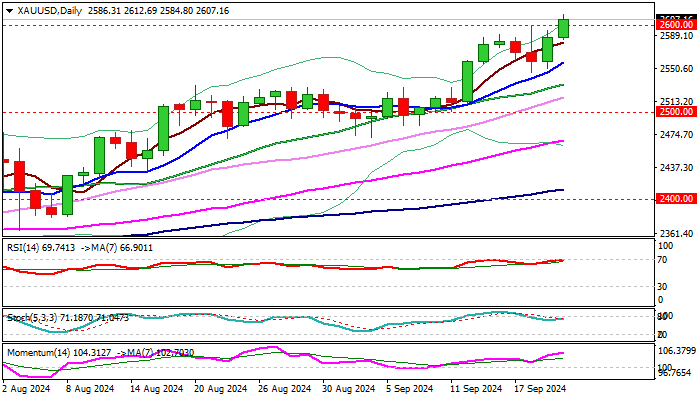
Gold broke through psychological $2600 barrier and hit new all-time high on Friday morning, on track to register clear break higher after the resistance was cracked in post-Fed jump but resisted attack.
The yellow metal shined after market digested Fed’s decision, with prospects for more rate cuts, deteriorating geopolitical situation, growing uncertainty over fiscal conditions in a number of Western economies and ongoing destabilization of the US dollar, boosting its safe haven appeal.
Fresh bull-leg $2546 (low of a shallow correction) signals continuation of larger uptrend, with close above $2600 to confirm signal.
Gold is also on track for the second consecutive weekly gain, which came after a triple weekly Doji candles, adding to bullish continuation signals.
Gold price has moved at a high speed and rose from $2000 (which marked very strong resistance) to $2600 in about ten months.
The sentiment is very bullish and sustained break above $2600 would look for targets at $2628 and $2650 (Fibo projections) initially, with stronger bullish acceleration to bring in focus $2700.
Dips on partial profit taking should be shallow and mark positioning for further advance.
Res: 2614; 2628; 2636; 2650.
Sup: 2600; 2589; 2581; 2557.
USD/CAD Eyes Canadian Retail Sales
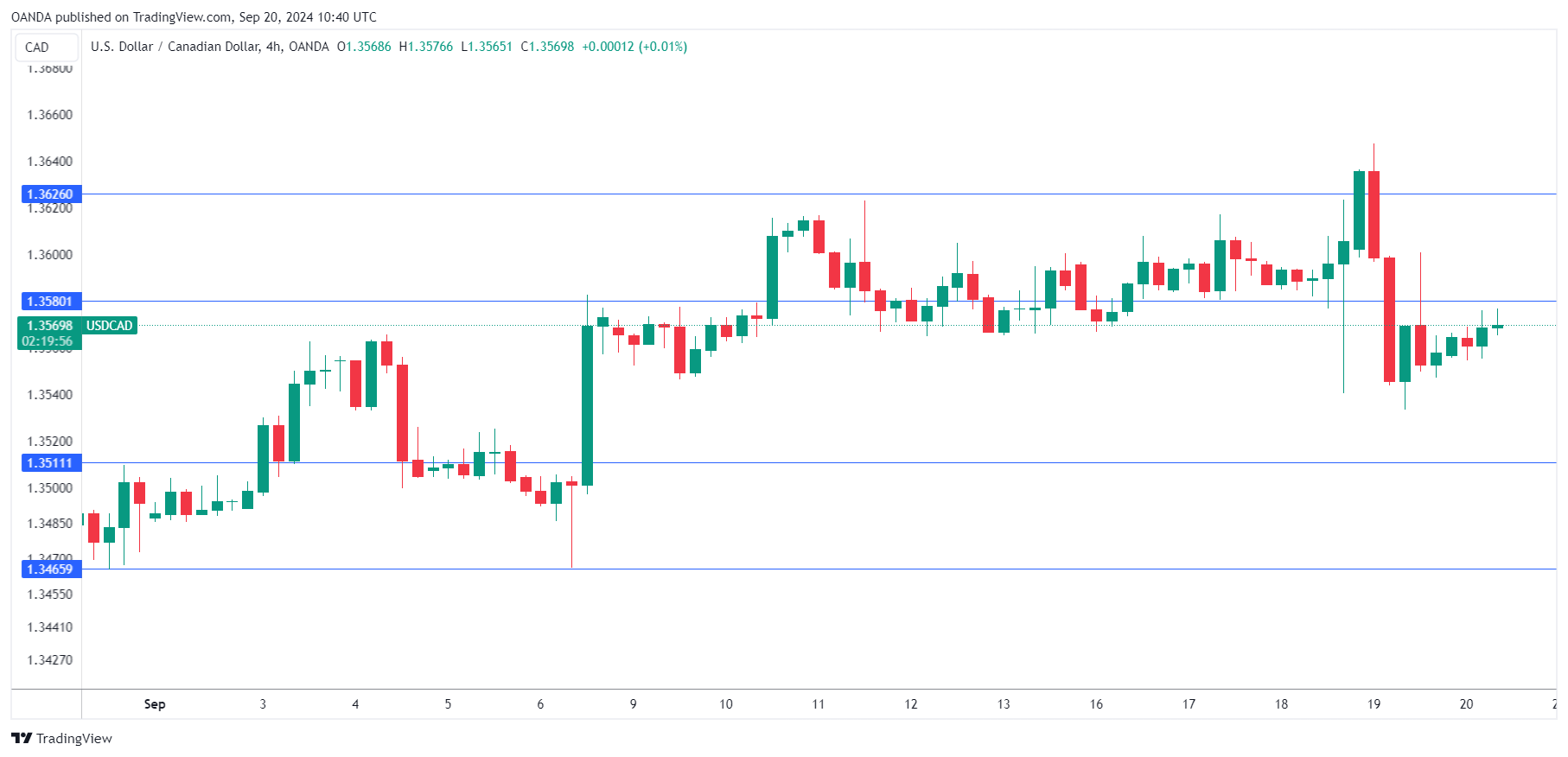
The Canadian dollar is steady on Friday. In the European session, USD/CAD is trading at 1.3573 at the time of writing, up 0.12% today. On the data calendar, Canada releases retail sales, while it’s an unusually quiet day in the US, with no releases.
Canada’s retail sales expected to bounce back in July
Canada’s retail sales are projected to have jumped 0.6% m/m in July, compared to -0.3% in June. On an annualized basis, retail sales are expected to improve to 0.7%, up from 0.2% in July. The Canadian economy is showing weakness, as high interest rates have taken their toll on economic growth. The good news is that inflation appears under control, falling to 2% in August, down from 2.5% a month earlier. This matches the Bank of Canada’s target and the aim now is to keep trimming rates and avoid a labor market crash. The BoC has already cut rates three times for a total of 0.75%, bringing the benchmark rate to 4.25%. The BoC doesn’t meet again until October 23 and will have plenty of data to review beforehand.
In the US, inflation is largely under control and the Federal Reserve has shifted its primary focus to the labor market, as job growth as deteriorated faster than expected. That slide has unnerved financial markets and may have been a key factor in the Fed’s jumbo rate cut of 50 basis points this week. Thursday’s unemployment claims for the period ending Sept. 14 were lower than expected, at 219 thousand. This was well below the revised 231 thousand reading a week earlier and beat the market estimate of 230 thousand.
USD/CAD Technical
- 1.3580 is under pressure in resistance. Above, there is resistance at 1.3626
- 1.3511 and 1.3465 are the next support levels
USD/JPY Surges as Bank of Japan Stays Pat
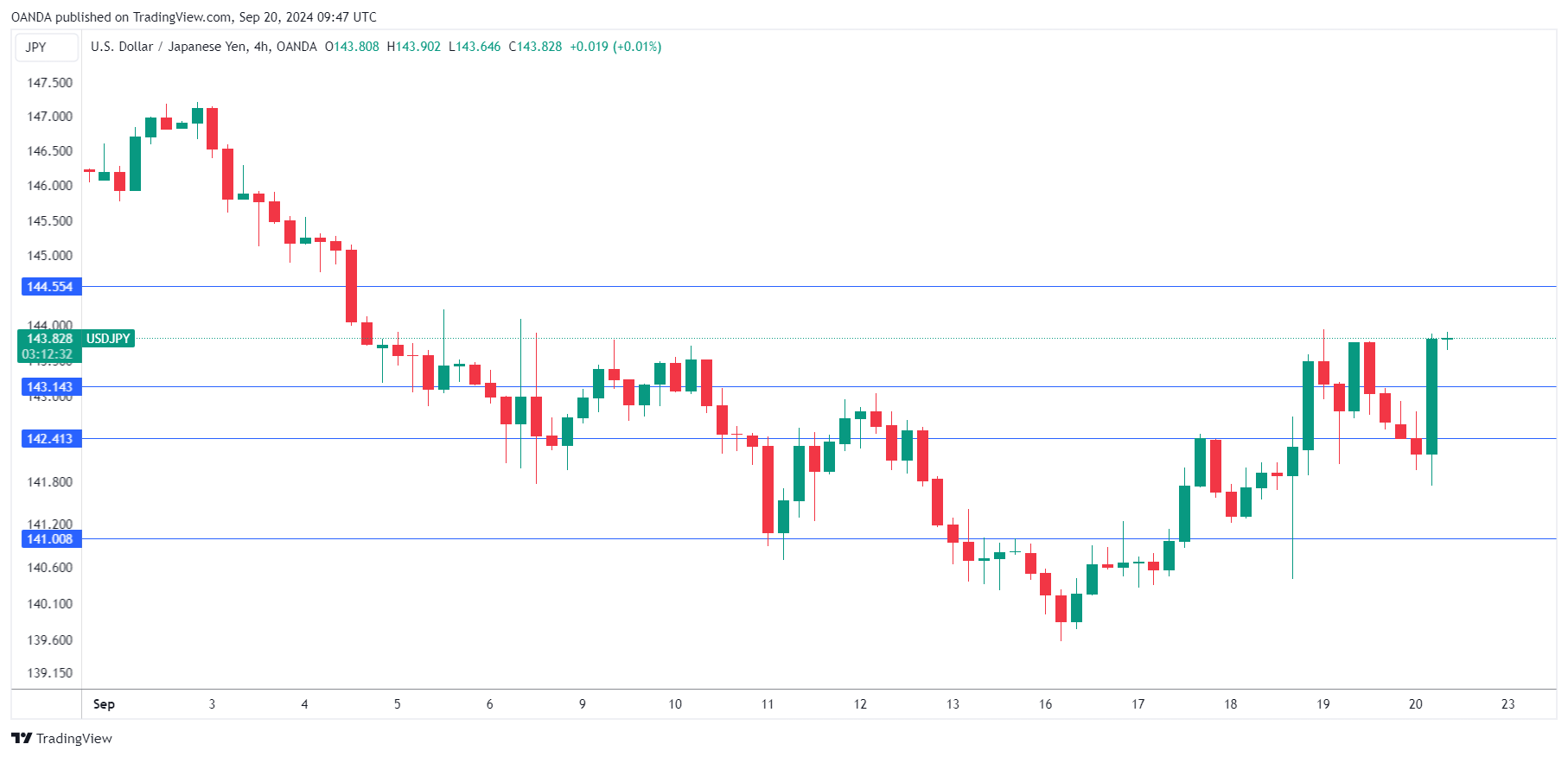
The US dollar has posted sharp gains on Friday. In the European session, USD/JPY is trading at 143.85, up 0.88% at the time of writing. The yen hit a 14-month high on Monday but the dollar has rebounded and is up 2.1% this week. It’s an unusually quiet Friday with no US events on the calendar.
Bank of Japan stays on sidelines
The Bank of Japan held its rate decision just after the Federal Reserve, but there was little drama at the BoJ meeting. The markets had expected that central bank to maintain rates at “around 0.25%” and the BoJ didn’t provide any clues about future hikes. The rate statement didn’t reveal much, stating that the economy had “recovered moderately” but some weakness remained.
The statement noted concern over “developments in financial and foreign exchange market and their impact on Japan’s economic activity and prices”. Governor Ueda said last month that the BoJ would raise rate if the economy and inflation were in line with the Bank’s projections. If key data, particularly inflation, is stronger than expected in the coming weeks, we could see a rate hike at the October meeting.
With inflation in the US largely under control, the Federal Reserve is keeping a worried eye on the labor market, as job growth as deteriorated quickly. That slide has unnerved financial markets and may have been a key factor in the Fed’s jumbo rate cut of 50 basis points this week. Thursday’s unemployment claims for the period ending Sept. 14 were better than expected, at 219 thousand. This was well below the revised 231 thousand reading a week earlier and beat the market estimate of 230 thousand.
USD/JPY Technical
- USD/JPY pushed above resistance at 142.41 earlier. The next resistance line is 144.55
- There is support at 142.41 and 141.00
Crypto Market’s Steady Ascent
Market Picture
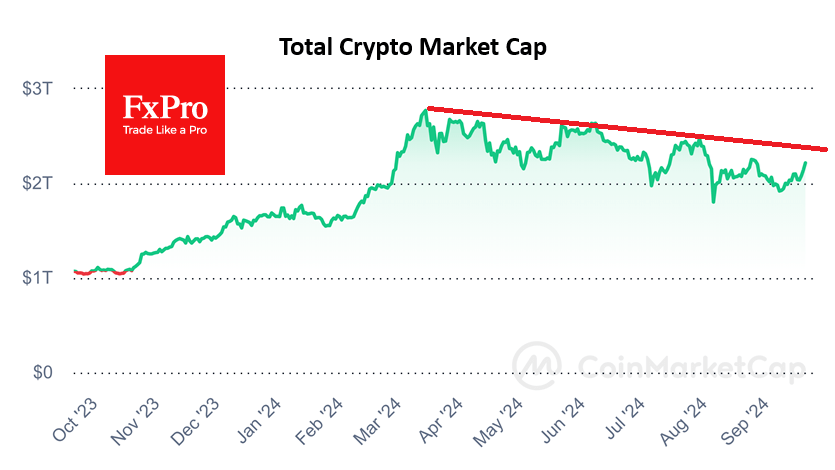
Active buying continues in the crypto market, with its total cap rising 3.2% in 24 hours to $2.21 trillion, reviving the fight to break the previous local high of $2.27 trillion a month ago. The local low in early September was above the previous low, and a break of the recent highs could provide fresh buying momentum and signal a break in the multi-month downtrend.
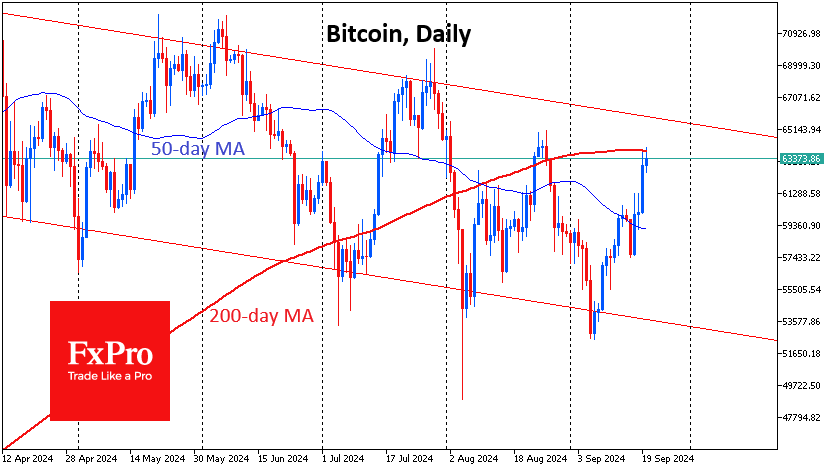
Bitcoin broke above $64K on Friday morning and is fast approaching a test of the emotionally important 200-day moving average, which also holds the late August highs. Overcoming this resistance would open the way to the upper boundary of the descending channel at $66K and a break of the downtrend on the rise above $68K.
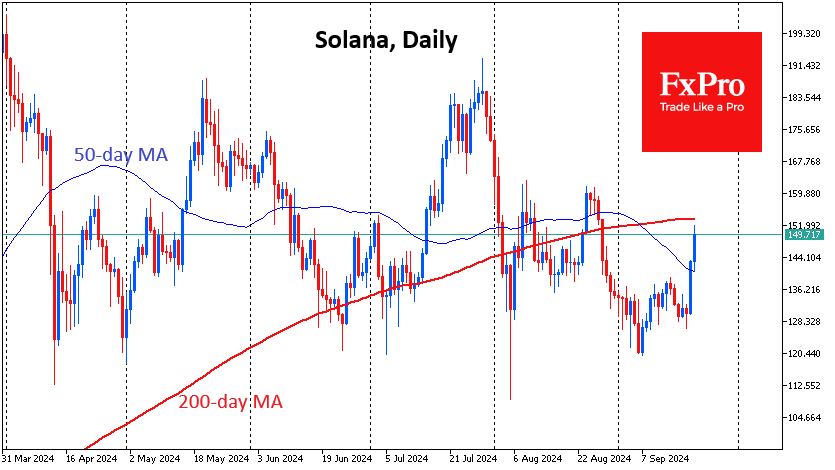
The turnaround in market sentiment has helped Solana, which has rallied around 20% from the lows seen just before the Fed meeting. In the daily timeframe, the coin has consolidated above the 50-day moving average and is approaching the 200-day (around $154) at current levels near $150.
News Background
The world’s largest investment company, BlackRock, called Bitcoin a unique tool for hedging global risks and a defence against a possible depreciation of the dollar amid the growing US federal budget deficit. At the same time, BlackRock has only $21bn in bitcoin ETFs, just 0.69% of the company’s assets in exchange-traded funds.
On 18 September, the documentary “Vitalik: An Ethereum Story” premiered in 23 countries.
US State Louisiana has integrated Bitcoin and Lightning Network, as well as USDC stablecoin, into state operations. A special service will convert incoming digital assets into dollars.
Commerzbank, one of Germany’s largest banks, will partner with Crypto Finance, a subsidiary of Deutsche Boerse Group, to offer cryptocurrency trading and custody services to corporate clients.
Tether called its curated stablecoin “a cornerstone in modern financial ecosystems.” USDT’s 350 million users transact with it, and its issuer works with 180 institutions in 45 jurisdictions. The report’s publication could be a response to a recent attack by consumer advocacy group Consumers’ Research.
German police seized the servers of 47 illegal cryptocurrency exchanges, which were being used by encryption virus operators, botnet owners, and darknet marketplace sellers.
BoE’s Mann favors extended tight policy before swift, aggressive cuts
In a speech today, BoE MPC member Catherine Mann emphasized the importance of a cautious approach to easing monetary policy, stating that it's preferable to remain restrictive longer amid inflation uncertainties.
She argued that "a risk management assessment implies it is better, under inflation uncertainty, to remain restrictive for longer, until right tail risks to the inflation process dissipate, and then to cut more aggressively."
This "more activist strategy", according to her, would allow for a sustainable inflation outcome with less impact on the economy, as she mentioned it helps achieve the target "at a lower sacrifice ratio."
Despite agreeing with the majority of the MPC members on holding rates steady in the latest meeting, Mann has expressed a "guarded view" on starting the cutting cycle. Having voted against the 25bps rate cut in August, Mann again voted to hold yesterday.