Sample Category Title
EUR/CHF Daily Outlook
Daily Pivots: (S1) 0.9392; (P) 0.9419; (R1) 0.9458; More....
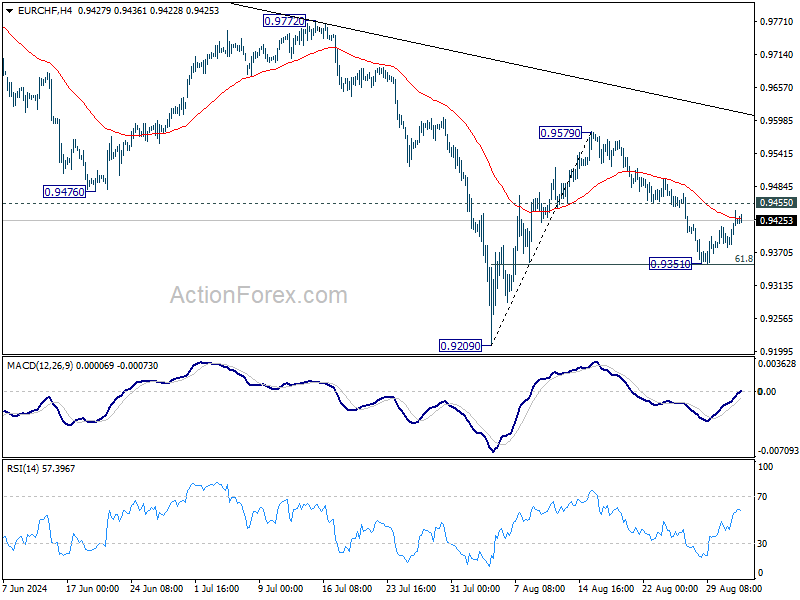
Intraday bias in EUR/CHF remains neutral and outlook is unchanged. As noted before, rebound from 0.9209 could have completed at 0.9579 already. Deeper fall is expected as long as 0.9455 minor resistance holds. Break of 0.9351 will target 0.9209 low next. However, break of 0.9497 will turn bias back to the upside for 0.9579 resistance instead.
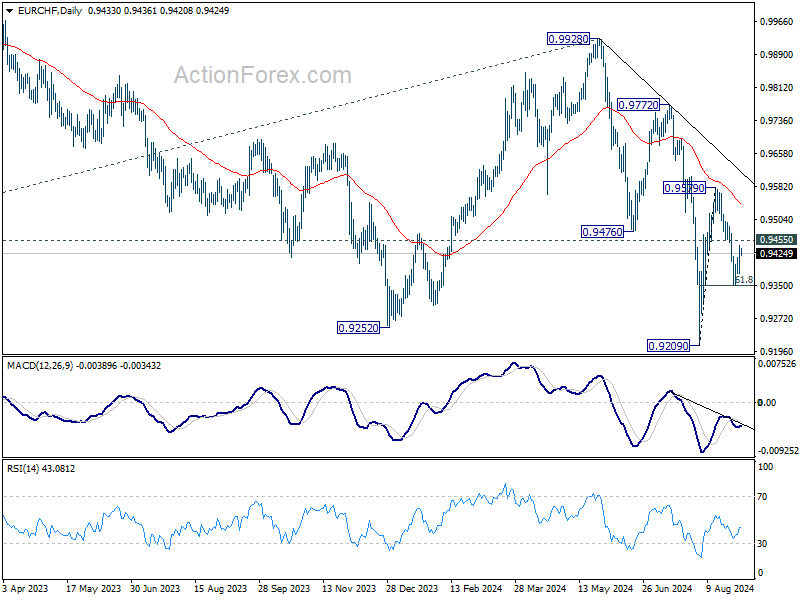
In the bigger picture, medium term corrective pattern from 0.9407 (2022 low) might have completed with three waves to 0.9928. Decisive break of 0.9252 (2023 low) will confirm long term down trend resumption. Next target will be 61.8% projection of 1.1149 to 0.9407 from 0.9928 at 0.8851. For now, outlook will stay bearish as long as 0.9928 resistance holds, even in case of strong rebound.
USD/CAD Daily Outlook
Daily Pivots: (S1) 1.3485; (P) 1.3495; (R1) 1.3505; More...
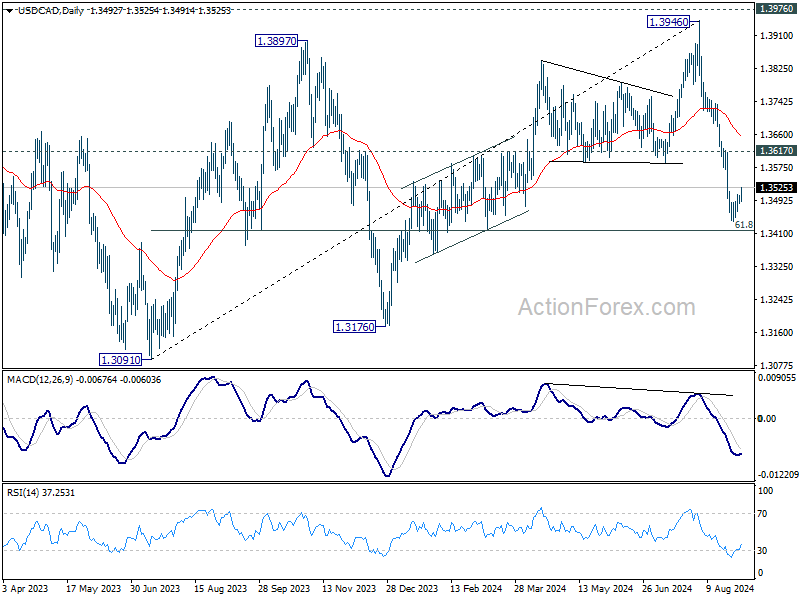
Intraday bias in USD/CAD remains neutral at this point. Some more consolidations would be seen above 1.3439, and stronger recovery cannot be ruled out. But further decline is expected as long as 1.3617 resistance holds. Break of 1.3439 and sustained trading below 61.8% retracement of 1.3091 to 1.3946 at 1.3418 will pave the way to 1.3091/3176 support zone next.

In the bigger picture, current development suggests that corrective pattern from 1.3976 (2022 high) is extending with another falling leg. While deeper decline could be seen, strong support should emerge above 1.2947 resistance turned support to bring rebound. Rise from 1.2005 (2021 low) is still in favor to resume at a later stage.
AUD/USD Daily Report
Daily Pivots: (S1) 0.6766; (P) 0.6782; (R1) 0.6807; More...
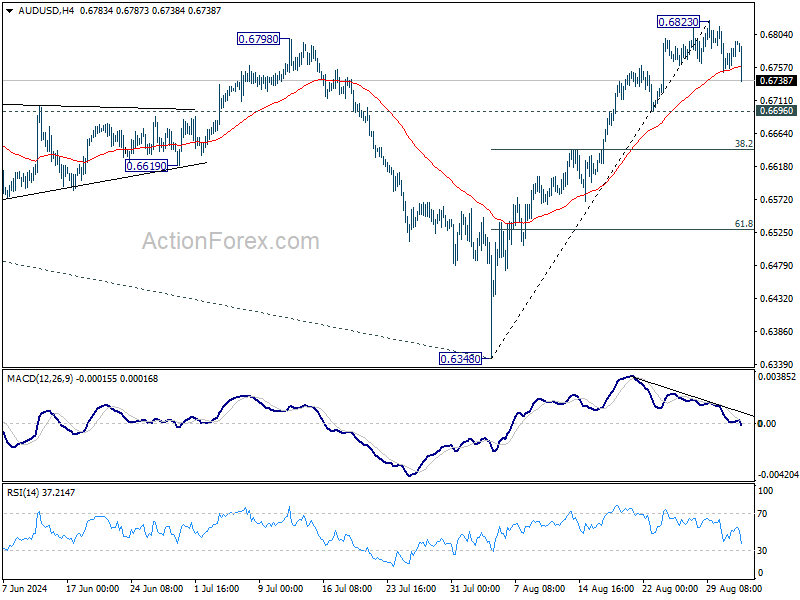
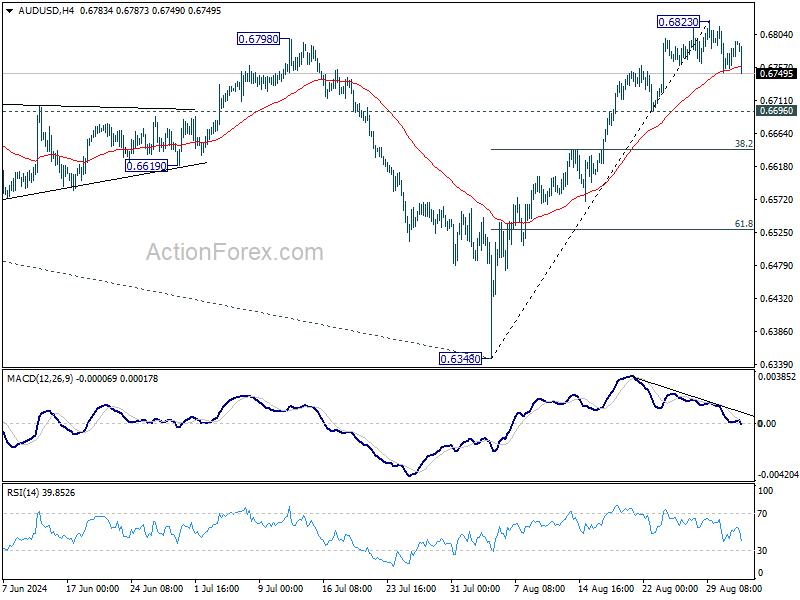
Intraday bias in AUD/USD remains neutral as consolidation form 0.6823 is extending. Deeper fall might be seen but downside should b contained by 0.6696 support to bring rebound. Above 0.6823 will target 0.6870 resistance next. However, break of 0.6696 support will indicate short term topping, on bearish divergence condition in 4H MACD, and turn bias back to the downside for 38.2% retracement of 0.6348 to 0.6823 at 0.6642 and possibly below.
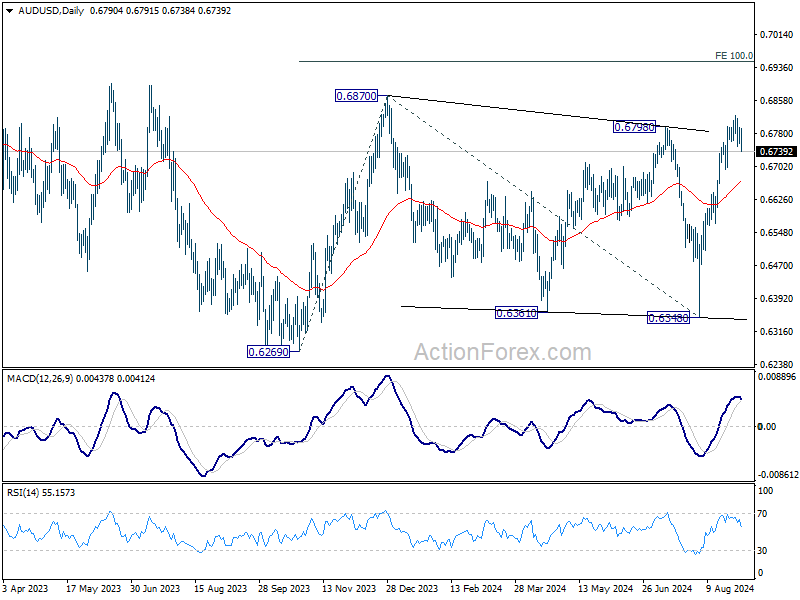
In the bigger picture, overall, price actions from 0.6169 (2022 low) are seen as a medium term corrective pattern, with rise from 0.6269 as the third leg. Firm break of 0.6798/6870 resistance zone will target 0.7156 resistance. In case of another fall, strong support should be seen from 0.6169/6361 to bring rebound.
EUR/USD Daily Outlook
Daily Pivots: (S1) 1.1050; (P) 1.1064; (R1) 1.1086; More....
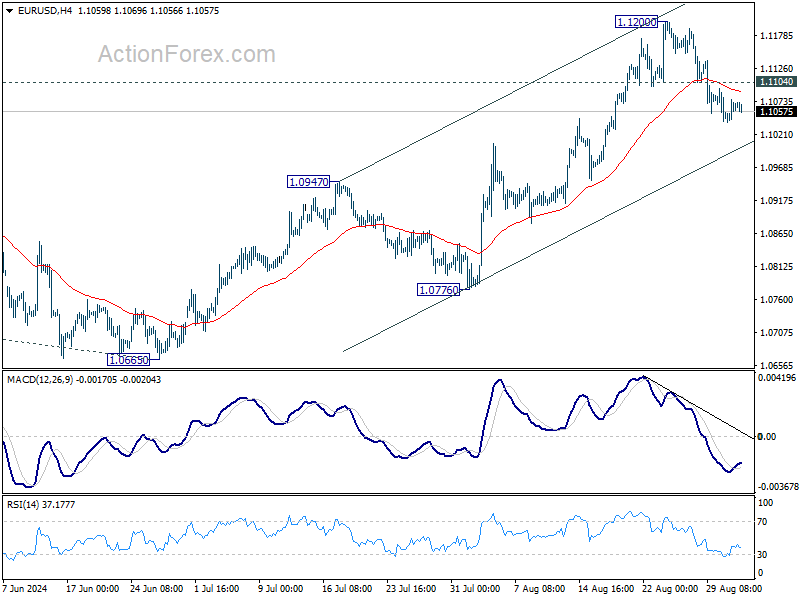
Intraday bias in EUR/USD remains neutral for the moment. While retreat from 1.1200 might extend lower, rally from 1.0665 is in favor to continue as long as 1.0947 resistance turned support holds. Above 1.1104 minor resistance will bring retest of 1.1200 first. Break there will target 1.1274 high next.
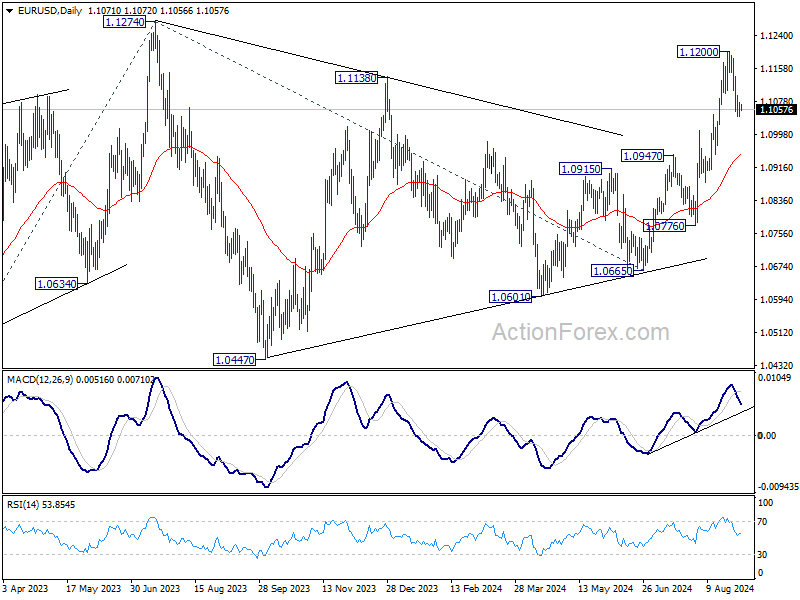
In the bigger picture, prior break of 1.1138 resistance indicates that corrective pattern from 1.1274 has completed at 1.0665 already. Decisive break of 1.1274 (2023 high) will confirm whole up trend from 0.9534 (2022 low). Next target will be 61.8% projection of 0.9534 to 1.1274 from 1.0665 at 1.1740. This will now be the favored case as long as 1.0947 resistance turned support holds.
GBP/USD Daily Outlook
Daily Pivots: (S1) 1.3126; (P) 1.3140; (R1) 1.3162; More...
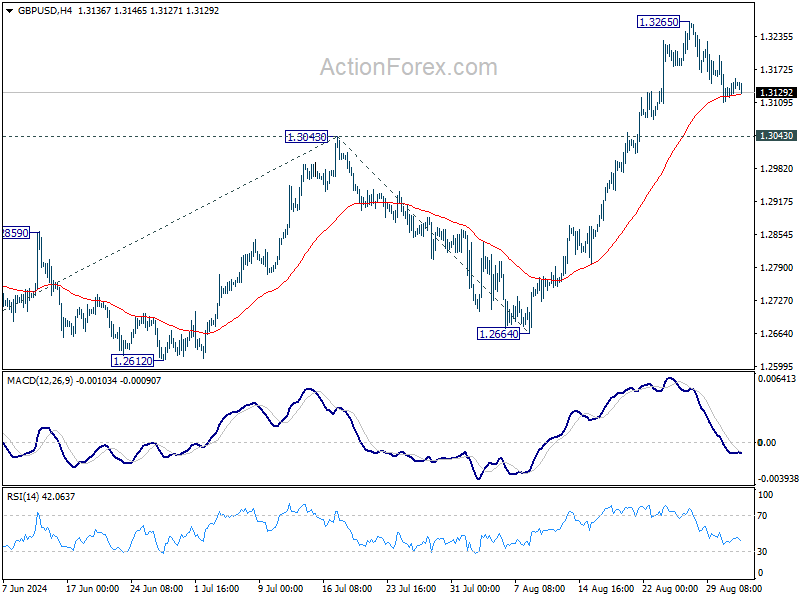
Intraday bias in GBP/USD remains neutral as consolidation continues below 1.3265. While deeper retreat cannot be ruled out, downside should be contained well above 1.3043 resistance turned support to bring rebound. On the upside, above 1.3265 will resume larger up trend to 100% projection of 1.2298 to 1.3043 from 1.2664 at 1.3409.
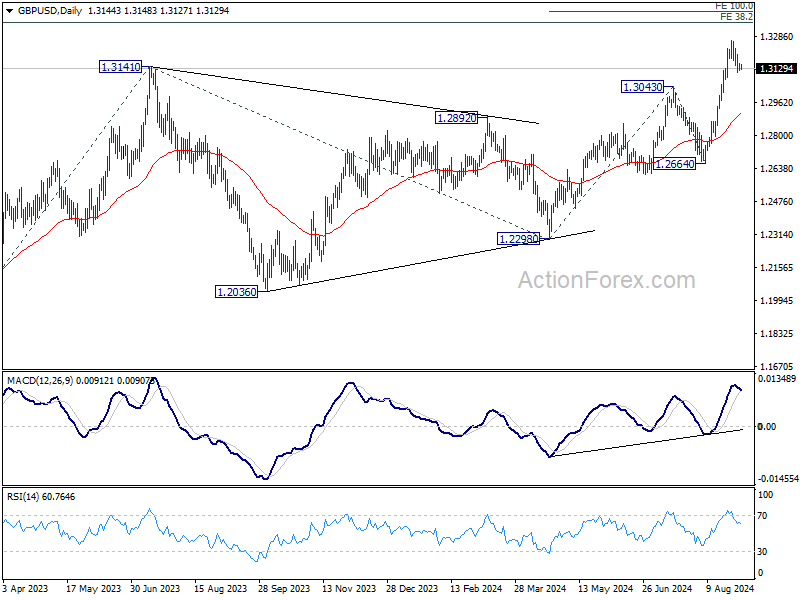
In the bigger picture, up trend from 1.0351 (2022 low) is resuming. Next target is 38.2% projection of 1.0351 to 1.3141 from 1.2298 at 1.3364. For now, outlook will stay bullish as long as 1.2664 support holds, even in case of deep pullback.
USD/JPY Daily Outlook
Daily Pivots: (S1) 146.08; (P) 146.62; (R1) 147.47; More...
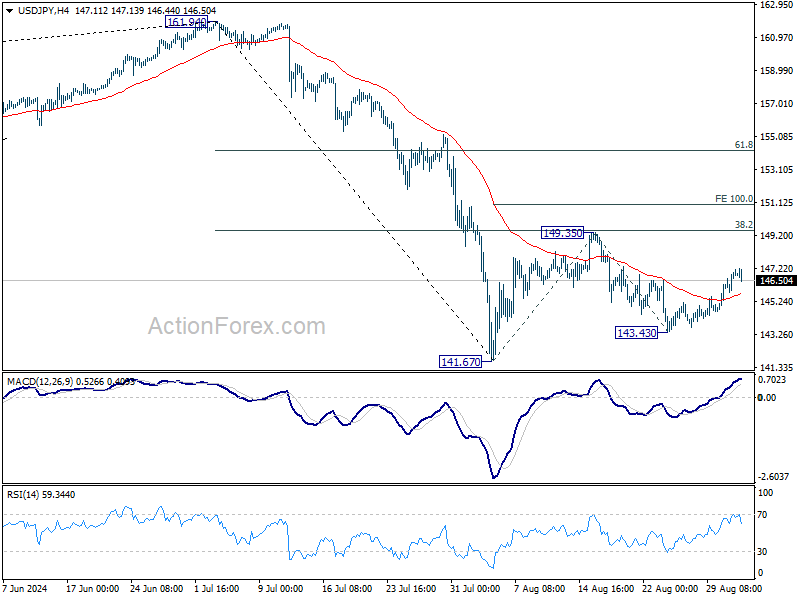
Intraday bias in USD/JPY remains mildly on the upside at this point. Pull back from 149.35 should have completed at 143.43 already. Further rise should be seen to 149.35 resistance first. Firm break there will resume the rebound from 141.67 and target 100% projection of 141.67 to 149.35 from 143.43 at 151.11, as the second leg of the corrective pattern from 161.94 high. For now, risk will stay on the upside as long as 143.43 support holds, in case of retreat.
In the bigger picture, fall from 161.94 medium term top is seen as correcting whole up trend from 102.58 (2021 low). Deeper decline could be seen to 38.2% retracement of 102.58 to 161.94 at 139.26, which is close to 140.25 support. In any case, risk will stay on the downside as long as 55 W EMA (now at 149.47) holds. Nevertheless, firm break of 55 W EMA will suggest that the range for medium term corrective pattern is already set.

USD/CHF Daily Outlook
Daily Pivots: (S1) 0.8489; (P) 0.8513; (R1) 0.8542; More…
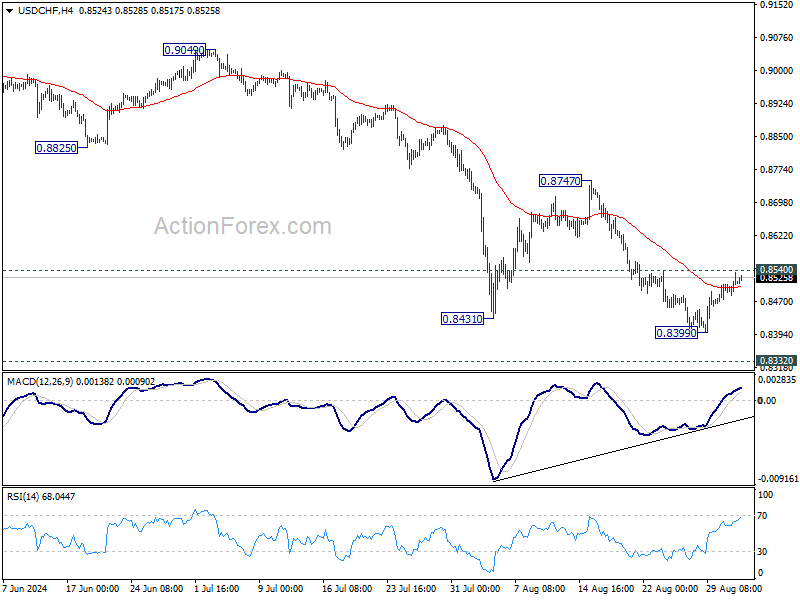
Intraday bias in USD/CHF remains neutral at this point and more consolidations could be seen above 0.8399. Further decline is expected as long as 0.8540 resistance holds. Break of 0.8339 will resume the fall from 0.9223 and target 0.8332 low. However, considering bullish convergence condition in 4H MACD, firm break of 0.8540 will confirm short term bottoming, and turn bias back to the upside for 0.8747 resistance instead.
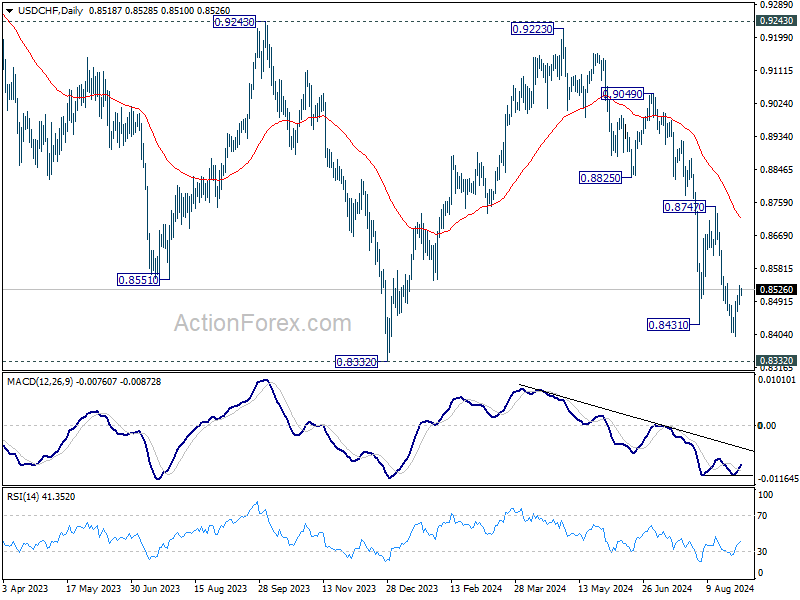
In the bigger picture, price actions from 0.8332 (2023 low) are currently seen as a medium term corrective pattern, with fall from 0.9223 as the second leg. Strong support could be seen from 0.8332 to bring rebound. Yet, overall outlook will continue to stay bearish as long as 0.9243 resistance holds. Firm break of 0.8332, however, will resume larger down trend from 1.0146 (2022 high).
Dollar Firm Ahead of ISM Manufacturing; Swiss GDP and CPI Also in Spotlight
Dollar is trading with a slightly firm tone this week, though overall forex market activity has been relatively subdued. It's worth noting that last month's sharp selloff in US stocks was actually started with disappointing ISM manufacturing data, which was then exacerbated by the non-farm payrolls report. Given this backdrop, today's release could trigger volatility if there are any surprises.
The US manufacturing sector has been contracting since late 2022, as indicated by the ISM index. The brief uptick to 50.3 in March, which signaled a return to expansion, turned out to be short-lived, with the index subsequently falling for four consecutive months, reaching a low of 46.8 in July. For August, a modest recovery to 47.8 is anticipated, but any negative surprise could reignite fears of a recession and lead to renewed market jitters.
In Europe, attention will be on Swiss CPI and GDP figures. Outgoing SNB Chair Thomas Jordan recently expressed concerns over the impact of a strong Swiss Franc and weak European demand on the Swiss industry. If today's GDP data disappoints, it could heighten concerns at the SNB, while a lower-than-expected inflation reading might provide the central bank with the flexibility to consider a 50 bps rate cut this month, rather than the widely anticipated 25bps.
Technically, AUD/USD is extending the retreat from 0.6823. While further fall cannot be ruled out, strong support should be seen from 0.6696 to bring rebound, and then resumption of whole rise from 0.6348. However, firm break of 0.6696 will indicate that deeper correction is underway for 38.2% retracement of 0.6348 to 0.6823 at 0.6642 and possibly below. The pair's next move will largely depend on the overall risk sentiment in the market as traders digest the upcoming economic data.
In Asia, at the time of writing, Nikkei is up 0.22%. Hong Kong HSI is down -0.38%. China Shanghai SSE is down -0.50%. Singapore Strait Times is up 0.25%. Japan 10-year JGB yield is up 0.0077 at 0.919.
NZIER expects Oct RBNZ rate cut, further easing hinges on demand recovery
The New Zealand Institute of Economic Research indicated today that it expects RBNZ to implement another interest rate cut during its October meeting. This follows RBNZ's decision in August to bring forward its easing cycle in response to "deterioration in economic outlook." However, NZIER notes that the pace of further easing remains highly uncertain, with a potential pause in November depending on how quickly demand recovers.
Weaker demand has become a significant concern for businesses, with 61% of firms identifying it as the primary constraint on their operations. This declining demand is also having an impact on the labor market, where there is now more slack as companies reduce hiring in response to the softer economic environment.
Looking ahead, NZIER forecasts GDP growth to remain subdued over the next year, contributing to further decline in inflation. The institute predicts that annual CPI inflation will fall back within RBNZ's target band by the end of this year, which underpins its expectation for another Official OCR cut in October.
However, the uncertainty surrounding the economic recovery suggests that any further rate cuts after October will be closely tied to the extent of demand recovery, with the November meeting likely to be a key decision point.
New Zealand's terms of trade improve in Q2 despite decline in export volumes
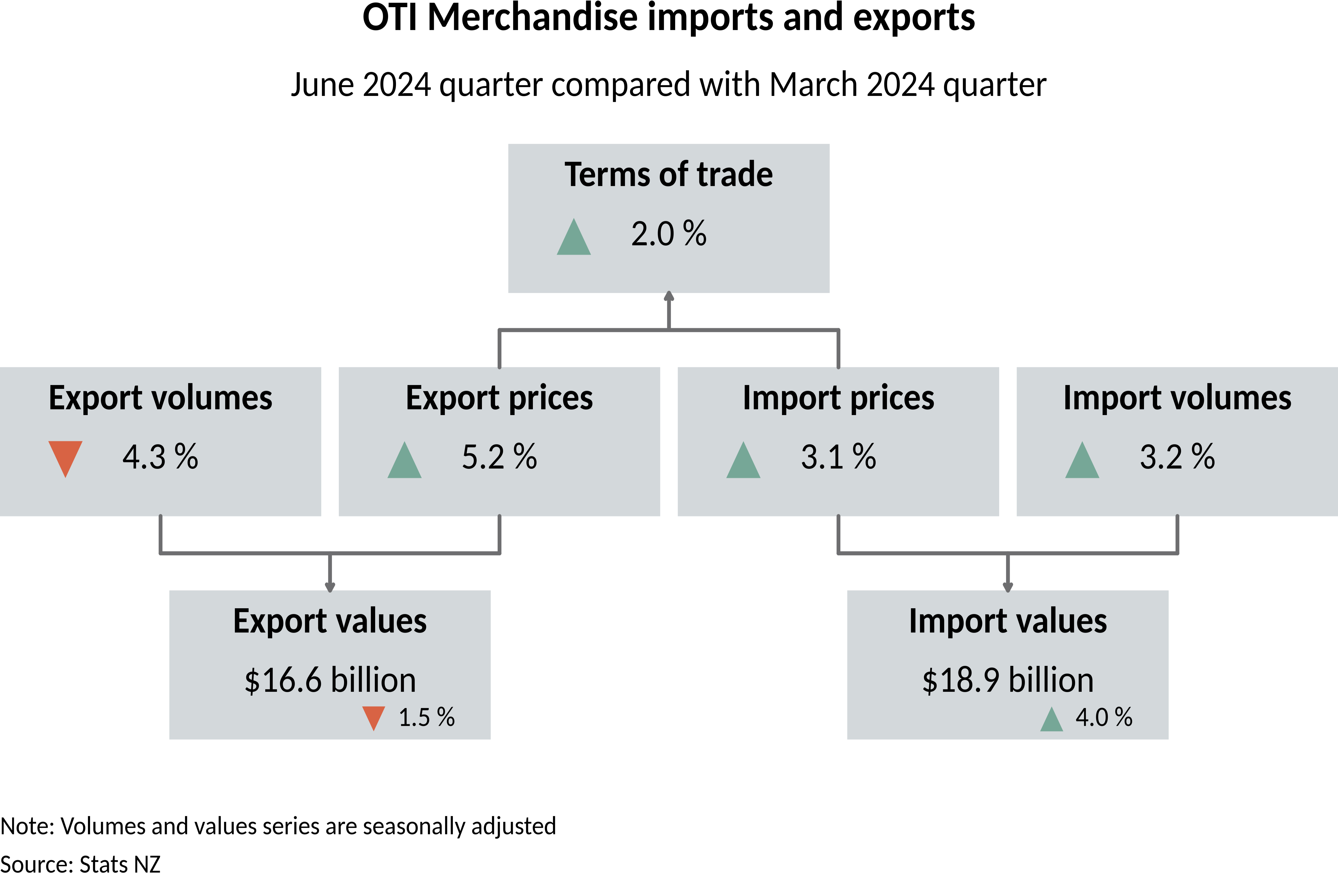
New Zealand's terms of trade saw a solid improvement in the second quarter of 2024, rising by 2.0%. This increase was driven by a 5.2% rise in export prices, which outpaced the 3.1% increase in import prices. However, the value of exports decreased by -1.5% to NZD 16.6 billion, largely due to a -4.3% drop in export volumes, even as higher prices provided some support.
Dairy products played a significant role in the export dynamics, with prices rising by 8.0%. Despite this, dairy export volumes fell sharply by -10%, leading to an 8-.0% decline in the overall value of dairy exports. The meat sector, on the other hand, performed better, with prices rising by 7.3%, volumes increasing by 4.1%, and the total value of meat exports up by 6.5%.
On the import side, the total value rose by 4.0% to NZD 18.9B, supported by a 3.2% increase in import volumes. Petroleum and petroleum products were notable contributors, with prices up by 4.0%. However, petroleum volumes declined by -8.0%, leading to a -4.4% decrease in the overall value of these imports.
Looking ahead
Swiss CPI and GDP are the two main focuses in European session. Later in the day, US ISM manufacturing will take center stage.
USD/CHF Daily Outlook
Daily Pivots: (S1) 0.8489; (P) 0.8513; (R1) 0.8542; More…
Intraday bias in USD/CHF remains neutral at this point and more consolidations could be seen above 0.8399. Further decline is expected as long as 0.8540 resistance holds. Break of 0.8339 will resume the fall from 0.9223 and target 0.8332 low. However, considering bullish convergence condition in 4H MACD, firm break of 0.8540 will confirm short term bottoming, and turn bias back to the upside for 0.8747 resistance instead.
In the bigger picture, price actions from 0.8332 (2023 low) are currently seen as a medium term corrective pattern, with fall from 0.9223 as the second leg. Strong support could be seen from 0.8332 to bring rebound. Yet, overall outlook will continue to stay bearish as long as 0.9243 resistance holds. Firm break of 0.8332, however, will resume larger down trend from 1.0146 (2022 high).
Economic Indicators Update
| GMT | Ccy | Events | Actual | Forecast | Previous | Revised |
|---|---|---|---|---|---|---|
| 22:45 | NZD | Terms of Trade Index Q2 | 2.00% | 2.80% | 5.10% | |
| 23:50 | JPY | Monetary Base Y/Y Aug | 0.60% | 0.60% | 1.00% | |
| 01:30 | AUD | Current Account (AUD) Q2 | -10.7B | -5.5B | -4.9B | -6.3B |
| 06:30 | CHF | CPI M/M Aug | 0.10% | -0.20% | ||
| 06:30 | CHF | CPI Y/Y Aug | 1.20% | 1.30% | ||
| 07:00 | CHF | GDP Q/Q Q2 | 0.60% | 0.50% | ||
| 13:30 | CAD | Manufacturing PMI Aug | 47.8 | |||
| 13:45 | USD | Manufacturing PMI Aug F | 48 | 48 | ||
| 14:00 | USD | ISM Manufacturing PMI Aug | 47.8 | 46.8 | ||
| 14:00 | USD | ISM Manufacturing Prices Paid Aug | 52.5 | 52.9 | ||
| 14:00 | USD | ISM Manufacturing Employment Aug | 43.4 | |||
| 14:00 | USD | Construction Spending M/M Jul | 0.10% | -0.30% |
NZIER expects Oct RBNZ rate cut, further easing hinges on demand recovery
The New Zealand Institute of Economic Research indicated today that it expects RBNZ to implement another interest rate cut during its October meeting. This follows RBNZ's decision in August to bring forward its easing cycle in response to "deterioration in economic outlook." However, NZIER notes that the pace of further easing remains highly uncertain, with a potential pause in November depending on how quickly demand recovers.
Weaker demand has become a significant concern for businesses, with 61% of firms identifying it as the primary constraint on their operations. This declining demand is also having an impact on the labor market, where there is now more slack as companies reduce hiring in response to the softer economic environment.
Looking ahead, NZIER forecasts GDP growth to remain subdued over the next year, contributing to further decline in inflation. The institute predicts that annual CPI inflation will fall back within RBNZ's target band by the end of this year, which underpins its expectation for another Official OCR cut in October.
However, the uncertainty surrounding the economic recovery suggests that any further rate cuts after October will be closely tied to the extent of demand recovery, with the November meeting likely to be a key decision point.
New Zealand’s terms of trade improve in Q2 despite decline in export volumes
New Zealand's terms of trade saw a solid improvement in the second quarter of 2024, rising by 2.0%. This increase was driven by a 5.2% rise in export prices, which outpaced the 3.1% increase in import prices. However, the value of exports decreased by -1.5% to NZD 16.6 billion, largely due to a -4.3% drop in export volumes, even as higher prices provided some support.
Dairy products played a significant role in the export dynamics, with prices rising by 8.0%. Despite this, dairy export volumes fell sharply by -10%, leading to an 8-.0% decline in the overall value of dairy exports. The meat sector, on the other hand, performed better, with prices rising by 7.3%, volumes increasing by 4.1%, and the total value of meat exports up by 6.5%.
On the import side, the total value rose by 4.0% to NZD 18.9B, supported by a 3.2% increase in import volumes. Petroleum and petroleum products were notable contributors, with prices up by 4.0%. However, petroleum volumes declined by -8.0%, leading to a -4.4% decrease in the overall value of these imports.