Sample Category Title
Market Analysis: AUD/USD and NZD/USD Sight Steady Increase
AUD/USD is attempting a recovery wave from 0.6590. NZD/USD could gain bullish momentum if there is a clear move above the 0.6150 resistance.
Important Takeaways for AUD/USD and NZD/USD Analysis Today
- The Aussie Dollar found support near 0.6590 and is now recovering against the US Dollar.
- There was a break above a key bearish trend line with resistance at 0.6630 on the hourly chart of AUD/USD at FXOpen.
- NZD/USD is attempting a recovery wave above the 0.6110 resistance.
- There is a major bearish trend line forming with resistance near 0.6150 on the hourly chart of NZD/USD at FXOpen.
AUD/USD Technical Analysis
On the hourly chart of AUD/USD at FXOpen, the pair dipped from the 0.6700 resistance zone. The Aussie Dollar declined below 0.6660, but the bulls were active near 0.6600 against the US Dollar.
A low was formed near 0.6590 and the pair is now correcting losses. There was a move above the 50% Fib retracement level of the downward move from the 0.6704 swing high to the 0.6585 low. There was also a break above a key bearish trend line with resistance at 0.6630.
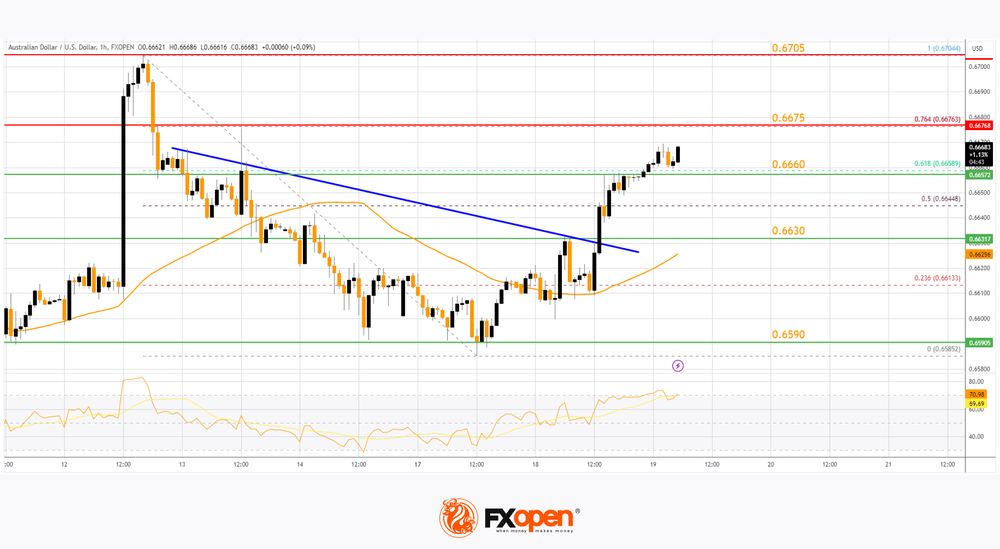
The pair is now above 0.6660 and the 50-hour simple moving average. On the upside, immediate resistance is near the 76.4% Fib retracement level of the downward move from the 0.6704 swing high to the 0.6585 low at 0.6675.
The first major resistance is near a rising channel at 0.6705. A clear upside break above 0.6705 could send the pair toward 0.6750. The next major resistance on the AUD/USD chart is near 0.6780, above which the price could rise toward 0.6800. Any more gains might send the pair toward 0.6820.
On the downside, initial support is near 0.6660. The next support could be the 0.6630 zone or the 50-hour simple moving average. Any more losses might send the pair toward the 0.6590 support.
Read analytical AUD/USD price forecasts for 2024 and beyond.
NZD/USD Technical Analysis
On the hourly chart of NZD/USD on FXOpen, the pair also followed a similar pattern and declined from the 0.6220 zone. The New Zealand Dollar gained bearish momentum and traded below 0.6150 against the US Dollar.
The pair even dropped below the 50-hour simple moving average and tested 0.6100. A low was formed near 0.6095 and the pair is now attempting a fresh increase. It is back above the 0.6110 level and the 50-hour simple moving average.
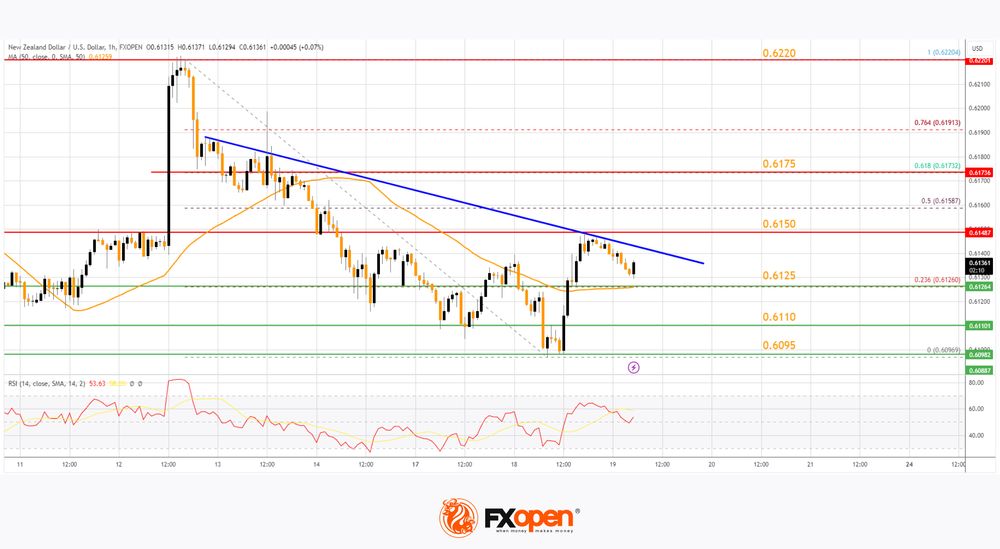
On the upside, the pair is facing resistance near the 50% Fib retracement level of the downward move from the 0.6220 swing high to the 0.6096 low. There is also a major bearish trend line forming with resistance near 0.6150.
The next major resistance is near the 61.8% Fib retracement level of the downward move from the 0.6220 swing high to the 0.6096 low at 0.6175. If there is a move above 0.6175, the pair could rise toward the 0.6220 resistance.
Any more gains might open the doors for a move toward the 0.6250 resistance zone. On the downside, immediate support on the NZD/USD chart is near 0.6125.
The next major support is near the 0.6110 zone. If there is a downside break below 0.6110, the pair could extend the decline toward the 0.6095 level. The next key support is near 0.6965.
Trade over 50 forex markets 24 hours a day with FXOpen. Take advantage of low commissions, deep liquidity, and spreads from 0.0 pips. Open your FXOpen account now or learn more about trading forex with FXOpen.
This article represents the opinion of the Companies operating under the FXOpen brand only. It is not to be construed as an offer, solicitation, or recommendation with respect to products and services provided by the Companies operating under the FXOpen brand, nor is it to be considered financial advice.
EUR/CHF Daily Outlook
Daily Pivots: (S1) 0.9466; (P) 0.9512; (R1) 0.9541; More....
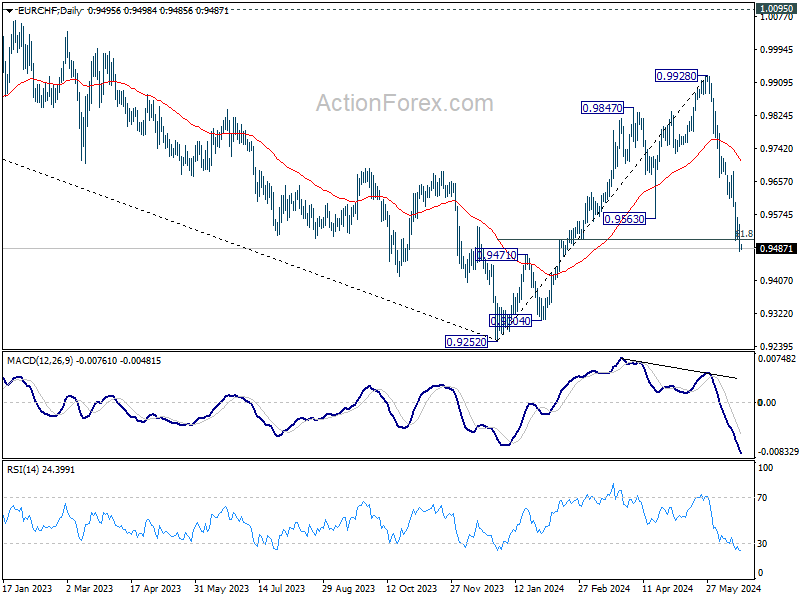
Intraday bias in EUR/CHF remains on the downside at this point Sustained trading below below 61.8% retracement of 0.9252 to 0.9928 at 0.9510 will raise the chance of long term down trend resumption, and target 0.9252 low next. On the upside, above 0.9566 minor resistance will turn intraday bias neutral again first.
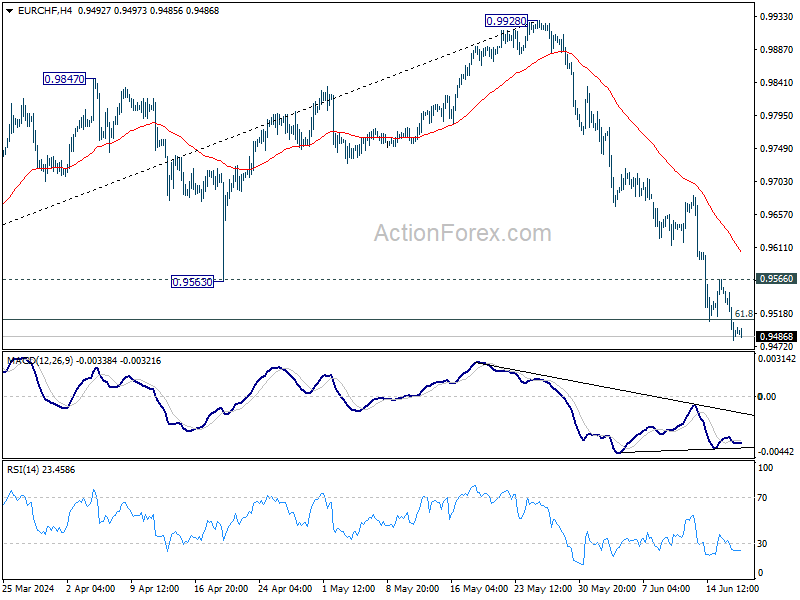
In the bigger picture, the break of 0.9563 support, as well as 55 W EMA (now at 0.9672) argues that rebound from 0.9252 has completed at 0.9928. Medium term bearish is maintained with both 1.0095 resistance intact. Firm break of 0.9252 will resume the down trend from 1.2004 (2018 high).
EUR/AUD Daily Outlook
Daily Pivots: (S1) 1.6093; (P) 1.6172; (R1) 1.6212; More...
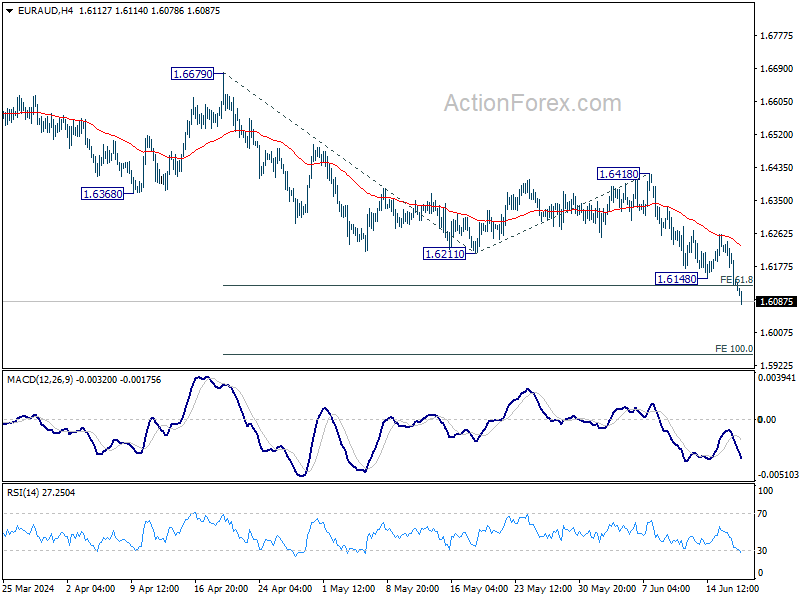
EUR/AUD's down trend resumed by breaking through 1.6148 temporary low and intraday bias is back on the downside. Next target is 100% projection of 1.6679 to 1.6211 from 1.6418 at 1.5950. On the upside, above 1.6148 minor resistance will turn intraday bias neutral and bring consolidations again, before staging another decline.
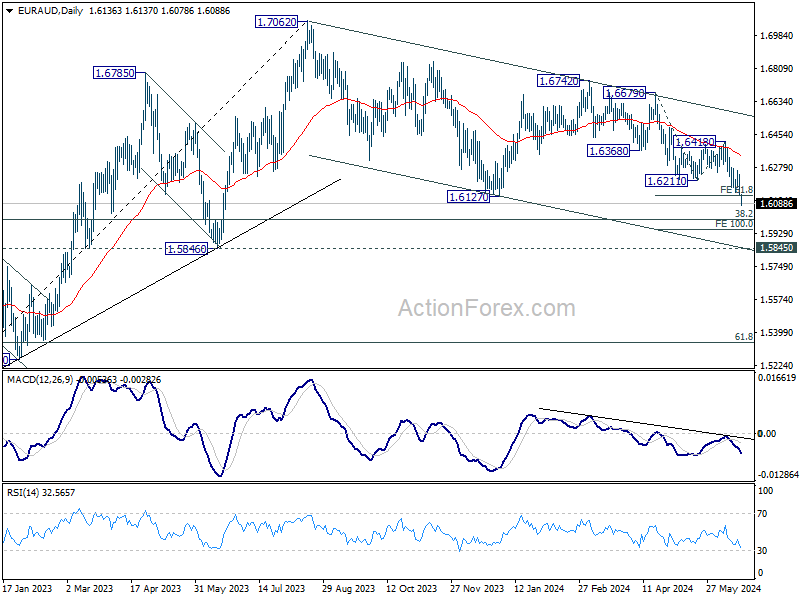
In the bigger picture, fall from 1.7062 medium term top is seen as a correction to the up trend from 1.4281 (2022 low). In case of deeper fall, strong support is expected around 1.5846 and 38.2% retracement of 1.4281 to 1.7062 at 1.6000 to bring rebound. Break of 1.7062 is in favor as a later stage.
EUR/GBP Daily Outlook
Daily Pivots: (S1) 0.8442; (P) 0.8453; (R1) 0.8463; More...
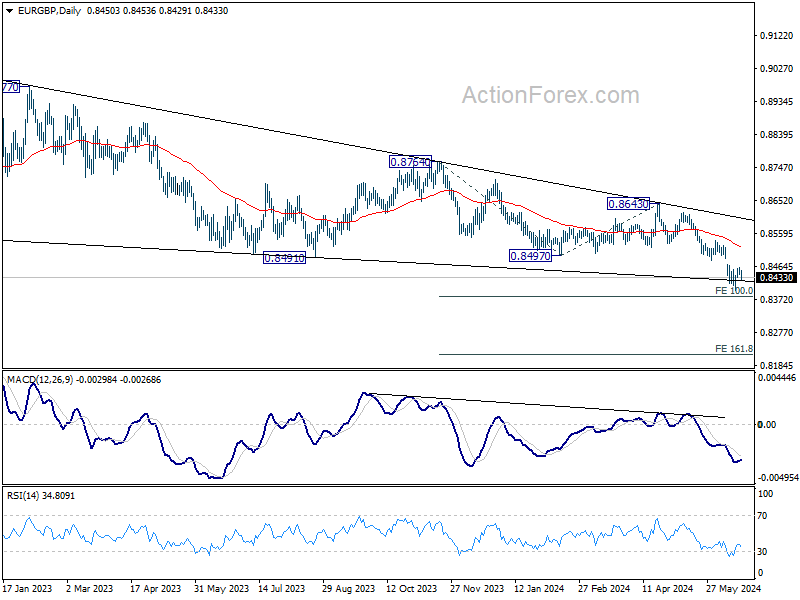
Intraday bias in EUR/GBP remains neutral first as consolidations continue above 0.8396. Outlook will remain bearish as long as 0.8482 support turned resistance holds. Below 0.8396 will resume larger down trend to 0.8376 projection level next.
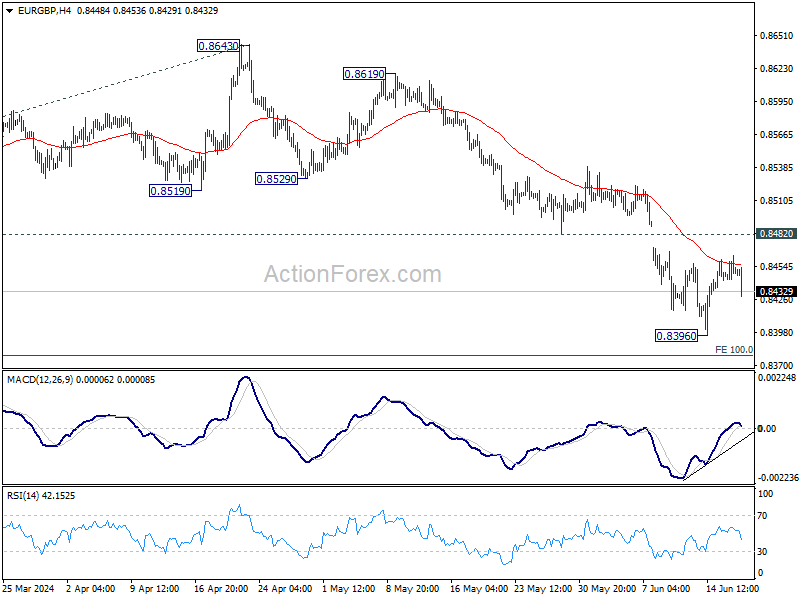
In the bigger picture, down trend from 0.9267 (2022 high) is in progress. Next target is 100% projection of 0.8764 to 0.8497 from 0.8643 at 0.8376. Sustained break there will target 161.8% projection at 0.8211 next. For now, outlook will remain bearish as long as 0.8643 resistance holds, even in case of stronger rebound.
EUR/JPY Daily Outlook
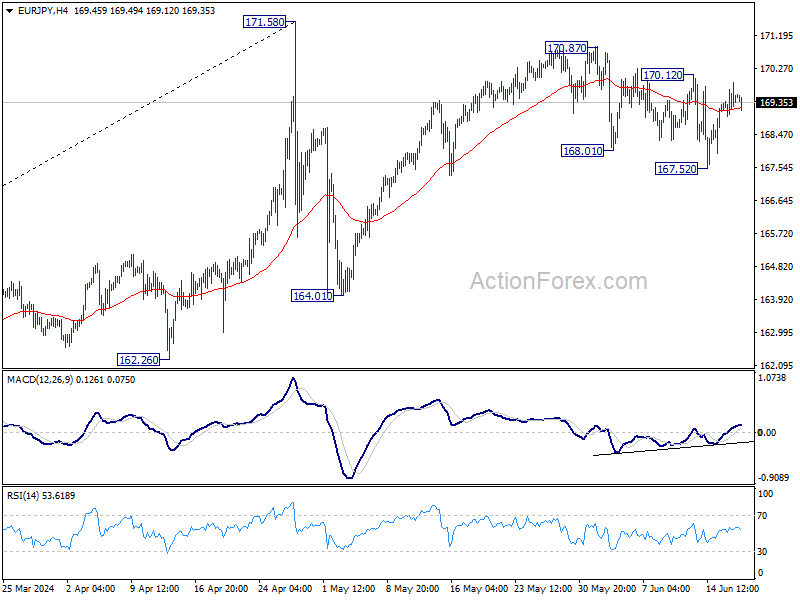
Daily Pivots: (S1) 169.04; (P) 169.47; (R1) 169.98; More...
Intraday bias in EUR/JPY stays neutral first. On the upside break of 170.12 resistance will argue that pull back from 170.87 has completed at167.52, after drawing support from 55 D EMA. Intraday bias will be back on the upside for 170.87 and then 171.58 high.
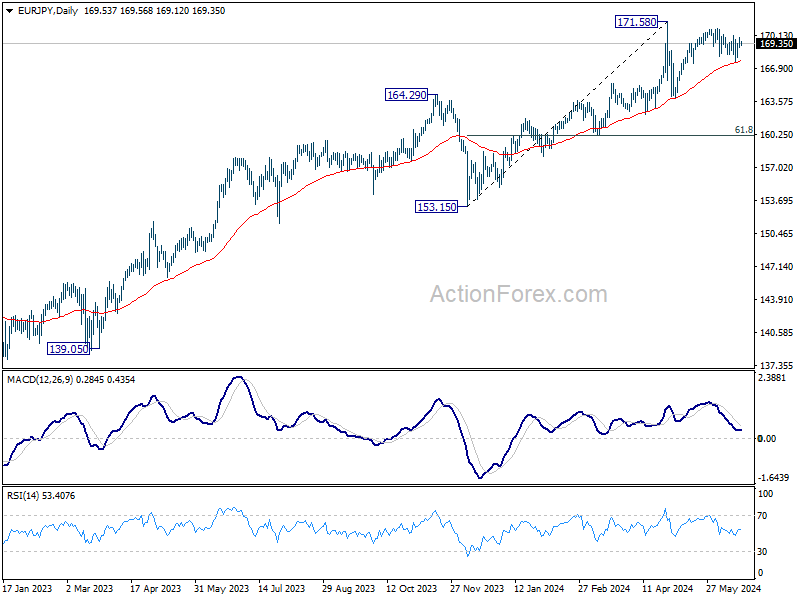
In the bigger picture, as long as 55 W EMA (now at 159.83) holds, price actions from 171.58 medium term top are seen as as correcting the rise from 153.15 only. That is, larger up trend remains in favor to continue as a later stage. However, sustained break of 55 W EMA will argue that larger scale correction is underway and target 153.15 support.
GBP/JPY Daily Outlook
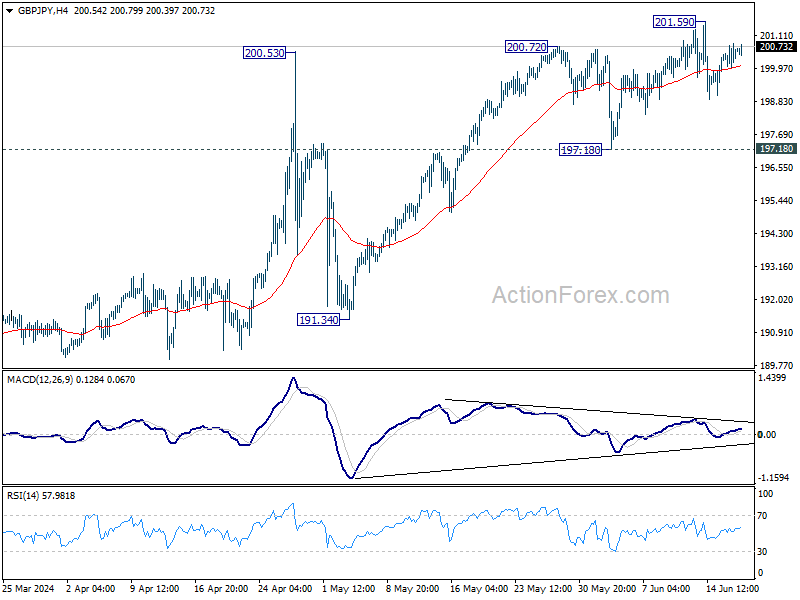
Daily Pivots: (S1) 200.14; (P) 200.49; (R1) 200.97; More...
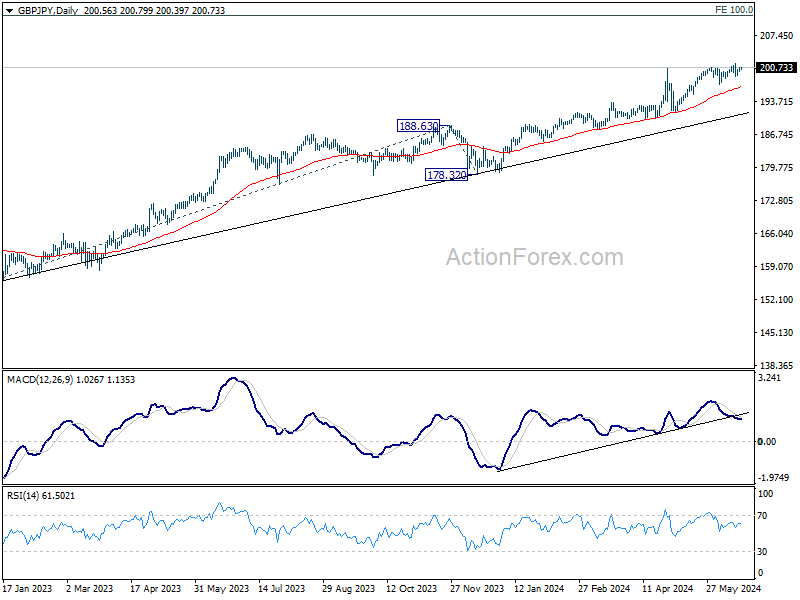
GBP/JPY is extending the consolidations below 201.59 and intraday bias stays neutral. Further rally is expected as long as 197.18 support holds. However, considering bearish divergence condition in 4H MACD, firm break of 197.18 will confirm short term topping, and turn bias back to the downside for 191.34 support instead.
In the bigger picture, as long as 188.63 resistance turned support holds, long term up trend is expected to continue. Next target is 100% projection of 155.33 to 188.63 from 178.32 at 211.62.
USD/CAD Daily Outlook
Daily Pivots: (S1) 1.3699; (P) 1.3728; (R1) 1.3747; More...
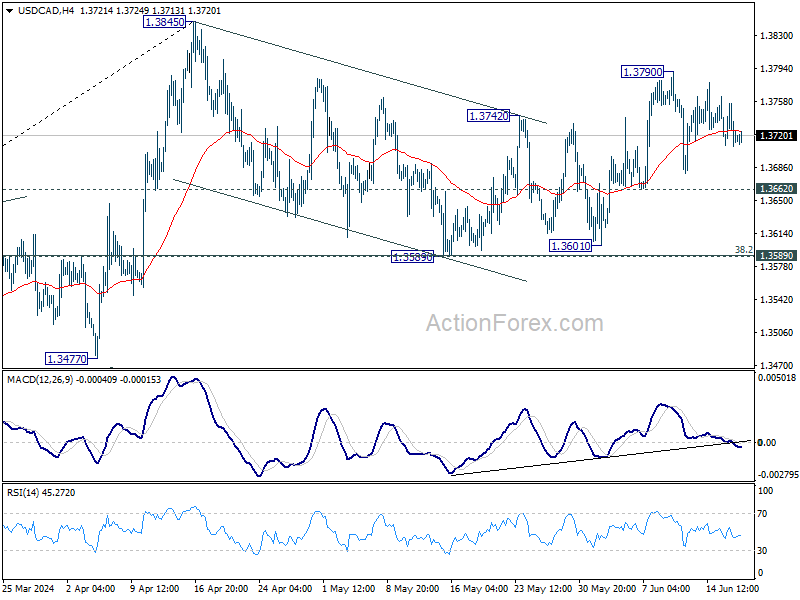
No change in USD/CAD's outlook as range trading continues. Intraday bias remains neutral for the moment. Corrective fall from 1.3845 should have completed already. Further rally is expected as long as 1.3662 support holds. Break of 1.3790 will target a retest on 1.3845 first. Nevertheless, break of 1.3662 will turn bias to the downside to extend the corrective pattern from 1.3845 with another falling leg.
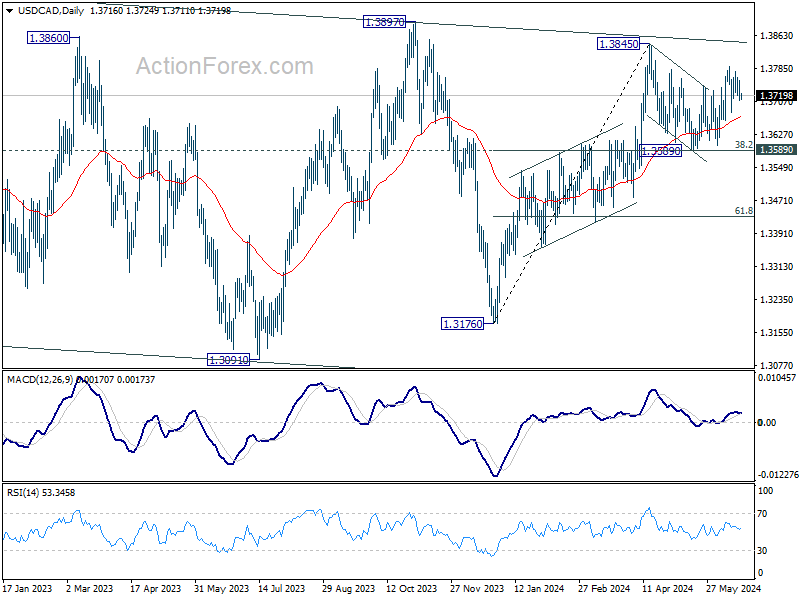
In the bigger picture, price actions from 1.3976 (2022 high) are viewed as a corrective pattern. In case of another fall, strong support should emerge above 1.2947 resistance turned support to bring rebound. Firm break of 1.3976 will confirm up resumption of whole up trend from 1.2005 (2021 low). Next target is 61.8% projection of 1.2401 to 1.3976 from 1.3176 at 1.4149.
AUD/USD Daily Report
Daily Pivots: (S1) 0.6619; (P) 0.6639; (R1) 0.6676; More...
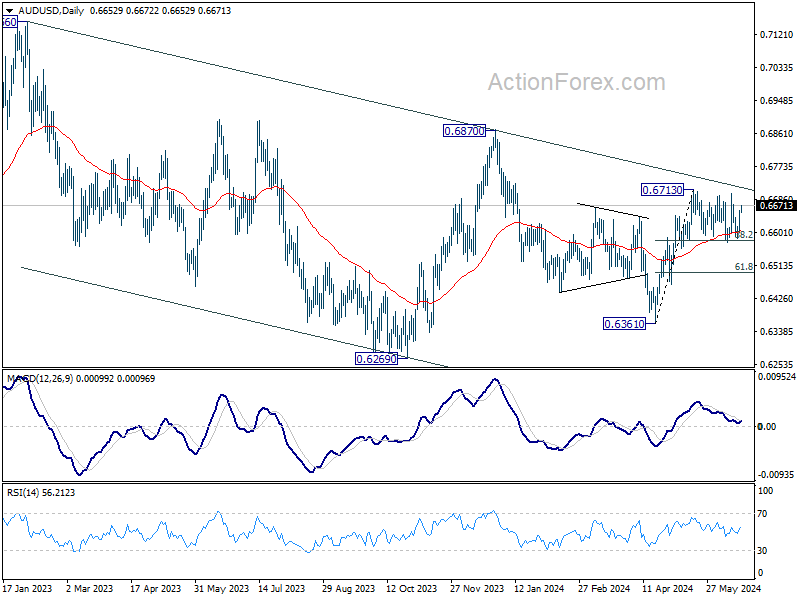
Range trading continues in AUD/USD and intraday bias remains neutral. Further rally remains in favor with 0.6578 cluster support (38.2% retracement of 0.6361 to 0.6713 at 0.6579) intact. On the upside, firm break of 0.6713 will resume whole rise from 0.6361 to 0.6870 resistance next. However, sustained break of 0.6578 will dampen this bullish view, and bring deeper fall to 61.8% retracement at 0.6495.
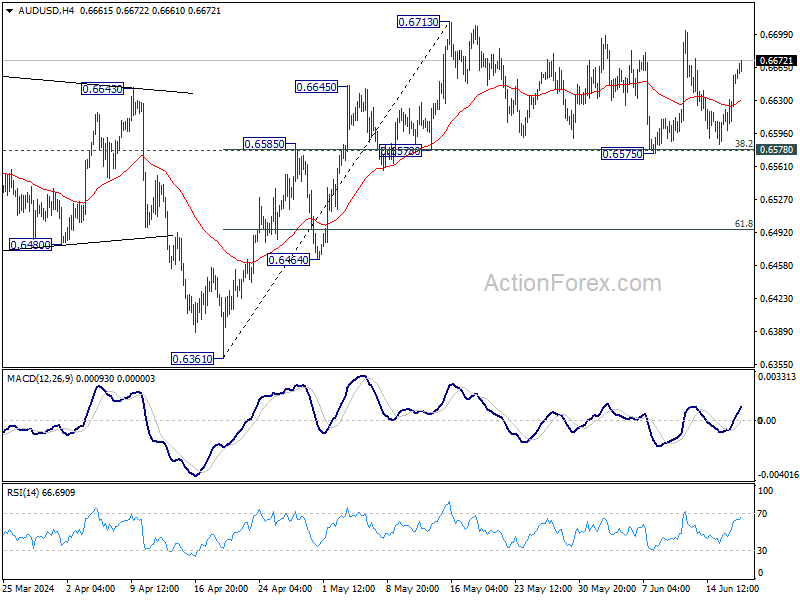
In the bigger picture, price actions from 0.6169 (2022 low) are seen as a medium term corrective pattern to the down trend from 0.8006 (2021 high). Fall from 0.7156 (2023 high) is seen as the second leg, which could have completed at 0.6269 already. Rise from there is seen as the third leg which is now trying to resume through 0.6870 resistance.
USD/JPY Daily Outlook
Daily Pivots: (S1) 157.50; (P) 157.87; (R1) 158.21; More...
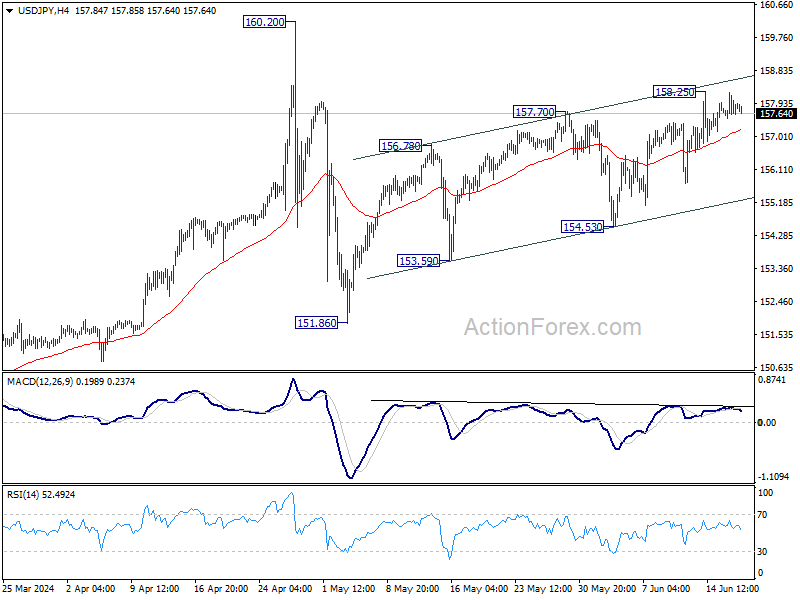
No change in USD/JPY's outlook and intraday bias stays neutral. Further rally would be in favor as long as 154.53 support holds. Break of 158.25 will resume the choppy rise from 151.86 towards 160.20 high. But upside should be limited there, at least on first attempt.
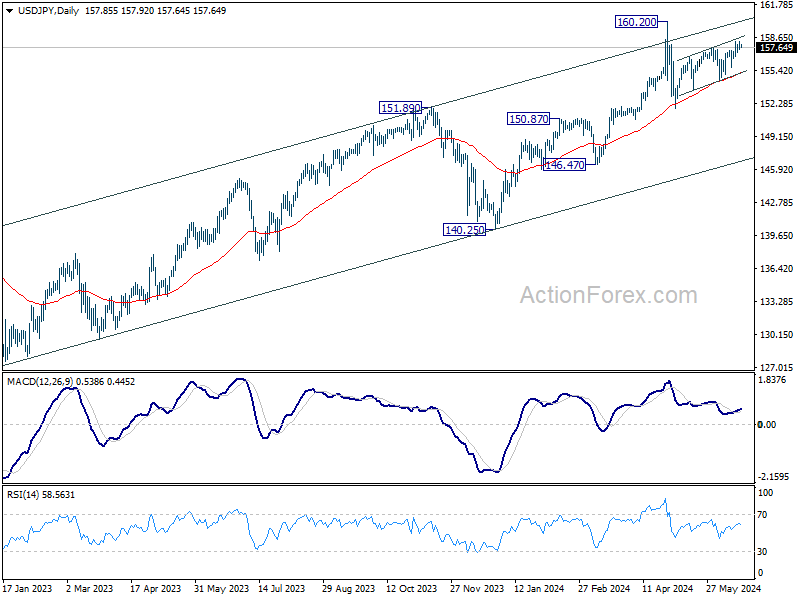
In the bigger picture, price actions from 160.20 medium term top are seen as a corrective pattern to rise from 150.25 only. Another rally is still expected at a later stage through 160.02 to resume the larger up trend. However, decisive break of 150.87 will argue that larger correction is possibly underway, and target 146.47 support next.
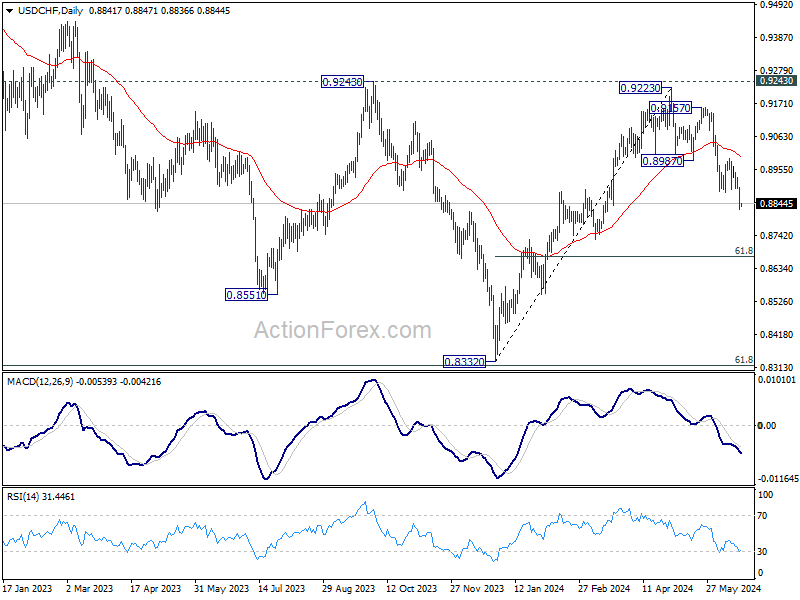
USD/CHF Daily Outlook
Daily Pivots: (S1) 0.8809; (P) 0.8860; (R1) 0.8892; More….
Intraday bias in USD/CHF stays on the downside for the moment. Rise from 0.8332 could have completed at 0.9223, ahead of 0.9243 key resistance. Further decline would be seen to 61.8% retracement of 0.8332 to 0.9223 at 0.8672 next. For now, risk will stay on the downside as long as 0.8992 resistance holds, in case of recovery.
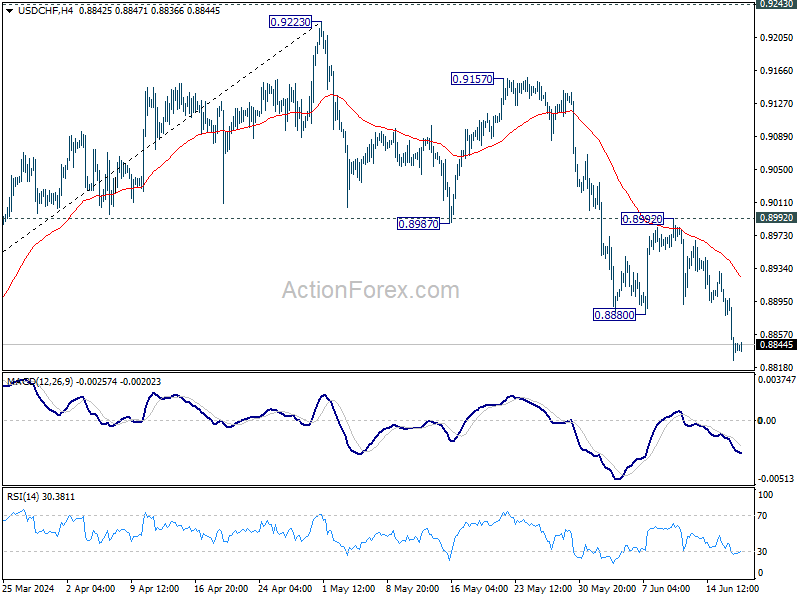
In the bigger picture, price actions from 0.8332 medium term bottom are seen as developing into a corrective pattern to the down trend from 1.0146 (2022 high). Rejection by 0.9243 resistance affirms this case, and maintains medium term bearishness. While more range trading could be seen between 0.8332/0.9243 first, downside break out is mildly in favor at a later stage.