Sample Category Title

Australian Dollar Weakens as RBA Says No Rate Hikes Planned

The Australian dollar has lost ground on Tuesday. AUD/USD has dropped by 0.31%, trading at 0.6604 in the European session at the time of writing.

RBA stays pat but wary of inflation

There was no surprise as the Reserve Bank of Australia maintained the cash rate at 4.35% for a sixth straight time. The RBA statement noted that inflation remained high and was falling more slowly than expected, adding that underlying inflation remained higher in large part due to services inflation.

RBA Governor Bullock said that inflation risks were tilted towards the upside and was quite candid about the possibility of raising rates, saying she hoped that the economy would not have to “stomach higher rates”.

Bullock said there was discussion at the meeting of raising rates but the Board decided that monetary policy was restrictive enough to bring inflation back down to the 2-3% target band by late 2025. Bullock said a rate hike can’t be ruled out, but doesn’t seem necessary. The markets may have been expecting a more hawkish message regarding rate hikes and the Australian dollar fell as much as 0.5% after the announcement.

The Federal Reserve has signaled that inflation remains too high for a rate cut just yet and on Monday two Fed members said that the Fed could afford to be patient. Richmond Fed President Barkin said that first-quarter inflation data was “disappointing” but he remained hopeful that the current restrictive policy would dampen demand and bring inflation back to the target of 2%. New York Fed President Williams said that policy was in “a very good place” and that a rate cut would depend on the data.

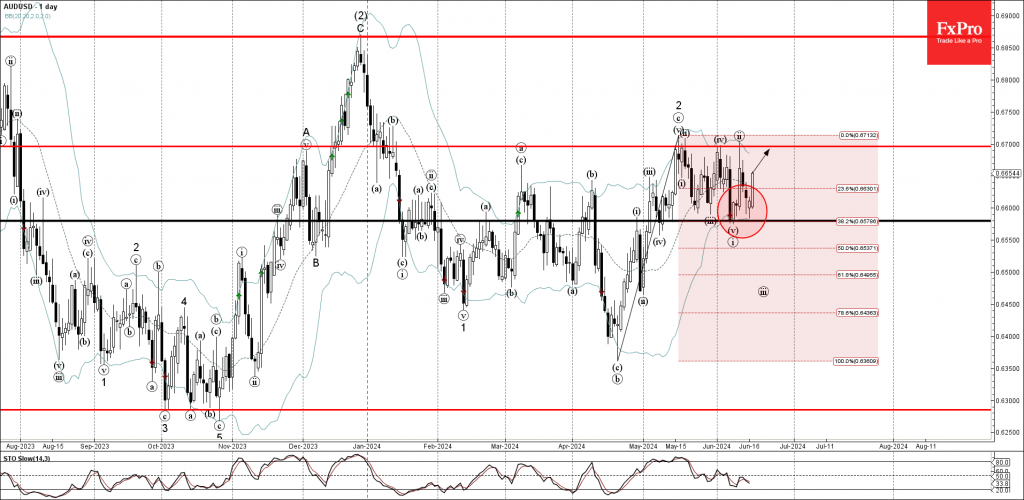
AUD/USD Technical

  • AUD/USD faces resistance at 0.6683 and 0.6756
  • 0.6574 and 0.6501 are providing support

Brent Crude Oil Experiences Modest Uptick Amid Mixed Market Signals

Brent crude oil is seeing a slight increase on Tuesday, priced around $83.57 per barrel. The market remains close to two-month lows, caught between optimism for a peaceful resolution to the Middle East conflict and concerns over crude oil inventories in the United States.

The primary focus in the stock market currently revolves around the ongoing negotiations between Israel and Hamas, facilitated by Egypt. However, these talks have hit an impasse, and there are renewed signs of conflict from both parties. Israel has expressed dissatisfaction, stating that the terms offered do not meet its demands, thereby complicating diplomatic efforts.

Despite these challenges, the ongoing conflict in the Middle East contributes to supporting energy prices due to fears of potential disruptions in raw material supplies. On the demand side, Saudi Arabia has recently increased its oil selling prices to Asian buyers, indicating an expectation of robust demand, particularly during the upcoming summer. This adjustment is often seen when a producer is confident about expanding demand, with Saudi Arabia likely counting on strong consumption from China, the world's leading oil importer.

Brent technical analysis

On the H4 chart, Brent has achieved the local target of the growth wave at 91.50. The correction towards 82.70 is nearing completion, and we anticipate the formation of a consolidation range above this level. Should the price break upwards from this range, a new wave of growth towards $95.00 could be initiated. This bullish scenario is technically supported by the MACD indicator, which shows the signal line at the lows under the zero mark, indicating potential growth to new highs.

On the H1 chart, the structure of the fifth wave of correction to 82.70 has been formed. A consolidation range has developed above this level, and we expect a growth link to 84.44. Should this level be surpassed, it could open the potential for a growth wave to 85.70, which is the initial target. This technical outlook is corroborated by the Stochastic oscillator, with its signal line above 20 and prepared to ascend to 80.

Bitcoin Can’t Accelerate But Won’t Give Up Trying

Market picture

The crypto market capitalisation fell by 1.7% in 24 hours to $2.29 trillion, as Bitcoin lost 1.1% and Ethereum – 3%, but Solana has added 4%. However, the latter is noticeably out of step, with most of the other coins going down.

On Monday, Bitcoin failed for the second time in a fortnight to break above the 50-day moving average. The price very easily went from $64.5K to $65.5K, where it met with impressive selling volume that pushed the price back to $62.6K by the end of the day. The positive performance of Asian and European stock exchanges fuels the appetite for Bitcoin. It cannot be ruled out that we will see further attempts to climb above the 50-day.

News background

Hong Kong-registered bitcoin-ETFs could soon become available to mainland Chinese investors, leading to a surge in demand for the product, according to SyzCapital. Chinese citizens channel most of their savings into property, and there is an urgent need for more investment opportunities.

The Bitcoin blockchain has processed one billion transactions in the last 15 years of operation. In the 5603 days of the blockchain’s existence, there have been an average of 178,475 transactions per day. The total does not include transactions on second-tier networks like the Lightning Network.

According to blockchain.com, bitcoin miners’ post-halving revenue has collapsed to its lowest since October 2023. Earlier, 10x Research admitted that miners could start selling off $5bn worth of Bitcoin reserves to sustain their operations.

The US SEC has issued a warning to broker Robinhood about the possibility of filing a lawsuit. This is a Wells notice, in which the agency says it has found violations of securities laws, and the case could go to court.

According to Bloomberg, more than 90% of transactions involving stablecoins are made by bots and large traders, suggesting little use of cryptocurrencies as a means of payment. “In the US, people still use cheques for 40-60% of business payments, which indicates where the market really is in terms of technology adoption”, Airwallex noted.

On 6 May, an unknown whale moved 687.33 BTC (about $44 million) after ten years and three months of “hibernation”, Lookonchain pointed out. According to Chainalysis and Fortune, 1.75 million Bitcoin wallets have been inactive for more than ten years. They hold 1.8 million BTC (~$121bn) or 8.5% of total issuance.

Japanese Yen to Stay in Recovery Mode, While Yields Turning from Resistance

We warned our members about limited weakness and recovery on Japanese yen right before intervention. As you can see, yen is already recovering because US 10Yr Yields are already turning down from resistance, while Japan 10Yr Yields are barely trying to follow due to holidays in Japan recently. If Yields will keep weakening then Japanese yen will most likely stay in the recovery mode, just be aware of short-term pullbacks.

Pound Shrugs as Construction PMI Jumps

The British pound is slightly lower on Tuesday. GBP/USD is down 0.21%, trading at 1.2535 in the European session at the time of writing.

The UK construction PMI jumped to 53.0 in April, up from 50.2 in March and above the forecast of 50.4. This is only the second reading showing growth after six straight months of contraction. Last week, the services PMI rose to 55.0, up from 53.1 in April. This was the strongest level since May 2023 and services has shown growth for six straight months, with readings above the 50 level. The PMI survey noted that business and consumer spending were higher in April and reflective of an improving UK economy.

Bank of England may provide clues for a June hike

The Bank of England meets on Thursday and is expected to maintain the cash rate at 5.25%. There is pressure on the central bank to ease the pain for households and businesses, which are groaning under high interest rates. With inflation falling to 3.2% in March, the BoE is closer to cutting rates, likely at the June 20th meeting. If this is indeed the plan, we should see some dovish signals at Thursday’s meeting, similar to the ECB, which signaled in April that it would lower rates at its next meeting on June 6.

Central banks aren’t working together but they are very aware of what’s on the plate of their counterparts and prefer not to act alone. The Fed has delayed lowering rates due to a rise in inflation but the anticipated ECB hike in June will make it a bit easier for BoE policy makers to follow with a rate cut two weeks later.

Fed members have sounded cautious about lowering rates and Richmond Fed President Barkin joined the chorus on Monday. Barkin said that first-quarter inflation data was “disappointing” but he remained hopeful that the current restrictive policy would dampen demand and bring inflation back to the target of 2%.

GBP/USD Technical

  • GBP/USD tested support at 1.2535 earlier. Below, there is support at 1.2504
  • 1.2565 and 1.2591 are the next resistance lines

Eurozone retail sales rises 0.8% mom in Mar, EU up 1.2% mom

Eurozone retail sales volume grew 0.8% mom in March, above expectation of 0.6% mom. Volume of retail trade increased for food, drinks, tobacco by 1.2%, for automotive fuel in specialised stores by 2.0%. Volume was stable for non-food products (except automotive fuel).

EU retail sales grew 1.2% mom. Among Member States for which data are available, the highest monthly increases in the total retail trade volume were recorded in Poland (+7.3%), Cyprus (+4.8%) and Hungary (+2.0%). The largest decreases were observed in Sweden (-1.8%), Malta (-1.0%) and Austria (-0.8%).

Full Eurozone retail sales release here.

Gold Attempts Recovery to Only Face Limitations Again

  • Gold stays trapped below 2,325 after Monday’s bounce
  • Technical signals reflect persisting caution

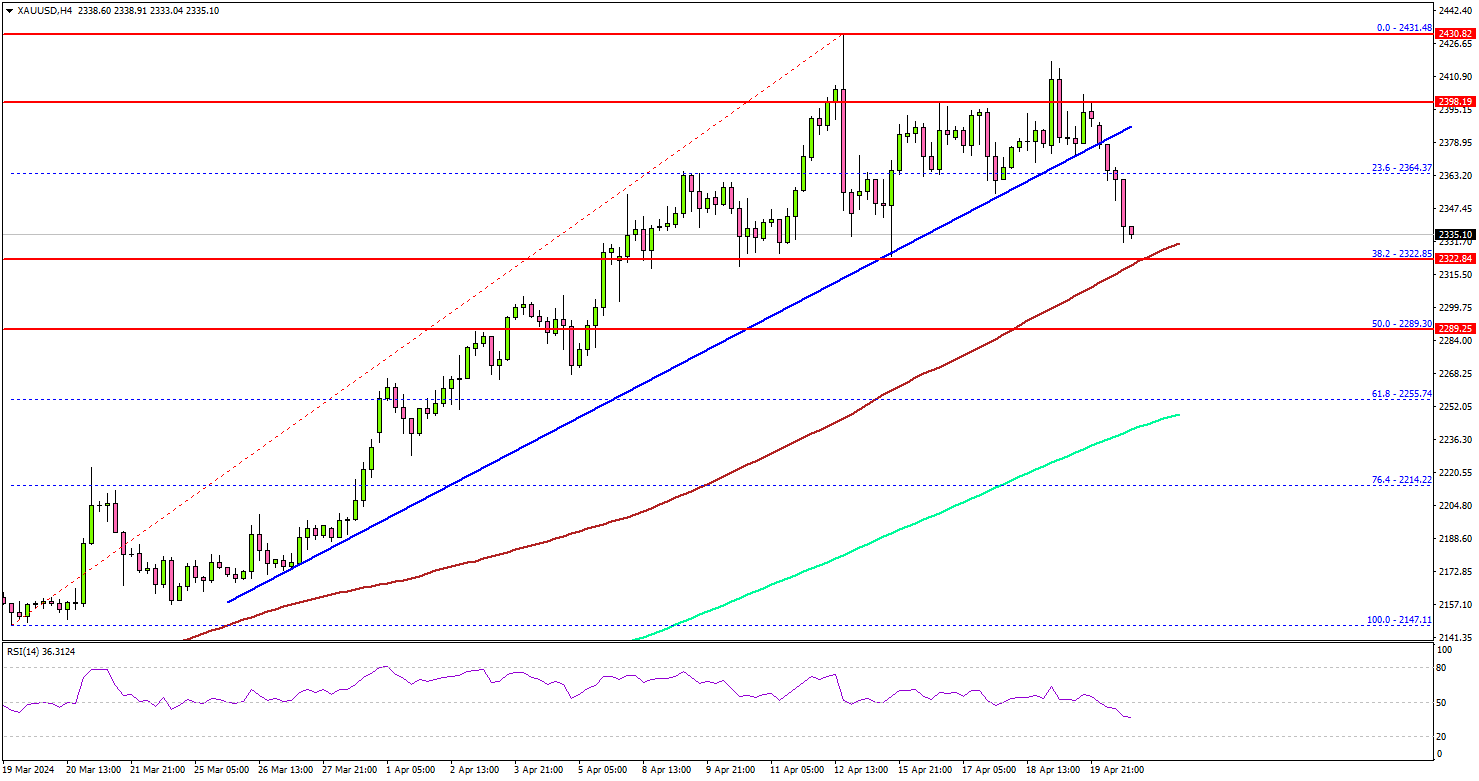
Gold had a positive start to the week, bouncing back above its 20-day exponential moving average (EMA), but the bullish attempt was not strong enough to drive the precious metal successfully above the constraining zone of 2,325. This is where the 23.6% Fibonacci retracement of the February-April uptrend and a former restrictive line are placed.

The price seems to have reached a make-or-break point and the technical picture cannot guarantee a meaningful bullish breakout. While the positive trend in the stochastic oscillator is an encouraging sign, the RSI has yet to violate its almost one-month-old downward path despite showing signs of a recovery above its 50 neutral mark.

If the bears retake control below the 20-day EMA, the price might slide towards the 38.2% Fibonacci of 2,260 and perhaps test the 50-day EMA around the same region. If the falling support line from April proves fragile around 2,240 as well, the next stop could be somewhere between 2,220 and the 50% Fibonacci of 2,207. A step lower could aggressively push the price towards the 61.8% Fibonacci of 2,154.

In the case the bulls win the battle around 2,325, they might initially challenge the 2,350 area, where the price peaked on April 26. A continuation higher could then find resistance around the 2,400 psychological mark, while a steeper increase could head for the all-time high of 2,431. Should the market venture into uncharted territory, it could establish a new higher high around the longer-term ascending line at 2,467.

Summing up, gold needs to knock down the wall at 2,325 and preferably overcome the 2,350 territory to bolster buying appetite again. Otherwise, the short-term downleg could stretch towards the 2,260 area.

UK PMI construction hits 14-month high but hiring trend subdued

UK PMI Construction surged from 50.2 to 53.0 in April, marking its most robust reading since February 2023. According to S&P Global, this growth was primarily driven by increased activity in commercial projects and civil engineering. However, house building experienced a decline, albeit amid improving supply conditions.

Tim Moore, Economics Director at S&P Global Market Intelligence, highlighted the sector's consolidation of its return to growth, with overall industry activity expanding at the fastest pace in 14 months. This growth was fueled by heightened confidence in the UK's economic outlook, leading to increased demand for construction services. Despite the uptick in workloads, hiring remained subdued, aligning with broader trends observed across the UK economy.

Full UK PMI construction release here.

RBA on Gold and Remains Vigilant to the Upside

Rates unchanged as expected, as Board balances near-term inflation risks with desire to avoid recession.

As expected, the RBA Board left the cash rate target unchanged at 4.35% following its May meeting but strengthened its rhetoric around upside inflation risks. The statement highlighted that inflation is declining, but more slowly than expected. Services inflation is moderating only gradually, driven by a labour market that the RBA now assesses to be tighter than previously thought. It is noteworthy that the more forward-looking indicators in the RBA’s suite have eased more than lag indicators such as the unemployment rate.

Monetary policy is assessed as restrictive, and the current level of the cash rate is seen as supporting continued progress on getting inflation back into the 2–3% target. In the media conference, the Governor confirmed that both a rate hike and holding rates unchanged were discussed at the meeting, with the Board ultimately deciding to hold.

The forward-looking parts of the statement continue to emphasise that the Board is not ruling anything in or out in terms of future policy. While there have been upside surprises in recent inflation and labour market data, these occurred in a context of weak domestic demand and a trajectory for inflation that is still clearly downwards. In the media conference, the Governor emphasised that the Board is trying to get inflation down in good time to ensure inflation expectations remain well anchored, while not going so fast that they tip the economy into recession.

Appropriately, the Board remains circumspect about the volatility in the data, noting that the disinflation journey is ‘unlikely to be smooth’. As we noted last week, reacting to every upside surprise carries its own risks. Recall that an upside surprise on inflation in the September quarter was met with a rate hike at the November meeting, only for the December quarter data to surprise on the downside and the upgrade to the forecasts reversed out for the February 2024 round. Despite the Board’s concerns, they were always going to need more than one quarter of upside surprise to adjust their strategy. In the media conference, the Governor highlighted that the Board had already taken out some insurance in November against inflation risks, and that the current forecasts looked a lot like the forecasts from November.

Given recent data, the RBA’s inflation forecasts for 2024 have been upgraded, but calendar 2025 and beyond are unchanged. The near-term growth forecasts have been downgraded, with GDP growth over 2024 now expected to be 1.6%, in line with Westpac’s forecast, rather than 1.8% as in the RBA’s February forecast round; the language in the Statement on Monetary Policy (SMP) is also more downbeat.

Most of the downgrade to the growth outlook was driven by a weaker outlook for consumption, despite an upgrade to expected income growth; the upgrade to household saving, both in the data and implied by the forecasts, highlights that the pure cashflow effect is not the only way higher interest rates affect consumption. In contrast to household consumption, the expected turnaround in dwelling investment has been shifted earlier. Given the continued decline in approvals, this puzzling revision might imply the RBA expects that the large pipeline of building work underway somehow unclogs.

Despite lower expected near-term GDP growth, the labour market forecasts have been upgraded (a lower unemployment rate in December 2025 and June 2026, now 4.3% from 4.4%), as were the forecasts for growth in the Wage Price Index (WPI). In contrast to previous statements, today’s statement notes ‘Wages growth appears to have peaked but is still above the level that can be sustained given trend productivity growth.’ The previous language was that ‘this level of wages growth remains consistent with the inflation target only on the assumption that productivity growth increases to around its long-run average.’ Our own forecast for WPI shows a turning point this year as last year’s outsized increase in minimum and award wages drops out of the year-ended growth calculation.

The new forecasts key off changed assumptions, including a higher path for market rates (market economist views are no longer an input). The RBA would also be aware that there is still some pass-through of past rate hikes to come, as remaining fixed-rate mortgages roll off.

As for the past few meetings, the media release states that the Board will be attentive to ‘developments in the global economy, trends in domestic demand, and the outlook for inflation and the labour market’. Contrast that with the language in the Bank of Canada’s statement: ‘Governing Council is particularly watching the evolution of core inflation, and continues to focus on the balance between demand and supply in the economy, inflation expectations, wage growth, and corporate pricing behaviour.’

The RBA language downplays the roles of supply and of firms’ decisions to pass on higher costs in slowing the decline in disinflation. The RBA’s analysis instead remains that high inflation declining slowly is a signal that aggregate demand is still too high. We did, however, note a shift away from the language in the November 2023 minutes, where an inflationary mindset among businesses was noted. In today’s SMP, the box on messages from liaison highlighted that firms were finding it harder to pass on cost increases and were instead focusing on cost containment and boosting productivity.

A special chapter in the SMP focused on potential output. This is a response to the recommendations of the RBA Review and reflects the revised Statement on the Conduct of Monetary Policy with the Government. An outworking of these recommendations is that the RBA staff are now being expected to rely a lot more on theoretical models in their analysis of the economy. While the chapter (and a companion Bulletin article on how full employment is assessed) sensibly highlight that no model is perfect and judgement is needed, one implication is a heightened risk that central banks including the RBA all make the same analytical mistake at the same time.

Overall, we see the policy decision as poised. As the Governor noted in the media conference, it is hoped that they will not need to raise rates further, but they will act if needed. Likewise, our house view is that the most likely outcome is unchanged rates for a period, but further upside surprises will change the calculus.

AUD/NZD: Aussie Medium-Term Outperformance Against Kiwi Intact Supported by RBA

  • Today’s RBA monetary policy decision statement has kept the possibility of a rate hike before 2024 ends “alive”.
  • The narrowing of the discount between Australia-New Zealand sovereign bonds yield spread has supported the potential continuation of the AUD/NZD medium-term uptrend phase.
  • Watch the key medium-term support of 1.0940 on the AUD/NZD.

The paths of inflationary trends between the two Antipodean countries have started to diverge in the past month.

Higher inflationary pressures in Australia versus New Zealand

Fig 1: Inflationary expectations of Australia & New Zealand with AU/NZ sovereign bond yield spreads as of 7 May 2024 (Source: TradingView, click to enlarge chart)

Forward-looking consumer inflation expectations in Australia have inched higher to 4.6% in April from 4.3% printed in March, its highest pace of increase since November 2023 amid elevated prices in services components. In contrast, New Zealand’s 2-year inflation expectations fell to 2.5% in Q1 2024, its lowest level since Q3 2021 from 2.76% recorded in Q4 2023 (see Fig 1).

Therefore, the Australian central bank, RBA has adopted a more cautious and prudent stance on its monetary policy guidance and opted to have a more hawkish tilt in keeping the doors open for a hike above the current policy cash rate at 4.35%.

RBA has kept the door open for a rate hike in 2024

RBA has chosen to maintain its policy cash rate at 4.35% in today’s monetary policy meeting for the fourth consecutive time, its highest level in almost 12 years. No major surprises and the tonality of the accompanying monetary policy statement is almost the same as the prior March’s meeting; the persistence of services inflation is a key uncertainty, some time is required for inflation to hit the target range of 2% to 3%, vigilant to upside risks, and not ruling anything in or out on future decisions are the key takeaways.

During RBA Governor Bullock’s press conference, she reiterated the key takeaways from the current momentary policy statement and added that current market pricing on the cash rate futures is “reasonably balanced” which implies that an RBA rate hike before 2024 is still a “live” event as the cash rate futures has priced in an implied yield of 4.43% on the September and October 2024 contracts as of 6 May 2024, above the policy cash rate of 4.35% by 7 basis points.

Bullish breakout in AUD/NZD

Fig 2: AUD/NZD major & medium-term trends with Gold/Copper ratio as of 7 May 2024 (Source: TradingView, click to enlarge chart)

In the medium-term (multi-week) horizon, recent price actions of the AUD/NZD cross pair via the late April’s bullish breakout above its former medium-term descending resistance from 20 December 2023 swing high has reinforced a medium-term uptrend phase in play since its 22 February 2024 low of 1.0570 (see Fig 2).

The daily MACD trend indicator has inched higher above its signal line which supports the ongoing medium-term uptrend phase of the AUD/NZD.

Intermarket analysis also reinforces a further potential outperformance of AUD against NZD via the narrowing of the 2-year and 10-year yield spread discount of Australia-New Zealand sovereign bonds in the past two months (see Fig 1).

Watch the 1.0940 key medium-term pivotal support on the AUD/NZD to maintain the bullish tone for the next medium-term resistance to come in at 1.1090 and 1.1165 (also the upper boundary of the ascending channel from the 22 February 2024 low).

On the other hand, a break below 1.0940 negates the bullish tone to expose the next intermediate support at 1.0870 (also the 50-day moving average).