Sample Category Title
How Low Can USDJPY Go?
USDJPY was slipping below 153 on Friday morning, a three-week low and having lost over 4.5% from a peak of 160.2 at the start of trading on Monday. Behind the pair’s rise is a long-term fundamental factor: a huge and widening interest rate differential with a shrinking trade surplus. Currency interventions of the Japanese Ministry of Finance cause the decline. Let’s try to understand at what levels USDJPY interventions will stop.
The yen’s growth impulses are diminishing. In October 2022, USDJPY went from a peak at 151.8 to a bottom at 127.3 (-16.3%) in about three months. The pullback in November 2023 was half as short (January) and half as deep (7.6%).
Yen growth impulses without direct intervention are also becoming less pronounced. There have also been two sustained declines in USDJPY, in July 2023 (around 5%) and March 2024 (around 2.7%), on speculation that the Bank of Japan will turn to active monetary tightening.
The authorities are in no hurry to burn foreign exchange reserves, content with more modest success than in the 1990s. The time with the least FX liquidity is chosen for intervention, allowing for more visible effects on the charts for less money.
We also note that the Bank of Japan has been dramatically slow in tightening monetary policy. After a rate hike in March, there was no further tightening as many expected.
This slowness is quite in the spirit of false hope from Japan’s monetary policy in recent years. The financial and monetary authorities hardly aim to put the yen on a growth path but only to slow its decline. This will allow Japan to increase the competitiveness of its exports further, revitalising domestic demand at the expense of inflation.
We assume that the interest in Yen appreciation will abruptly subside as USDJPY approaches the 50-week moving average. This is how it was in 2023. At the end of the year, that curve will be around 150 and is now passing through 147.
A more ambitious target of a USDJPY decline towards 122, where the pair has had two peaks in 2007 and 2015, cannot be completely ruled out.
Sanctions Reach Won’t Disrupt The Dollar’s Reserve Currency Status
Summary
In recent times, the U.S. dollar's status as the global reserve currency has been questioned, more so now that the reach of U.S. sanctions capabilities has been expanded to seize foreign government dollar assets. But despite the risk of having assets confiscated, in addition to recent efforts to diversify from the greenback, we continue to believe the U.S. dollar will remain the global reserve currency for the foreseeable future. Sanctions capabilities could also have a significant impact on China as official sector assets seem to have material exposure to the U.S. dollar and Western financial markets more broadly. U.S.-China geopolitical tensions, theoretically, should prompt China to make a concerted effort to move away from dollar and other advanced economy assets; however, China will face challenges in shifting away from the greenback.
U.S. Dollar Reserve Status Is Safe Despite Sanctions Reach
Over the past few years, the status of the U.S. dollar as the global reserve currency has come into question at times. Developments such as Brazil and China announcing clearing arrangements in each other's currencies, energy exporting Middle East nations willing to accept renminbi as payment, as well as a possible BRICS nation common currency prompted suggestions that the dollar's downfall was inevitable. In response to those suggestions, we published our perspective, highlighting that we do not believe the U.S. dollar would lose its reserve status at any point over the foreseeable future, and that we were not concerned about recent attempts to pivot away from the dollar. In the case of China and Brazil settling in each other's currencies, the China-Brazil trade relationship is worth only ~0.40% of total global trade, far from material enough to result in noticeable de-dollarization. We also had doubts that Middle East energy exporters, most of whom operate under a fixed exchange rate regime to the U.S. dollar, would be willing to potentially put currency pegs at risk by generating less dollar revenues. And a BRICS common currency, in our view, is unlikely to gather momentum. BRICS countries have intra-bloc competing objectives—both geopolitical (China-India, Saudi Arabia-Iran) and economic (China-India, Brazil-South Africa)—that we believe would ultimately limit policymaking options for most nations in the bloc. Not to mention, we have been skeptical that BRICS nations would want to expose themselves to potential secondary sanctions from perceived or actual doing business with sanctioned Russian government and corporate entities.
While at the margin, the U.S. dollar could experience less use in trade or investment purposes as a result of these initiatives, we continue to believe there is no credible, reliable or viable alternative to the U.S. dollar. To that point, we see many characteristics that continue to indicate the U.S. dollar will remain the preeminent reserve currency going forward. To be considered a “reserve currency,” certain characteristics must be demonstrated. These attributes include being
- Freely convertible (i.e., not pegged and/or subject to capital controls)
- Widely accepted and used in trade and global transactions
- Backed by large and liquid debt markets easily accessible to foreign investors
- Not subject to political influence (i.e., associated with an independent central bank)
The U.S. dollar checks all of these boxes, and while other currencies are also associated with these characteristics, we believe issues exist that will prevent the dollar from losing its status. In Europe, the euro and British pound are freely convertible, not pegged, nor subject to capital controls; however, while sovereign debt markets are sizable, government debt markets are not as deep as the U.S. and are also somewhat segmented. Fragmentation is also a relevant regional risk and one that has gathered momentum since the euro was adopted. Brexit—as well as the risk of Frexit, Grexit, Italexit, Spexit and other percolating EU-fragmentation movements—in our view, is enough for FX reserve managers to at least pause when considering allocating an outsized amount to European currencies and respective Eurozone or U.K. sovereign bonds. For the Japanese yen, the government bond market has been, and continues to be, significantly distorted by the Bank of Japan (BoJ). The BoJ holds a significant majority of outstanding Japanese Government Bonds, and while Yield Curve Control has ended, yields on Japanese sovereign debt remain quite low. While the independence of the Bank of Japan is not in question, the BoJ's substantial bond holdings are to some extent limiting accessibility to the JGB market by foreign investors, which also likely limits the yen's ability to make headway toward becoming the dominant global reserve currency. Also, with the Japanese yen facing extreme depreciation pressures, Japan's Ministry of Finance and BoJ policymakers have intervened more actively to support the yen. While the yen is not a managed currency, more government intervention in FX markets could make it less than ideal for FX allocators. And with respect to the Chinese renminbi and Chinese government bonds, capital controls and convertibility concerns as well as the managed exchange rate regime of the renminbi should provide disincentive for reserve managers to allocate currency holdings toward Chinese assets. Taking these factors into account, we see limited alternatives for FX reserve managers to U.S. government bonds and, accordingly, view the U.S. dollar's status as the global reserve currency as secure for the foreseeable future.
However, sanctions imposed on Russia following the invasion of Ukraine, as well as recently passed U.S. legislation, at least introduce a potential new vulnerability to the U.S. dollar's world reserve currency status. For context, Russia's FX reserves—more specifically dollar-denominated reserves held primarily in the U.S. and Western Europe—were frozen not long after the invasion of Ukraine as part of the overall sanctions regime. In total, ~$300 billion of Russia's ~$600 billion FX reserves are currently unable to be accessed by the Central Bank of Russia, in effect frozen. Of this $300B, ~$5B is sitting within the U.S. financial system. For the past two years, U.S. policymakers have only provided authority to freeze the $5B of Russia's FX reserves, not confiscate them. Meaning, as of now, all frozen FX reserves, whether located in the U.S., Western Europe or elsewhere, still belong to Russia. Fast-forward to last week, as part of the latest U.S. financial aid bill for Ukraine, Israel and Taiwan, President Biden has now been given authority to seize Russian assets held in U.S. banks, take ownership of $5B of Russia's FX reserves, and direct those assets into a fund established to eventually rebuild Ukraine. While we will refrain from offering a view on whether this is prudent foreign policy, and whether President Biden will exercise his option to confiscate Russia's assets, freezing and confiscating foreign FX reserves could present a problem for the U.S. dollar's reserve currency status. The risk to the U.S. dollar's reserve currency status stems from foreign central banks opting to reallocate their FX reserves away from the U.S. dollar to minimize confiscation risk should strategic views or geopolitical objectives not align with the United States. To date, central bank FX allocators have not been overly shaken by the possibility of assets being frozen or seized. As of the end of 2023, the U.S. dollar accounted for 58.5% of total central bank FX reserve assets, essentially unchanged from the 58.8% at the end of 2021 prior to Russia's invasion of Ukraine (Figure 1). In addition, and while a bit of a twist from central bank reserve allocations, since the onset of the Russia-Ukraine conflict, there are signs the use of the U.S. dollar in the global marketplace has increased. As of March 2024, and as measured by the SWIFT payments system, the dollar is used in over 47% of all payments, while use of the euro has fallen and other major currencies have not become integrated enough into payments systems to challenge the dollar (Figure 2).
China Is Very Exposed to a Russia-Style Sanctions Regime...
The possibility of central bank assets being frozen or confiscated puts China in an interesting position. Persistent U.S.-China economic and geopolitical tensions—which have broadened to include most Western and advanced economy governments—raise the possibility that a sanctions regime similar to that imposed on Russia could conceivably be imposed on China. Sanctions have already been placed on select Chinese corporate entities and individuals, but up to this point, the U.S. and U.S.-aligned nations have stopped short of sanctioning China's central bank, sovereign wealth fund and state-owned banks. In a hypothetical scenario where the same Russia sanctions regime is placed on China, as best we can ascertain, a sizable portion of China's FX reserves could be at risk of being frozen and/or seized. We say “as best we can ascertain” since China does not offer consistent visibility into the composition of FX reserves, and estimating the currency composition of China's central bank assets is a challenge. On one hand, certain data sets suggest China is reducing its dollar assets. However, very compelling evidence suggests that, at a minimum, China has maintained a steady exposure to U.S. dollar-denominated assets, possibly even increased exposure to the dollar. These analyses suggest the decline in China's U.S. asset holdings is due to the nature of financial and statistical reporting, in combination with techniques adopted by Chinese authorities. China could just be using alternative financial centers as the custodian location of central bank reserve assets. Other theories such as the PBoC shifting reserves to state-owned bank balance sheets or China having too many FX reserves and deploying excess assets toward China's Belt & Road Initiative also exist and are possibilities we cannot dismiss.
As intriguing as the evidence is around China's potential use of financial techniques, we will use official published data to highlight and get a sense of China's vulnerability to a coordinated sanctions program. As mentioned, the PBoC does not offer much insight into the composition of FX reserves, although it did disclose that ~60% of its reserve assets were held in U.S. dollars at the end of 2015. Given the lack of visibility and official data since then, we will assume 60% of China's FX reserves are still held in dollar assets. The most recent People's Bank of China (PBoC) data indicates that China has $3.25T of FX reserves. Applying that 60% ratio disclosed in 2015 leaves the PBoC with $1.95T of its FX reserves exposed to sanctions risk. We would also be remiss not to highlight the possibility that China's sovereign wealth fund assets could also be at risk. Sanctions imposed on Russia also targeted Russia's sovereign wealth fund, prohibiting transactions with Russia's National Wealth Fund as well as freezing the fund's assets held in the U.S. and Western financial systems. China Investment Corporation (CIC), China's sovereign wealth fund, had assets worth $1.24T at the end of 2022. According to the CIC 2022 annual report, CIC allocated ~25% of total assets to U.S. and advanced economy equities, ~8% to advanced economy sovereign debt, and ~3% to “cash products,” which seem to be mostly short-term U.S. Treasury bills. In total, ~36% of CIC assets are held in U.S. and advanced economies financial assets—all of whom participated in the Russian sanctions regime and would likely coordinate again in a possible China sanctions program. The CIC's asset allocation leaves ~$443B at risk of being frozen or seized. Combined with at risk central bank FX reserves, ~$2.4T of China's total external buffer assets could be frozen or seized, or ~51% of China's FX reserves, sovereign wealth fund and other assets such as gold (Figure 3).
...But, China Has Few, If Any, Options to Reduce Sanctions Vulnerabilities
More than half of “official sector” assets at risk is a major vulnerability for China's economy and financial markets. China's large external asset buffers provide China with an exorbitant amount of financial influence, flexibility and freedom, and theoretically, should prompt Chinese authorities to consider allocating away from dollar-denominated assets and the currencies of Western financial markets more broadly. But China faces many challenges that complicates this shift. First off, the PBoC operates a heavily managed exchange rate regime. PBoC FX intervention to stabilize the renminbi or influence the currency in a certain direction is very common. While the PBoC may not target a specific level, policymakers do manage the USD/CNY and USD/CNH exchange rates. In order to intervene in FX markets as frequently as China's central bank does and influence the USD/CNY and USD/CNH exchange rates, a large and available amount of dollar reserves is required. Sure, the PBoC could move to a free-floating, market-driven exchange rate regime to reduce sanctions risks and allow for diversification away from the dollar; however, at least at the current juncture, PBoC officials seem determined to achieve currency stability. For about a year, PBoC policymakers have set the overnight fix significantly stronger than analyst estimates in an effort to prevent renminbi depreciation (Figure 4). Even if PBoC policymakers did move to a market-driven exchange rate regime, that adjustment could also be costly. In August 2015, when the PBoC allowed for a one-time depreciation of the renminbi, China experienced large capital outflows that disrupted the local economy and caused a sharp selloff in local financial markets. In our view, China would prefer to protect against another round of capital outflows originating from currency depreciation. Aside from the overnight fix, PBoC policymakers tools to stabilize the renminbi include verbal intervention and interest rate hikes. Verbal intervention is more of a short-term policy tool, while raising interest rates is likely not a macro-prudential policy option given how fragile interest rate sensitive sectors such as real estate are, and how soft consumption is.
To illustrate an example, let's assume PBoC policymakers did float the renminbi and reduce a degree of dollar dependency. China would likely still want and/or need to diversify away from its own currency and financial markets, and attempt to achieve some type of return on assets. The problem with China attempting to invest abroad comes back to the sanctions U.S. and advanced economy peers might now be willing to impose. Just about all the major economies, and certainly those that could be associated with a potential reserve currency option, participated in the coordinated sanctions on Russia. As of now, we have little reason to believe a similar coordinated sanctions program would not be placed on China if circumstances called for such action. Which raises the question, where can China safely invest its assets? To offer some guidance on this, we utilized our U.S.-China fragmentation framework, which is designed to identify countries that could align with the United States or form an allegiance to China should the global economy fracture as a result of intensifying geopolitical hostilities. Using our framework, we determine that 90% of the global sovereign debt market (ex-China) would likely align with the United States (Figure 5). We also make the assumption that in a fragmented world, these U.S.-aligned countries would also participate in a Russia-style coordinated sanctions program. Meaning, 90% of the sovereign debt market could be shut off to China as feasible or desirable investment options. Only 6% of the government debt market we identify as “neutral” and opting not to align with either the U.S. or China. These countries' financial markets could be options for Chinese overseas investment. Caveats, however, related to neutral nations do exist, most notably that India flashes as opting for neutrality. India is important because the government debt market is large, though policymakers restrict foreign access to domestic bonds. While the percent of foreign investors allowed to participate in India's sovereign debt market has risen over time, China would likely meet headwinds accessing India's debt markets due to policy restrictions. Countries that would more fully align with China in a fragmented world would then represent the most feasible options. These countries represent a small sliver of the global stock of sovereign debt. While countries associated with strong creditworthiness are in this segment—such as Saudi Arabia and the United Arab Emirates—opportunity to deploy a significant amount of China's assets into these markets simply does not exist. For China to invest a material amount of its asset position into China-aligned nations, the PBoC and CIC would likely have to be willing to invest in less creditworthy nation financial markets and take on a significant amount of credit risk. Given half of China's assets would already be frozen, we have our doubts deploying the remaining assets into credit risky markets would be considered prudent investing by Chinese investment allocators.
This is all a way of saying that the U.S. dollar, despite recent efforts to reallocate away from the greenback, is unlikely to lose its reserve status simply due to lack of alternatives. If one of the geopolitically tense relationships with the United States is likely to experience challenges moving away from the dollar, we doubt diversification away from the dollar will material momentum. Headline-grabbing news may continue to appear going forward, but in our view, these represent more noise than they do substance. Long live the U.S. dollar as the global reserve currency.
Forex and Cryptocurrency Forecast
EUR/USD: What's Wrong with the US Soft Landing?
The headline of our last review stated that inflation remains stubborn, and the US GDP is slowing. Newly arrived data have only confirmed these assertions. A crucial inflation measure that the Federal Reserve follows – the Personal Consumption Expenditures Price Index (PCE) – increased from 2.5% to 2.7% in March. The ISM Manufacturing Sector PMI surpassed the critical level of 50.0 points, dropping from 50.3 to 49.2 points. It is important to remember that the 50.0 threshold separates economic growth from contraction. In such circumstances, neither raising nor lowering the interest rate is advisable, which is exactly what the FOMC (Federal Open Market Committee) of the US Federal Reserve decided. At its meeting on Wednesday, 01 May, the committee members unanimously left the rate unchanged at 5.50%, marking the highest rate in 23 years and unchanged for the sixth consecutive meeting.
This decision matched market expectations. Thus, greater interest was on the press conference and comments from the regulator's leadership after the meeting. The head of the Fed, Jerome Powell, stated that inflation in the US is still too high and further progress in reducing it is not guaranteed as it has not shown signs of slowing in recent months. According to him, the Fed is fully committed to returning inflation to the 2.0% target. However, "I don't know how long it will take," Powell admitted.
The outcomes of the FOMC meeting appear neutral except for one "dovish pill." The regulator announced that from June, it would reduce the amount of Treasury securities it redeems from its balance sheet from $60 billion to $25 billion per month. This tightening of the money supply is not yet a shift to quantitative easing (QE) but a definite step towards reducing the scale of quantitative tightening (QT). It must be noted that this did not make a strong impression on market participants.
Besides fighting inflation, the Fed's other main goal is maximum employment. "If inflation remains persistent and the labour market strong, it would be appropriate to delay lowering rates," Powell stated. Following his remarks, the market anticipated the important US Bureau of Labor Statistics (BLS) report, which was to be released on Friday, 03 May. This document disappointed dollar bulls as the number of people employed in the non-agricultural sector (NFP) in the US only grew by 175K in April, significantly lower than both the March figure of 315K and market expectations of 238K. The employment report also showed an increase in unemployment from 3.8% to 3.9%. The only solace for Powell and other Fed officials was the reduction in wage inflation – the annual growth rate of hourly earnings slowed from 4.1% to 3.9%.
European economy. Consumer Price Index (CPI) in Germany increased from 0.4% to 0.5% on a monthly basis. Retail sales also increased, from -2.7% to +0.3% year-on-year. Germany's GDP also moved into positive territory, rising in Q1 from -0.3% to 0.2%, exceeding the forecast of 0.1%. Regarding the Eurozone as a whole, the economy looks quite healthy – it is growing and inflation is falling. Preliminary data for Q1 shows GDP rising from 0.1% to 0.4% year-on-year and from 0.0% to 0.3% quarter-on-quarter. Core inflation (CPI) fell from 1.1% to 0.7% on a monthly basis and from 2.9% to 2.7% year-on-year, not far from the target of 2.0%.
This suggests that the European Central Bank (ECB) may begin to lower interest rates earlier than the Fed. However, it is still too early to make final conclusions. If based on the derivatives market, the probability of the first rate cut for the dollar in September is about 50%. Some economists, including analysts from Morgan Stanley and Societe Generale, even suggest that the Fed might postpone the first rate cut until early 2025.
After the release of the weak employment report in the US, the week's maximum was recorded at 1.0811. However, everything then calmed down a bit and the last point was placed by EUR/USD at 1.0762. As for the forecast for the near future, as of the evening of 03 May, 75% of experts expect the dollar to strengthen, 25% – its weakening. Among the oscillators on D1, the opposite is true: only 25% are on the side of the reds, 60% – are coloured green, 15% – in neutral gray. Among the trend indicators, there is a balance: 50% for the reds, just as much for the greens. The nearest support for the pair is located in the zone 1.0710-1.0725, then 1.0650, 1.0600-1.0620, 1.0560, 1.0495-1.0515, 1.0450, 1.0375, 1.0255, 1.0130, 1.0000. Resistance zones are located in the areas 1.0795-1.0805, 1.0865, 1.0895-1.0925, 1.0965-1.0980, 1.1015, 1.1050, 1.1100-1.1140.
No events as important as those of the past week are anticipated. However, the calendar still highlights Tuesday, 07 May, when revised retail sales data in the Eurozone will be released, and Thursday, 09 May, when the number of unemployment benefit claims in the US is traditionally made known.
GBP/USD: Will the Pair Fall to 1.2000?
Not the pound but the dollar defined the week for GBP/USD. This is evidenced by the fact that the pair completely ignored the forecast of the Organisation for Economic Co-operation and Development according to which the UK will face the slowest economic growth and the highest inflation among the G7 countries, excluding Germany, this and next year. It is expected that the UK's GDP in 2024 will decrease from 0.7% to 0.4% and in 2025 – from 1.2% to 1%.
Commenting on this rather sad forecast, the UK Finance Minister Jeremy Hunt stated that the country's economy continues to fight inflation with high interest rates, which put significant pressure on the pace of economic growth.
Like other central banks, the BoE faces a tough choice – to prioritize fighting inflation or supporting the national economy. It is very difficult to sit on two chairs at once. Economists from the investment bank Morgan Stanley believe that the divergence in monetary policy between the Bank of England and the Fed could put serious pressure on GBP/USD. In their opinion, if markets decide that the Fed will refrain from lowering the rate this year and the BoE begins a softening cycle (by 75 basis points this year), the pound may once again test the 1.2000 level.
The pair ended the week at 1.2546. The median forecast of analysts regarding its behaviour in the near future looks maximally uncertain: a third voted for the pair's movement south, a third – north, and just as many – east. Regarding technical analysis, among trend indicators on D1, 35% point south and 65% look north. Among the oscillators, only 10% recommend selling, the rest 90% – buying, although a quarter of them give signals of the pair's overbought.
The pair will encounter resistance at levels 1.2575-1.2610, 1.2695-1.2710, 1.2755-1.2775, 1.2800-1.2820, 1.2885-1.2900. In case of a fall, it will meet support levels and zones at 1.2500-1.2520, 1.2450, 1.2400-1.2420, 1.2300-1.2330, 1.2185-1.2210, 1.2110, 1.2035-1.2070, 1.1960, and 1.1840.
If last week the dynamics of GBP/USD were mainly determined by news from the US, much will depend on what happens in the UK during the upcoming week. Thus, on Thursday, 09 May, a meeting of the Bank of England will take place, where a decision on further monetary policy, including changes in interest rates and the planned volume of asset purchases, will be made. And at the very end of the working week, on Friday, 10 May, data on the country's GDP for Q1 2024 will be released.
USD/JPY: A Truly Crazy Week
At its meeting on 26 April, the members of the Bank of Japan (BoJ) Board unanimously decided to leave the key rate and the parameters of the QE program unchanged. There was no harsh commentary expected by many on the future prospects. Such inaction by the central bank intensified pressure on the national currency, sending USD/JPY to new heights.
A significant part of the previous review was devoted to discussing how much the yen would need to weaken before Japanese financial authorities moved from observation and soothing statements to real active measures. USD/JPY had long surpassed levels around 152.00, where intervention occurred in October 2022 and where a reversal happened about a year later. This time, strategists from the Dutch Rabobank called 155.00 a critical level for the start of currency interventions by the Ministry of Finance and the Bank of Japan. The same mark was mentioned by 16 out of 21 economists surveyed by Reuters. Others forecasted similar actions at levels of 156.00 (2 respondents), 157.00 (1), and 158.00 (2). We suggested raising the forecast bar to 160.00, and as a reversal point, we indicated 160.30. And we were right.
Firstly, on Monday, 29 April, when the country celebrated the birth of Hirohito (Emperor Showa), USD/JPY continued its cosmic epic and updated another 34-year high by reaching 160.22. Thus, in just two days, it rose by more than 520 points. The last time such an impressive surge was observed was 10 years ago.
However, the situation did not calm down there. On the same day, a short powerful impulse sent the pair back down by 570 points to 154.50. Then followed a rebound, and late in the evening on 01 May, when the sun was already rising over Japan the next day, another crash occurred – in just one hour, the pair dropped 460 points, stopping its fall near 153.00. This movement occurred after relatively mild decisions by the Fed, but the cause was clearly not this, as other major currencies at that moment strengthened against the dollar much less. For example, the euro by 50 points, the British pound – by 70.
Such sharp movements in favour of the yen were very similar to the currency interventions of the BoJ in 2022. Although there was no official confirmation of intervention by the Japanese authorities, according to estimates by Bloomberg, this time on the intervention on Monday, 29 April, 5.5 trillion yen was spent, and on 01 May, according to calculations by the Itochu Institute, another 5 trillion yen.
And now the question arises: what next? The effect of the autumn interventions of 2022 lasted a couple of months – already at the beginning of January 2023, the yen began to weaken again. So it is quite possible that in a few weeks or months, we will again see USD/JPY around 160.00.
The BoJ's statement following the latest meeting stated that "the prospects for economic and price developments in Japan are extremely uncertain" and "it is expected that relaxed monetary policy will be maintained for some time." There is currently no need to raise the interest rate as core inflation is significantly and sharply decreasing, it has fallen from 2.4% to 1.6%. Especially since tightening monetary policy could harm the country's economy. The growth rate of GDP remains close to zero. Moreover, the public debt is 264% of GDP. (For comparison: the constantly discussed US public debt is half that – 129%). So the mentioned "some time" in the statement of the regulator may stretch for many months.
It is appropriate to recall BoJ board member Asahi Noguchi, who recently stated that the pace of future rate increases is likely to be much slower than global counterparts, and it is impossible to say whether there will be another increase this year. So a new strengthening of the yen is possible only in two cases – thanks to new currency interventions and thanks to the start of easing monetary policy by the Fed.
According to Japanese MUFG Bank economists, interventions will only help buy time, not initiate a long-term reversal. Bloomberg believes that the intervention itself will be effective only if it is coordinated, particularly with the USA. According to forecasts by analysts of this agency, this year USD/JPY may rise to approximately 165.00, although overcoming the mark at 160.00 may take some time.
After all these crazy ups and downs, the past week ended at a level of 152.96. The experts' forecast regarding its nearest future, as in the case with GBP/USD, gives no clear directions: a third are for its rise, a third – for its fall, and a third have taken a neutral position. Technical analysis instruments are also in complete disarray. Among the trend indicators on D1, the distribution of forces is 50% to 50%. Among the oscillators, 50% point south (a third are in the oversold zone), 25% look north, and 25% – east. Traders should keep in mind that due to such volatility; the magnitude of slippage can reach many dozens of points. The nearest support level is located in the area of 150.00-150.80, then follow 146.50-146.90, 143.30-143.75, and 140.25-141.00. Resistance levels are 154.80-155.00, 156.25, 157.80-158.30, 159.40, and 160.00-160.25.
No significant events regarding the state of the Japanese economy are expected next week. Moreover, traders should keep in mind that Monday, 06 May is another holiday in Japan – the country celebrates Children's Day.
CRYPTOCURRENCIES: BTC-2025 Target – $150,000-200,000
In the last review, we wondered where bitcoin would fall. Now we know the answer: on 01 May, it fell to the mark of $56,566. The last time the main cryptocurrency was valued this low was at the end of February 2024.
Bearish sentiments apparently arose because the trading volumes of new ETFs in Hong Kong turned out to be significantly lower than expected. Optimism in this regard has dried up. Against this backdrop, there began a withdrawal of funds from exchange-traded BTC-ETFs in the USA. Analysts from Fidelity Digital Assets, a leading issuer of one of these funds, noted a growing interest in selling and locking in profits from the side of long-term hodlers. For this reason, Fidelity revised its medium-term forecast for bitcoin from positive to neutral. According to CoinGlass monitoring, liquidations of long positions reached $230 million per day. Another negative factor for the market is called the geopolitical escalation in the Middle East, as a result of which investors began to flee from any high-risk assets. Instead, they began to invest capital in traditional financial instruments. In light of these events, the main beneficiaries in March-April were the dollar and US Treasury bonds, as well as precious metals.
Analysts from Glassnode hope that bullish sentiments will still prevail since the market prefers to "buy on the fall." However, they admit that the loss of support in the area of $60,000 may lead to further collapse of the BTC rate. Co-founder of CMCC Crest Willy Woo called support from short-term holders at the mark of $58,900 critical. After its breach, in Woo's opinion, the market risks transitioning to a bearish phase.
So, last week, both these lines of defense of the bulls were broken. What's next? In Glassnode, as a bottom, they call the level of $52,000. The founder of venture company Pomp Investments Anthony Pompliano believes that the price will not fall below $50,000. Another expert – Alan Santana does not exclude a failure to $30,000. All these forecasts indicate that in the coming months, investors may not see new historical maximums of BTC.
For example, legendary trader, analyst, and head of Factor LLC Peter Brandt with a probability of 25% admitted that bitcoin has already formed another maximum (ATH) within the current cycle. This happened on 14 March at the height of $73,745. The expert referred to the concept of "exponential decay." The latter describes the process of decreasing the amount of growth by a constant percentage over a certain period. "Bitcoin has historically traded within approximately a four-year cycle, often associated with halvings. After the initial bullish rally, there were three more, each being 80% less powerful than the previous one in terms of price growth," the specialist explains.
"In my analysis, I estimated the probability [of such a scenario] at 25%. But I trust more the report that I published in February. […] Building a cycle 'before/after halving' suggests that the current bullish trend will reach its peak in the range of $140,000–160,000 somewhere in the late summer/early fall of 2025," Peter Brandt clarified.
CEO of Quantonomy Giovanni Santostasi doubted the correctness of applying the theory of exponential decay in this particular case. "We have three data points if we exclude the period before [the first] halving and actually only two if we consider the ratios. This is not enough for any meaningful statistical analysis," Santostasi commented on the assumption expressed by Brandt. According to his own model of power dependence, the peak of the fourth cycle falls approximately in December 2025 at the level of ~$210,000.
Note that not only Giovanni Santostasi, but also many other participants in the crypto market, are counting on the continuation of the bull rally and reaching a new ATH. For example, the aforementioned Anthony Pompliano believes that within 12-18 months, the coin is waiting for growth to $100,000 with chances to reach $150,000-200,000. Analyst at Glassnode James Check hopes that at this stage, the BTC rate will reach $250,000. And Peter Brand himself in the mentioned February report called $200,000 as a potential landmark. At the same time, economists from QCP Capital believe that it is necessary to wait at least two months before assessing the effect of the past fourth halving. "The spot price grew exponentially only 50-100 days after each of the three previous halvings. If this pattern repeats this time, bitcoin bulls still have weeks to build a larger long position," their report states.
According to CEO of Morgan Creek Capital Mark Yusko, the appearance of exchange-traded BTC-ETFs has led to a significant change in demand. However, the full effect of this is yet to be felt. According to the businessman, the main capital flows will come from baby boomers, i.e., those born between 1946 and 1964, through pension accounts managed by investment consultants. The capital of baby boomers is estimated at $30 trillion. "I believe that within 12 months, $300 billion will flow into the crypto sphere – this is 1% of 30 trillion dollars. In fact, this is more money than has ever been converted into bitcoins in 15 years," Yusko shared his forecast, adding that the inflow could potentially increase the capitalization of the crypto market to $6 trillion.
Another forecast was given by specialists from Spot On Chain. According to their words, the analytical model developed by them is based on an extensive data set. In particular, it takes into account halvings, interest rate cycles, the ETF factor, venture investors' activity, and sales of bitcoins by miners. Using the artificial intelligence platform Vertex AI from Google Cloud, Spot On Chain obtained forecasts for the BTC price for the years 2024-2025.
During May-July, the price of the first cryptocurrency, according to their calculations, will be in the range of $56,000-70,000. This period is characterized by increased volatility. In the second half of 2024, with a probability of 63%, BTC will rise to $100,000. "This forecast signals the prevailing bullish sentiments in the market, which will be facilitated by the expected reduction in interest rates [by the US Federal Reserve]. This may increase the demand for risky assets such as stocks and bitcoin," representatives of Spot On Chain explained.
According to their words, there is a "convincing probability" of 42% that in the first half of 2025, digital gold will overcome the $150,000 mark, as the first cryptocurrency usually updates the historical maximum within 6-12 months after each halving. If we take the whole of 2025, the chances of growth to $150,000 increase to 70%.
Thus, as follows from the forecasts presented above, the main target range for bitcoin in 2025 is at the height of $150,000-200,000. Of course, these are just forecasts and not at all a fact that they will come true, especially if we take into account the opinion of the "funeral team" consisting of Warren Buffett, Charlie Munger, Peter Schiff, and other ardent critics of the first cryptocurrency. Meanwhile, at the time of writing this review, on the evening of Friday, 03 May, BTC/USD, taking advantage of the weakening dollar, grew to $63,000. The total capitalization of the crypto market is $2.33 trillion ($2.36 trillion a week ago). The Bitcoin Fear & Greed Index showed a serious drop – from 70 to 48 points and moved from the Greed zone to the Neutral zone.
Dollar Falls as Prospects of Two Fed Rate Cuts This Year Reemerge
Dollar concluded last week with significant losses, influenced by a set of factors that realigned market expectations and investor sentiment. A pivotal moment came with Fed Chair Jerome Powell's much less-hawkish-than-feared remarks at the FOMC press conference, coupled with disappointing US employment figures. These developments led markets back to anticipate two Fed rate cuts by year-end. This recalibration in interest rate expectations spurred a rally in US stocks and a marked reduction in Treasury yields, which in turn exerted additional downward pressure on the Dollar.
Compounding Dollar's decline was Japan's purported intervention in the currency markets. Substantial buying in Yen, after it breached a significant psychological level against Dollar, helped boosted Yen to the top for the week. This intervention appeared timed strategically around key market shifts, echoing Japan's readiness to engage in currency markets any time of the day.
Meanwhile, Dollar was only the week's second worst casualty. Canadian Dollar ended as the weakest among major currencies, suffering from dual pressures: markets' increased predictions of a near-term rate cut by BoC and the protracted downturn in oil prices, which was somewhat alleviated by emerging hopes for ceasefire between Israel and Hamas.
Conversely, Australian Dollar secured its position as the second-strongest currency, benefiting from delayed expectations of interest rate cut by RBA. Additionally, a renewed risk-on mood, particularly around Hong Kong and China's financial markets, further uplifted the Aussie. New Zealand Dollar followed closely, buoyed by similar risk-on sentiments.
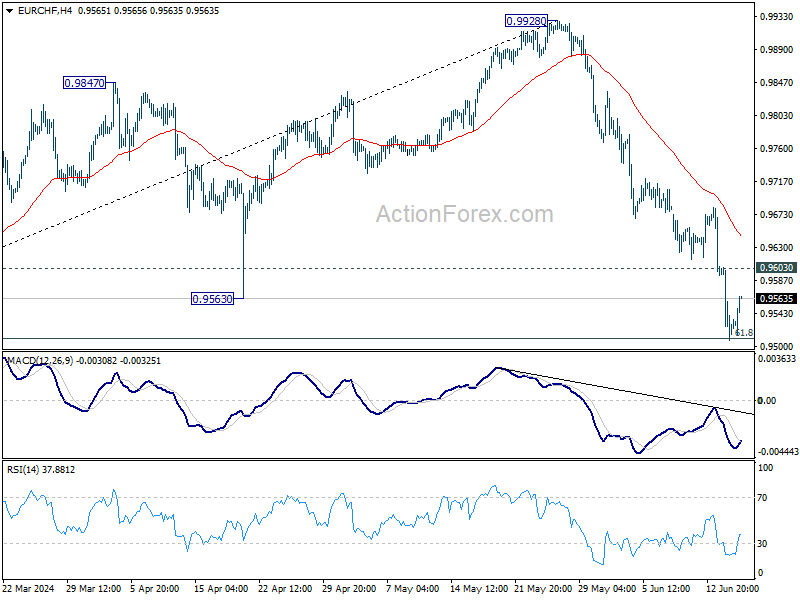
In Europe, Swiss Franc distinguished itself among its peers, rallying robustly against other major European currencies following unexpectedly high inflation readings.
US Investor Sentiment Buoyed by Fed Powell's Guidance and Softer Payroll Data
The US financial markets witnessed a U-turn last week, with surging stocks while treasury yields and Dollar plummeted. A solid foundation for market optimism was laid down by Fed Chair Jerome Powell's much less hawkish than feared post-FOMC press conference. There he explicitly dismissed the possibility of further rate hikes, stating that the next move by the Fed would likely involve "cutting" or "not cutting" rates, rather than increasing them. This clarification has helped alleviate investor anxieties about more monetary tightening.
Nevertheless, the direct catalyst for the strong rally in US stocks was the goldilocks non-farm payroll report. While showing a headline job growth of 175k in April, markedly below the anticipated figures, the average job growth of 242k in the past three months ( 236k in February and 315k in March) still aligned with the average monthly job growth over the past year.
This underscores a stable and healthy employment environment rather than an overheated labor market. Additionally, a slight rise in the unemployment rate to 3.9% and still decent wage growth of 0.2% mom are seen as positive signs that the labor market is cooling without destabilizing. The set of figures suggest a balanced scenario that supports Powell's stance against immediate rate hikes.
While the initial reaction to the payroll data has been largely positive, interpreting it as a 'Goldilocks' scenario—neither too hot nor too cold—some economists are voicing caution. They suggest that the softening numbers could herald the beginning of a broader economic slowdown, especially when considered alongside contractions in both ISM manufacturing and service sector PMIs. This perspective, though currently less dominant, could gain traction if future data trends support a more bearish economic outlook.
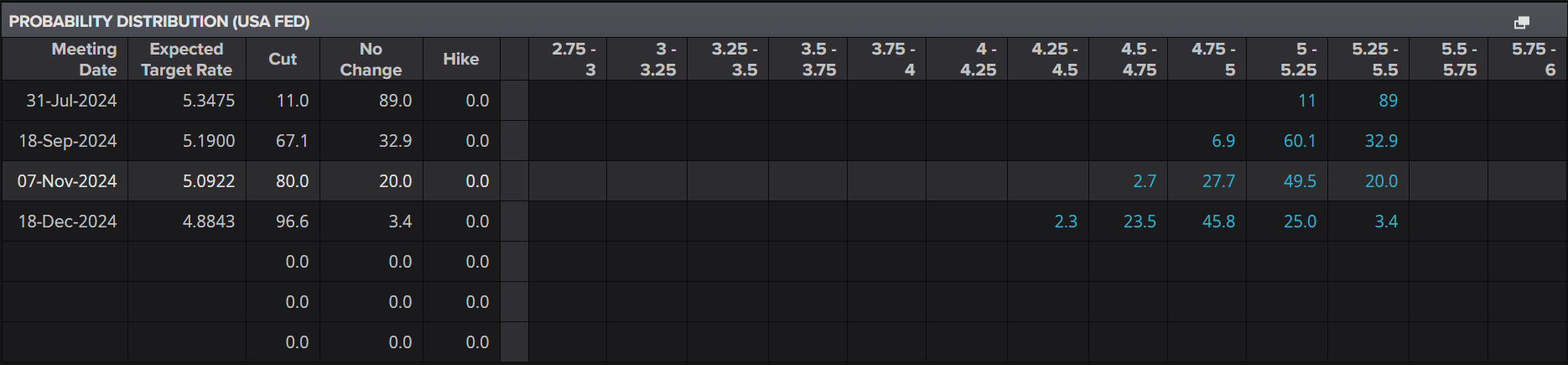
Current expectations for future monetary policy, as indicated by fed fund futures, now show a 67.4% probability of a rate cut by September, with the likelihood of two rate reductions by year-end estimated at 61.8%.
DOW's strong break of 55 D EMA (now at 38402.19) should confirm that pullback from 39899.05 high has completed at 37611.56 already. The corrective pattern from there is now in its second leg. Further rise is likely for retesting 39889.05. In case of another fall, as the corrective pattern starts its third leg, downside should be contained by 38.2% retracement of 32327.20 to 39889.05 at 37000.42.
10-year yield's steep pull back on Friday confirmed short term topping at 4.730. Focus is back on 38.2% retracement 3.780 to 4.730 at 4.367. Strong support from there would maintain near term bullishness. That is, rise from 3.780 would resume through 3.730 to retest 4.997 at a later stage. However, firm break of 4.367 will argue that rebound from 3.780 has completed. TNX should then be in the third leg of the pattern from 4.997. In this bearish case, deeper fall would be seen back to 61.8% retracement at 4.142 and below.
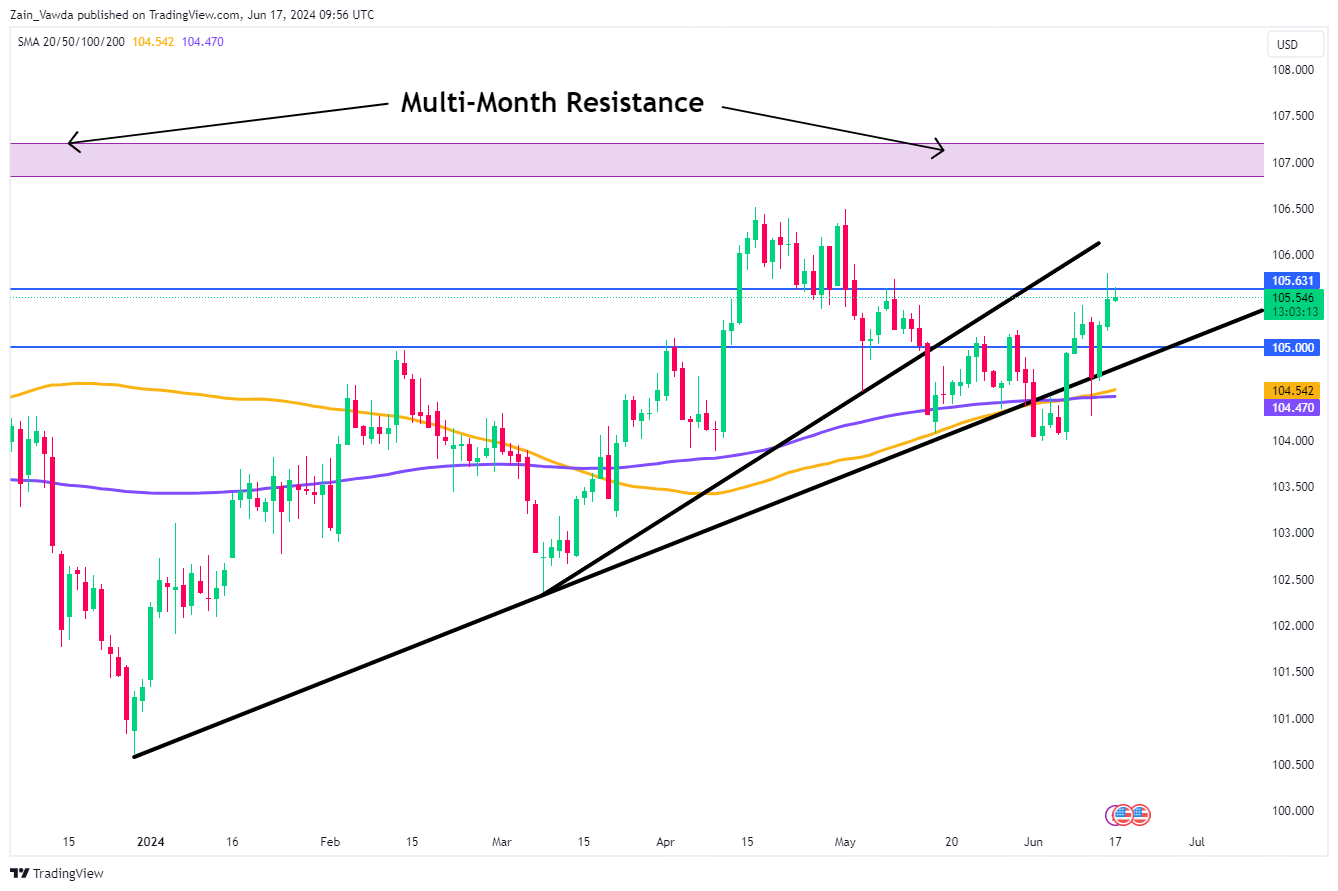
Dollar index's steep decline and break of 104.97 resistance turned support also confirmed short term topping at 106.51. Some more consolidations would be seen with risk of deeper retreat. Nevertheless, as long as lower channel support (now at 103.75) holds, rise from 100.61 is still in favor to continue to 107.34 and above. However, sustained break of the channel will argue that rebound from 100.61 has completed as a three-wave corrective move. Deeper fall would then be seen through 102.35 support in this bearish case.
Dollar's Misfortune Intensified by Suspected Japanese Market Interventions
Adding to Dollar's woe last week was alleged currency market interventions by Japan on two occasions, which were not confirmed by the government. USD/JPY eventually closed the week down -3.5%.
The first intervention is believed to have occurred just as after USD/JPY breack through the significant psychological mark of 160 during Monday's Asian trading session. The second intervention reportedly took place on Wednesday, shortly after the post-FOMC press conference, which had already placed some pressure on Dollar.
These actions align with recent statements from Masato Kanda, Japan's top currency diplomat, who emphasized Japan's readiness to engage in currency market interventions "24 hours a day," regardless of the global financial market hours, be it London, New York, or Wellington.
Estimates suggest that Japan may have spent approximately USD 35B in Monday's intervention alone. With analysts speculating that Japan's total intervention war chest could be around USD 300B, this substantial reserve allows Japan to maintain an active presence in the currency markets.
Technically, while the pull back from 160.20 was steep, it's still seen as developing into a corrective pattern only. 150.87 resistance turned support should contain downside to set the range for a sideway pattern, probably in form of a triangle. Break of 160.20 could still be seen before rise 140.25 completes a five-wave move.
However, if US treasury yield extends last week's decline with acceleration, that would put additional pressure on USD/JPY through 150.87. That could trigger more selloff in the pair and indicate that rise from 140.25 has indeed finished at 160.20. In this bearish case, larger scale correction is already underway.
Canadian Dollar's Challenges: June BoC Cut Expectations and Falling Oil Prices
Canadian Dollar performed even more poorly than the greenback over the past week. This was partly influenced by growing market expectations for BoC rate cut in June following disappointing GDP growth data. The money markets are now pricing in 60% probability that BoC will reduce its benchmark interest rate at the upcoming policy meeting on June 5. Furthermore, expectations are set around a total of 60bps of easing from the central bank by the end of 2024.
The extended decline in oil prices has possibly added to Loonie's troubles too. The geopolitical risk premiums that spiked due to the Israel-Hamas conflict have begun to subside as both parties show openness to negotiations, with talks potentially leading to a temporary ceasefire. Hamas has announced plans to send a delegation to Cairo for discussions that could pave the way for a truce and the release of hostages in Gaza.
The strong break of channel support in WTI crude oil argues that rebound from 67.79 has completed with three waves at 87.84 already. Immediate focus is now on 100% projection of 87.84 to 81.20 from 84.88 at 78.24. Decisive break there could prompt downside acceleration to 161.8% projection at 74.13. That would also strengthen the case of bearish trend reversal, and open up deeper fall back to 67.79 support.
Aussie Strengthens as Rate Cut Expectations Push to November
Australian Dollar has charted a markedly different course compared to its Canadian counterpart, buoyed by shifts in monetary policy expectations and positive market sentiment abroad. Australia's leading financial institutions, the "Big Four" banks, have now adjusted their forecasts, pushing the expected RBA rate cut from September to November. This revision also reflects a more cautious and extended easing cycle, primarily due to persistently high inflation rates within the country.
A senior economist at Commonwealth Bank highlighted that strong net overseas immigration is exerting upward pressure on certain components of CPI. This demographic pressure complicates RBA's efforts to steer inflation back to its target, necessitating a more gradual and deliberate rate cutting strategy.
Simultaneously, Aussie is drawing strength from a surge in optimism in the Hong Kong stock markets, which are currently experiencing their longest winning streak since 2018. Following a near 40% drop over the previous four years, the Hang Seng Index's low valuations have attracted significant investment, fueling a rally that could potentially encourage further inflows from investors eager not to miss out. This optimism appears to overshadow concerns about China's economic fluctuations and geopolitical uncertainties, at least for the moment.
Technically, the strong break of 38.2% retracement of 22700.85 to 14794.16 at 17814.51 now suggests that HSI is reversing whole down trend from 22700.85. Near term outlook will stay bullish 17214.67 resistance turned support holds. Next target is 61.8 retracement at 19680.49. Also, considering that current rise is likely the third leg of the pattern from 14597.31, decisive break of 19680.49 will pave the way back to 22700.85.
AUD/CAD's strong rally and break of 0.9005 resistance suggests that consolidation pattern from 0.9063 has completed at 0.8779 already. Further is expected as long as 0.8997 resistance turned support holds, to resume the whole rebound from 0.8562. Key focus is on 61.8% projection of 0.8562 to 0.9063 from 0.8779 at 0.9089. Firm break there will add to the case that it's reversing whole down trend from 0.9545 rather than correcting it. Next target will be 100% projection at 0.9280.
EUR/USD Weekly Outlook
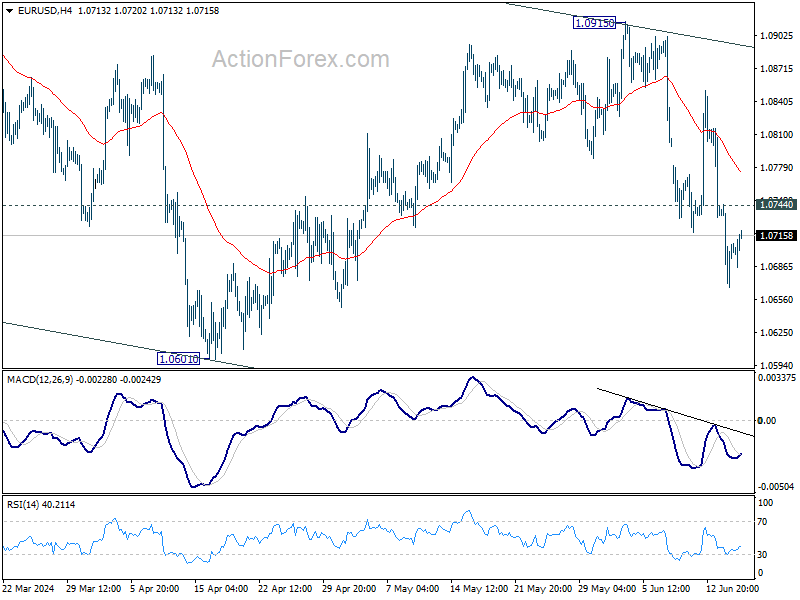
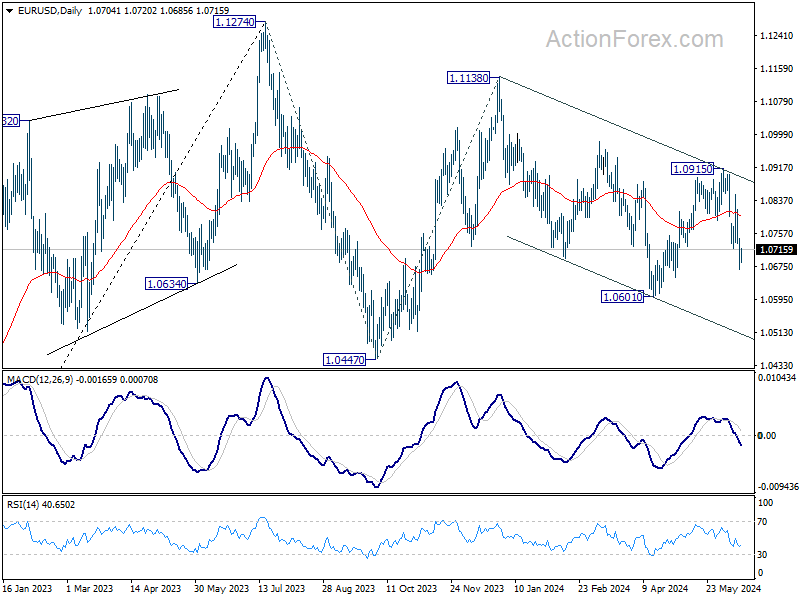
EUR/USD's rise from 1.0601 resumed last week and the strong break of 55 D EMA argues that fall from 1.1138 might have completed. Initial bias stays on the upside this week. Firm break of 100% projection of 1.0601 to 1.0752 from 1.0648 at 1.0799 will pave the way to 161.8% projection at 1.0892. For now, risk will stay on the upside as long as 1.0648 support holds, in case of retreat.
In the bigger picture, price actions from 1.1274 are viewed as a corrective pattern. Fall from 1.1138 is seen as the third leg and could have completed. Firm break of 1.1138 will argue that larger up trend from 0.9534 (2022 low) is ready to resume through 1.1274 high. On the downside, break of 1.0601 will extend the corrective pattern instead.
In the long term picture, a long term bottom is in place at 0.9534 on bullish convergence condition in M MACD. It's still early to call for bullish trend reversal with the pair staying inside falling channel in the monthly chart. Nevertheless, sustained trading above 55 M EMA (now at 1.1027) and break of 1.1274 resistance will raise the chance of reversal and target 1.2348 resistance for confirmation.
EUR/USD Weekly Outlook
EUR/USD's rise from 1.0601 resumed last week and the strong break of 55 D EMA argues that fall from 1.1138 might have completed. Initial bias stays on the upside this week. Firm break of 100% projection of 1.0601 to 1.0752 from 1.0648 at 1.0799 will pave the way to 161.8% projection at 1.0892. For now, risk will stay on the upside as long as 1.0648 support holds, in case of retreat.
In the bigger picture, price actions from 1.1274 are viewed as a corrective pattern. Fall from 1.1138 is seen as the third leg and could have completed. Firm break of 1.1138 will argue that larger up trend from 0.9534 (2022 low) is ready to resume through 1.1274 high. On the downside, break of 1.0601 will extend the corrective pattern instead.
In the long term picture, a long term bottom is in place at 0.9534 on bullish convergence condition in M MACD. It's still early to call for bullish trend reversal with the pair staying inside falling channel in the monthly chart. Nevertheless, sustained trading above 55 M EMA (now at 1.1027) and break of 1.1274 resistance will raise the chance of reversal and target 1.2348 resistance for confirmation.
USD/JPY Weekly Outlook
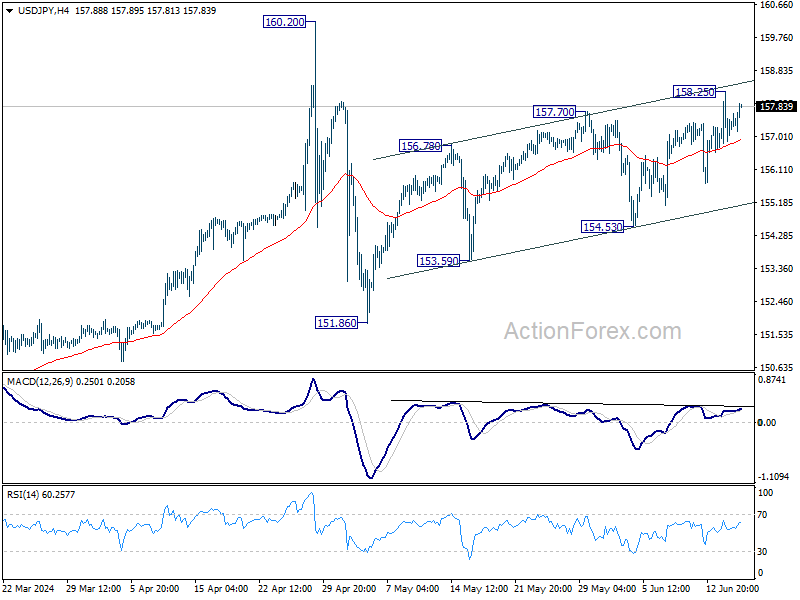
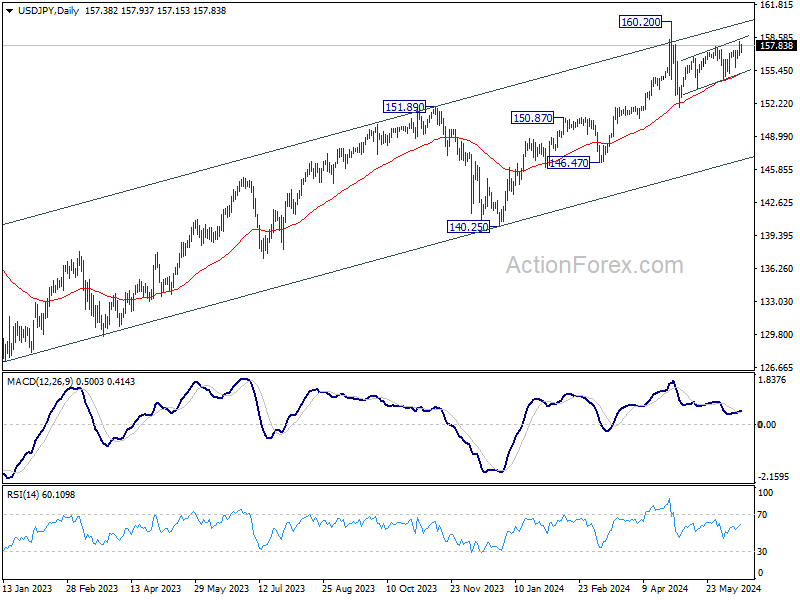
USD/JPY reversed after spiking higher to 160.20 last week, and fell sharply since then. Initial bias remains on the downside this week for deeper fall. But strong support should be seen from 150.87 resistance turned support to bring rebound. Above 153.81 minor resistance will turn intraday bias neutral first.
In the bigger picture, a medium term top might be formed at 160.20. But as long as 150.87 resistance turned support holds, fall from there is seen as correcting rise from 150.25 only. However, decisive break of 150.87 will argue that larger correction is possibly underway, and target 146.47 support next.
In the long term picture, as long as 140.25 support holds, up trend from 75.56 (2011 low) is still in progress. Next target is 138.2% projection of 75.56 (2011 low) to 125.85 (2015 high) from 102.58 at 172.08.
GBP/USD Weekly Outlook
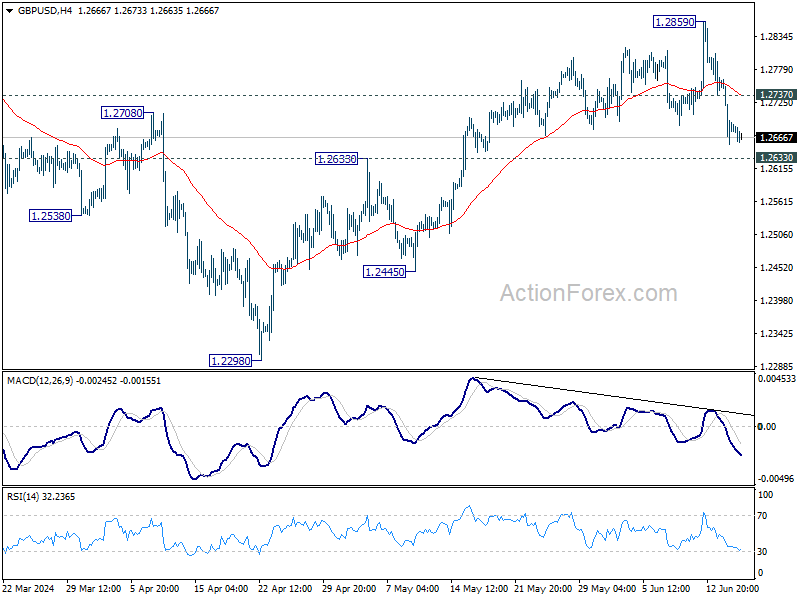
GBP/USD's rebound from 1.2298 resumed by breaking through 1.2568 last week. The strong break of 55 D EMA suggest that fall from 1.2892 has completed with three waves down to 1.2298. Initial bias stays on the upside this week. Break of 61.8% projection of 1.2298 to 1.2568 from 1.2471 will target 100% projection at 1.2741. For now, further rally will be expected as long as 1.2471 support holds, in case of retreat.
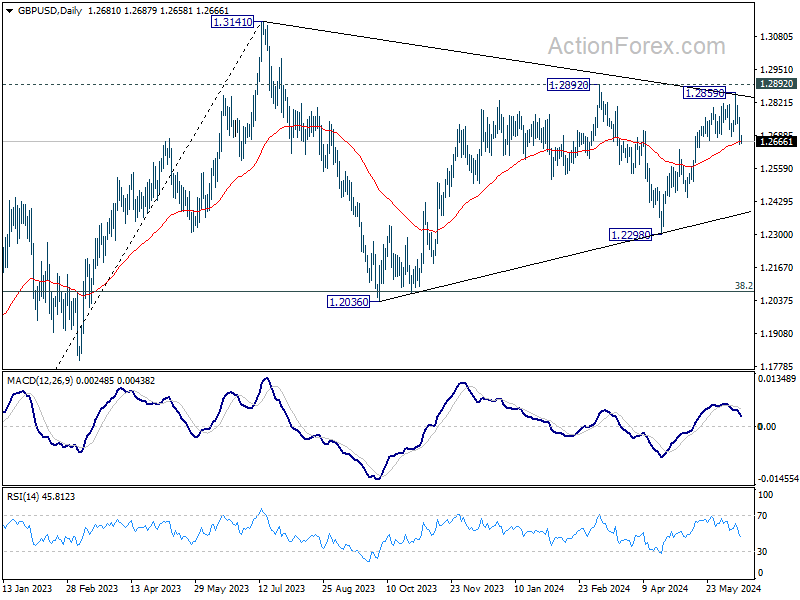
In the bigger picture, price actions from 1.3141 medium term top are seen as a corrective pattern. Fall from 1.2892 is seen as the third leg which might have completed already. Break of 1.2892 resistance will argue that larger up trend from 1.0351(2022 low) is ready to resume through 1.3141. Meanwhile, break of 1.2298 support will extend the corrective pattern instead.
In the long term picture, a long term bottom should be in place at 1.0351 on bullish convergence condition in M MACD. But momentum of the rebound from 1.3051 argues GBP/USD is merely in consolidation, rather than trend reversal. Range trading is likely between 1.0351/4248 for some more time.
USD/CHF Weekly Outlook
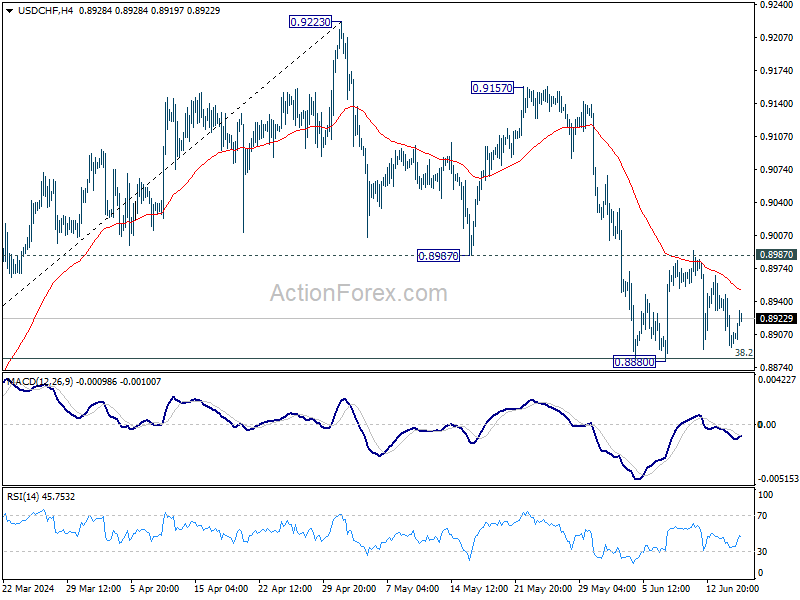
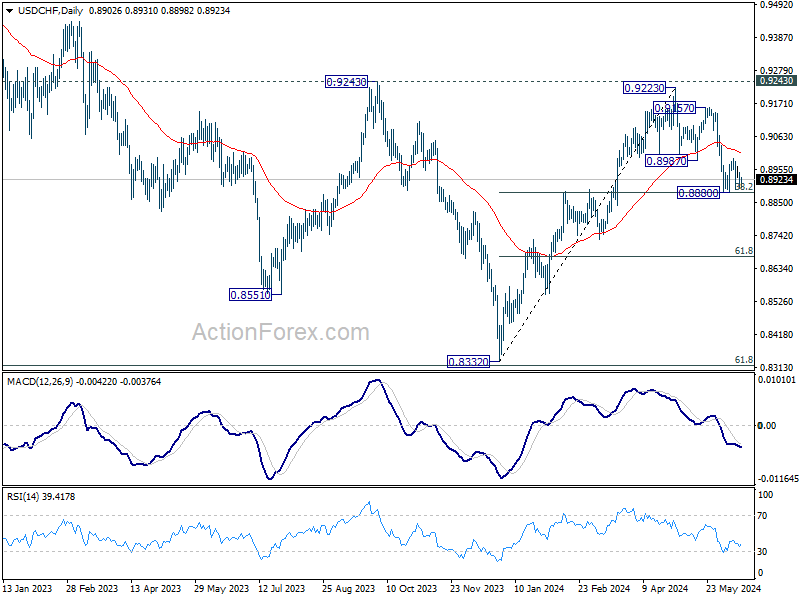
Despite edging higher initial to 0.9223 last week, USD/CHF was rejected by 0.9243 key resistance and fell sharply since then. Initial bias stays on the downside this week. Sustained break of 55 D EMA (now at 0.8989) will bring deeper fall to 38.2% retracement of 0.8332 to 0.9223 at 0.8883. On the upside, above 0.9087 minor resistance will turn intraday bias again first.
In the bigger picture, price actions from 0.8332 medium term bottom are tentatively seen as developing into a corrective pattern to the down trend from 1.0146 (2022 high). Rejection by 0.9243 resistance, followed by sustained break of 38.2% retracement of 0.8332 to 0.9223 at 0.8883 will strengthen this case, and maintain medium term bearishness. However, decisive break of 0.9243 will argue that the trend has already reversed and turn medium term outlook bullish for 1.0146.
In the long term picture, price action from 0.7065 (2011 high) are seen as a corrective pattern to the multi-decade down trend from 1.8305 (2000 high). Strong rebound from 61.8% retracement of 0.7065 to 1.0342 (2016 high) will start the third leg as a medium term rally. But there will be no sign of long term reversal until firm break of 38.2% retracement of 1.8305 to 0.7065 at 1.1359.
AUD/USD Weekly Report
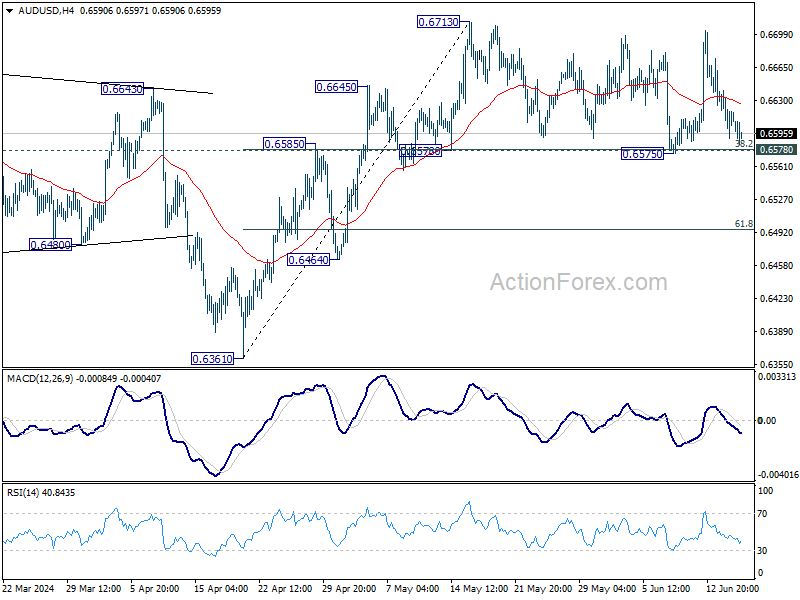
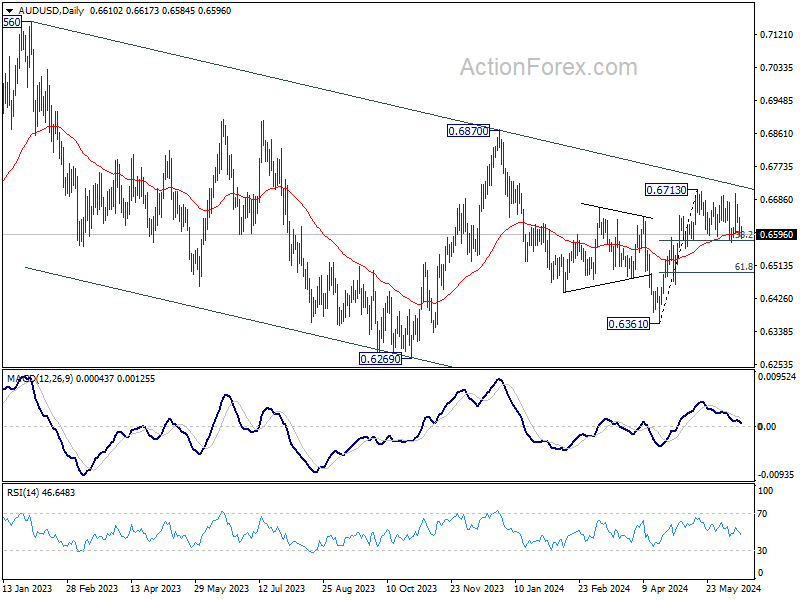
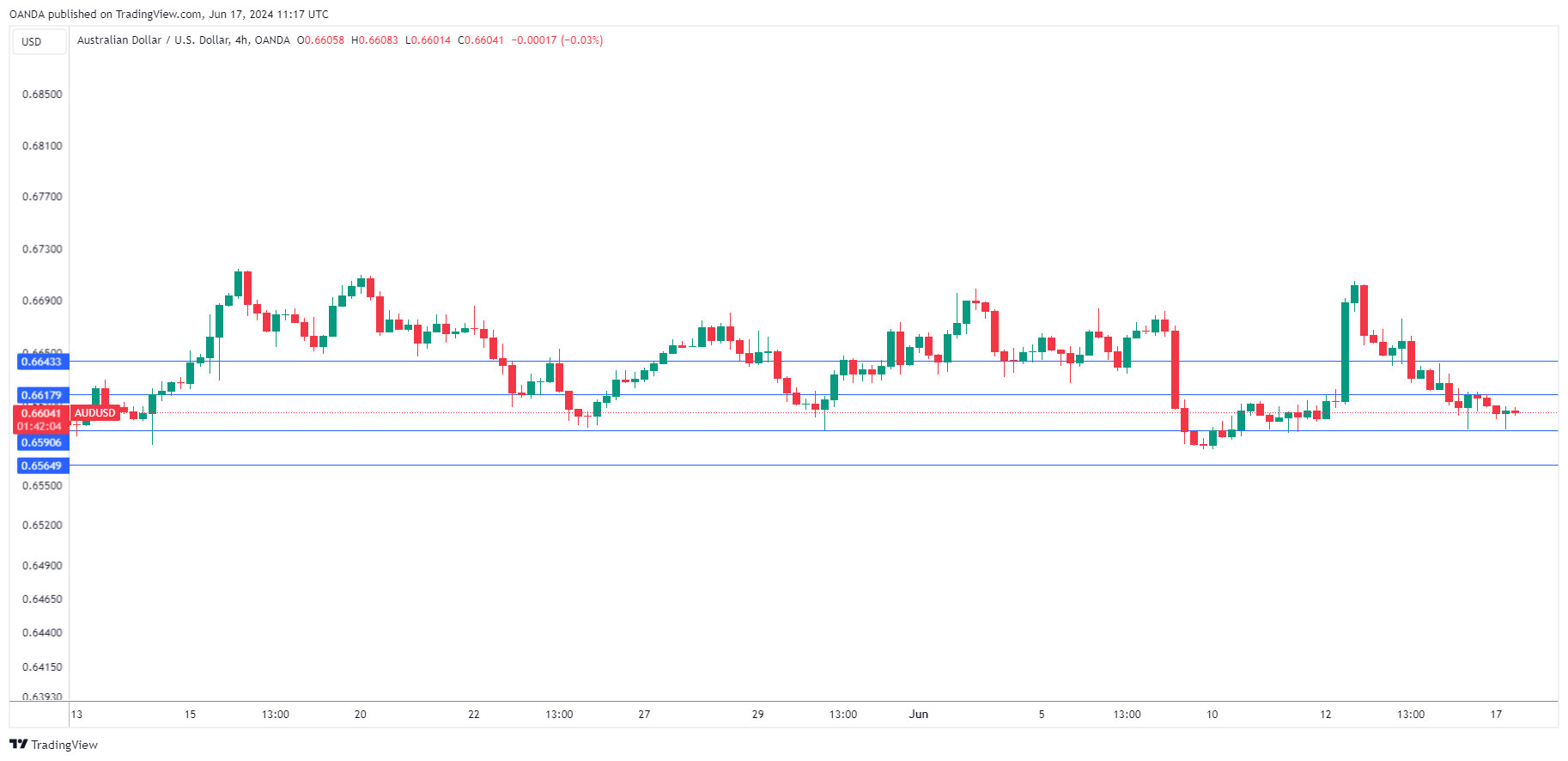
AUD/USD's rebound from 0.6361 continued last week despite interim pull back. Breach of 0.6643 resistance affirms the case that fall from 0.6870 has completed with three waves down to 0.6361. Initial bias stays on the upside this week for 100% projection of 0.6361 to 0.6585 from 0.6464 at 0.6688 next. For now, risk will stay on the upside as long as 0.6464 support holds, in case of retreat.
In the bigger picture, price actions from 0.6169 (2022 low) are seen as a medium term corrective pattern to the down trend from 0.8006 (2021 high). Fall from 0.7156 (2023 high) is seen as the second leg, which could still be in progress. Overall, sideway trading could continue in range of 0.6169/7156 for some more time. But as long as 0.7156 holds, an eventual downside breakout would be mildly in favor.
In the long term picture, the down trend from 1.1079 (2011 high) should have completed at 0.5506 (2020 low) already. It's unsure yet whether price actions from 0.5506 are developing into a corrective pattern, or trend reversal. But in either case, fall from 0.8006 is seen the second leg of the pattern. Hence, in case of deeper decline, strong support should emerge above 0.5506 to bring reversal.