Sample Category Title
Could BoE Adopt a More Dovish Stance on Thursday?
- The BoE meets on Thursday; no interest rate change is expected
- Quarterly projections could support market expectations for rate cuts
- Pound in need of a boost against the euro
Decision time for the BoE
The Bank of England will hold its third gathering for 2024 on Thursday. The press statement, the meeting’s minutes and the Monetary Policy Report will be published at 11:00 GMT, with the important press conference following 30 minutes later.
The market expects no change at the current bank rate of 5.25% with the focus being on three factors: the inflation projections in the Monetary Policy Report, the voting pattern, and the overall rhetoric at the press conference.
What changed in the economy since the last meeting?
Since the BoE’s March 21 meeting, data has been mostly mixed. The economy appears to have returned to growth during the first quarter of 2024, as made evident by the PMI surveys. Similarly, the housing sector is showing signs of life despite the higher interest rates.
Inflation though remains the BoE’s main problem. With the labour market not yet falling off a cliff and retail sales showing some leftover consumer appetite, inflation is still elevated with the core CPI indicator remaining above 4% for the 28th consecutive month. In addition, average earnings continue to grow at a high pace with the MPC member Greene recently pointing out that “wage growth in services price inflation is not consistent with this sustainable return to 2% inflation”.
Quarterly forecasts to hit the newswires at 11:00 GMT
The February Monetary Policy Report showed headline inflation dropping to 2.3% by the end of 2026. An upwards revision of the inflation outlook would probably deliver a strong blow to the current market expectations and possibly raise the bar for any imminent rate cuts. On the other hand, a drop below the 2% threshold for the 2026 figure could go a long way towards cementing a rate cut over the next few meetings.
Could the hawks vote for a rate hike again?
BoE members Mann, Haskel and Greene voted consistently for rate hikes since the August 2023 meeting. However, the gradual easing in inflation since the start of the year forced them to side with the majority once again. They will most likely stick with the majority camp at this gathering as well, even though they acknowledge that more progress is needed on the inflation front.
Another uneventful meeting?
On the back of the latest economic developments and Wednesday’s Fed meeting most likely keeping the door shut to rate cuts over the summer, the BoE does not appear ready for a dovish shift. The markets are currently fully pricing in a 25bps rate cut by September, but inflation remains a thorn in the BoE’s side.
Provided that the quarterly forecasts do not point to a significant easing of inflation in the forecast period, Governor Bailey is expected to maintain the current somewhat dovish stance at the press conference and keep his cards close to the chest. Developments in the Middle East, with its likely implications on oil prices, China, and the Fed’s refusal to signal rate cuts do not leave much more for complacency.
However, there will be lots of talk about the April inflation figure. Due to energy prices being much lower this time around compared to April 2023, inflation could drop to just above the 2% level. Bailey et al could brand this move as monetary policy victory but the hawks have already expressed their view that inflation will gradually pick up, closing the door to hasty decisions.
The pound’s fate is at the hands of the BoE
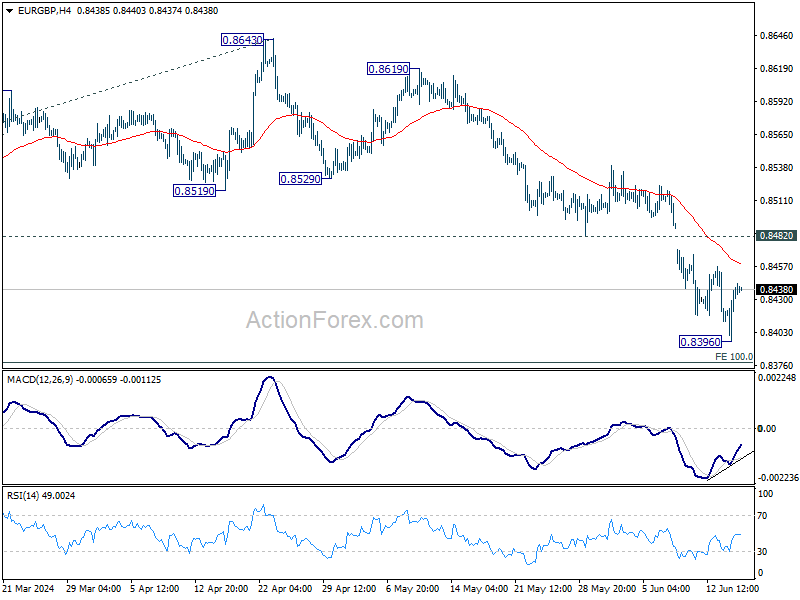
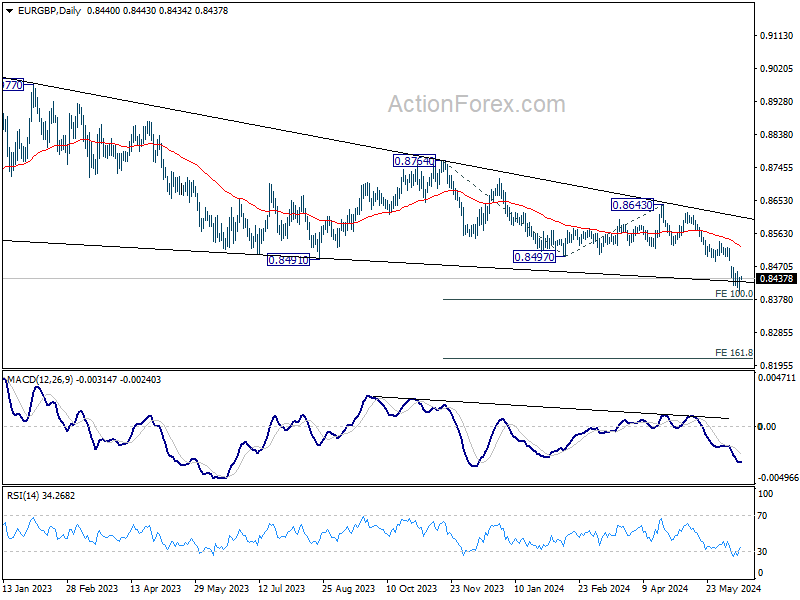
Market analysts are currently split for a June rate cut. A BoE gathering pre-committing to a June rate cut, could leave the pound unsupported with the euro/pound pair possibly rallying towards the 200-day SMA and potentially threatening the April 2024 highs.
On the flip side, another uneventful meeting could cause this pair to bounce lower towards the early March lows at the 0.8492-0.8505 area.
Week Ahead – BoE and RBA Decisions Headline a Calm Week
- Bank of England meets on Thursday, unlikely to signal rate cuts
- Reserve Bank of Australia could maintain a higher-for-longer stance
- Elsewhere, Bank of Japan releases summary of opinions
BoE - No rate cuts yet
Britain’s economy seems to have escaped the shallow recession it fell into last year, and has finally entered the recovery phase. Business surveys point to solid growth in the first quarter and even stronger momentum in the second quarter, powered by a rebound in consumer spending as wage growth has remained resilient.
The dark side of this economic resurgence is that inflation remains persistently hot. The core CPI rate held above 4% in March and business surveys warn of a reacceleration in the coming months as companies lift their prices to pass rising costs onto consumers.
In this light, the Bank of England is unlikely to signal any imminent rate cuts when it concludes its meeting on Thursday, reflecting the stubbornness of inflationary pressures. Of course, that wouldn’t be surprising for investors, who currently expect the first rate cut to be delivered in August.
A message that rate cuts are still some distance away could benefit the pound, although the broader FX reaction will also depend on the new economic forecasts and the vote composition of the Committee. A single member voted for an immediate cut last time, but given the recent string of encouraging data, this official could also vote for keeping rates unchanged this time.
In the big picture, the outlook for the British pound seems cautiously optimistic. While sterling has lost about 1.5% against the mighty US dollar this year, it has gained a similar amount against the euro, and almost 7% against the sinking Japanese yen. Therefore, expectations of higher-for-longer rates have supported sterling, even if it hasn’t shown up against the dollar.
Another element that has supported the pound has been the risk-on tone in equity markets, given its strong correlation with global risk sentiment. Assuming these factors remain in force, the currency could continue to shine, at least against the euro and yen.
Beyond the BoE meeting, the nation’s GDP numbers for the first quarter are out on Friday, and will likely show that economic growth flipped positive after a minor contraction late last year.
RBA unlikely to rock the boat
Crossing into Australia, the Reserve Bank will wrap up its own meeting early on Tuesday. No action is expected, and judging by incoming economic data, policymakers are unlikely to change their neutral tone either.
Consumer and producer inflation came in hotter than expected in the first quarter, signaling that the path for bringing inflation back down might be slower than the central bank had anticipated. The strength in the labor market reinforces this notion, alongside the rapid increases in house prices.
Similarly, there have been some early signs of recovery in China’s industrial sector, which is great news for Australia, whose entire business model relies on shipping its commodity exports to China. Over time, this can help boost Australian growth.
Blending everything together, there is no reason for the RBA to deviate from its neutral stance at this meeting. If anything, it could strike a slightly more hawkish tone, but is unlikely to go as far as to signal another rate increase.
A neutral message on rates would leave the Australian dollar mostly in the hands of global risk appetite and any China developments. In this sense, China’s latest trade numbers on Thursday could be crucial for the currency.
Bank of Japan releases summary of opinions
Over in Japan, the government has intervened in the FX market to buy the sinking yen, propelling the currency more than 3% higher this week. That said, the fundamental factors that pushed the yen to its lowest levels in three decades are still present, raising questions about the sustainability of this recovery.
For the yen to enjoy a proper trend reversal, interest rate differentials need to narrow - either with the Fed cutting rates or with the Bank of Japan raising them. Neither seems likely over the next few months, which suggests the yen could remain under pressure overall, although FX interventions might help ensure it doesn’t hit new lows.
The Bank of Japan will release the summary of opinions from its April meeting on Thursday, which will provide some clues around the potential timing of the next rate increase, alongside the latest batch of national wage numbers.
Finally in Canada, employment stats for April will hit the markets on Friday.
Weekly Focus – Spring Has Brought a More Muted Euro Area Price Pressure
Longer dated yields edged a bit lower in a week with few data surprises and no surprises from the Fed. In FX markets, yen trading has been the most action packed with USD/JPY touching 160 for the first time since 1990, triggering what looks like intervention from Japanese authorities on several occasions. Data suggests the Bank of Japan has bought close to JPY9 trillion to support the currency, which finally caught some tailwind by the end of the week not least from the oil market. The oil price fell to its lowest level since mid-March, likely triggered by weaker demand and perhaps a reduction of the geopolitical risk premium in the absence of further escalation of the conflict in the Middle East. Also, industrial metal prices corrected a bit lower following the very steep price surge we have seen through April.
Inflation data confirmed that euro area price pressures have muted in the spring after Easter effects blurred the picture somewhat in the promising March data. Core inflation edged lower to 2.7% but the ECB will continue to worry about service price growth, which corresponds to above 5% annual service inflation. The first estimate of GDP-growth came in a bit stronger than expected at 0.3% for Q1 aiming nicely with the soft-landing scenario playing out but of course also increasing the risk of new inflation headaches.
At the FOMC meeting, the Fed kept rates unchanged and chairman Powell provided few new clues on the policy outlook. He made it clear that the Fed remains in a good place with its current policy and he did not go into speculation on a potential rate hike, sparking a modest dovish reaction in markets. The Fed decided to taper the pace of QT, which came as no surprise. Q1 productivity growth slowed down sharply offering some explanation behind the recent broad-based increasing price pressures. Job openings declined more than expected in March, which points to easing wage pressures over the next few months.
Chinese manufacturing PMIs were robust and are overall still in line with a moderate manufacturing recovery. Strong export orders highlight the improvement in growth on export markets in line with our case for a rising global manufacturing cycle. This is also supported by the surge in global metal prices lately. Service PMIs on the other hand were weaker than expected.
Over the coming two weeks, we have lots of interesting data releases. Markets will pay particularly close attention to US CPI data where we expect a slight moderation in core price momentum following the last couple of months' hot prints. We expect the Bank of England to keep the Bank Rate unchanged next week. Overall, we expect softer communication priming markets for a rate cut in June.
From China we will get another badge of inflation data. It will likely catch some headlines as China is flirting with sub-zero inflation rates. Retail and home sales will also be interesting to gauge developments in the housing crisis and the domestic economy.
Bank of England Preview – Setting the Stage for a June Cut
- We expect the Bank of England (BoE) to keep the Bank Rate unchanged at 5.25% on 9 May, which is in line with consensus and current market pricing.
- Overall, we expect the MPC to soften its communication, priming the markets for imminent start to a cutting cycle. We expect the first 25bp cut in June.
- We expect EUR/GBP to end the day higher on a dovish vote split and remarks as well as a downward revision to the inflation forecast in the medium term.
We expect the Bank of England (BoE) to keep the Bank Rate unchanged at 5.25% on 9 May, which is in line with consensus and current market pricing. We expect the vote split to be 7-2, with the majority voting for an unchanged decision and Ramsden joining Dhingra in voting for a cut. Note, this meeting will include both updated projections and a press conference following the release of the statement.
Overall, we expect the MPC to soften its communication, priming the markets for an imminent start to a cutting cycle. We expect them to retain much of its wording in terms of forward guidance, repeating that "monetary policy could remain restrictive even if Bank Rate were to be reduced, given that it was starting from an already restrictive level" and "the Committee will keep under review for how long Bank Rate should be maintained at its current level". Since the last monetary policy decision in March, data has overall been slightly stronger than expected. Both headline and service inflation are slightly above the MPC's forecast from February and wage growth is likely to overshoot the Q1 forecast of 5.7%. The growth backdrop remains a challenge for the MPC with the outlook of a growth rebound in 2024. We expect a downward revision of the inflation forecast in the medium-term as the implied Bank Rate conditioning path will be decisively higher with currently close to 45bp worth of cuts priced in for the year (vs 100bp in February MPR).
The MPC continues to be divided and increasingly within the internal members as well. Ramsden, who early in the hiking cycle was a hawkish dissenter, recently struck a dovish tone noting that "the balance of domestic risks to the outlook for UK inflation ... is now tilted to the downside" and that he saw "promising developments in service inflation". Likewise, Governor Bailey is leaning to the dovish side. On the other hand, Pill, who has voted with the majority for the entire hiking cycle, noted that a cut "remains some way off" and there is still "some way to go" before he is convinced of a sustainable return to the inflation target. We expect the majority to vote for a cut in June.
BoE call. We expect the BoE to prime markets for a rate cut at the meeting next week delivering the first cut of 25bp in June. We expect a 25bp cut in each of the subsequent quarters, totalling 75bp of rate cuts for 2024. Markets are pricing 45bp for the remainder of the year with the first 25bp cut only priced by August.
FX. In our base case we expect EUR/GBP to end the day higher on the back of a dovish vote split and remarks as well as a downward revision to the inflation forecast in the medium term. We expect this to be cautiously reemphasised during the press conference. Overall, we see relative rates as a negative for GBP and see current levels as attractive levels to sell GBP. We forecast EUR/GBP towards 0.89 in 6-12 months.
April Showers on the Jobs Market
Summary
The employment situation report for April kicked off the second quarter with signs that the labor market is cooling. Nonfarm payrolls increased by 175K in the month, below consensus expectations for a 240K gain, while the unemployment rate rose a tenth to 3.9%. Meantime, average hourly earnings growth slowed and, at just 3.9% year-over-year, is not too far above the 3.3% average that prevailed in 2019.
Overall, today's data point to a jobs market that is still tight, but not nearly as hot as it was a year or two ago. This should support a further slowdown in inflation as the year progresses, even if improvement proceeds only gradually. We think it is unlikely the FOMC will be ready to start cutting rates by its next meeting in June, but our base case for the first rate cut to occur at the September 18 FOMC meeting remains firmly in play based on today's employment data.
Employment Underwhelms to Start Q2
The April employment report leaves the jobs market looking a little more vulnerable to the Fed's efforts to cool the economy down. Nonfarm payrolls registered an increase of 175K compared to a prior three-month average of 276K (now 269K incorporating revisions). The increase fell short of consensus expectations for a 240K gain in what is only the fourth time in the past two years the initial print undershot the consensus.
On an industry basis, job growth remained solid in healthcare & social assistance (+87K), while picking up in manufacturing (+8K). However, elsewhere the picture was underwhelming. Leisure & hospitality and construction employment slowed sharply relative to their Q1 averages, suggesting the mild winter weather and early Easter/spring breaks may have pulled some hiring forward. Government hiring also downshifted notably, up by just 8K compared to an average of 55K the prior 12 months. Higher-wage industries also struggled to add jobs, with payrolls declining in information, professional & business services and mining, flat within the utilities industry, and up only modestly in the financial industry in April.
The weak outturn in payrolls for higher-paying industries as well as gradual loosening in labor market conditions weighed on average hourly earnings (AHE) growth over the month. AHE for private sector workers increased 0.2%, which was a tick less than the consensus and our own expectations. On a year-ago basis, average hourly earnings growth slowed to 3.9%, the first sub-4% print in nearly three years. While average hourly earnings are less encompassing than the employment cost index and prone to revision, the subdued gain in April suggests the labor market is still on track to bring some relief on the inflation front this year after the downward trend in both labor costs and inflation stalled in Q1. While the slower rate of nominal wage growth in April may be good news for the Fed's inflation fight, in the near term it is likely to challenge consumer spending, particularly when coupled with the slower rate of job growth and another dip in the average workweek.
The more volatile household survey showed employment rising by just 25K in April. A 63K increase in unemployment helped push the unemployment rate up a tenth to 3.9%. Although still low, the unemployment rate is now 0.3ppt above its 2023 average of 3.6%. The labor force participation rate held steady at 62.7% amid an 87K increase in the labor force in the month.
It was not all bad news in the household survey. Full-time employment rose by 949K, with a 649K decline in people working part-time for noneconomic reasons. The share of the "prime-age" population that was working in April also climbed a tick and is now just one-tenth away from reclaiming the high that was reached in the summer of 2023 (chart). Household employment growth over the past year remains significantly weaker than the payroll survey, but as we discussed at length in a recent report, we do not think the household measure is presaging an imminent collapse in payrolls.
The data for the U.S. economy were strong across-the-board in Q1, with employment and prices both accelerating through the first few months of the year. The first employment report of Q2 offers a tentative sign that the underlying trend is not quite as hot as the Q1 data suggested. Nonfarm payrolls grew in April at the slowest pace since October of last year, the unemployment rate climbed by a tenth and average hourly earnings dipped below a 4% year-ago pace for the first time since early 2021. These data points are broadly consistent with a labor market that is still tight but not nearly as hot as it was a year or two ago. This in turn should be associated with a continued slowdown in inflation as the year progresses, albeit gradually.
That said, a 175K increase in nonfarm payrolls and a 3.9% unemployment rate is hardly cause for panic. Furthermore, the FOMC will want to see if the pending inflation data also show signs of a slowdown relative to Q1. The next CPI report will be released on May 15, and the one after that will be released on June 12, coinciding with the conclusion of the next FOMC meeting. We think it is unlikely the FOMC will be ready to start cutting rates by its next meeting in June, but our base case for the first rate cut to occur at the September 18 FOMC meeting remains firmly in play based on today's employment data. The next few months of inflation data will be critical to that forecast.
Sunset Market Commentary
Markets
Yields this morning cautiously continued the downtrend after Powell’s rather mild assessment at the press conference on Wednesday. The Fed chair indicated that, despite disinflation making little progress of late, keeping the policy rate a while longer at current level will likely still suffice to return inflation to target over time. An unexpected and substantial deterioration of labour market conditions even could cause the Fed to ease policy pre-emptively. Today’s payrolls were a first high profile reality check. Whether it will be enough for Fed governors to already ignore strong activity data and higher than expected inflation over the previous months still has to be seen, but the April payrolls were weaker across the board. The US economy last month ‘only’ added 175k jobs versus 240k expected, the slowest gain in six months. There were no really big negative outliers in the major subcategories, but no or limited job growth in temporary help (-16k), leisure and hospitality (+5 k) or government (8k) did catch to eye. Also the household survey was soft with limited reported job growth and the unemployment rate rising from 3.8% to 3.9% amid an unchanged participation rate (62.7%). Average hourly earnings eased to 0.2% M/M and 3.9% (from 0.3% M/M and 4.1%). Interest rate markets understandably continued on the post-FOMC momentum. US yields decline between 9 bps (5-y) and 6 bps (30-y). Money markets again see a first rate cut as early as the September meeting with a second step almost full discounted again for December. Before Wednesday’s Fed communication, investors only saw a 75% chance of a first rate in November. German yields are essentially following the trend in the US easing between 6.5 bps (2-y) and 3 bps (30-y) as the Fed rate path remains a important variable for almost other central banks, including the ECB. The easing on the interesting rate markets triggers a broad equity rebound. The EuroStoxx 50 gains 0.9%. US indices open up to 1.75% higher (Nasdaq). Oil still struggles to avoid further losses (Brent $ 84 p/b). Golds also fails to profit from lower yields and/or a weaker dollar ($ 2302 p/oz). On FX, the post-Fed USD correction builds with the DXY trade weighted index tumbling below 105 (104.8). EUR/USD briefly tested the 1.0807 level (38% retracement decline end Dec/mid-April) (currently 1.079). The broader USD decline also provides some relief for the BOJ with USD/JPY trading at 152.5, to be compared with ‘intervention levels’ north of 160 touched earlier this week. Sterling slightly underperforms the euro as markets look forward top next week’s BoE policy meeting (EUR/GBP 0.857).
After finishing this report, the US services ISM will still be published. However, we would be surprised that even a strong report would be able to reverse the post-payrolls’ market dynamics.
News & Views
The Norges Bank (NB) today as expected left its policy rate unchanged at 4.50%. The MPC assesses that the policy rate is sufficiently high to return inflation to target within a reasonable time horizon, but it will likely be kept at current level from some time ahead. At 3.9% Y/Y for headline inflation and 4.5% for the core CPI-ATE measure (ex-energy and taxes), inflation holds well above the 2.0% target, but has been slightly lower than projected. At the same time, economic activity is slightly better than expected and wage growth may turn out to be slightly higher than projected, too. The NB also keeps close eye at external developments. Market policy rate expectations have risen internationally as did Norwegian policy rate expectations. The US dollar has appreciated broadly and the krone exchange rate is weaker than assumed. The NB will have more information at its policy meeting in June, when new forecasts will be presented. In March, the NB indicated that the policy rate could stay at current level till autumn before gradually moving down. Data so far suggest that a tight monetary policy stance may be needed for somewhat longer than previously envisaged. The Norwegian krone was captured in a protracted weakening trend since the start of the year, but outperforms today. EUR/NOK eased from the 11.80 area to currently trade at 11.69. Admittedly, the NOK rebound this afternoon also was helped by the broader post-payrolls USD correction.
Graphs
EUR/NOK: Norwegian krone rebounds as weak currency gets bigger weight in the NB’s policy assessment.
Dollar extends correction. EUR/USD tests 38 % retracement of Dec/April decline (1.0807).
US 2-y yield ‘nosedives’ off 5.0% barrier as market again contemplates September rate cut.
Nasdaq tries to escape sell-on-upticks dynamics as global financial conditions ease.
US ISM services falls to 49.4, back in contraction
US ISM Services PMI fell from 51.4 to 49.4 in April, well below expectation of 52.3. That's the first contraction reading in after 15 months of growth. Business activity/production fell sharply from 57.4 to 50.9. New orders fell from 54.4 to 52.2. Employment tumbled from 48.5 to 45.9. Prices, however, jumped from 53.4 to 59.2.
ISM said: "The past relationship between the Services PMI® and the overall economy indicates that the Services PMI® for April (49.4 percent) corresponds to a 0.2-percent increase in real gross domestic product (GDP) on an annualized basis."
US: Job Gains Lose Some Momentum in April, Unemployment Rate Ticks Up to 3.9%
Non-farm employment rose by 175k in April, below the consensus forecast of 240k. Job gains in the two prior months were also revised lower by a combined 22k.
Private payrolls rose 167k, with most of the gains concentrated in health care & social assistance (87k), transportation & warehousing (21.8k) and retail trade (20.1k). Meanwhile, information (-8k), professional & business services (-4k) and mining & logging (-3k) all shed jobs last month. Government hiring slowed considerably, adding just 8k jobs last month – well below the 62k averaged over the prior three months.
In the household survey, both civilian employment (+25k) and the labor force (+87k) saw very modest gains. With the latter outstripping the former, the unemployment rate ticked up 0.1 percentage points to 3.9%. Meanwhile, the labor force participation rate held steady at 62.7%.
Average hourly earnings (AHE) were up 0.2% month-on-month (m/m) – a deceleration from March's 0.3% m/m gain. On a twelve-month basis, AHE slipped to 3.9 % – the slowest pace of growth in nearly three years – while the three-month annualized rate of change dipped to an even softer 2.8% (from 4.0% in March).
Key Implications
The U.S. job engine lost a bit of momentum in April, with payrolls printing below the 200k mark for the first time in five months. However, smoothing through the monthly volatility shows job gains have averaged a still healthy 242k over the past three-months, which is only a modest step down from Q1's 269K, and still above Q4'2023's average of 212k. Importantly, wage growth decelerated a bit more than expected last month. This will be welcome news for Fed officials – particularly after other data points out this week including the Employment Cost Index showed an uptick in wage pressures more recently.
By most metrics, the labor market remains both healthy and tight. Employment gains remain robust, the unemployment rate is low, and job openings – while falling – are still elevated relative to pre-pandemic levels. With the unemployment rate expected to hold steady through Q2, inflation is unlikely to ease in a way that would give policymakers enough confidence that it's on sustainable path back to 2% until sometime in the second half of the year. As a result, we have pushed out the timing of the first Fed rate cut until December.
EUR/USD Mid-Day Outlook
Daily Pivots: (S1) 1.0689; (P) 1.0710; (R1) 1.0745; More...
EUR/USD's rebound from 1.0601 resumed by breaking through 1.0752 and intraday bias back on the upside. Strong break of 55 D EMA suggests that fall from 1.0980 has completed with three waves down to 1.0601. Further rally is expected and firm break of 100% projection of 1.0601 to 1.0752 from 1.0648 at 1.0799 will pave the way to 161.8% projection at 1.0892. For now, risk will stay on the upside as long as 1.0648 support holds, in case of retreat.
In the bigger picture, price actions from 1.1274 are viewed as a corrective pattern. Fall from 1.1138 is seen as the third leg and could have completed. Firm break of 1.1138 will argue that larger up trend from 0.9534 (2022 low) is ready to resume through 1.1274 high. On the downside, break of 1.0601 will extend the corrective pattern instead.
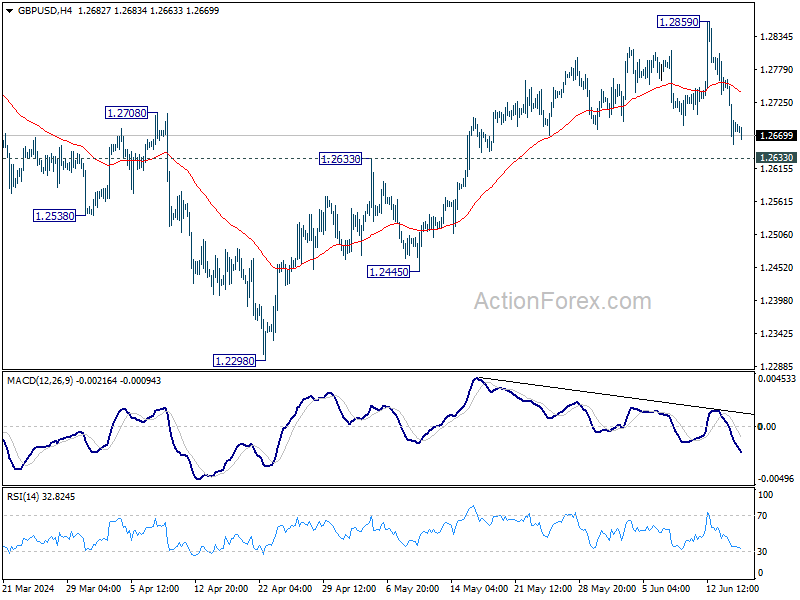
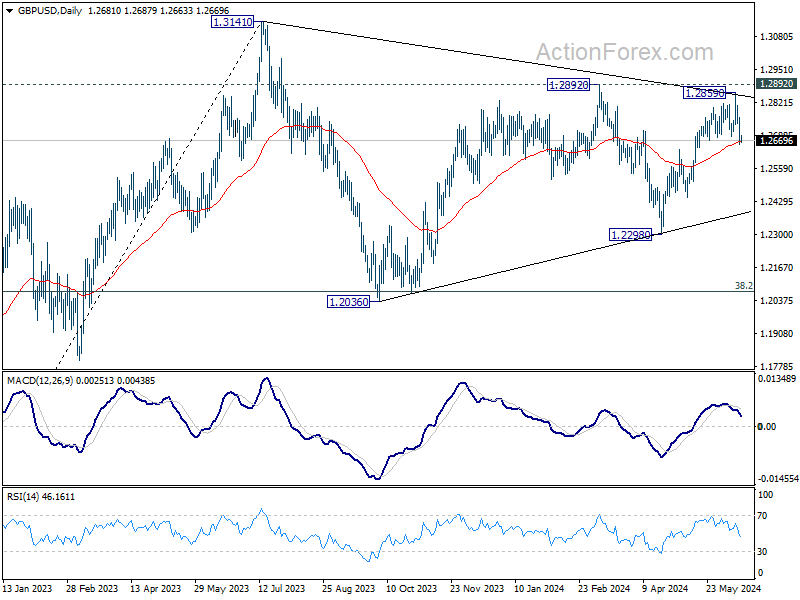
GBP/USD Mid-Day Outlook
Daily Pivots: (S1) 1.2490; (P) 1.2517; (R1) 1.2563; More...
GBP/USD's rebound from 1.2298 resumed by breaking through 1.2568 resistance and intraday bias is back on the upside. Strong break of 55 D EMA suggest that fall from 1.2892 has completed with three waves down to 1.2298. Further rise should be seen and break of 61.8% projection of 1.2298 to 1.2568 from 1.2471 will target 100% projection at 1.2741. For now, further rally will be expected as long as 1.2471 support holds, in case of retreat.
In the bigger picture, price actions from 1.3141 medium term top are seen as a corrective pattern. Fall from 1.2892 is seen as the third leg which might have completed already. Break of 1.2892 resistance will argue that larger up trend from 1.0351(2022 low) is ready to resume through 1.3141. Meanwhile, break of 1.2298 support will extend the corrective pattern instead.