Sample Category Title
Focus on EMU Side Turns to Thursday’s ECB Meeting
Markets
US Treasuries closed near Friday’s best levels on slightly softer April spending figures and a slower (but in line with forecasts) core PCE deflator pace. Daily changes on the US yield curve ranged between -6 bps (5-yr) and -3 bps (30-yr). This contrasted with yield increases of up to 2.5 bps (3-yr) in Germany on the back of accelerating May EMU CPI data (core: 2.9% Y/Y from 2.7% Y/Y). The combination pushed EUR/USD to the high 1.08 resistance area, but a real test didn’t occur. The pair closed the week where it started it, near 1.0840. US stock markets avoided losses thank to a late-session sprint higher which resulted in gains of up to 1.5% for the Dow Jones. For once, the tech-heavy Nasdaq underperformed (flat).
The May US manufacturing ISM kicks off a data-heavy US week today. Consensus expects a marginal improvement from 49.2 to 49.6. Apart from a one-off in March this year, the manufacturing ISM is in recessionary territory since November 2022. US Jolts Job openings are on tap tomorrow followed by ADP employment change and the services ISM on Wednesday. Payrolls finish it off on Friday. Don’t look for Fed speeches as the black-out period in the run-up to the June 12 policy meeting kicked in. From a market point of view, the flavour of the US data could switch the needle again between September and December for a first rate cut but this will likely keep US rates within recent trading ranges (eg US 10-yr yield 4.3%-4.73%). Focus on the EMU side turns to Thursday’s ECB meeting which will bring a first 25 bps rate cut to the deposit rate (3.75% from 4%). The bigger question remains whether the central bank commits to any guidance for the following meetings, something they refused to do so far. Sticky Q1 wage growth, the bumpy inflation path ahead, recovering economic growth, and the Fed’s reaction function all suggest limited scope to for follow-up cuts. We nevertheless think that the ECB will keep the option open. Given current market pricing (2nd rate cut only discounted in December), this leaves scope for a more dovish market reaction at the front end of the curve (in the euro’s disadvantage) in a steepening move. We see the longer end of the curve underperforming in such scenario on rising inflation expectations.
News & Views
Rating agency S&P cut the French credit rating from AA to AA- with a stable outlook as public finances are a huge concern. S&P expects the French debt-to-GDP ratio to increase to increase to 112% of GDP in 2027, from about 109% in 2023, which would be the third highest in the euro area, after Greece and Italy. Last year’s budget deficit came out at a higher than expected 5.5%. While the rating agency expects the deficit to shrink due to the economic recovery and recently implemented economic and budgetary measures, it will still average 4.6% over the 2024-2026 period before declining to 3.5% in 2027. In a broader perspective, S&P also assesses that France’s track record of fiscal consolidation has been weak over the past decades. It has not reported a primary budget surplus since 2001. The agency expects interest rate payments to increase to 5% of generaml government revenues in 2027 from 3% in 2023. Even so, the pass-through is mitigated due to the long maturity of France’s outstanding debt (> 8.5 years).
OPEC+ decided to extend the level of agreed production cuts for an amount of 3.66mn b/d until the end of 2025. Aside from these cuts in the general framework, eight members of the cartel, including Saudi Arabia and Russia also committed to 2.2mn of voluntary cuts. These cuts were due to expire at the end of June, but are prolonged untill the end of September 2024. Afterwards, they will be gradually reduced between October 2024 and September 2025. The meeting this weekend also addressed the issue on the capacity targets of individual members. The group intends to decide on capacity levels on the basis of an external review as a reference for 2026. Even as production cuts have been prolonged, the oil price (Brent crude) dropped to currently $81/b. That’s probably as markets doubt whether demand will be strong enough to digest the gradual reduction of the voluntary production cuts.
Graphs
GE 10y yield
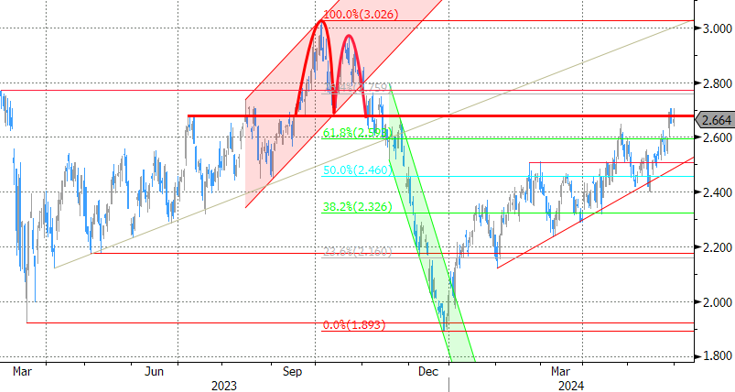
ECB President Lagarde clearly hinted at a June rate cut which has broad backing. A more bumpy inflation path in H2 2024, the EMU economy gradually regaining traction and the Fed’s higher for longer US strategy make follow-up moves difficult. Markets are coming to terms with that. The German 10y yield is setting a new YtD top.
US 10y yield
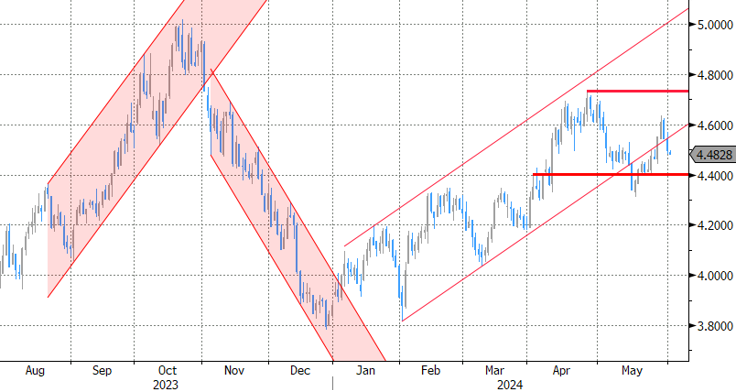
The Fed in May acknowledged the lack of progress towards the 2% inflation objective, but Fed’s Powell indicated that further tightening was unlikely. Soft US early month data triggering a correction off YTD peak levels. However, the Fed minutes still showed internal debate whether policy is restrictive enough. Sticky inflation suggests any rate cut will be a tough balancing act. The US 10-y yield is rebounding in the 4.30/4.70% trading range.
EUR/USD
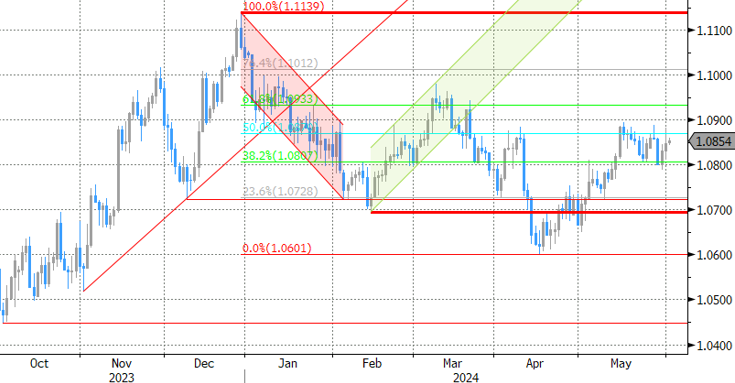
Economic divergence, a likely desynchronized rate cut cycle with the ECB exceptionally taking the lead and higher than expected US CPI data pushed EUR/USD to the 1.06 area. From there, better EMU data gave the euro some breathing space. The dollar lost further momentum on softer than expected early May US data. Some further consolidation in the 1.06/1.09 area might be on the cards short-term.
EUR/GBP
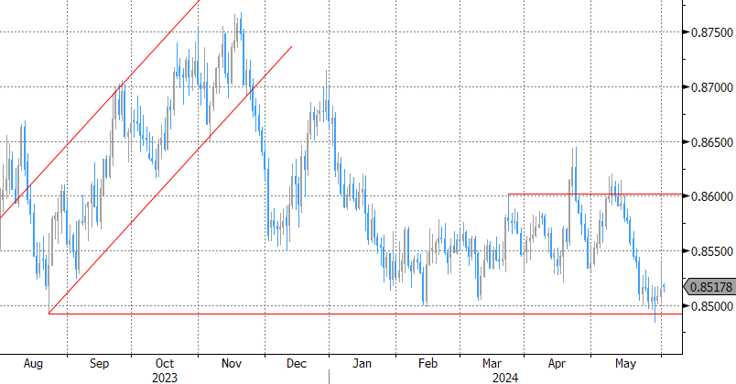
Debate at the Bank of England is focused at the timing of rate cuts. Slower than expected April disinflation and a surprise general election on July 4 suggest that a June cut in line with the ECB looks improbable. Sterling gained momentum with money markets now discounting a Fed-like scenario. EUR/GBP tested the 2023 & 2024 lows near 0.85. We expect this important support level to hold.
EUR/USD Daily Outlook
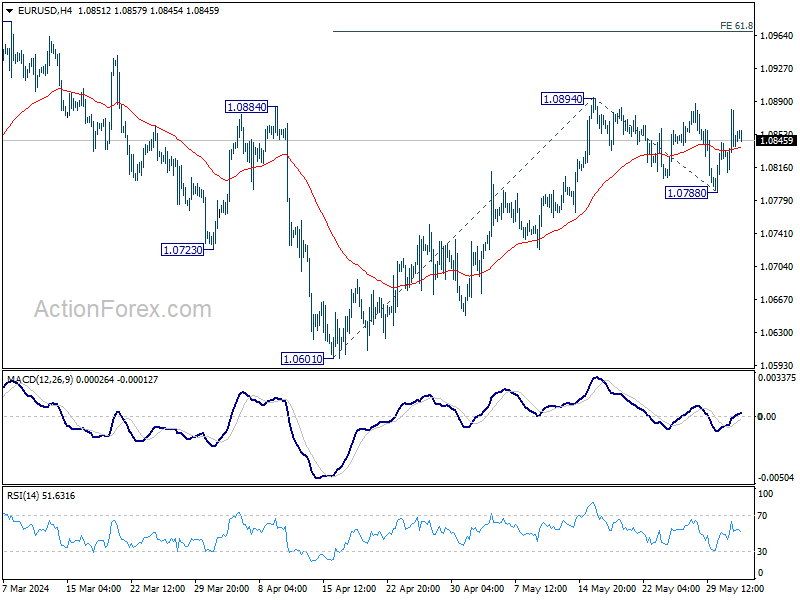
Daily Pivots: (S1) 1.0812; (P) 1.0847; (R1) 1.0883; More….
Intraday bias in EUR/USD remains neutral as range trading continues below 1.0894. On the upside, firm break of 1.0894 will resume whole rally from 1.0601, and target 61.8% projection of 1.0601 to 1.0894 from 1.0788 at 1.0969. For now, risk will stay on the upside as long as 1.0788 support holds, in case of retreat.
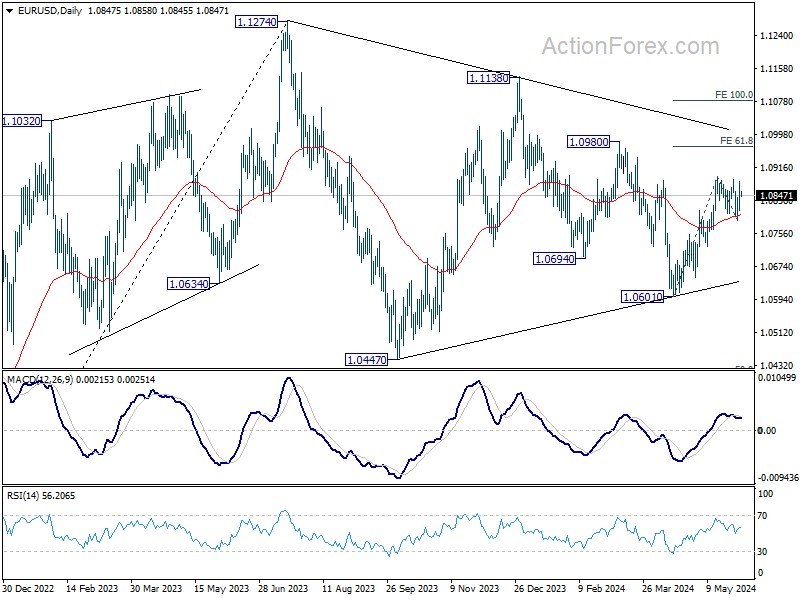
In the bigger picture, price actions from 1.1274 are viewed as a corrective pattern. Fall from 1.1138 is seen as the third leg and could have completed. Firm break of 1.1138 will argue that larger up trend from 0.9534 (2022 low) is ready to resume through 1.1274 high. On the downside, break of 1.0601 will extend the corrective pattern instead.
USD/JPY Daily Outlook
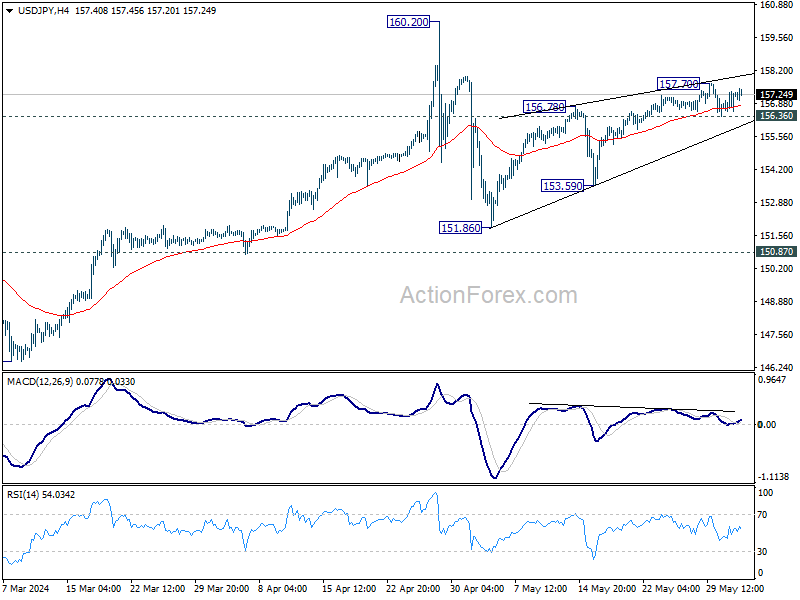
Daily Pivots: (S1) 156.77; (P) 157.07; (R1) 157.58; More….
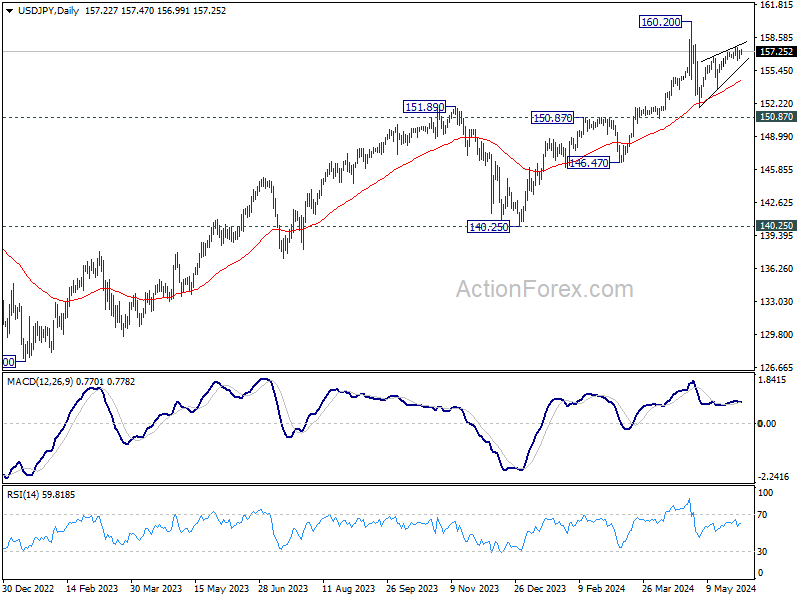
Intraday bias in USD/JPY remains neutral for the moment. On the downside, decisive break of 156.36 minor support will confirm short term topping at 157.70, on bearish divergence condition in 4H MACD. Intraday bias will be back on the downside for 153.59 support. Firm break there will target 151.86 and below as the third leg of the corrective pattern from 160.20. However, break of 157.70 will extend the rally from 151.86 towards 160.20.
In the bigger picture, a medium term top might be formed at 160.20. But as long as 150.87 resistance turned support holds, fall from there is seen as correcting rise from 150.25 only. However, decisive break of 150.87 will argue that larger correction is possibly underway, and target 146.47 support next.
GBP/USD Daily Outlook
Daily Pivots: (S1) 1.2706; (P) 1.2736; (R1) 1.2772; More….
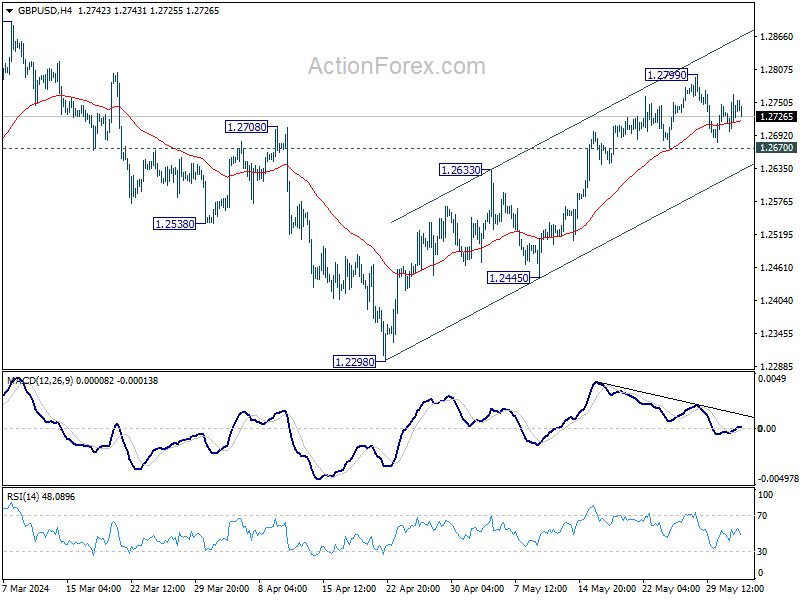
Intraday bias in GBP/USD remains neutral as consolidation from 1.2799 continues. Further rise is expected as long as 1.2670 support holds. Above 1.2799 will resume the rally from 1.2298 and target 1.2892 resistance. However, break of 1.2670 will indicate short term topping, and turn bias back to the downside for deeper pullback.
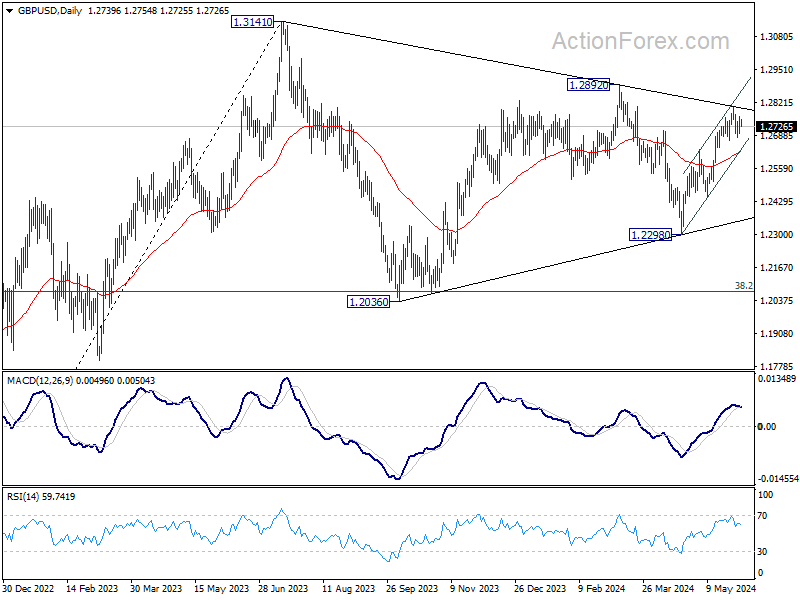
In the bigger picture, price actions from 1.3141 medium term top are seen as a corrective pattern. Fall from 1.2892 is seen as the third leg which might have completed already. Break of 1.2892 resistance will argue that larger up trend from 1.0351(2022 low) is ready to resume through 1.3141. Meanwhile, break of 1.2445 support will extend the corrective pattern with another decline instead.
USD/CHF Daily Outlook
Daily Pivots: (S1) 0.8995 (P) 0.9032; (R1) 0.9061; More….
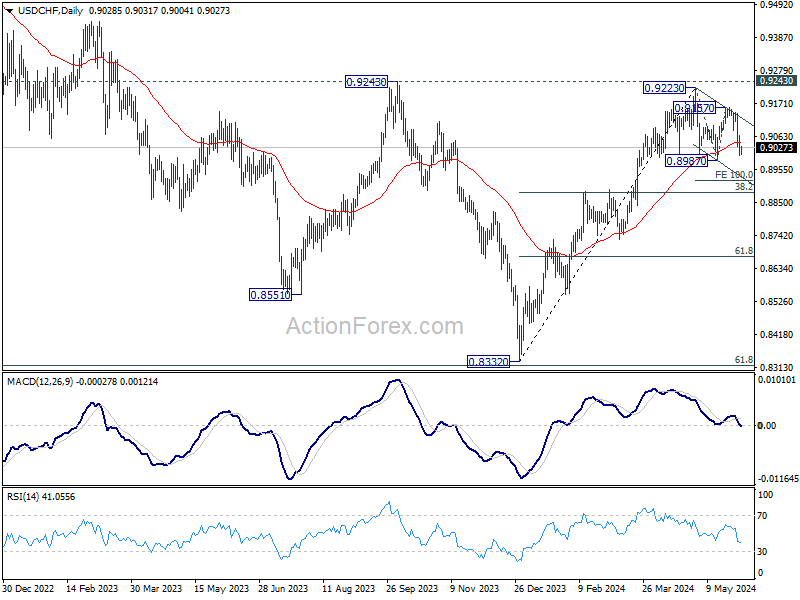
Intraday bias in USD/CHF remains on the downside for 0.8987 support. Firm break there will resume whole fall from 0.9223 and target 100% projection of 0.9223 to 0.8987 from 0.9157 at 0.8921. On the upside, above 0.9065 minor resistance will turn intraday bias neutral first.
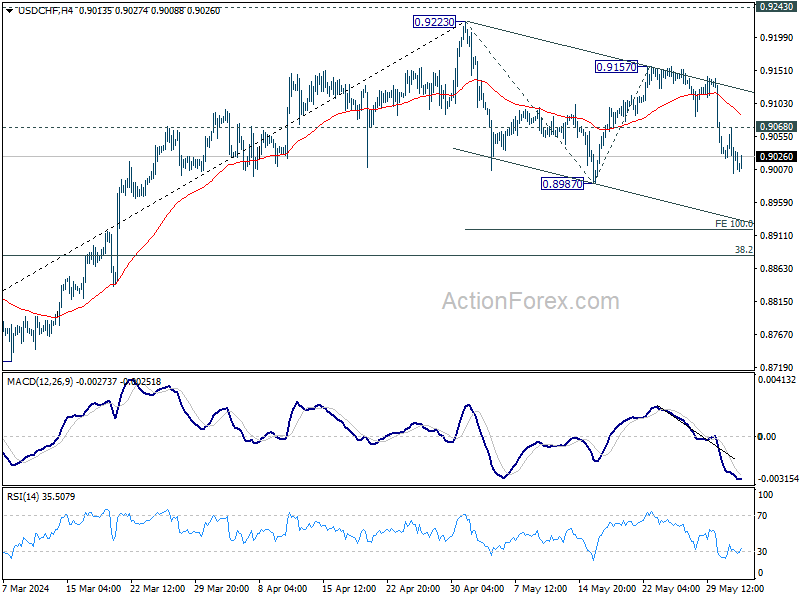
In the bigger picture, price actions from 0.8332 medium term bottom are tentatively seen as developing into a corrective pattern to the down trend from 1.0146 (2022 high). Rejection by 0.9243 resistance, followed by sustained break of 38.2% retracement of 0.8332 to 0.9223 at 0.8883 will strengthen this case, and maintain medium term bearishness. However, decisive break of 0.9243 will argue that the trend has already reversed and turn medium term outlook bullish for 1.0146.
AUD/USD Daily Report
Daily Pivots: (S1) 0.6629; (P) 0.6651; (R1) 0.6675; More….
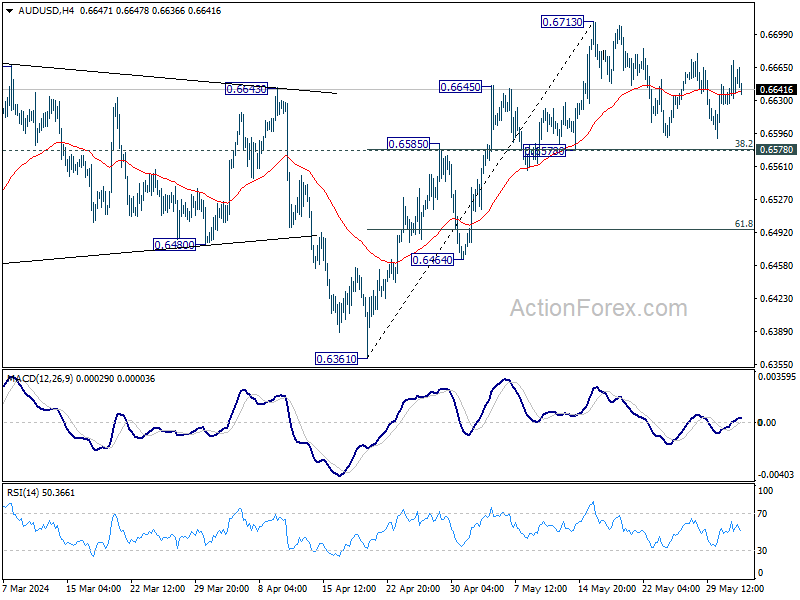
AUD/USD is staying in range below 0.6713 and intraday bias stays neutral at this point. Further rally is in favor with 0.6578 cluster support (38.2% retracement of 0.6361 to 0.6713 at 0.6579) intact. On the upside, firm break of 0.6713 will resume whole rise from 0.6361 to 0.6870 resistance next. However, sustained break of 0.6578 will dampen this bullish view, and bring deeper fall to 61.8% retracement at 0.6495.
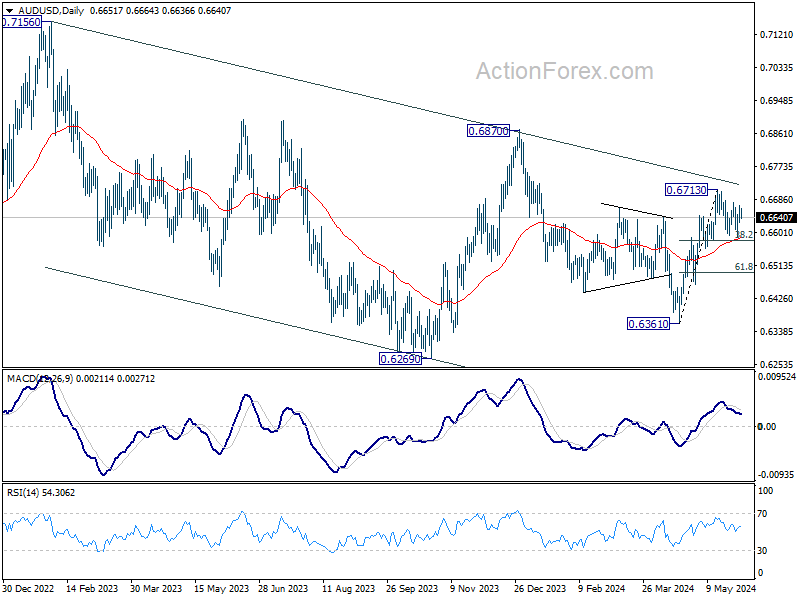
In the bigger picture, price actions from 0.6169 (2022 low) are seen as a medium term corrective pattern to the down trend from 0.8006 (2021 high). Fall from 0.7156 (2023 high) is seen as the second leg, which could have completed at 0.6269 already. Rise from there is seen as the third leg which is now trying to resume through 0.6870 resistance.
USD/CAD Daily Outlook
Daily Pivots: (S1) 1.3601; (P) 1.3645; (R1) 1.3672; More….
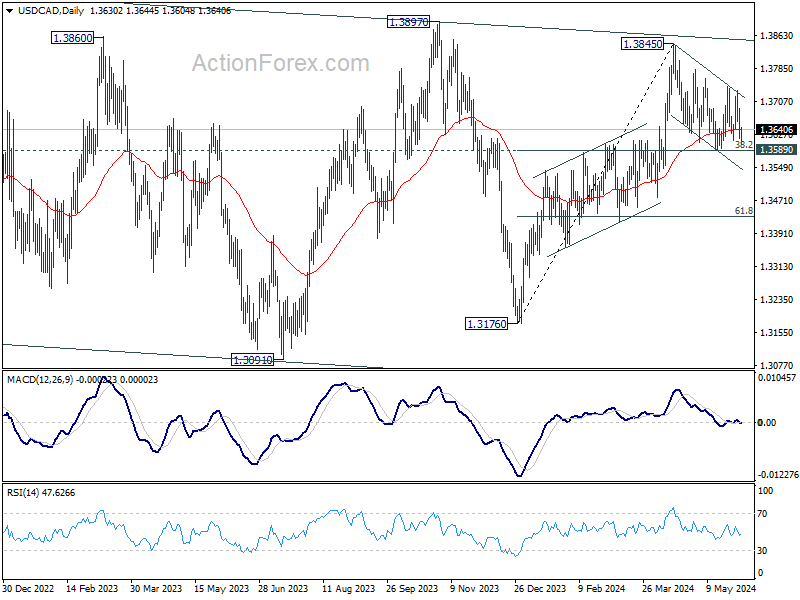
Range trading continues in USD/CAD and intraday bias remains neutral. On the upside, break of 1.3742 resistance will revive the case that correction from 1.3845 has completed at 1.3589. Intraday bias will be back on the upside for retesting 1.3845. On the downside, firm break of 1.3589 support will argue that whole rise from 1.3176 has completed at 1.3845 already. Fall from 1.3845 should then resume to 61.8% retracement of 1.3176 to 1.3845 at 1.3432.
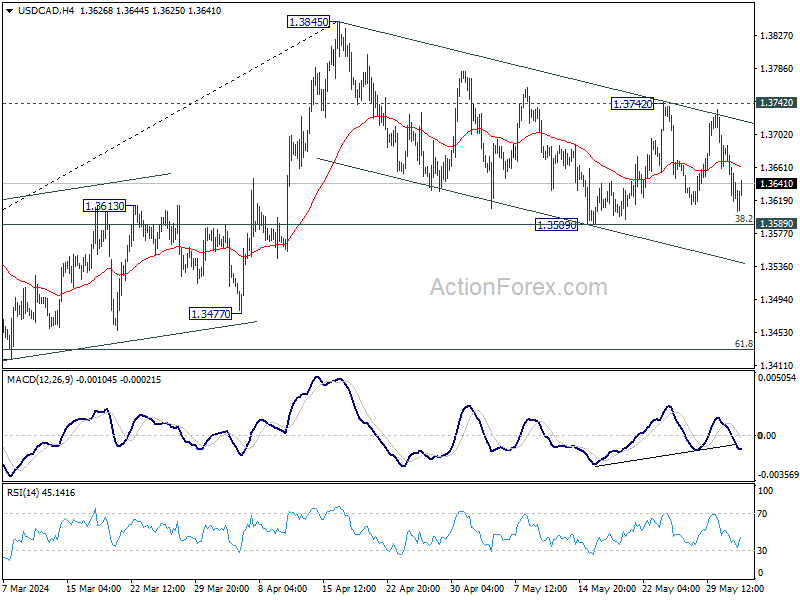
In the bigger picture, price actions from 1.3976 (2022 high) are viewed as a corrective pattern. In case of another fall, strong support should emerge above 1.2947 resistance turned support to bring rebound. Firm break of 1.3976 will confirm up resumption of whole up trend from 1.2005 (2021 low). Next target is 61.8% projection of 1.2401 to 1.3976 from 1.3176 at 1.4149.
EUR/CHF Daily Outlook
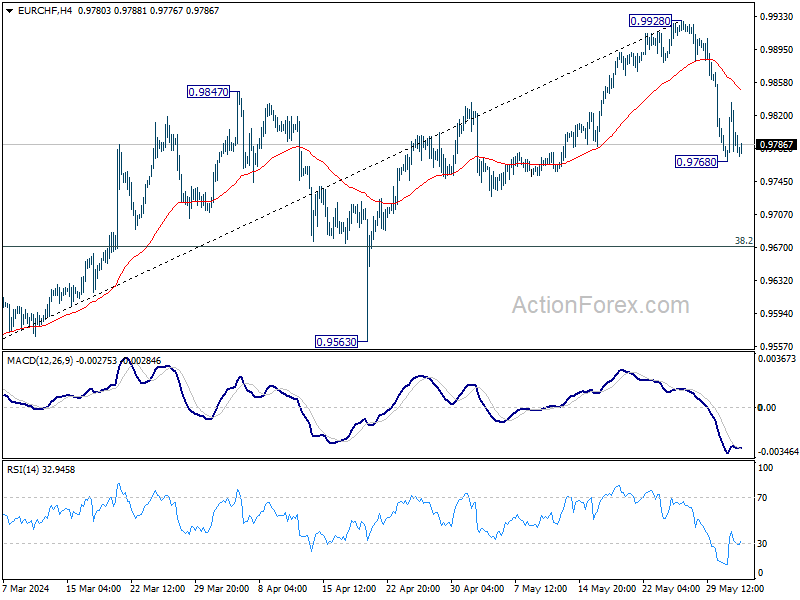
Intraday bias in EUR/CHF stays neutral for consolidation above 0.9768 temporary low. As noted before, a medium term could be formed at 0.9928 on bearish divergence condition in D MACD. Risk will now stay mildly on the downside as long as 0.9928 resistance holds, in case of recovery. Break of 0.9768 and sustained trading below 55 D EMA (now at 0.9765), will bring deeper fall to 38.2% retracement of 0.9252 to 0.9928 at 0.9670. Strong support is expected there to complete the pull back and bring rebound.
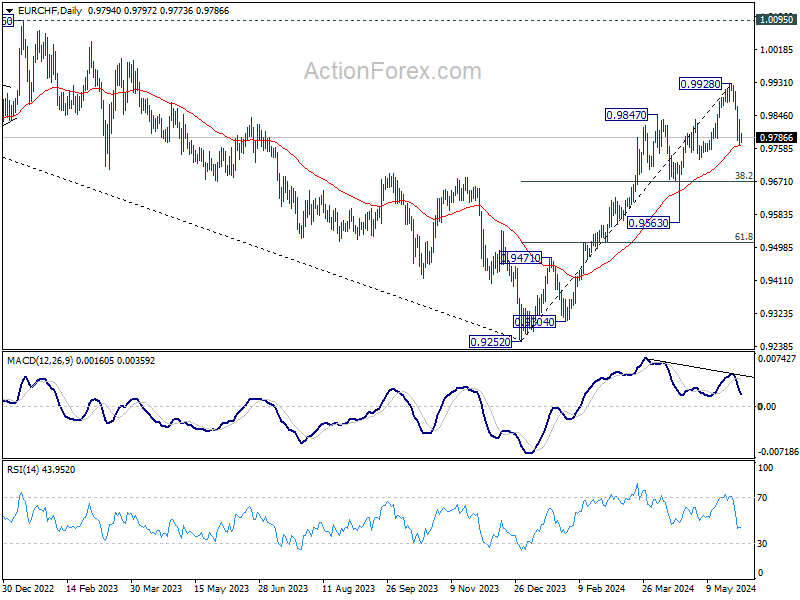
In the bigger picture, as long as 0.9563 support holds, rise from 0.9252 medium term bottom is still in favor to continue. Next target is 38.2% retracement of 1.2004 (2018 high) to 0.9252 (2023 low) at 1.0303, even just as a correction to the down trend from 1.2004.
EUR/GBP Daily Outlook
Daily Pivots: (S1) 0.8496; (P) 0.8519; (R1) 0.8536; More….
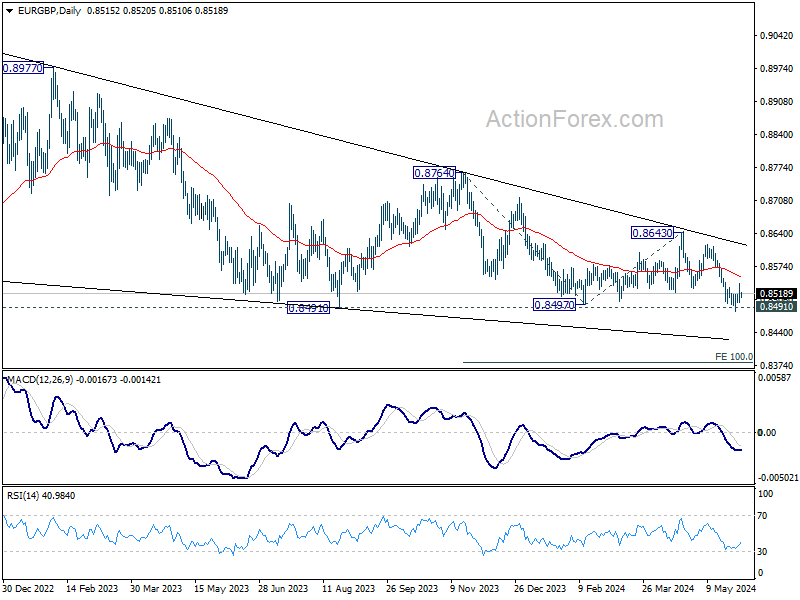
Intraday bias in EURGBP remains neutral and some more sideway consolidations could be seen. Further decline is expected as long as 55 D EMA (now at 0.8553) holds. Decisive break of 0.8491/7 will resume larger down trend to 0.8376 projection level next. However, sustained break of 55 D EMA will turn bias back to the upside for 0.9643 resistance instead.
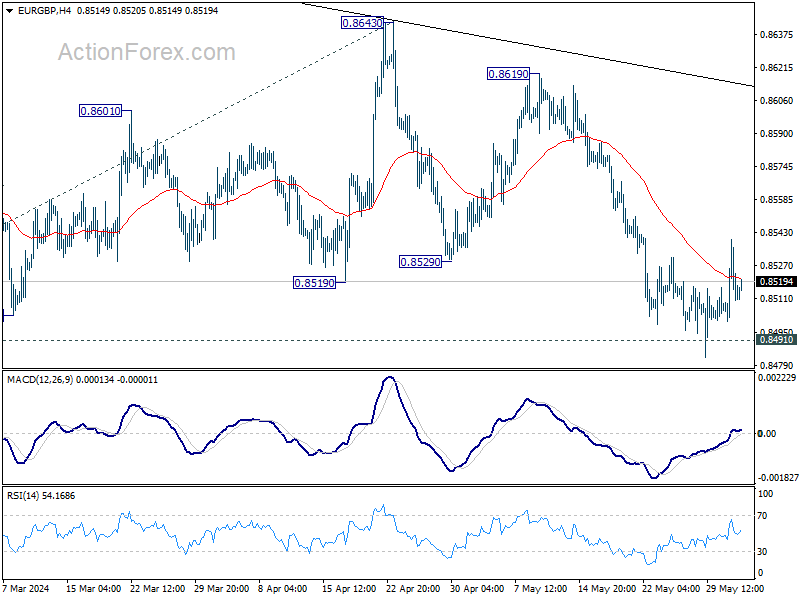
In the bigger picture, outlook remains bearish as EUR/GBP is capped below medium term falling trendline. That is, down trend from 0.9267 (2022 high) is still in progress. Firm break of 0.8491/7 will target 100% projection of 0.8764 to 0.8497 from 0.8643 at 0.8376.
EUR/AUD Daily Outlook
Daily Pivots: (S1) 1.6279; (P) 1.6316; (R1) 1.6342; More….
Range trading continues in EUR/AUD above 1.6211 short term bottom and intraday bias remains neutral. On the downside, firm break of 1.6211 support will resume the whole decline from 1.6742, as the third leg of the correction from 1.7062. On the upside, above 1.6403 will resume the rebound from 1.6211 instead.
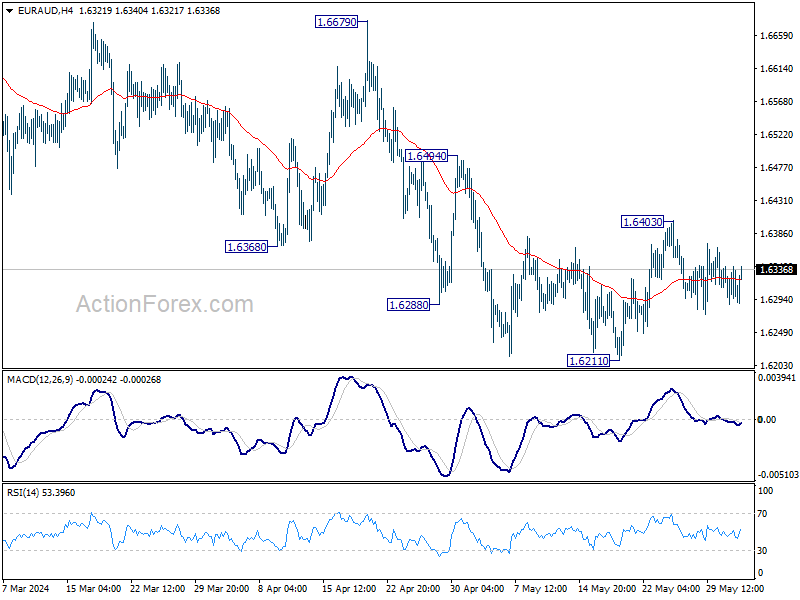
In the bigger picture, fall from 1.7062 medium term top is seen as a correction to the up trend from 1.4281 (2022 low). In case of deeper fall, strong support is expected around 1.5846 and 38.2% retracement of 1.4281 to 1.7062 at 1.6000 to bring rebound. Break of 1.7062 is in favor as a later stage.