

Sample Category Title
Ethereum’s momentum wanes, Bitcoin’s consolidation due soon
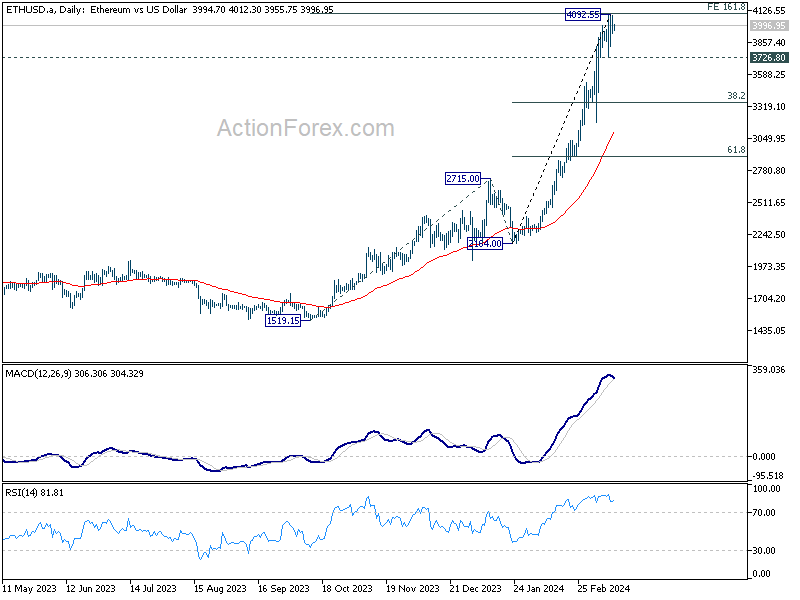
Ethereum's rally appears to be losing momentum as seen in D MACD, after accelerating to as high as 4092.5. Overbought consolidation in D RSI is probably limiting it at 161.8% projection of 1519.1 to 2715.0 from 2164.0 at 4098.6. Break of 3726.8 support will confirm short term topping, and bring correction to 38.2% retracement of 2164.0 to 4092.5 at 3355.8, and then set the range for sideway consolidations.
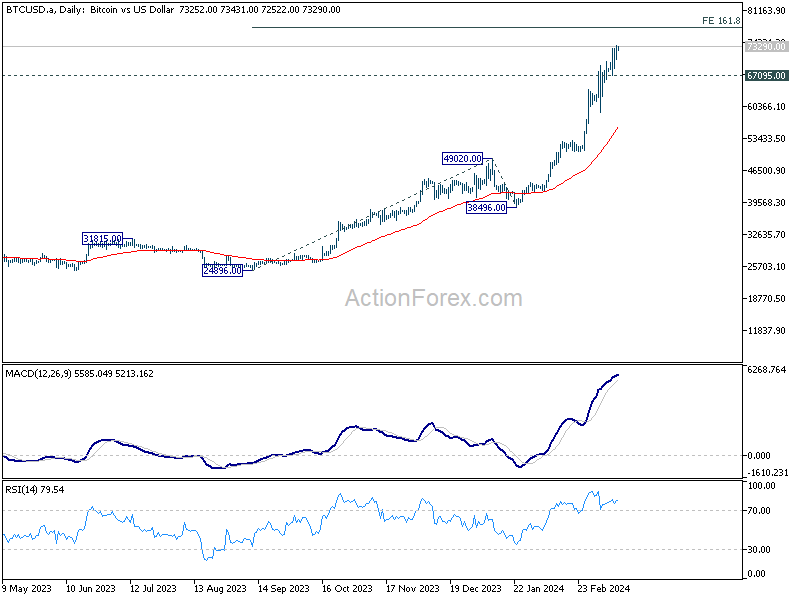
As for Bitcoin, there might still be room to extend the record run, but upside potential is limited for the near term, as some consolidations should be due after the strong rally. Upside should be limited by 161.8% projection of 24896 to 49020 from 38496 at 77528. Meanwhile, break of 67095 support will indicate that a short term top is already formed, and deeper pull back could be seen next to start a consolidation phase.
Silver targeting key resistance zone at 26 as momentum picks up
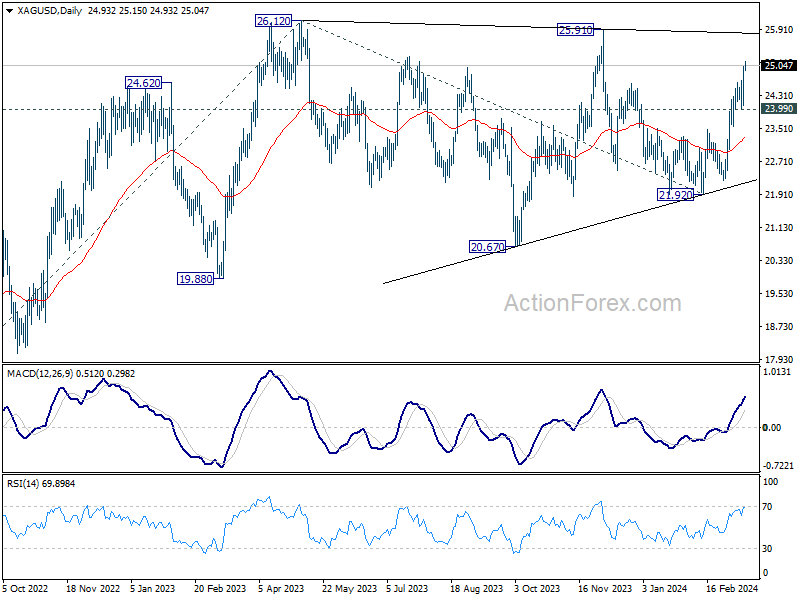
While Gold's rally stalled after hitting new record high last week, Silver is picking up momentum. Given that Silver has been clearly lagging Gold this year, there is room for Silver to catch up and outperform in Q2.
Fundamentally, both Gold and Silver as precious metal would benefit from policy loosening of major global central banks. But as additionally as an industrial metal, Silver could be benefited more with global growth and industrial demands pick up.
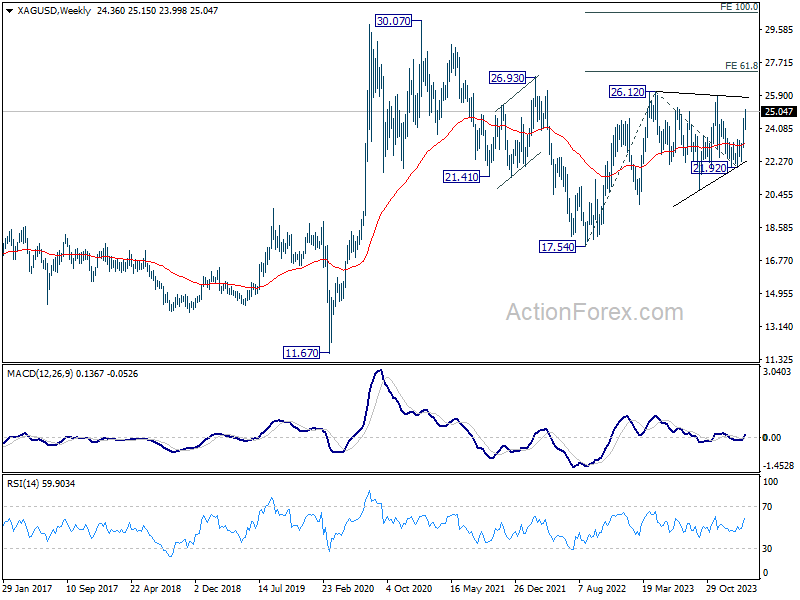
Yet, technically, Silver has to overcome key resistance level around 26 first. For now, near term outlook will stay bullish as long as 23.99 support holds. It's possible that consolidation pattern from 26.12 has completed with three waves to 21.92 already.
Decisive break of 26.12 will confirm resumption of whole rise from 17.54 (2022 low). In this case, the near medium term target will be 61.8% projection of 17.54 to 26.12 from 21.92 at 27.22. Firm break there will pave the way for new record high above 30 later in the year.
Nevertheless, rejection by 25.91/26.12 resistance zone, or break of 23.99 support, will delay the bullish case and extend the consolidation from 26.12 with another falling leg instead.
GBP/USD Eyes Fresh Increase, Gold Could Rally Further
Key Highlights
- GBP/USD started a decent increase above the 1.2800 resistance.
- A major bullish trend line is forming with support at 1.2790 on the 4-hour chart.
- Gold prices could accelerate further higher above the $2,180 resistance zone.
- Bitcoin price seems to be setting up for more upsides above $73,000.
GBP/USD Technical Analysis
The British Pound started a fresh increase above the 1.2650 level against the US Dollar. GBP/USD broke the 1.2740 level to move into a positive zone.
Looking at the 4-hour chart, the pair settled above the 1.2750 level, the 100 simple moving average (red, 4-hour), and the 200 simple moving average (green, 4-hour). It also traded above the 1.2800 level before the bears appeared.
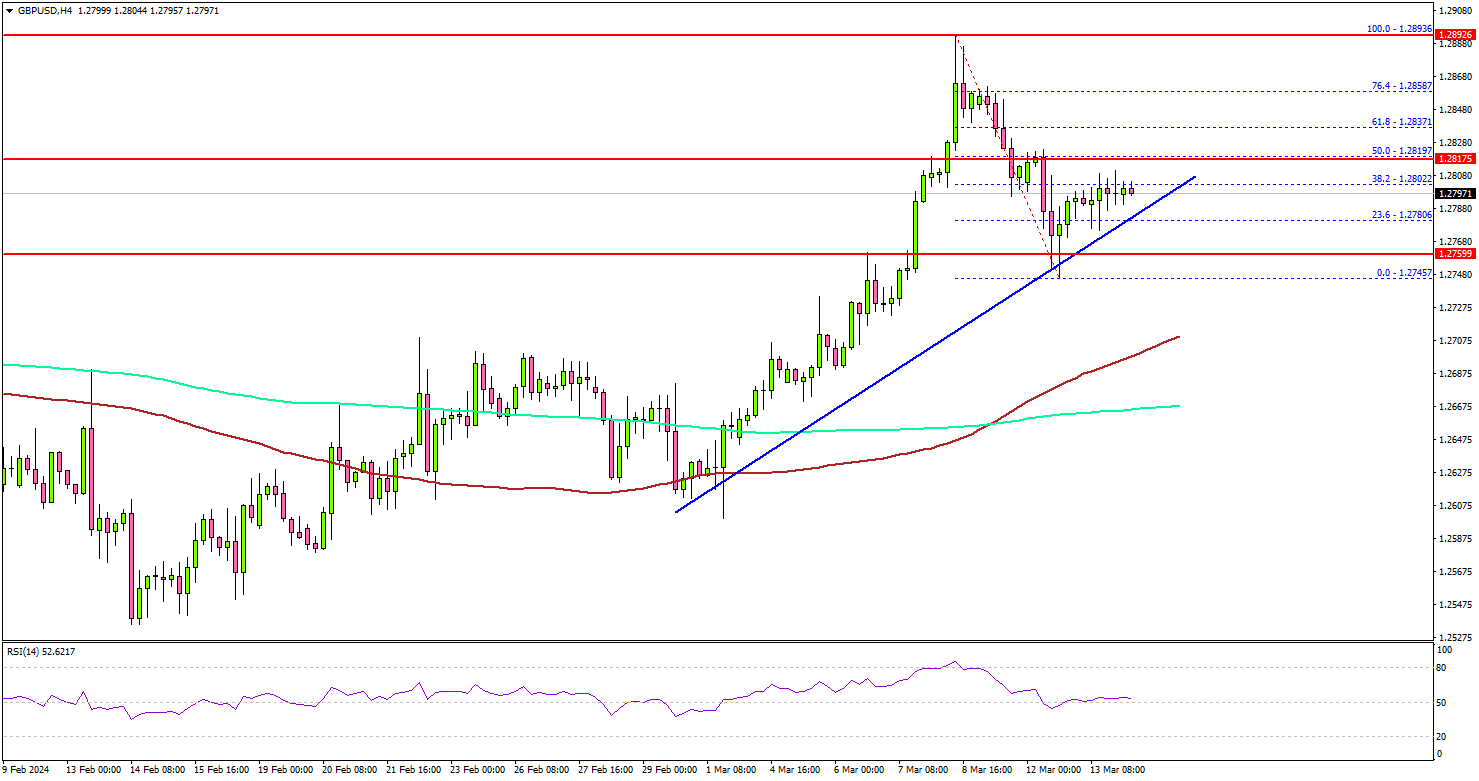
A high was formed at 1.2893 before the pair corrected lower. There was a move below the 1.2800 level. It tested the 1.2750 zone and is now attempting a fresh increase.
The pair is trading above the 1.2780 level. There is also a major bullish trend line forming with support at 1.2790 on the same chart. On the upside, the pair could face resistance near the 1.2820 level.
The first major resistance is now forming near 1.2840. The main resistance is near 1.2880. A close above the 1.2880 zone could open the doors for more upsides. The next stop for the bulls might be 1.2950.
Immediate support is near the 1.2780 level. The next major support is at 1.2740. If there is a downside break below the 1.2740 support, the pair could decline toward the 1.2650 support.
Looking at Gold, there was a strong increase above the $2,150 resistance and the bulls might aim for a move toward $2,250.
Economic Releases
- US Initial Jobless Claims - Forecast 218K, versus 217K previous.
- US Retail Sales for Feb 2024 (MoM) – Forecast +0.1%, versus -0.4% previous.
In Wage Growth the BoJ Hopes
The spring wage decision will reflect cyclical factors rather than a structural shift leaving little reason for the BoJ to consider contractionary action.
The Bank of Japan and financial markets are eagerly awaiting the Shunto wage decision for Japan’s largest trade confederation RENGO, which is due in. In our view, the result will likely be more of a reflection of near-term cyclicality than structural strength in the economy. It is therefore unlikely to justify a material policy shift by the Bank of Japan (BoJ).
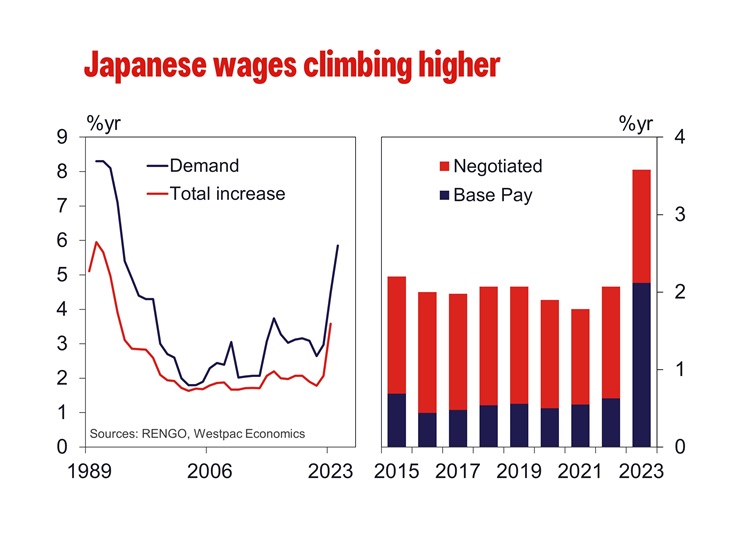
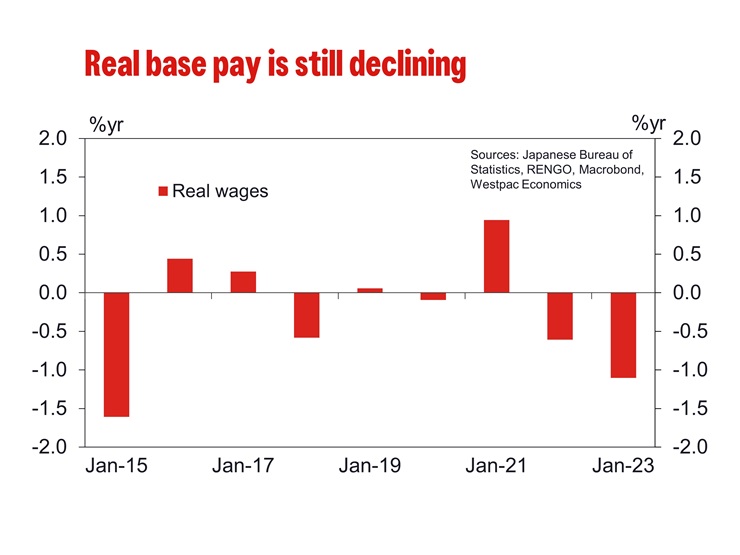
Japan’s recent strong wage growth reflects the lagged effect of cyclical momentum in the economy. RENGO wages rose 3.6% in 2023 after averaging 2% between 2014 and 2022. Base pay, which goes to all employees, rose 2% trumping the average 0.6% rise since 2015. In justifying their decision, RENGO drew attention to higher cost of living. Inflation rose 4% through 2022, well above the 0.5%yr average between 2010 and 2019. Inflation subsequently eased to 2.6%yr during 2023, following the global disinflationary pulse, and is expected to ease further hence.
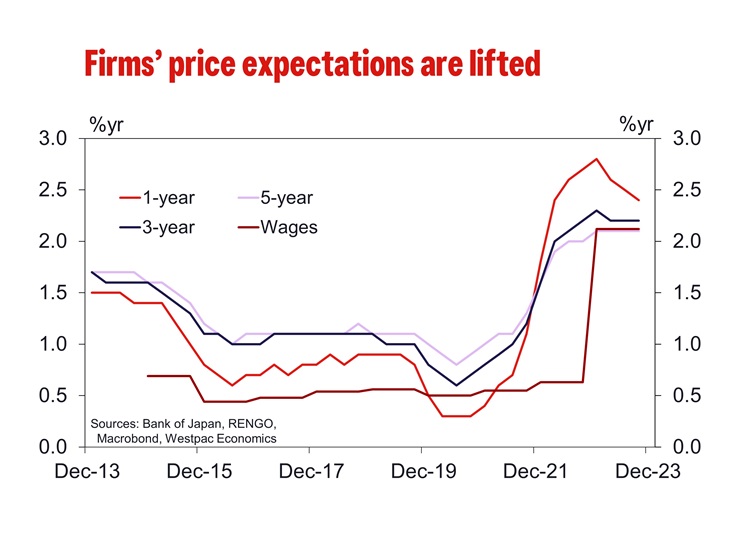
As of 2023 Q4, the inflation outlook for 1, 3 and 5 years came to 2.4%, 2.2% and 2.1% respectively. While still above the circa 1% average for all three time periods 2014 to 2019, it is also materially below where inflation has been. Still-elevated current inflation expectations may support wage growth in the near-term, but this effect looks set to dissipate as actual inflation prints come in weaker.
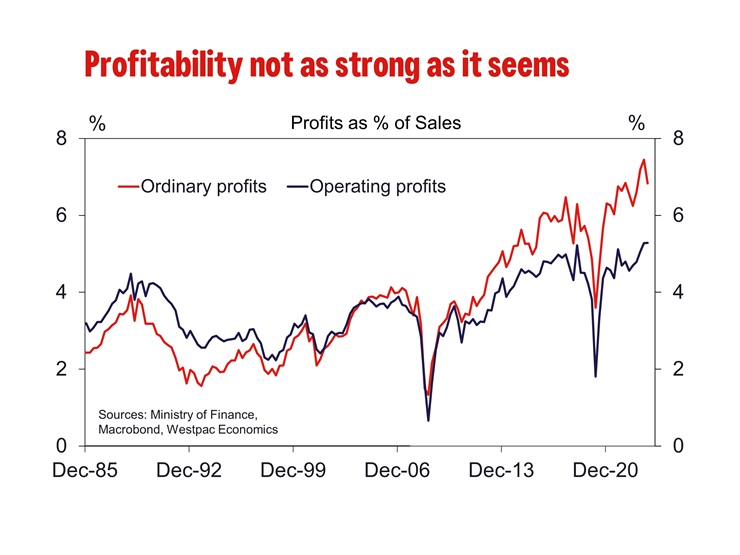
Rising profitability has also been used to argue for stronger wage growth in 2024 with a focus on strength in ordinary profits. However, operating profits are only slightly above the pre-COVID peak and below the 10-year pre-COVID trend. Operating profit as a share of sales are also relatively unimpressive, hovering around pre-COVID rates. The disparity between operating profits, which do not include investment-related income, and ordinary profits implies profitability is being flattered by financial investment returns not firms’ underlying profitability. It is only the latter that would given businesses confidence to increase wages at or above the rate of inflation.
Rather than being a support for wage growth, beyond 2024, we expect structural factors to act at a headwind for sustained wages growth. In Japan, wage increases depend on seniority, so job mobility is low and companies typically find it unnecessary to raise wages to retain staff. This also disincentivises employees from reskilling or making career changes into higher growth areas. In 2016, then Govenor Kuroda outlined low job mobility as a key challenge for the labour market and the country’s growth potential.
Further, participation has recently been rising thanks to a growing cohort of part-time workers, primarily women and those aged 65 and above. Wage growth is slower for part time workers, and the loss of tax and social benefits for secondary income earners dissaude many from labour market and the country's growth potential.
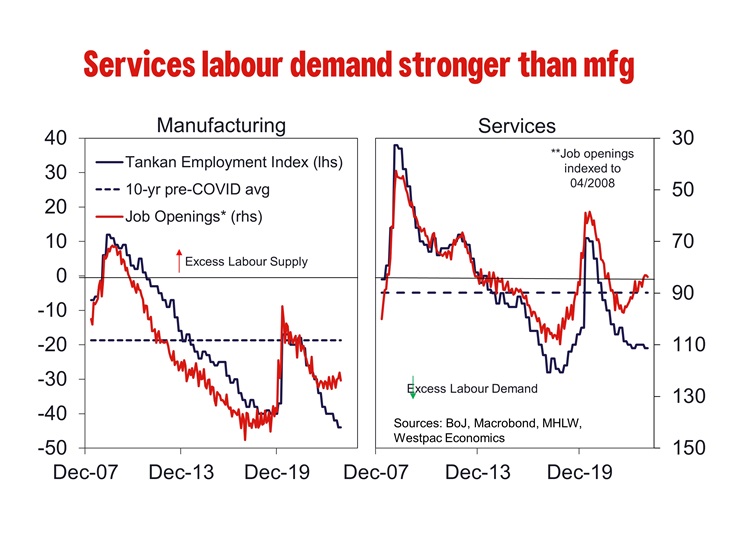
While some large companies such as Suntory and Nomura have publicly committed to raising salaries by 7-16%, many others will hold back believing the labour they will require will remain available. According to the Tankan survey, firms are reporting labour shortages as less severe than pre-COVID in manufacturing; while shortages in services persist to what was seen in the early 1990s. The number of new job openings in the services sector are also settling below the pre-COVID peak while new openings in manufacturing continue to decline. Part of this reflects a structural decline in manufacturing jobs, with south-east Asia providing attractive alternative locations for facilities and automation also limiting labour demand. Given manufacturing employs around 15% of the labour force, weaker demand will act as a drag on aggregate wages. This points to a softening labour market overall but also diverging outcomes for services and manufacturing.
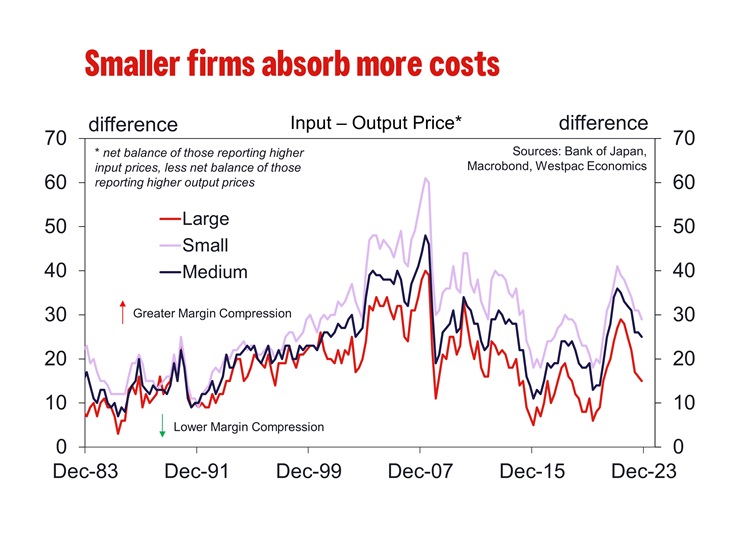
Small businesses have been particularly unenthusiastic about raising wages. As an example, a survey completed by Johnan Shinkin Bank and the Tokyo Shimbun daily reported 72.8% of small and medium-sized businesses in the Tokyo metropolitan area said they ” have no plans to raise wages this year”. Smaller employers tend to make up the bulk of employers and so can have a significant effect on aggregate outcomes. Their reluctance is arguably principally due to an inability to pass on higher costs to consumers, particularly when households are price sensitive as they are now, but also as they are much less able to scale up and therefore benefit from efficiency and large markets.
One segment of the labour market that is showing increasing wages is younger Japanese workers. They are more likely to have in demand skills, particularly for high-skill work, and are also more likely to job hop being early in their careers. As such, wage gains are thought to be skewed towards younger workers. BoJ research also shows that wages for high skill workers are increasing. However given Japan’s ageing population and weak immigration program, young people make up a small fraction of the labour force, so wage gains in this cohort is unlikely to drive aggregate wage gains or consumption.
Looking beyond 2024, both cyclical and structural factors are likely to limit wage gains and thereby keep a lid on domestic inflation pressures. While the second estimate for GDP has revised away recession, the economy remains weak and at risk of global developments. All this points to an absence of demand-side inflation pressures necessary to justify a tightening cycle of scale. While the BoJ can likely justify the end of negative rates in coming months, moving the policy materially above zero is unwarranted and potentially a decision that would put at risk all the work undertaken in recent years to aim to achieve the inflation target on a sustainable basis. All considered, the shunto wage outcome is unlikely to be the opportunity markets are hoping for a generational change in monetary policy.
AUDJPY Wave Analysis
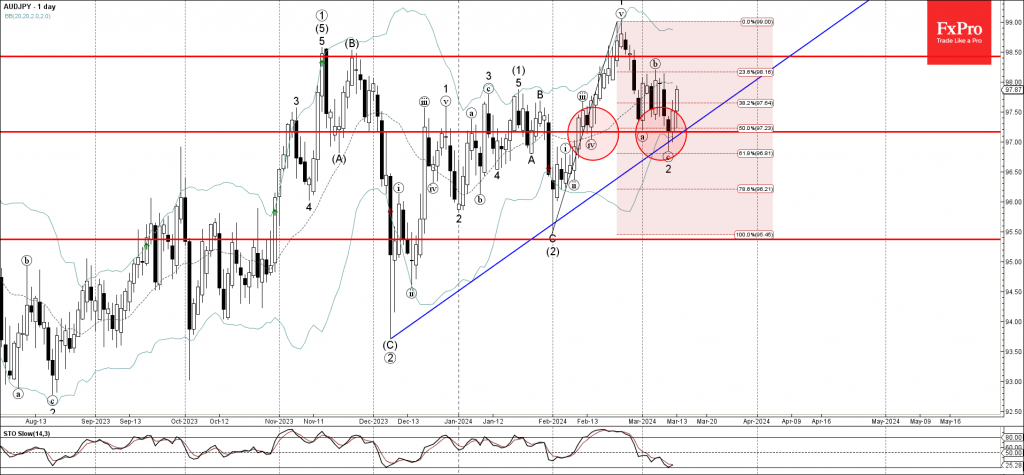
- AUDJPY reversed from key support level 97.20
- Likely to rise to resistance level 98.50
AUDJPY currency pair recently reversed up from the key support level 97.20 (which stopped the previous minor corrections iv and a, as can be seen below) coinciding with the lower daily Bollinger Band.
The support level 97.20 was strengthened by the 50% Fibonacci correction of the upward impulse 1 from the start of February and by the support trendline from December.
Given the clear daily uptrend and the bearish yen sentiment, AUDJPY currency pair can be expected to rise further toward the next resistance level 98.50.
Silver Wave Analysis
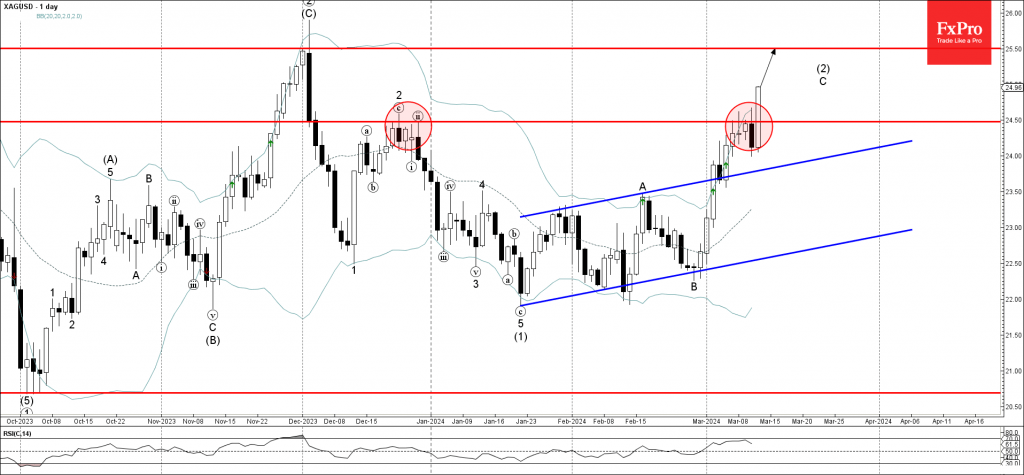
- Silver broke key resistance level 24.50
- Likely to rise to resistance level 25.5
Silver today broke the key resistance level 24.50 (which stopped the previous minor ABC correction 2 as can be seen below).
The breakout of the resistance level 24.50 continues the active impulse wave C of the ABC correction (2) from January.
Given the predominantly bullish sentiment that can be seen on the precious metal markets today Silver can be expected to rise further toward the next resistance level 25.5 (which stopped wave C in December).
Copper Rises Rapidly to 11-Month High
- Copper wins nearly 3.0% on production cuts
- Overbought signals detected around key resistance
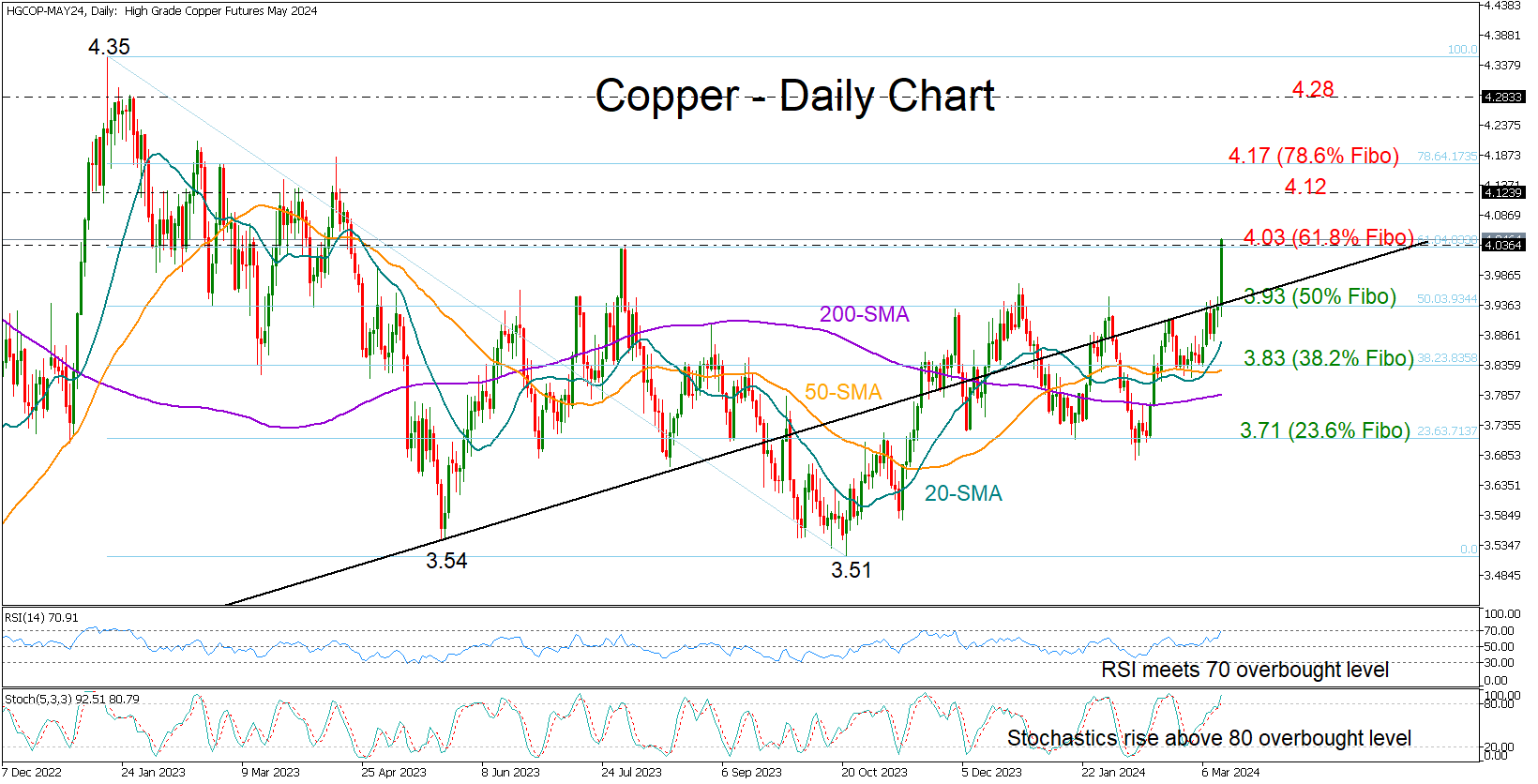
Copper futures (May delivery) surged to an almost one-year high of 4.04 on Wednesday after China’s biggest producers agreed on a rare supply cut amid raw material shortages.
Technically, the 61.8% Fibonacci retracement of the 2023 downtrend is currently under examination. A step above that border could lift the price instantly into the 4.12-4.17 zone, where the 78.6% Fibonacci mark is positioned. If upside pressures persist above 4.20, the next obstacle could pop up around the 2023 bar of 4.28.
The risk of a downside correction, however, is increasing as both the RSI and the stochastic oscillator are entering the overbought area, suggesting that today’s quick rally may not be sustainable.
Should the bears take over, the price might dive to retest the 50% Fibonacci mark of 3.93 and the ascending line from July 2022. If the 20-day simple moving average (SMA) gives way too, the next stop could be around the 38.2% Fibonacci of 3.83, while a drop below the 200-day SMA could clear the way towards the 23.6% Fibonacci of 3.71.
In brief, Copper futures are witnessing the fastest daily rally since July 2022. While a pullback cannot be ruled out, a close above 4.03 could delay any downside moves.
March Flashlight for the FOMC Blackout Period
Summary
- We do not expect the FOMC to change the federal funds rate or alter its current pace of balance sheet runoff at its upcoming meeting on March 19-20.
- Since the Committee last met, the U.S. inflation data have come in a bit stronger than expected, while the labor market generally has remained resilient. With payroll growth still solid and inflation proving to be a bit stickier recently, we suspect the FOMC will still be seeking greater confidence at the end of its meeting next week that inflation is headed back to 2% on a durable basis.
- That said, beneath the robust headline figures, we see building evidence that the labor market is cooling and inflation is still slowing on trend. Chair Powell testified to Congress shortly before the March blackout period that the Committee is "not far" from the confidence needed to dial back the level of policy restriction.
- We now expect the FOMC will initiate the first cut to the federal funds rate at its June 12 meeting (our previous expectation was at the May 1 meeting). We look for 100 bps of easing in total this year and another 100 bps of easing over the course of 2025 to bring the fed funds target range to 3.25%-3.50% by year-end 2025.
- In light of the recent slate of data and Fed-speak, we see few changes to the post-meeting statement after a meaningful rework following the January meeting.
- The March meeting will include an update to the Committee's Summary of Economic Projections (SEP). We do not expect material changes to the median projections for real GDP growth and the unemployment rate.
- The story is similar for inflation. Our most recent forecast projects headline and core PCE inflation of 2.3% and 2.5%, respectively, in 2024. The Committee's median projection in the December SEP was 2.4% for both headline and core PCE, suggesting that the current outlook is not materially different from December for most FOMC members. We think the core PCE inflation median for 2024 will rise by a tenth or so, putting it closer to the midpoint of the central tendency range from December.
- That said, even if the magnitude of the changes to the outlook for growth and inflation are relatively small, the direction of the revisions likely will be toward a hotter outlook, i.e. faster growth, and higher inflation. Will the dots follow suit?
- Our base case is that the median dot for 2024 will remain unchanged at 4.625%, but the risks are skewed toward a higher median given the distribution of the prior dots and the recent run of inflation data. Similarly, we expect no change to the 2025 and 2026 median dots, though here too we think the risks are skewed to the upside.
- A slowdown in the pace of the Fed's balance sheet runoff program also appears to be coming closer into view, and the Committee is likely to have a broad discussion of the central bank's plan for quantitative tightening (QT) at the March meeting.
- Our base case remains that the FOMC will announce a plan to slow the pace of QT at its June meeting, although we would not be shocked if the Committee decided to do so one meeting earlier or later. Specifically, we expect the runoff caps for Treasury securities to be reduced to $30 billion while MBS caps are dropped to $20 billion starting on July 1. We anticipate this slower pace of QT running until year-end 2024.
A Little More Conversation, but Still No Action
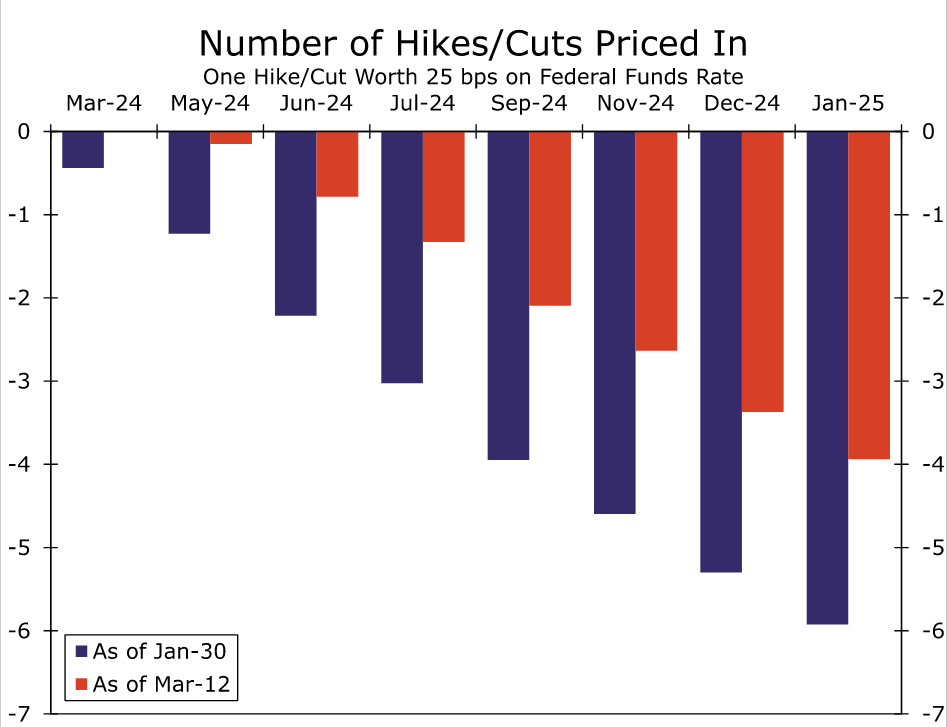
We do not expect any policy changes from the FOMC at its meeting next week, but the Committee's post-meeting communications should shed more light on the potential path of policy adjustments later this year. The prospects of the first rate cut occurring on March 20 initially started to slip away at the end of the Committee's last meeting on January 31. In the post-meeting press conference, Chair Powell shared that "I don't think it's likely that the Committee will reach a level of confidence by the time of the March meeting to identify March as the time to do that." Since then, generally stronger-than-expected data and the string of Fed officials indicating they are in no big rush to ease policy have driven down the odds of a rate cut at next week's meeting to essentially nil. Expectations that a rate cut could first come at the May 1 meeting have also been pared back (Figure 1).
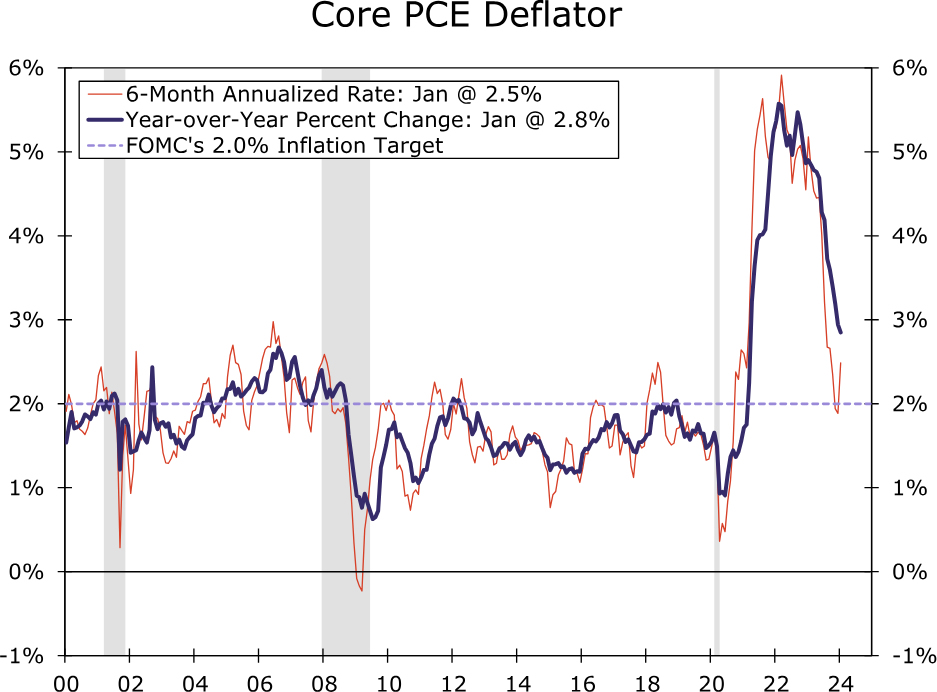
The tempered expectations for rate cuts follows a pickup in inflation to start the year. After the 6-month annualized rate of change in the core PCE deflator slowed to below 2% in the second half of last year, a hot print at the start of 2024 pushed this rate back up to 2.5% in January (Figure 2). The Consumer Price Index, which includes data through February, shows core inflation running at a 4.2% annualized rate the past three months compared to the 3.3% clip at the time of the FOMC's past meeting.
Job growth has also held up well in recent months. In February, nonfarm payrolls again surpassed consensus expectations, and the three-month average pace of 265K remains well above the ~100K pace that we estimate is currently needed to absorb labor force entrants. With the jobs market holding up for now and inflation looking a little stickier of late, Fed officials over the inter-meeting period seem to largely be on the same page as Governor Waller when it comes to the near-term prospect of rate cuts: "What's the rush?"
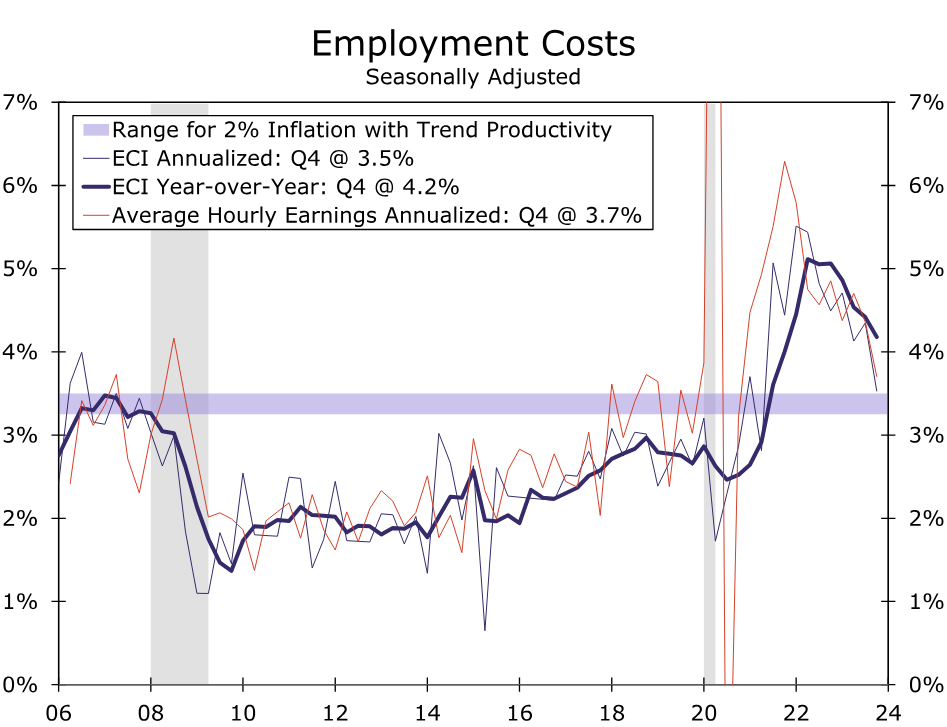
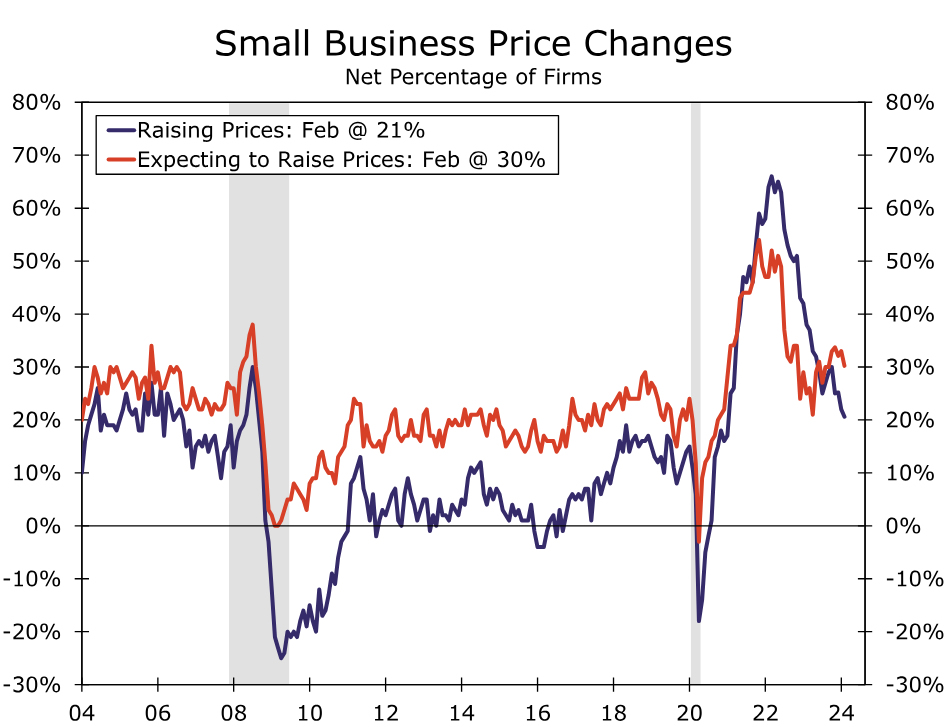
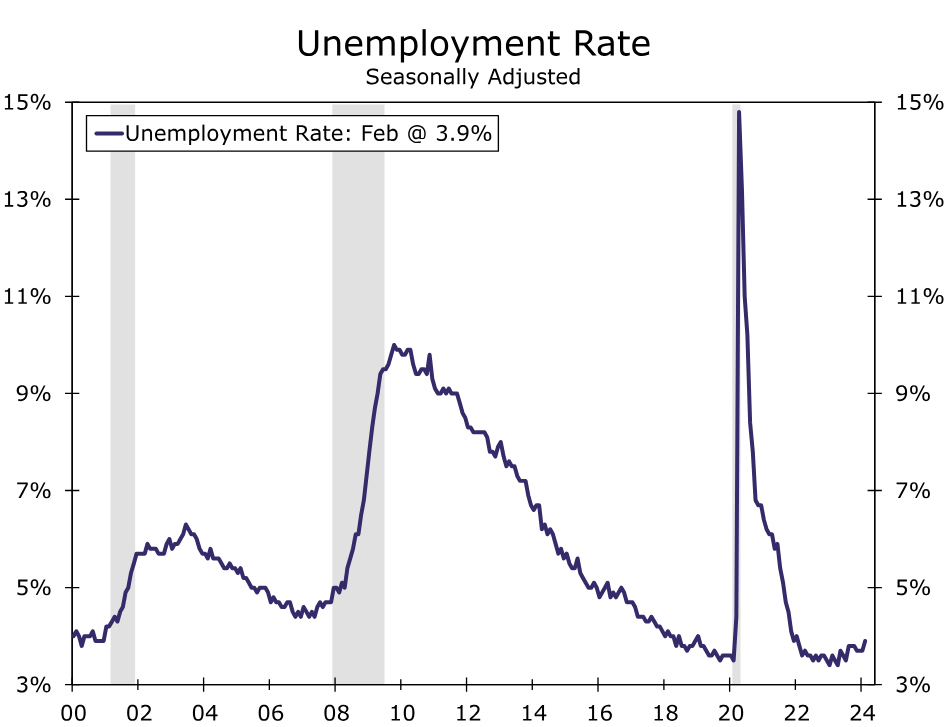
While most Fed officials seem in no hurry to ease policy, we expect the post-meeting communications to indicate that the FOMC continues to inch toward rate cuts later this year. Beyond the strength of nonfarm payrolls lies broad signs of labor market softening that suggest it does not need to cool significantly more for the Fed to achieve price stability. The unemployment rate reached a two-year high in February of 3.9%, while a pickup in layoff announcements and decline in job openings and hiring plans indicate demand for workers is diminishing. While wage growth currently remains stronger than during the last cycle, the trend continues to cool and, accounting for productivity growth, is not far from the pace consistent with the Fed's inflation target of 2% (Figure 3). Businesses are having more difficulty passing on higher costs to consumers, as was noted in the Fed's most recent Beige Book, and a shrinking share of businesses report raising prices (Figure 4). Furthermore, the improvement in supply chains since 2022 is helping to keep a lid on goods prices. With the jobs market in better balance and inflation pressures continuing to subside, Chair Powell testified to Congress shortly before the March blackout period that the Committee is "not far" from the confidence needed to dial back the level of policy restriction.
In light of the recent slate of data and Fed-speak, we see few changes to the post-meeting statement. The characterization of recent economic conditions may be tweaked slightly. We would not be surprised for the statement to note that the recent pace of economic activity appears to have cooled from the fourth quarter's solid pace, or that the unemployment rate has moved up but remains low.
Elsewhere, adjustments are likely to be minimal after a meaningful rework following the January meeting. January's statement removed the directional bias of the next rate move in a clear sign the hiking cycle probably has ended. The statement also noted that the risks to the inflation and employment sides of its mandate "are moving into better balance," but the FOMC would need to see "greater confidence that inflation is moving sustainably back toward 2%" before it is appropriate to reduce the fed funds target range. With the three-month annualized rate of core CPI inflation strengthening to 4.2% through February, we suspect the FOMC will still be seeking greater confidence at the end of its meeting next weekand will not hint that a rate cut is imminent at its following meeting on May 1.
We now expect the FOMC will initiate the first cut to the federal funds rate at its June 12 meeting (our previous expectation was the May meeting). We look for 100 bps of easing in total this year and another 100 bps of easing over the course of 2025 to bring the fed funds target range to 3.25%-3.50% by year-end 2025. We will publish a more detailed update on our expectations for the path of the fed funds rate, inflation and economic growth tomorrow in our March Monthly Economic Outlook.
SEP: Will the 2024 Median Dot Go Higher?
With the statement likely to offer nothing new in terms of rate guidance, the updated Summary of Economic Projections (SEP) will shed light on how the Committee sees the path of interest rates, economic growth and inflation unfolding beyond the next couple of months. The current SEP was released at the December FOMC meeting and, as discussed above, the economy generally has remained solid over the past few months. Real GDP rose 3.1% on a year-ago basis in Q4-2023, half a percentage point stronger than the median Committee projection in the December SEP. Similarly, the unemployment rate was 3.9% in February, a tenth above the median projection for year-end 2023 but still two-tenths below the median projection for year-end 2024 (Figure 5). It is still early in the year, and the fundamental picture has not changed much since December, so we doubt most Committee members will want to make major changes in their projections for economic growth and unemployment. We expect the medians for growth and the unemployment rate to remain more or less unchanged.
The story on the inflation front is similar. PCE inflation finished 2023 roughly in line with the Committee's expectations, but price growth topped expectations in January. Our most recent forecast looks for PCE inflation to be 2.3% year-over-year in Q4-2024. Excluding food and energy prices, we look for core PCE inflation of 2.5% over the same period. The median projections for 2024 inflation in the December SEP were 2.4% for both headline and core, and the central tendency ranges were 2.2%-2.5% and 2.4%-2.7%. This suggests to us that the inflation outlook is not materially different from what it was in December for most participants. We think the core PCE inflation median for 2024 probably will rise by a tenth or so, putting it closer to the midpoint of the central tendency range from December. Upward revisions much larger than this would surprise us and suggest that the Committee is more worried about the recent inflation data.
On balance, we expect the revisions to the Committee's expectations for growth, unemployment and inflation to be relatively modest. However, we think the direction of these revisions will be toward a hotter outlook, i.e. faster growth, and higher inflation. This raises the question of whether the dots will follow suit. The median dot for 2024 currently sits at 4.625%, implying 75 bps of rate cuts by year-end (Figure 6). The distribution of the 2024 dots has an upward bias. Eight participants submitted projections in December with less than 75 bps of easing, while just five participants penciled in more than 75 bps of cuts. As a result, if just two participants shift from 75 bps of easing to 50 bps, the median will move from the former to the latter.
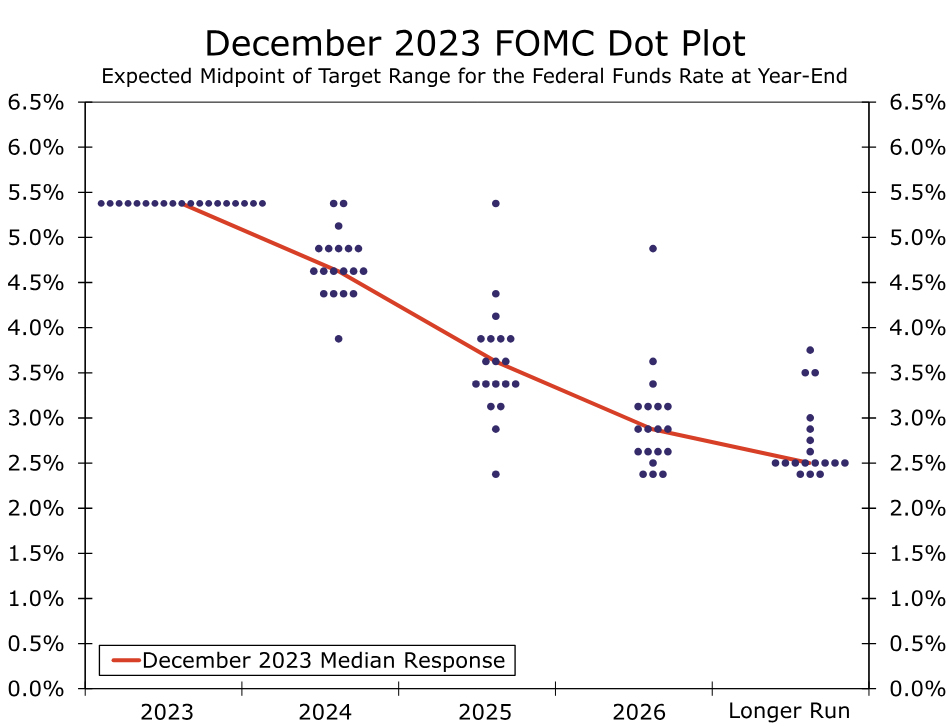
Our base case is that the median dot for 2024 will remain unchanged at 4.625%, but the risks are skewed toward a higher median given the distribution of the December dots and the recent run of inflation data. Similarly, we expect no change to the 2025 and 2026 median dots, though here too we think the risks are skewed to the upside.
QT Discussion to Occur at March Meeting
The FOMC is not only inching closer to cutting the fed funds rate. A slowdown in the pace of the Fed's balance sheet runoff program also appears to be coming closer into view. In his post-meeting press conference after the January FOMC meeting, Chair Powell made clear that the Committee would engage in a broad discussion of the central bank's balance sheet runoff program, more commonly know as quantitative tightening (QT), at the March meeting. The FOMC began allowing a maximum of $30 billion of Treasury securities and $17.5 billion of mortgage-backed securities (MBS) per month to roll off its balance sheet in June 2022. These caps were increased to $60 billion and $35 billion, respectively, in September 2022, and they have subsequently remained unchanged. At present, the Fed's balance sheet totals roughly $7.5 trillion, down from nearly $9 trillion at its peak in Q2-2022.
Our base case remains that the FOMC will announce a plan to slow the pace of QT at its June meeting, although we would not be shocked if the Committee decided to do so one meeting earlier or later (May 1 or July 31). Specifically, we expect the runoff caps for Treasury securities to be reduced to $30 billion while MBS caps are dropped to $20 billion starting on July 1. We anticipate this slower pace of QT running until year-end 2024. Starting in 2025, we look for balance sheet growth to resume to accommodate organic growth in liabilities (e.g., paper currency and bank reserves). We expect the FOMC will continue to passively reduce its MBS holdings in 2025 and beyond while replacing these MBS with Treasury securities, a move that would replicate what occurred in 2019.
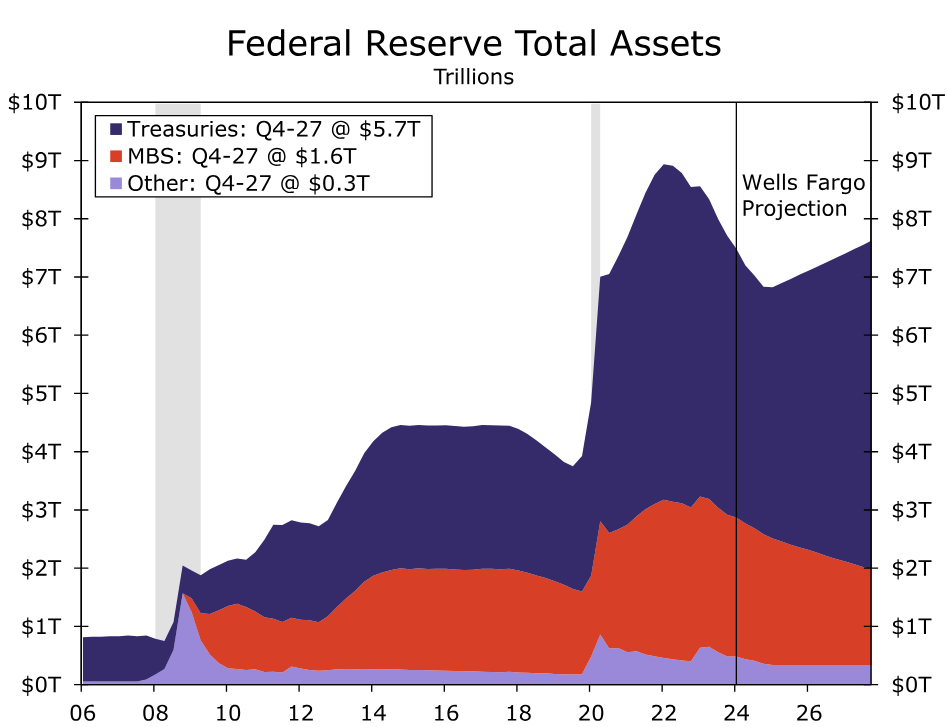
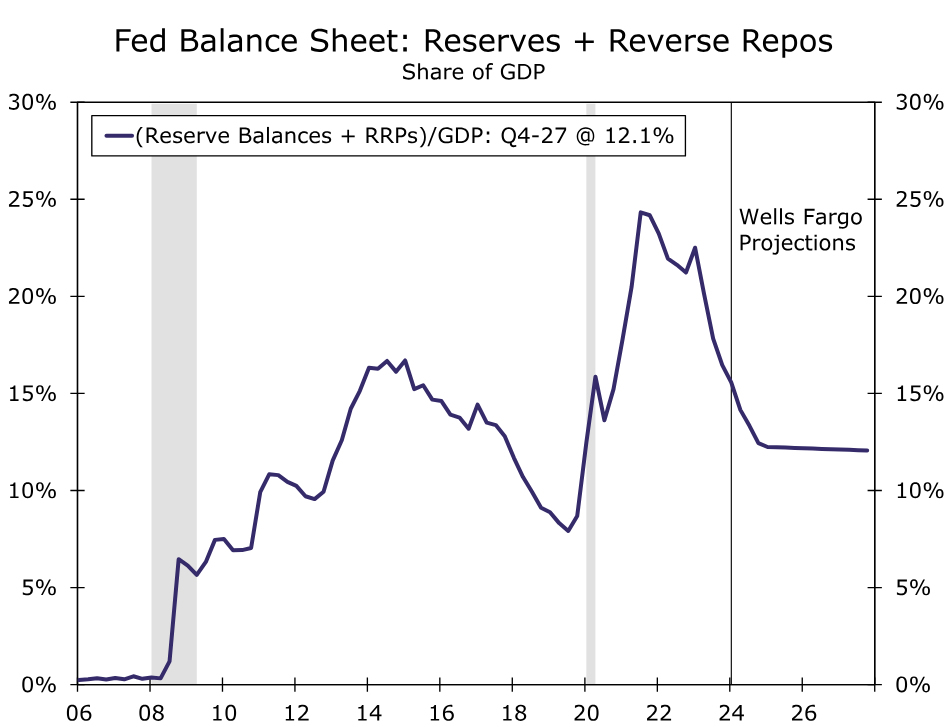
If our forecast is realized, the Fed's balance sheet would reach a trough of $6.8 trillion or so at year-end 2024 and begin growing gradually again thereafter (Figure 7). The nadir in the Fed's balance sheet would be only a bit higher than the $6.5 trillion projection in our "middle-of-the-road" scenario outlined in our report on QT from last October. In this scenario, we look for RRP balances to decline to about $200 billion by year-end, with bank reserves that are around $3 trillion at the trough. As a share of GDP, this would represent a meaningful liquidity buffer relative to pre-pandemic levels (Figure 8).
1 – Quotation from Governor Waller at the Finding Forward Speaker Series at the University of St. Thomas on February 22, 2024.
Will BoJ Take Interest Rates Out of Negative Territory?
- Investors assign nearly 50% chance for a March BoJ hike
- Wage negotiations set to conclude with strong pay hikes
- Recession is avoided, inflation reaccelerates
- The BoJ meets on Tuesday at 02:30 GMT
March hike speculation intensifies
The yen staged a strong recovery last week following several reports suggesting that the Bank of Japan (BoJ) may abolish its ultra-loose monetary policy as early as its upcoming policy meeting, which is scheduled for next week.
After a couple of policymakers noted that the economy is making progress towards achieving the Bank’s 2% inflation objective, another report hit the wires this week, citing sources familiar with the Bank’s thinking, saying that there is a growing number of members warming to the idea of ending negative interest rates this month. This appears to be a realistic take as Japan’s largest industrial labor group said that 25 of its member unions have already seen their wage demands being met in full, which means that the central bank may not necessarily have to wait for April to act.
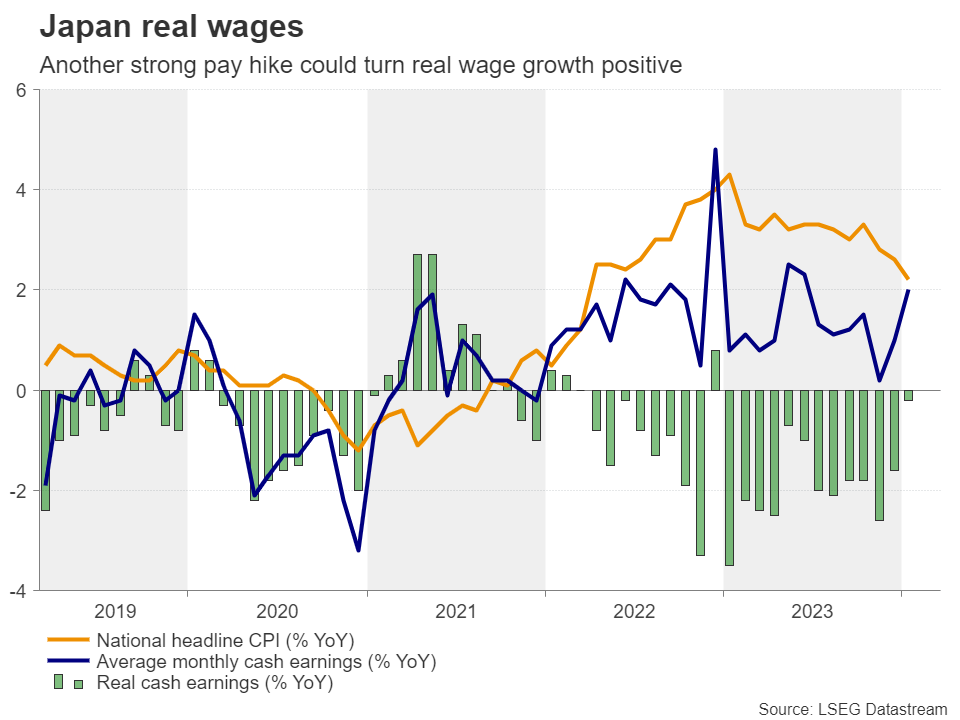
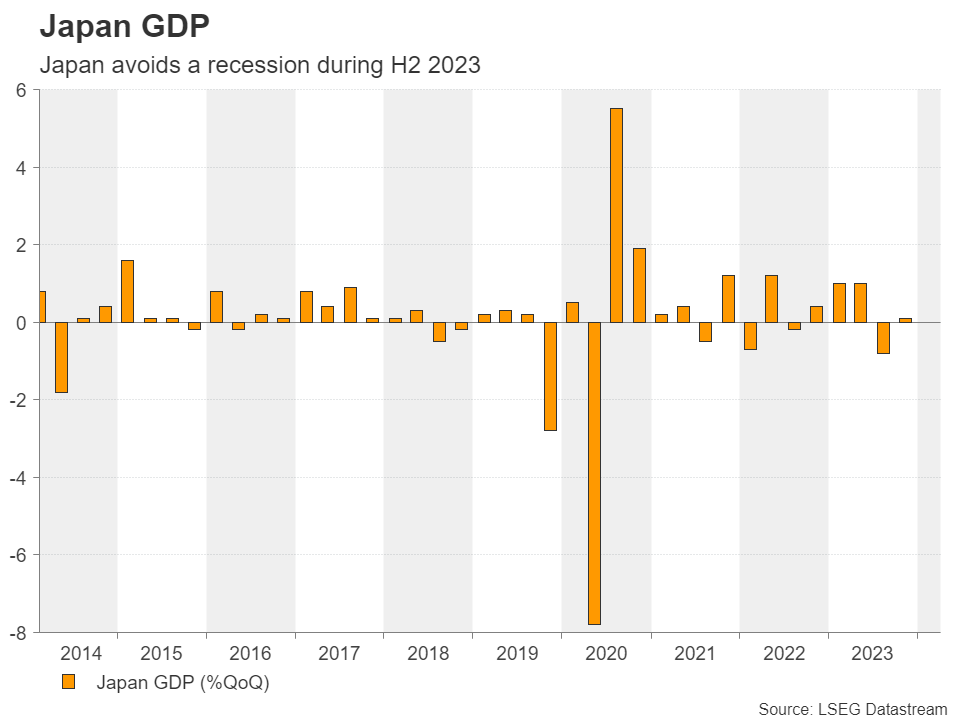
All this, combined with revised government data suggesting that the economy avoided a technical recession during the second half of 2023, prompted market participants to assign around a 50% probability for the Bank to take interest rates out of negative territory at next week’s gathering.
That said, on Tuesday, BoJ Governor Ueda said that although the Japanese economy is recovering, it is still showing signs of weakness, while Finance Minister Suzuki noted that they cannot declare that deflation is beaten yet, despite some positive developments like the strong pay hikes. Nonetheless, although the yen reacted negatively to those remarks, the probability of a March hike slid only to 45%.
Rate hike or yield curve control adjustment?
So, the big question on everyone’s mind is of course: Will the BoJ exit its negative-rate policy next week? The upward revision of the GDP data for the last quarter of 2023 pointed to a 0.1% q/q expansion instead of the initially suggested 0.1% contraction, while the latest set of Tokyo CPI numbers revealed strong acceleration in inflation, corroborating the market’s view for a decent probability of a March rate hike. Even if they don’t push the hike button at this gathering, policymakers could well telegraph an April move and even tweak their yield curve control.
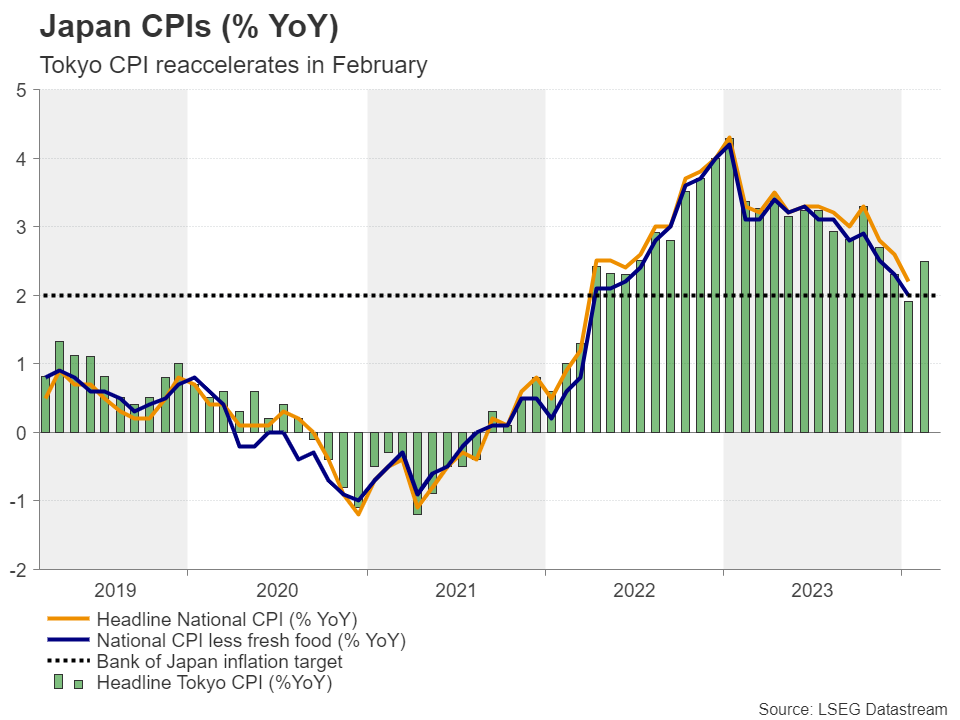
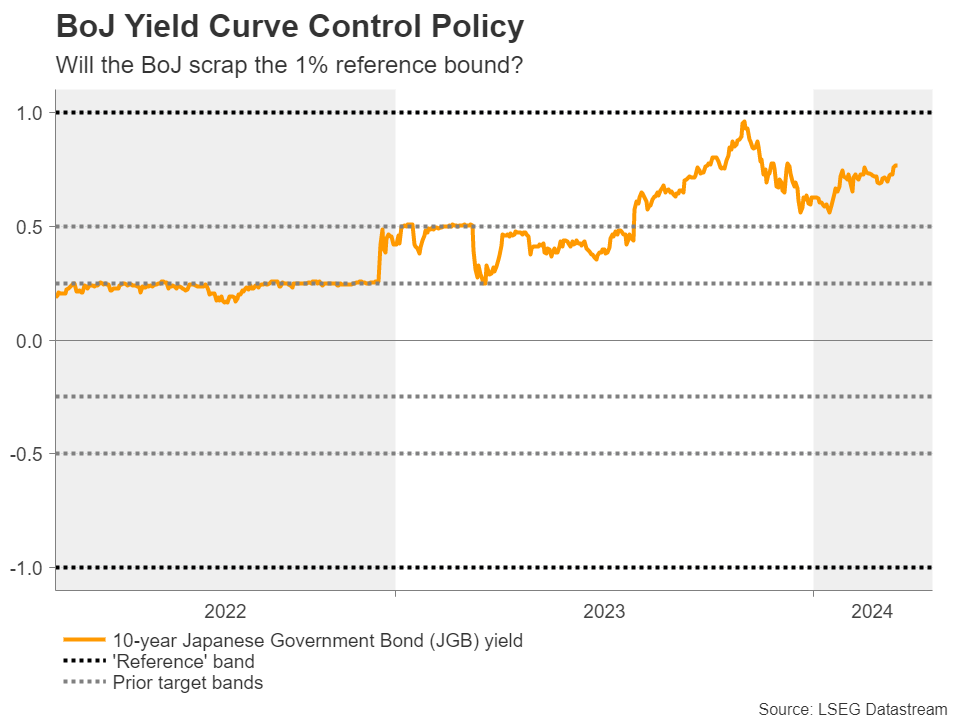
There is already a Bloomberg report saying that the BoJ is considering scrapping its yield curve control and instead start reporting the amount of government bonds it plans to purchase each time. In other words, they could stop aiming at keeping 10-year yields around 0% and start targeting the volume of purchases.
How may the yen respond?
Having said all that though, even if the Bank announces such a change to its yield curve control framework, but doesn’t press the hike button at this gathering, the yen may pull back as that nearly 50% of participants expecting an immediate liftoff might get disappointed. Nonetheless, with other major central banks seen cutting interest rates at some point during the summer months, a long-lasting fall may be unlikely if the Bank clearly hints at an April liftoff.
On the other hand, a hike now could add fuel to the yen’s engines, especially if it is accompanied by a decision to abandon yield curve control at its current form. Whether this will develop into a sustainable yen uptrend, though, will depend on the pace of subsequent rate increases. Several officials have already noted that after the first hike, the tightening process will be slow and gradual, and if it proves slower than the market’s own projections, then the yen may struggle to stay on the front foot.
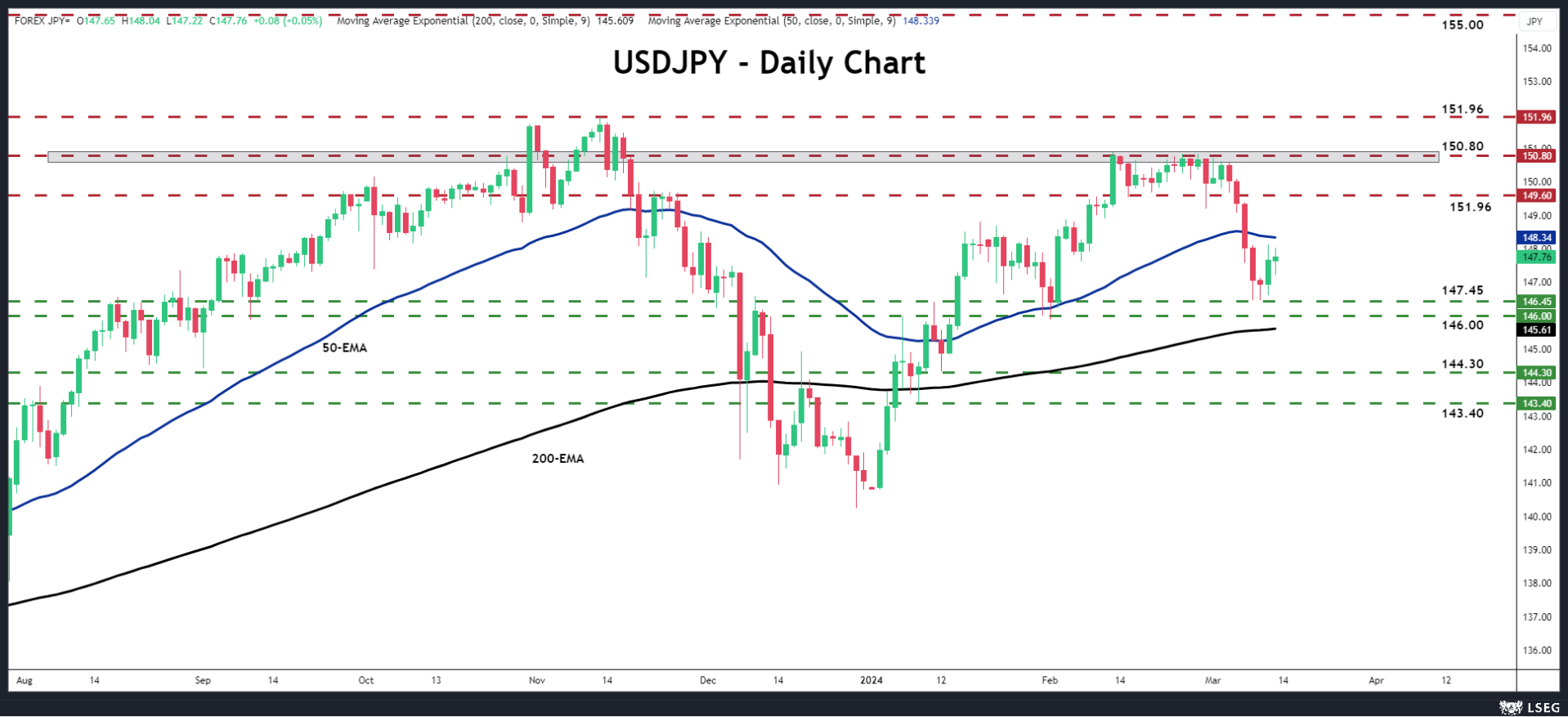
Dollar/yen entered a recovery mode this week, after it hit support at around 146.45. However, the pair covered less than half of the previous week’s losses, keeping the short-term outlook blurry. For the picture to brighten, the bulls may need to climb all the way above the 150.80 zone, which acted as a ceiling during February. On the downside, a dip below 146.00, marked by the low of February 1, will confirm a lower low on the daily chart and perhaps invite more bears into the action.