

Sample Category Title
AUD/USD Daily Report
Daily Pivots: (S1) 0.6515; (P) 0.6529; (R1) 0.6545; More...
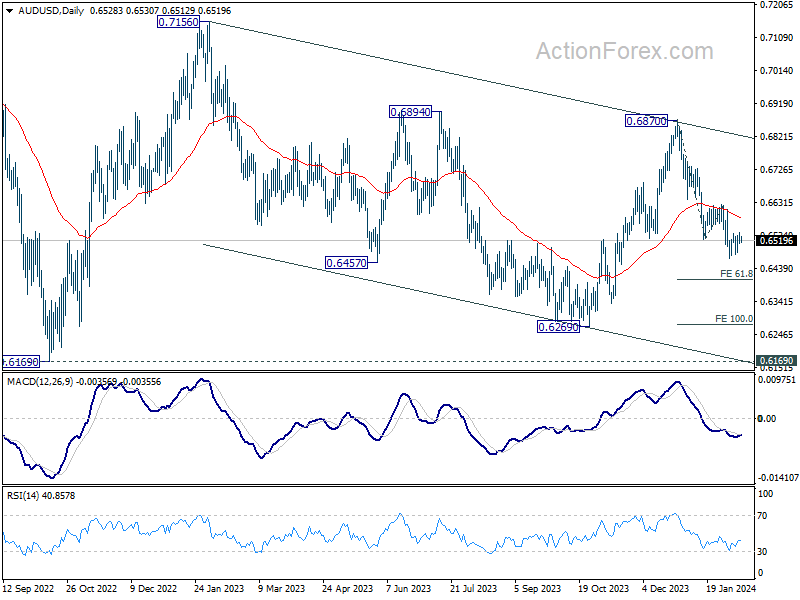
AUD/USD's consolidation from 0.6468 is still in progress and intraday bias remains neutral at this point. While stronger recovery cannot be ruled out, outlook will remain bearish as long as 0.6621 resistance holds. Break of 0.6468 will resume the decline from 0.6870 to 61.8% projection of 0.6870 to 0.6524 from 0.6621 at 0.6407.
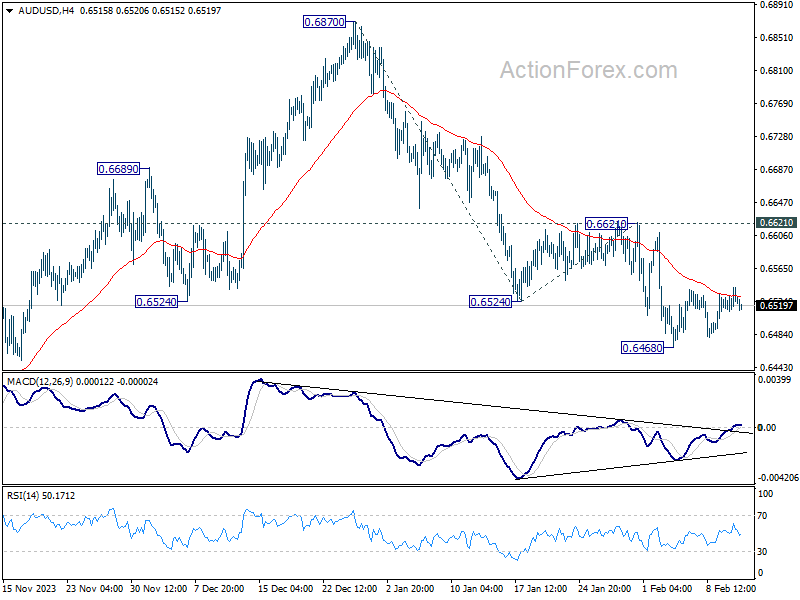
In the bigger picture, price actions from 0.6169 (2022 low) are seen as a medium term corrective pattern to the down trend from 0.8006 (2021 high). Fall from 0.7156 (2023 high) is seen as the second leg, which might still be in progress. Overall, sideway trading could continue in range of 0.6169/7156 for some more time. But as long as 0.7156 holds, an eventual downside breakout would be mildly in favor.
EUR/USD Daily Outlook
Daily Pivots: (S1) 1.0750; (P) 1.0778; (R1) 1.0800; More...
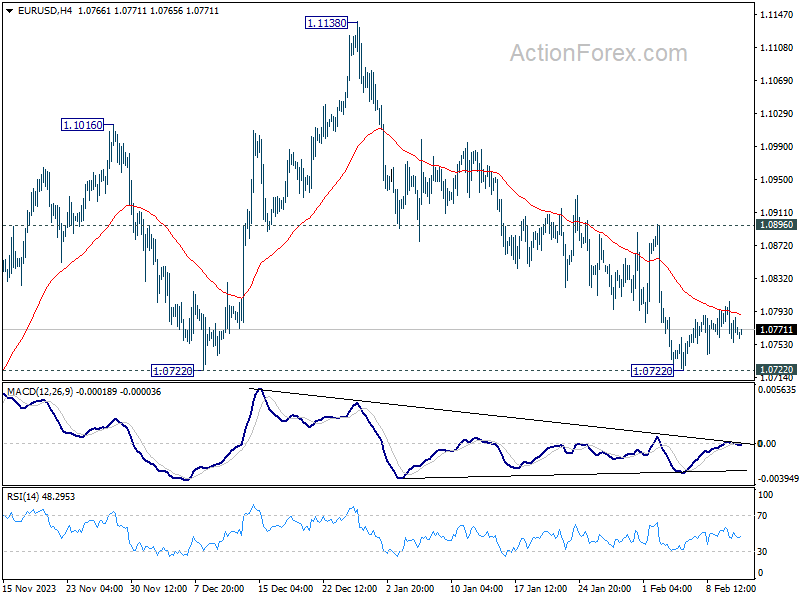
EUR/USD's consolidation from 1.0722 is still extending and intraday bias remains neutral. While stronger recovery cannot be ruled out, outlook will stay bearish as long as 1.0896 resistance holds. On the downside, sustained break of 1.0722 will argue that whole rise from 1.0447 has completed. Deeper fall would then be seen to target this low.
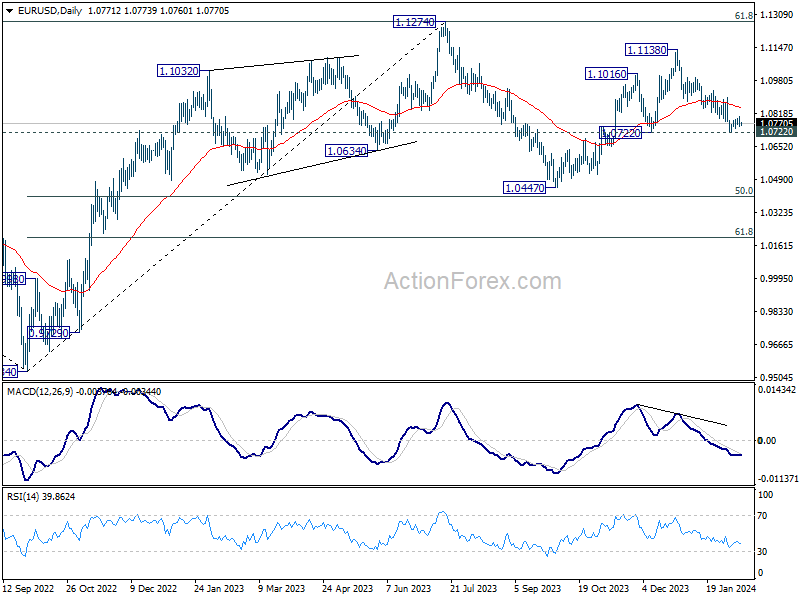
In the bigger picture, price actions from 1.1274 are viewed as a corrective pattern to rise from 0.9534 (2022 low). Rise from 1.0447 is seen as the second leg. While further rally could cannot be ruled out, upside should be limited by 1.1274 to bring the third leg of the pattern. Meanwhile, sustained break of 1.0722 support will argue that the third leg has already started for 1.0447 and possibly below.
GBP/USD Daily Outlook
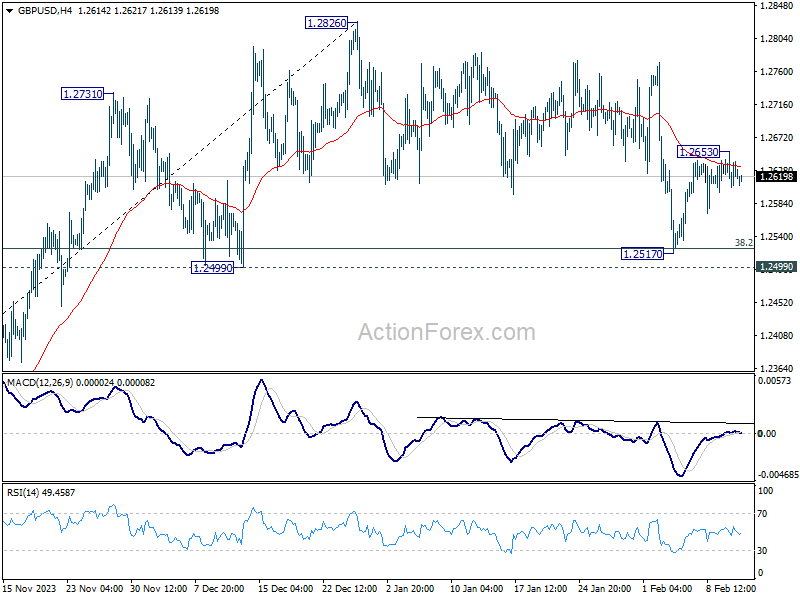
Daily Pivots: (S1) 1.2604; (P) 1.2630; (R1) 1.2653; More...
Intraday bias in GBP/USD remains neutral at this point. On the upside, firm break of 1.2653 resistance will affirm the case that correction from 1.2826 has completed at 1.2517, after drawing support from 1.2499. Intraday bias will be back on the upside for retesting 1.2826. Nevertheless, decisive break of 1.2499 will argue that whole rise from 1.2036 has completed and turn near term outlook bearish.
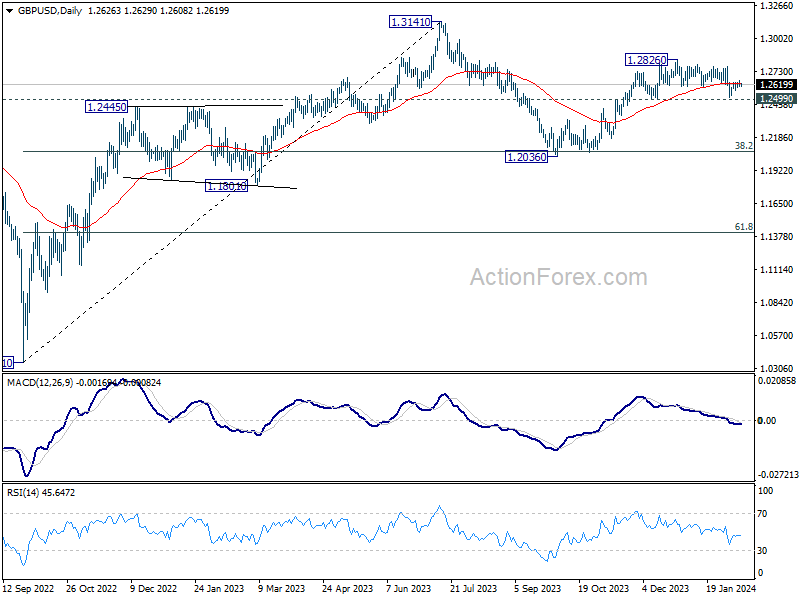
In the bigger picture, price actions from 1.3141 medium term top are seen as a corrective pattern to up trend from 1.0351 (2022 low). Rise from 1.2036 is seen as the second leg, would could be still in progress. But upside should be limited by 1.3141 to bring the third leg of the pattern. Meanwhile, break of 1.2499 support will argue that the third leg has already started for 38.2% retracement of 1.0351 (2022 low) to 1.3141 at 1.2075 again.
USD/JPY Daily Outlook
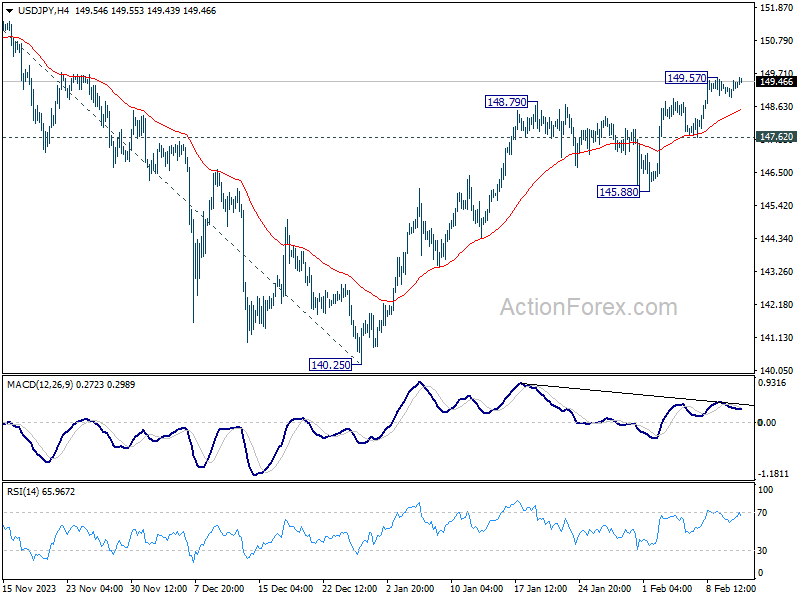
Daily Pivots: (S1) 149.03; (P) 149.25; (R1) 149.58; More...
Intraday bias in USD/JPY stays neutral and more consolidations could still be seen. But further further rally is expected as long as 147.62 support holds. Above 149.57 will resume the rise from 140.25 to retest 151.89/93 key resistance zone. Decisive break there will confirm resumption of larger up trend.
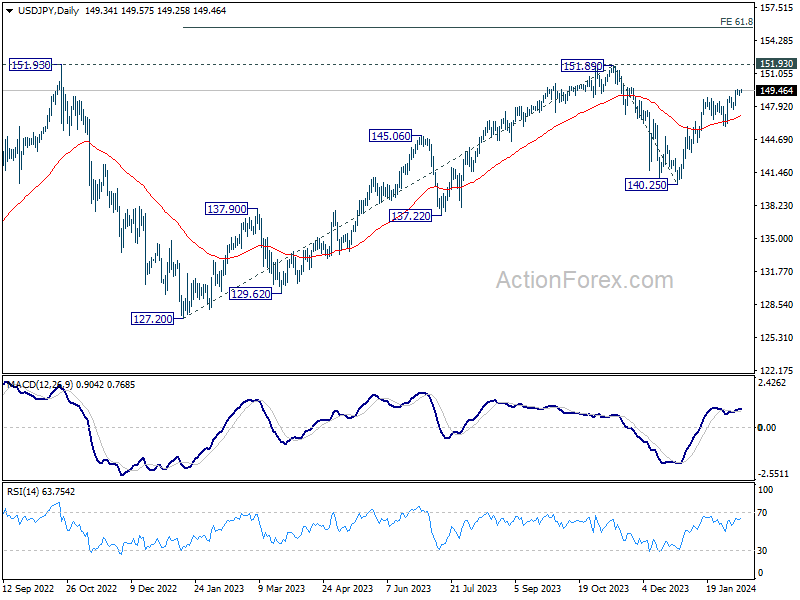
In the bigger picture, fall from 151.89 is seen as a correction to the rally from 127.20, which might have completed at 140.25 already. Firm break of 151.89/93 resistance zone will confirm up trend resumption, and next target will be 61.8% projection of 127.20 to 151.89 from 140.25 at 155.50. This will now remain the favored case as long as 140.25 support holds.
CHFJPY Perfectly Reacting Higher From Blue Box Area
In this technical blog, we will look at the past performance of the 4-hour Elliott Wave Charts of CHFJPY. In which, the rally from 14 December 2023 low unfolded as an impulse sequence and called for an extension higher to take place. Therefore, we knew that the structure in CHFJPY should remain supported & extend higher. So, we advised members not to sell the pair & buy the dips in 3, 7, or 11 swings at the blue box areas. We will explain the structure & forecast below:
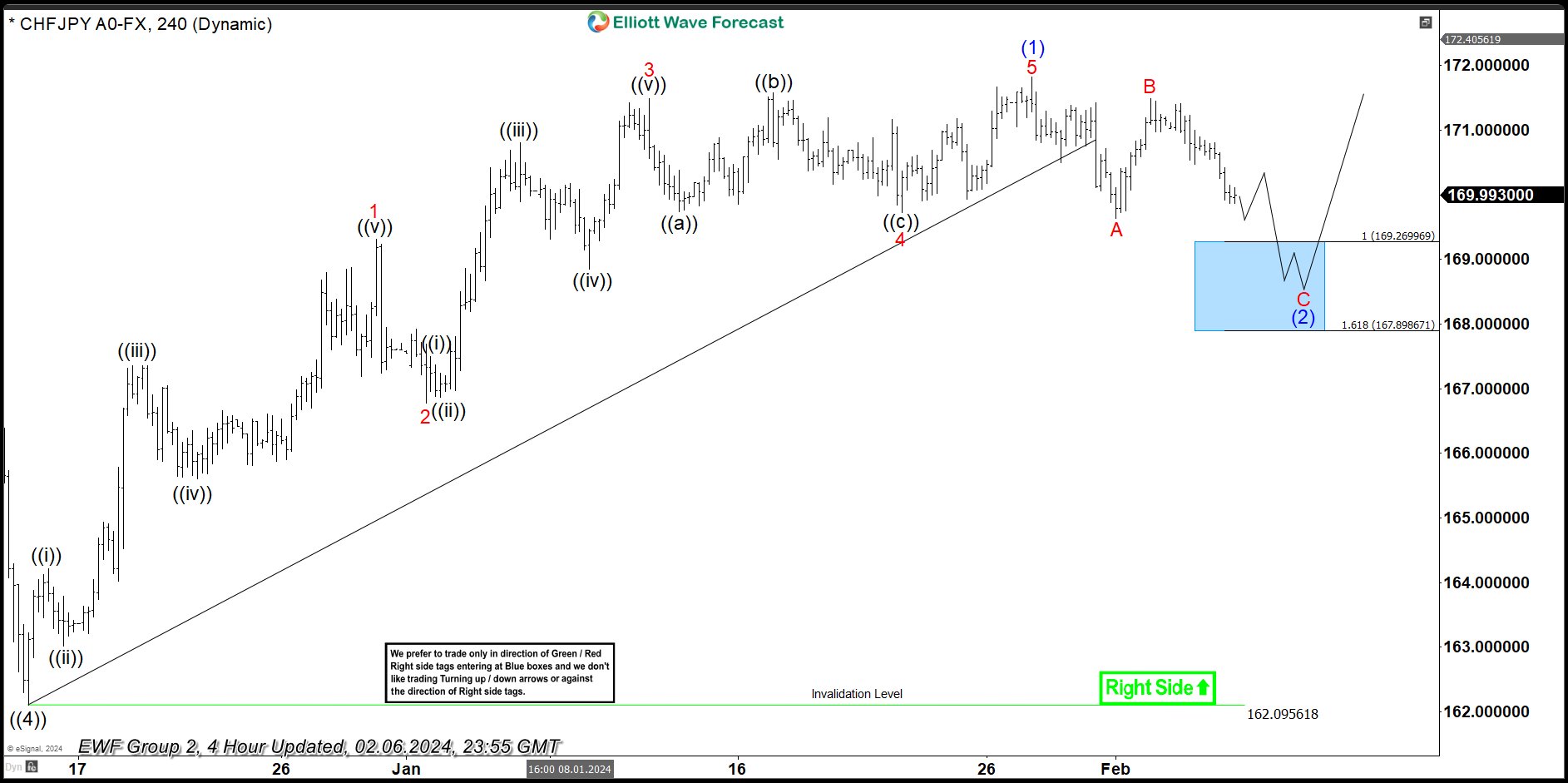
CHFJPY 4-Hour Elliott Wave Chart From 2.06.2024
Here’s the 4-hour Elliott wave Chart from the 2/06/2024 update. In which, the rally to 171.82 high-ended wave (1) & made a pullback in wave (2). The internals of that pullback unfolded as Elliott wave zigzag correction where wave A ended in 3 swings at 169.64 low. Then a bounce to 171.48 high-ended wave B & started the next leg lower in wave C towards 169.26- 167.89 blue box area. From there, buyers were expected to appear looking for new highs ideally or for a 3-wave bounce minimum.
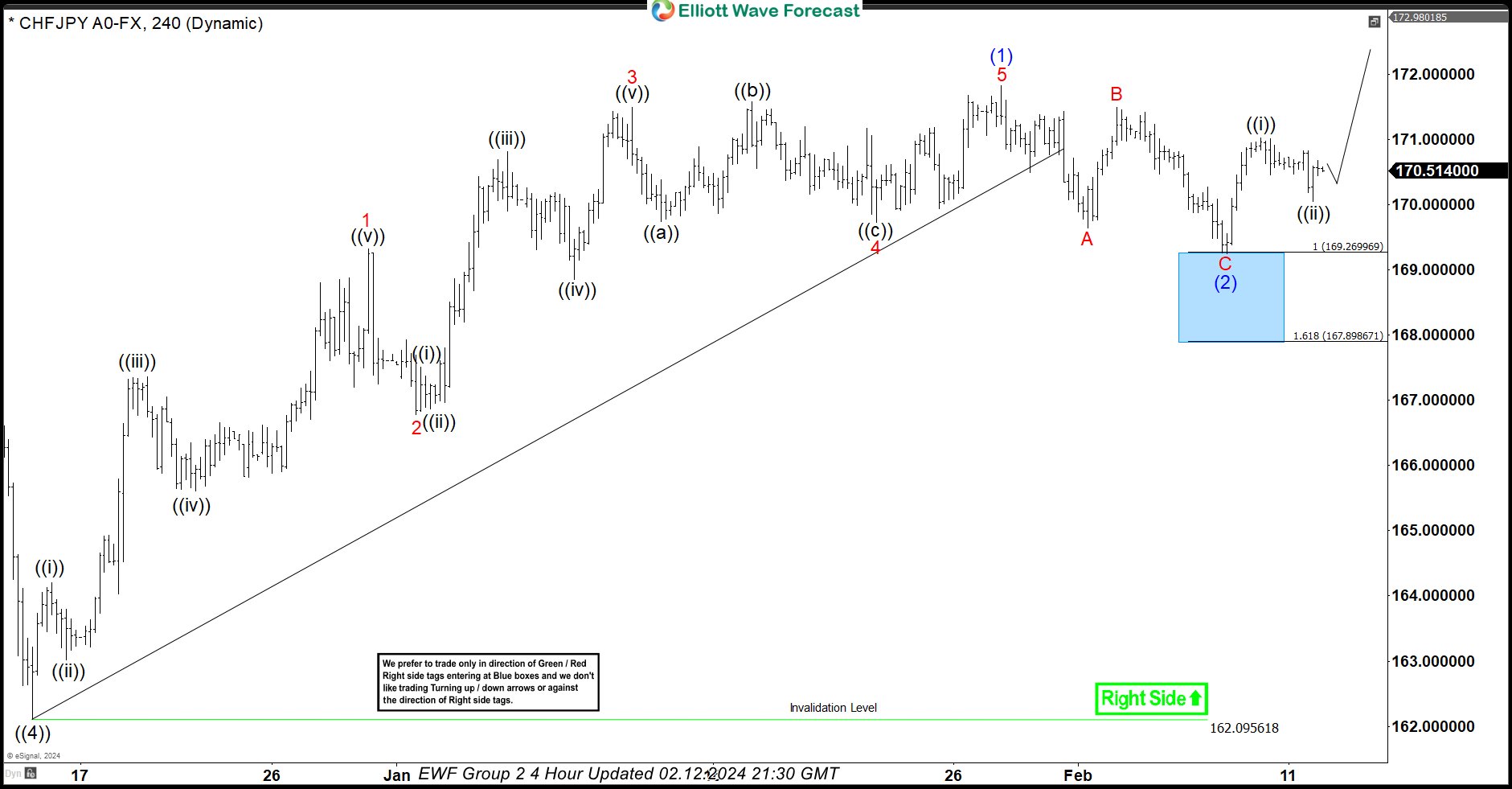
CHFJPY Latest 4-Hour Elliott Wave Chart From 2.12.2024
This is the latest 4-hour Elliott wave Chart from the 2/12/2024 update. In which the pair is showing a reaction higher taking place, right after ending the correction within the blue box area. Allowed members to create a risk-free position shortly after taking the long position at the blue box area. However, a break above 171.82 high is still needed to confirm the next extension higher & avoid further correction lower.
USD/CHF Daily Outlook
Daily Pivots: (S1) 0.8732; (P) 0.8752; (R1) 0.8778; More....
Intraday bias in USD/CHF remains on the upside despite loss of momentum as seen in 4H MACD. Current rise from 0.8332 should target 61.8% retracement of 0.9243 to 0.8332 at 0.8995. On the downside, below 0.8725 minor support will turn intraday bias neutral first. But near term outlook will stay cautiously bullish as long as 0.8550 support holds.
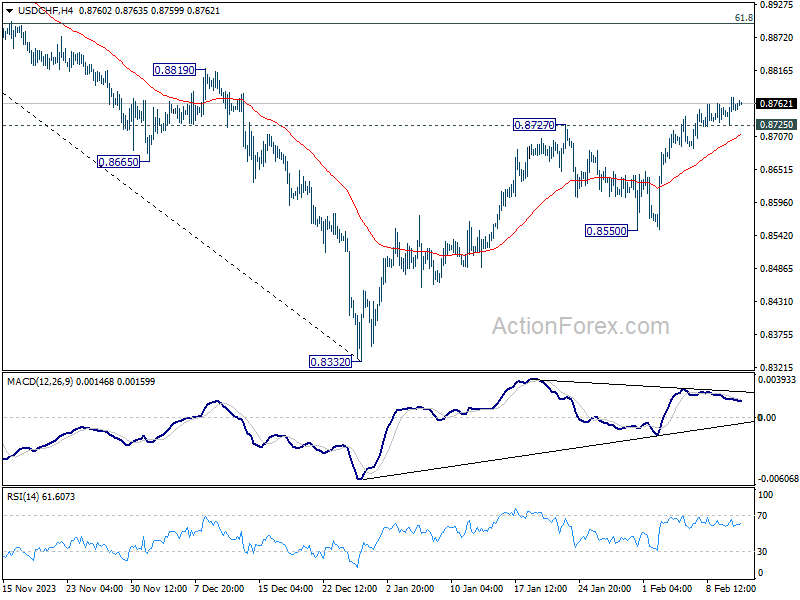
In the bigger picture, sustained trading above 55 D EMA (now at 0.8687) will solidify the case of medium term bottoming at 0.8332, just ahead of 0.8317 long term fibonacci support, on bullish convergence condition in W MACD. Further rise should be seen to 0.9243 resistance, even as a correction to the larger down trend from 1.0146 (2022 high).
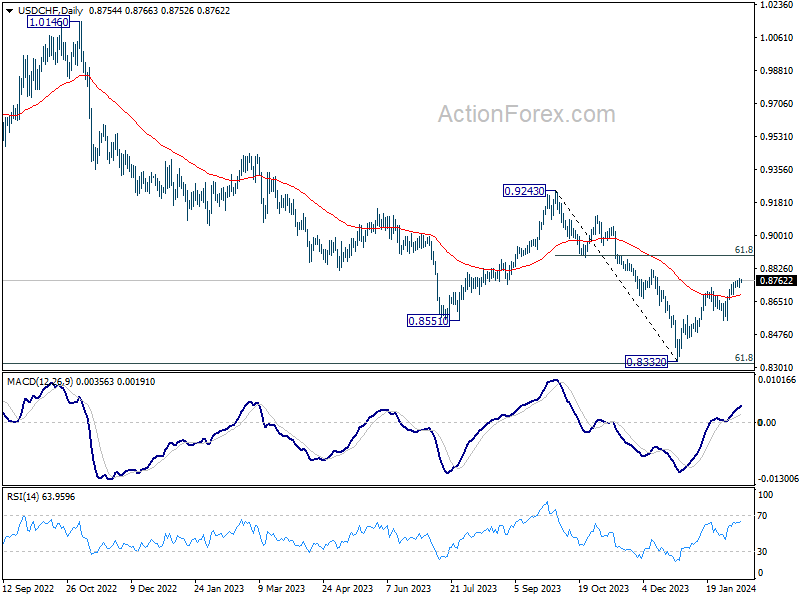
A Packed Day With UK Employment, Swiss CPI, German ZEW, and US CPI
New Zealand Dollar falls notably during Asian session, triggered by the latest survey from the RBNZ, which revealed a further easing in inflation expectations. The implications of these findings have prompted traders to pare back the bets on the likelihood of more monetary tightening imminent meeting February. Australian Dollar is also dragged down by the Kiwi and trades as the second weakest for the moment.
Meanwhile, Japanese Yen finds itself on the losing end as well, contributing to the extended rally in Nikkei, which soared to a new 34-year high, breaking past the 37,000 psychological level.
On the contrary, Dollar stands out as the day's strongest performer for now, with the financial markets on edge for the upcoming US CPI data release. Analysts are forecasting deceleration in headline CPI from 3.4% to 2.9% in January, alongside minor decrease in core CPI from 3.9% to 3.8%.
It should be emphasized that the broadening of disinflation from goods to services sectors remains a critical consideration for Fed. The pace and timing of rate rate cuts hinge on this data. Presently, Fed fund futures indicate a 57% likelihood of a rate cut by May, with the probability exceeding 90% by June.
Elsewhere in the currency markets, Euro is currently the second strongest while Swiss Franc and Sterling are mixed. UK employment and wages down will be a key focus in European session. But Swiss CPI and Germany ZEW economic sentiment could also be market moving.
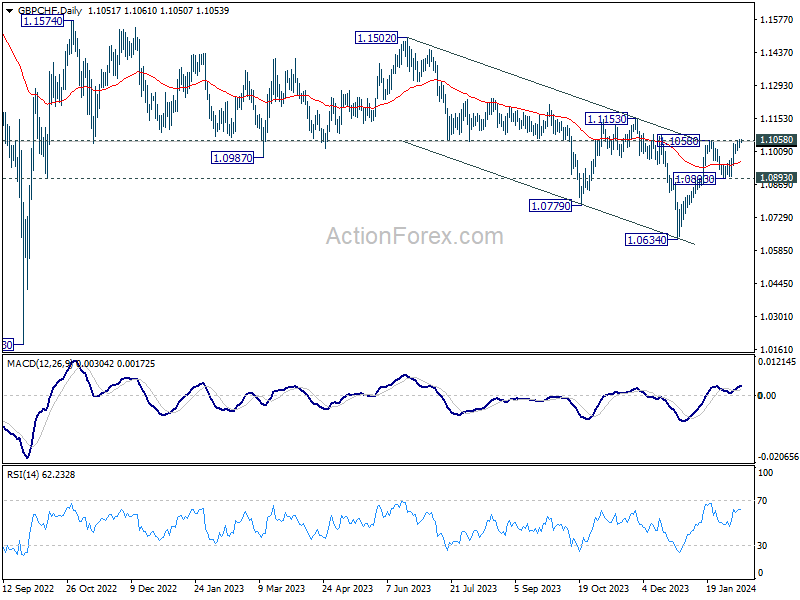
A pair garnering particular interest is GBP/CHF, which is currently pressing 1.1058 resistance level. Decisive break there will resume the whole rebound from 1.0634. More importantly, that would strength the case that whole corrective down trend from 1.1574 ha completed. Further rally would be seen to 1.1153 resistance for confirmation. At the same time, break of 0.8512 support in EUR/GBP will also solidify Sterling's overall momentum, as least against its European peers.
In Europe, at the time of writing, Nikkei is up 2.88%. Japan 10-year JGB yield is up 0.0042 at 0.729. Singapore Strait Times is down -0.14%. Hong Kong and China are still on holiday. Overnight, DOW rose 0.33%. S&P 500 fell -0.09%. NASDAQ fell -0.30%. 10-year yield fell -0.015 to 4.172.
RBA's Kohler points to slightly faster than expected inflation decline
Marion Kohler, RBA's Head of Economic Analysis, noted in a speech that inflation is "still high" but acknowledged a welcome trend: it's decreasing "at a slightly faster rate" than what RBA had forecasted three months prior.
Looking ahead, RBA's expectation is for inflation to settle back into its 2-3% target range by 2025 and reach the midpoint by the following year. However, Kohler underscored the "substantial uncertainty" surrounding these long-term predictions.
A notable aspect of Australia's inflation dynamics, as Kohler pointed out, is the "divergence in the path of core goods and services price inflation."
The primary driver behind the recent dip in inflation rates is the decrease in goods price inflation, whereas services price inflation remains "high and broadly based." This sector's inflation is predicted to "only gradually" diminish as a more equitable demand-supply relationship is established and domestic cost pressures begin to ease.
Kohler also touched on labor costs, particularly significant in the labor-intensive services sector, as a crucial factor influencing the pricing strategies of businesses. RBA believes wage growth is "around its peak" and anticipates a gradual reduction in line with improvements in the labor market. Signs of "easing wage pressures" are already evident in specific industries, notably within business services.
Australia NAB business conditions down to 6, price pressures easing
Australia NAB Business Confidence improved slightly form 0 to 1 in January. Despite this marginal improvement, Business Conditions dropped from 8 to 6, with notable decreases in trading conditions from 11 to 8, profitability conditions from 7 to 5, and employment conditions also falling from 7 to 5.
In terms of cost pressures, labour cost growth remained steady at 2.0% in quarterly equivalent terms, while purchase cost growth saw a slight increase to 1.8% from 1.7%. Product price growth experienced a pickup, moving to 1.2% in quarterly terms from 0.9%, reflecting a broader trend of easing price pressures. Specifically, retail price growth rose to 0.9% from 0.5%, and the growth rate for recreation & personal services prices increased to 1.2% from 0.9%.
NAB Chief Economist Alan Oster commented on the findings, stating, " Capacity utilisation remains high, despite the slowing in growth over the second half of 2023, and price pressures are easing, with hopes they settle well below where they are now."
Australian Westpac consumer sentiment hits 20-Month high, but still pessimistic
Australia Westpac Consumer Sentiment Index surged by 6.2% mom to 86 in February, marking the highest level since June 2022. This increase also represents the largest monthly gain since April of the previous year, which conincided with a period when RBA temporarily halted its tightening cycle.
According to Westpac, the surge in consumer sentiment was notably propelled by improved sentiment towards major purchases, which climbed 11.3% to 86.8, and more optimistic outlook for the economy over the next year, rising 8.8% to 88.9—the highest since May 2022. Additionally, five-year economic outlook rose 4.4% to 93.
The cooling inflation and more favorable perspective on interest rates are believed to be the primary factors behind this uplift. However, despite the recent gains, consumer mood remains in the pessimistic territory.
A notable "sharp turnaround" in sentiment was observed following RBA's decision in February to maintain the cash rate steady, with sentiment dropping from 94.1 to just 80 post-meeting. While the decision to keep rates unchanged aligned with general expectations, the decline in sentiment suggests consumers were anticipating a "clearer indication" that interest rates might begin to decrease.
Looking forward, Westpac anticipates the RBA will maintain the current interest rate in March, contingent on inflation continuing to align with expectations.
RBNZ survey reveals easing inflation expectations, NZD dips
According to RBNZ's latest Survey of Expectations, one-year inflation expectation fell by 38 basis points from 3.60% to 3.22%, marking its lowest point since September 2021. The survey also indicates a growing consensus, with more than half of respondents expecting that CPI inflation will fall back to RBNZ's target range of 1-3% by the end of 2024
Furthermore, the survey pointed to a decrease in inflation expectations over the longer term, with two-year-ahead predictions dropping from 2.76% to 2.50%, and expectations for five and ten years ahead also seeing decline to 2.25% (from 2.43%) and 2.16% (from 2.28%), respectively.
In terms of interest rates, survey participants anticipate OCR to average at 5.46% by the end of March, with projected decrease to 4.74% by the end of the year. The OCR currently stands at 5.50%.
The publication of the survey's results led to a discernible decline in the NZD, as market participants began to reevaluate the likelihood of another RBNZ rate hikes.
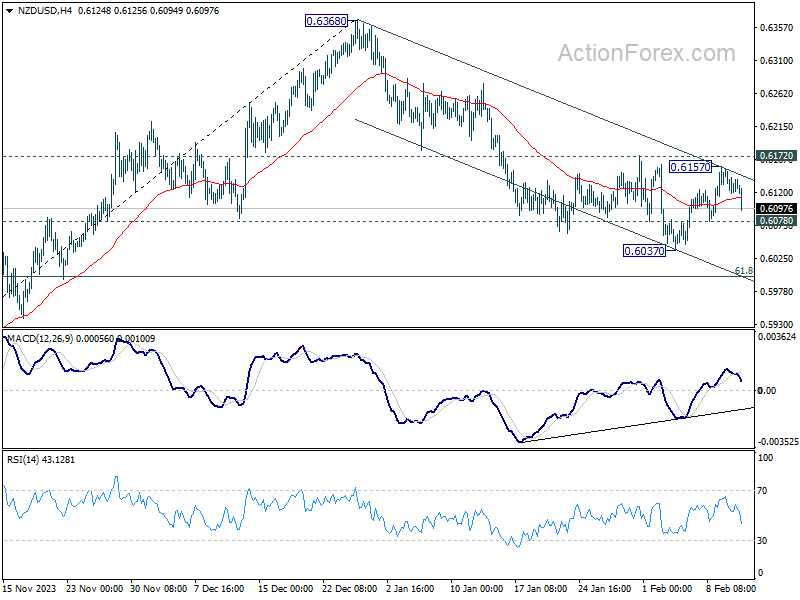
Technically, with 0.6172 resistance intact, recovery from 0.6037 is seen as a correction to the fall from 0.6368 only. Break of 0.6078 minor support will argue that this decline is ready to resume through 0.6037.
ECB's Cipollone: No further economic slack necessary
In a speech overnight, ECB Executive Board member Piero Cipollone suggested that additional tightening of monetary policy may not be necessary to rein in inflation. His remarks hint at a potentially less restrictive approach going forward, should inflationary pressures continue to subside.
Cipollone emphasized that the current economic conditions, "with demand still weak and inflation expectations anchored", arguing against the need for monetary policy to "generate further slack to keep inflation in check". This perspective underlines a significant shift from aggressive tightening to a more measured stance, possibly preparing the ground for a more accommodative monetary policy in the near future.
Unwinding of supply shocks offers room for demand to pick up "without fuelling inflation". Additionally, the downturn in energy prices could allow for "some wage catch-up, especially if profits normalize."
However, Cipollone also stressed the importance of a balanced approach to policy-making, pointing out that the path to the ECB's inflation target would depend on a complex interplay of economic factors. Consequently, he advocated for a "data-driven" approach to future monetary-policy decisions.
Looking ahead
UK employment, Swiss CPI and German ZEW economic sentiment will be released in European session. Later in the day, US CPI will tak center stage.
USD/CHF Daily Outlook
Daily Pivots: (S1) 0.8732; (P) 0.8752; (R1) 0.8778; More....
Intraday bias in USD/CHF remains on the upside despite loss of momentum as seen in 4H MACD. Current rise from 0.8332 should target 61.8% retracement of 0.9243 to 0.8332 at 0.8995. On the downside, below 0.8725 minor support will turn intraday bias neutral first. But near term outlook will stay cautiously bullish as long as 0.8550 support holds.
In the bigger picture, sustained trading above 55 D EMA (now at 0.8687) will solidify the case of medium term bottoming at 0.8332, just ahead of 0.8317 long term fibonacci support, on bullish convergence condition in W MACD. Further rise should be seen to 0.9243 resistance, even as a correction to the larger down trend from 1.0146 (2022 high).
Economic Indicators Update
| GMT | Ccy | Events | Actual | Forecast | Previous | Revised |
|---|---|---|---|---|---|---|
| 23:30 | AUD | Westpac Consumer Confidence Feb | 6.20% | -1.30% | ||
| 23:50 | JPY | PPI Y/Y Jan | 0.20% | 0.10% | 0.00% | 0.20% |
| 00:30 | AUD | NAB Business Confidence Jan | 1 | -1 | ||
| 00:30 | AUD | NAB Business Conditions Jan | 6 | 7 | ||
| 02:00 | NZD | RBNZ Inflation Expectations Q1 | 2.50% | 2.76% | ||
| 06:00 | JPY | Machine Tool Orders Y/Y Jan | -9.90% | |||
| 07:00 | GBP | Claimant Count Change Jan | 15.2K | 11.7K | ||
| 07:00 | GBP | Unemployment rate Dec | 4.00% | 4.20% | ||
| 07:00 | GBP | Average Earnings Including Bonus 3M/Y Dec | 5.70% | 6.50% | ||
| 07:00 | GBP | Average Earnings Excluding Bonus 3M/Y Dec | 6.00% | 6.60% | ||
| 07:30 | CHF | CPI M/M Jan | 0.60% | 0% | ||
| 07:30 | CHF | CPI Y/Y Jan | 1.60% | 1.70% | ||
| 10:00 | EUR | Germany ZEW Economic Sentiment Feb | 17.5 | 15.2 | ||
| 10:00 | EUR | Germany ZEW Current Situation Feb | -79 | -77.3 | ||
| 10:00 | EUR | Eurozone ZEW Economic Sentiment Feb | 20.1 | 22.7 | ||
| 11:00 | USD | NFIB Business Optimism Index Jan | 91.1 | 91.9 | ||
| 13:30 | USD | CPI M/M Jan | 0.20% | 0.30% | ||
| 13:30 | USD | CPI Y/Y Jan | 2.90% | 3.40% | ||
| 13:30 | USD | CPI Core M/M Jan | 0.30% | 0.30% | ||
| 13:30 | USD | CPI Core Y/Y Jan | 3.80% | 3.90% |
GBPJPY Looking to Extend Higher in Impulsive Structure
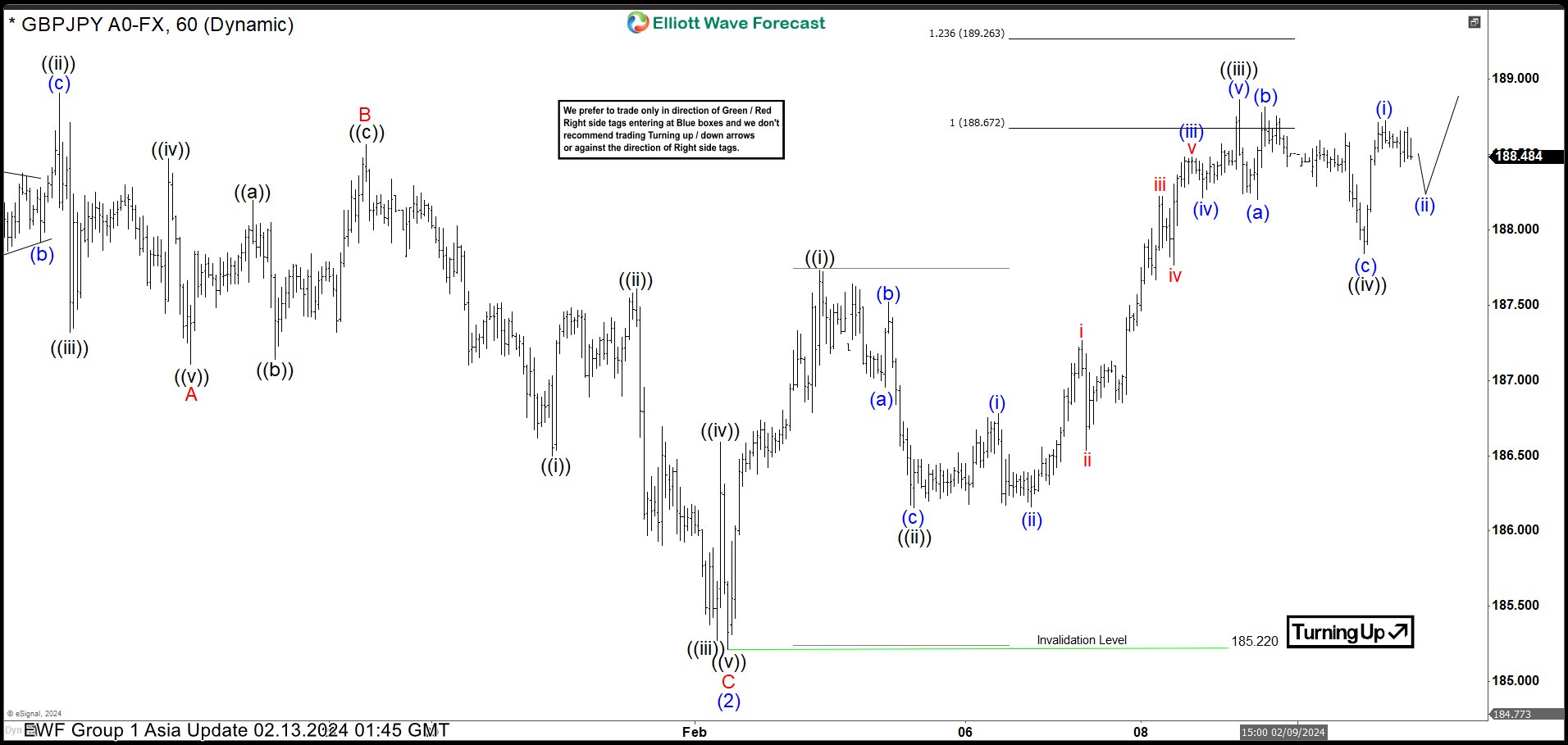
Cycle from 12.14.2023 low is in progress as a 5 waves impulse Elliott Wave structure. Up from 12.14.2023 low, wave (1) ended at 188.93 and pullback in wave (2) ended at 18522. Internal subdivision of wave (2) unfolded as a zigzag structure. Down from wave (1), wave A ended at 187.1, wave B ended at 188.56, and wave C lower ended at 185.22 which completed wave (2). Pair then rallied higher in wave (3). Up from wave (2), wave ((i)) ended at 187.73 and pullback in wave ((ii)) ended at 186.15.
Pair resumes higher from wave ((ii)). Up from there, wave (i) ended at 186.78 and wave (ii) ended at 186.16. Wave (iii) higher ended at 188.48, wave (iv) ended at 188.21 and wave (v) ended at 188.86 which completed wave ((iii)). Pullback in wave ((iv)) ended at 187.84. Pair has resumed higher in wave ((v)). Near term, as far as pivot at 185.22 low stays intact, expect dips to find support in 3, 7, or 11 swing for further upside.
GBPJPY 1 Hour Elliott Wave Chart
GBPJPY Elliott Wave Video
https://www.youtube.com/watch?v=fe469CFThqY
RBNZ survey reveals easing inflation expectations, NZD dips
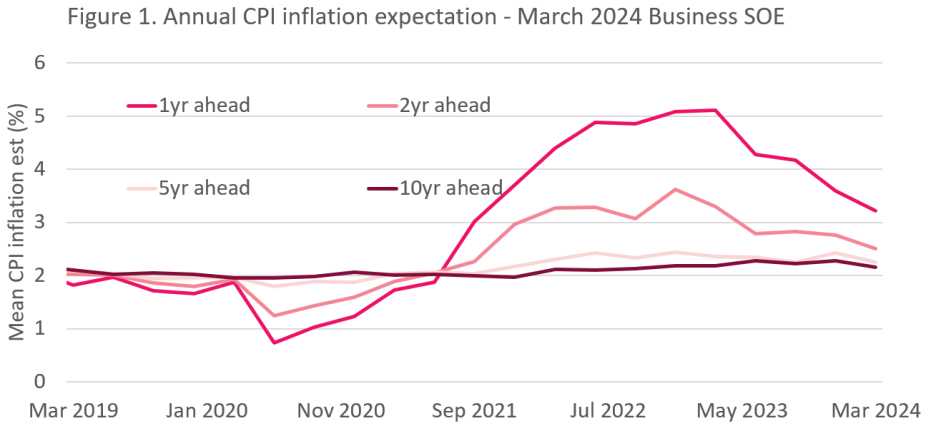
According to RBNZ's latest Survey of Expectations, one-year inflation expectation fell by 38 basis points from 3.60% to 3.22%, marking its lowest point since September 2021. The survey also indicates a growing consensus, with more than half of respondents expecting that CPI inflation will fall back to RBNZ's target range of 1-3% by the end of 2024
Furthermore, the survey pointed to a decrease in inflation expectations over the longer term, with two-year-ahead predictions dropping from 2.76% to 2.50%, and expectations for five and ten years ahead also seeing decline to 2.25% (from 2.43%) and 2.16% (from 2.28%), respectively.
In terms of interest rates, survey participants anticipate OCR to average at 5.46% by the end of March, with projected decrease to 4.74% by the end of the year. The OCR currently stands at 5.50%.
The publication of the survey's results led to a discernible decline in the NZD, as market participants began to reevaluate the likelihood of another RBNZ rate hikes.
Technically, with 0.6172 resistance intact, recovery from 0.6037 is seen as a correction to the fall from 0.6368 only. Break of 0.6078 minor support will argue that this decline is ready to resume through 0.6037.
What Next for the RBNZ?
- We continue to think the OCR will remain at 5.5% at the February Monetary Policy Statement.
- Resilience in domestic inflation pressures and the labour market will be of concern to the RBNZ.
- But very weak economic momentum, lower headline inflation and a flatter housing market of late are important mitigants.
- We see another hawkish Statement that even might bring forward potential tightening and continues to lean heavily against expectations of policy easing this year.
- Data on inflation, the labour and housing markets, together with the details of the Budget, will be important in making the case for further tightening, if required.
- We don't see scope for interest rate cuts in 2024.
Where the RBNZ was in November.
Expectations have fluctuated wildly in New Zealand since the RBNZ November Monetary Policy Statement. Back then the RBNZ surprised almost all with the threat of further tightening in 2024 if inflation pressures didn't recede fast enough. Central to their thesis was concern that:
- domestic inflation pressures were only slowly subsiding;
- the labour market was taking longer to adjust than expected;
- the housing market was showing signs of resurgence driven by strong net migration;
- migration was putting a floor under growth at the time when policy was trying to increase excess capacity;
- growth was in aggregate stronger than consistent with inflation pressures easing quick enough. The Governor indicated the revised forecast had the minimum sized recession consistent with bringing inflation into line;
- a reinvigorated focus on returning inflation to the middle of the target range by H2 2025 whereas earlier the sense had been that anything inside the 1-3% range might be close enough;
- a concern that fiscal policy might not do enough to assist the disinflation process.
The outcome was a threat of higher rates in Q3 2024 should the outlook not evolve according to plan. There was very limited scope for any further delay in the disinflationary process or any resilience in the economy or labour market.
Having said that, the November Statement did not focus on a potential tightening as soon as its February meeting. The RBNZ's forecasts implied the potential for action in the September quarter of 2024. Some market participants and commentators concluded that the less imminent timeframe for interest rate increases meant that the RBNZ's rhetoric was likely an empty threat designed to manage easing expectations. We didn't believe that then and don't believe it now.
But we saw a hurdle for the data to jump over to get to the view we held back in November that a February tightening would occur. We expected ongoing resilience in growth, migration, the labour market and especially the housing market. We anticipated that inflation would remain sticky and only slowly fall. We didn't see inflation getting back inside the 1-3% range until 2025. Hence even after a further 25bp tightening, we thought it would be 2025 before easing could begin and from there it would be a slow cycle down to a higher terminal rate (3.5%) than was seen pre-Covid.
Implicit in our view was that the RBNZ preferred a strategy of "longer" versus "higher" for the interest rate cycle. Hence, we had moved away from the view we held in mid 2023 that a 6% OCR would be required to break the back of inflation in the face of a historically strong migration cycle. We still think that would have been a superior strategy as it would have allowed for earlier easing than what we face now. But that's a choice for the RBNZ to make.
Key developments since November 2023.
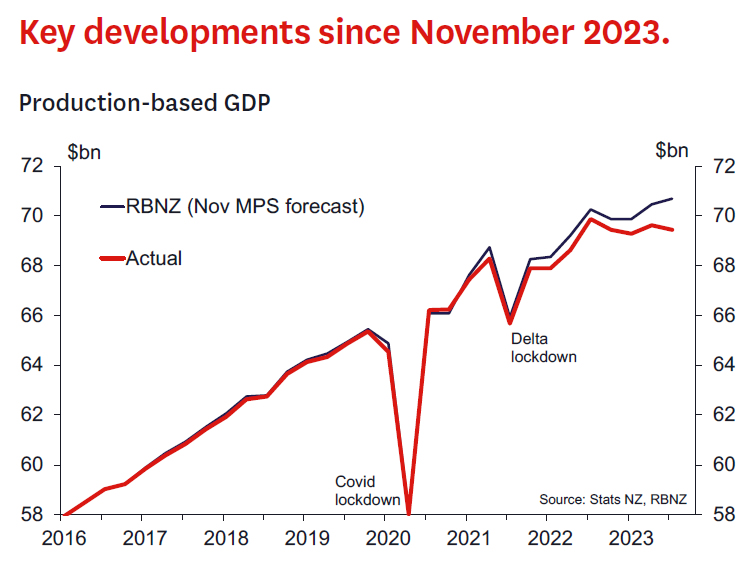
Since November last year we revised down our expectations for the OCR and moved to the view that the peak OCR would be 5.5%. The key factor driving that change was a significant reassessment of the momentum of the economy. GDP was significantly revised down when it was released in December and growth in Q3 itself was weaker than even our below consensus view at the time. We concluded that with an economy contracting at 0.6% yoy and a real probability that 2023 was a year bookended by recessions that there was clear evidence that the 5.5% OCR was providing sufficient pressure on core inflation even despite our concerns that inflation would only slowly fall. Even though some components of demand such as private consumption were as expected in the September quarter, in light of revisions, momentum over the past year was nonetheless much weaker than the RBNZ had expected.
Markets were also especially moved by the weakening in traded goods prices, airfares and food prices shown in the new monthly selected price indices. We were less impressed as these were always going to fall in the near term - whether now or in a quarter or two was of little consequence for the appropriate policy rate today. Certainly, it was helpful for expectations management that these factors drove the headline rate down a bit faster than expected. But the key information in those releases was (and will continue to be) those slow moving components such as rents which continued to be strong beyond what might normally be expected for inflation to stably return to the target range.
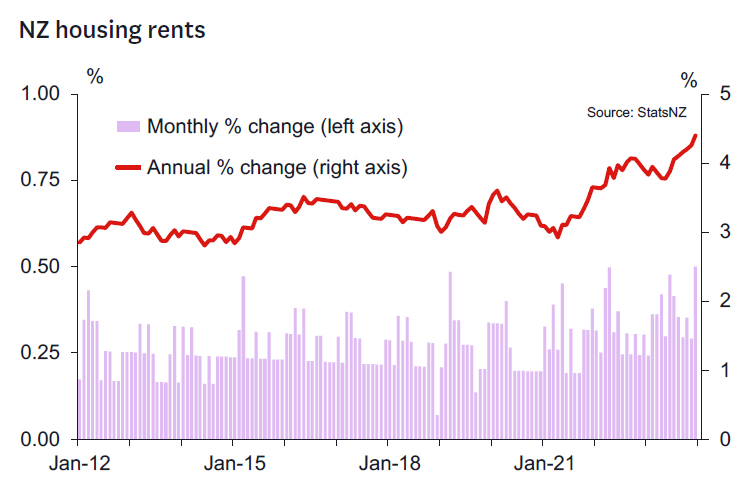
Hence, we were very sceptical when markets swung to expecting rate cuts as early as May 2024. We could see a case for an earlier easing in August if things went very well, but the core view was that the OCR would need to stay at 5.5% in 2024 to lean against sticky inflation, strong migration and the RBNZ's strategy of going "longer" as opposed to "higher".
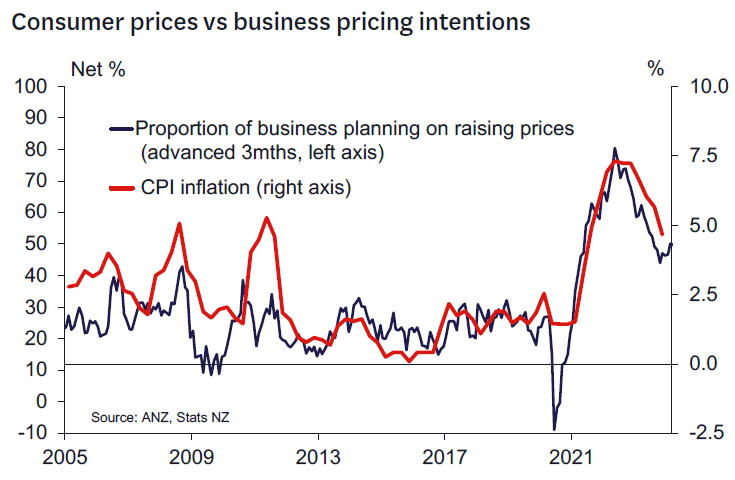
And as it turns out things have not gone very well. When the December quarter CPI was released in late January, those key domestic inflation components were revealed to be markedly stronger than forecast. Last week's Q4 2023 labour market data revealed that the labour market has remained relatively resilient. Both core inflation and the labour market are adjusting, but at a slow rate. Business confidence indicators suggest optimism in the business sector and pricing intentions indicators might suggest a risk of inflation getting stuck at too high levels. Together, these observations are consistent with the idea that an OCR of 5.5% is tight, but perhaps not extremely tight. Hence, it's going to take time to get inflation back in its box.
However, it is not all bad. One thing in favour of an optimistic view that inflation will adjust is that the housing market has not yet kicked on from the green shoots seen up to September 2023. This is important as a key element of the slow disinflation thesis is that strong population growth coming from net migration would see housing recover and aid a recovery in consumption and investment earlier than needed to ensure inflation durably returned to target.
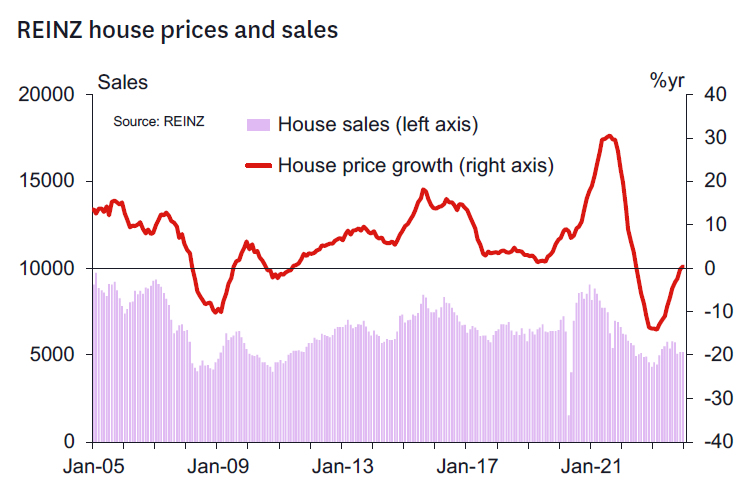
We think the jury is still out with respect to the performance of the housing market and still see strong signs that housing will have a decent year. The new government's investor tax policies, population growth, rents and a likely weakening in construction this year all tell us prices should rise. But it may be that interest rates are high enough to keep them in check - we need to see more data to decide.
What to expect from the RBNZ now?
So where are we now? While some commentators and markets have quickly jumped ship from "team easing" to "team tightening," we still find ourselves somewhere in the middle. We think the "longer" strategy can still work but the time is shortening to continue giving the data the benefit of the doubt.
We are perhaps even slightly more confident that the recent drop in headline inflation will allow for a return to the target range before 2025. But we think progress will be slower beyond that without a significant near term easing in the labour market. If this economy keeps adding jobs at the current interest rate, then a higher rate may well be required.
Monetary policy also needs mates and more supportive fiscal policy. The Government has indicated a policy of fiscal restraint and consolidation. It will be important the Government backs its rhetoric with action as current Treasury projections seem consistent with ongoing fiscal deficits and an avalanche of bonds. Just reducing spending and cutting taxes likely won't cut it.
We also don't think the RBNZ is ready to abruptly change strategy from longer to higher. We think the RBNZ want to encourage monetary conditions to fully reflect their view that the OCR will remain at the current level for longer as opposed to the fanciful ideas of near-term easing being pushed by markets as late as 2 weeks ago.
We think the RBNZ will be on edge. The RBNZ will likely threaten further tightening and may ultimately deliver action this year should inflation pressures not recede fast enough. The RBNZ's new mandate allows little scope for further waiting and hoping. Action in the next 6 months will determine inflation outcomes in the second half of 2025.
But we do think the RBNZ has time to let the data talk. Economic momentum is very weak, and the possibility of a rapid labour market adjustment remains real as firms react to the weakness in demand seen in the last six months of last year. And we don't know what the Government is going to do with fiscal policy.
Hence, we see another hawkish Statement later this month, that could potentially threaten policy tightening sooner than indicated in November. We see that as consistent with continuing with the "longer" strategy while managing the risks that the current OCR might not deliver sufficient disinflation. A sudden switch in strategy to one of higher interest rates seems dangerous this late in the cycle. And in the context of likely developments in interest rates in other advanced economies over the second half of this year, a further hike in domestic interest rates would inevitably put upward pressure on the exchange rate – at least in the near term.
We recognise that such late cycle tightenings have happened before (for example immediately before the Global Financial Crisis and during the Asian Financial Crisis). While this could happen again, we think the RBNZ will be more cautious than that right now given that global central banks look set to head into their easing cycles later this year. And it's important to remember that the RBNZ has been pleasantly surprised with the decline in headline CPI inflation recently.
We don't think the RBNZ will panic just yet. But forget about easings in 2024 - it just isn't happening based on what we see now. And we might be back to tightening should conditions prove necessary. Maybe the RBNZ will give us a clue this week in speeches if there's a change in strategy coming. Let's see.