Sample Category Title
Canada’s GDP Rebounds in First Quarter of 2023
The Canadian economy expanded by 3.1% quarter/quarter annualized (q/q) in 2023 Q1. Furthermore, the flash estimate for April showed a 0.2% month-on-month increase.
Consumer spending drove the first quarter gains, up 5.7% q/q. This was led by spending on durable goods, including "new trucks, vans, and sport utility vehicles". Spending on services also rose, led by Canadians' desire to go out to dinner and bars.
Exports also rose by 10.1% q/q, led by sales of "passenger cars and light trucks, unwrought gold, silver, and platinum group metals and their alloys, other crop products, and wheat." At the same time, imports were flat at 0.9% q/q, as increases in oil imports "were largely offset by declines in imports of passenger cars and light trucks, unwrought gold, silver, and platinum group metals and their alloys, and clothing, footwear, and accessories."
Investment was a drag once again, as housing investment (-14.6% q/q) led the decline. Statcan noted that the "decline in investment was widespread—as new construction (-6.0%), renovations (-2.1%), and ownership transfer costs (-1.5%), which represents resale activity, were all down. The decline in new construction was observed in every province and territory except Yukon."
The incomes of Canadians also rose, as employee compensation rose 7.2% q/q – "the largest quarterly growth in compensation of employees since the second quarter of 2022." This was driven by higher wages and employment gains over the quarter. The savings rate hit 2.9%, down from 5.8% in 2022 Q4.
Key Implications
Canada's economy bounced back in a meaningful way in the first quarter of 2023. Growth was driven by an acceleration in consumer spending, supported by a record-breaking increase in employment during the first quarter and wage growth that now outpaces inflation. This labour market strength enabled final domestic demand to surge by 2.6% q/q, well above the trend rate of growth. The encouraging flash estimate for April GDP points to less of a deceleration heading into the second quarter than previously expected, with 2023 Q2 now tracking around 1% q/q.
The Bank of Canada's (BoC) next interest rate decision is next week, and while today's report might not force a move off the sidelines, it may be used as rationale for a hike later this summer. Thus far, the BoC's rhetoric has focused on its expectation for a quick deceleration in economic growth over the remainder of the year. That slowdown still seems likely, but if the data keep coming in hot, the BoC may be compelled to move once again.
USD/JPY Mid-Day Outlook
Daily Pivots: (S1) 139.26; (P) 140.10; (R1) 140.62; More...
Intraday bias in USD/JPY remains neutral for consolidations below 140.90. Downside of retreat should be contained above 138.22 support to bring another rally. Break of 140.90 will resume larger rise from 127.20 to 142.48 fibonacci level. However, considering bearish divergence condition in 4 hour MACD, break of 138.22 will confirm short term topping, and turn bias back to the downside for 55 D EMA (now at 135.89).
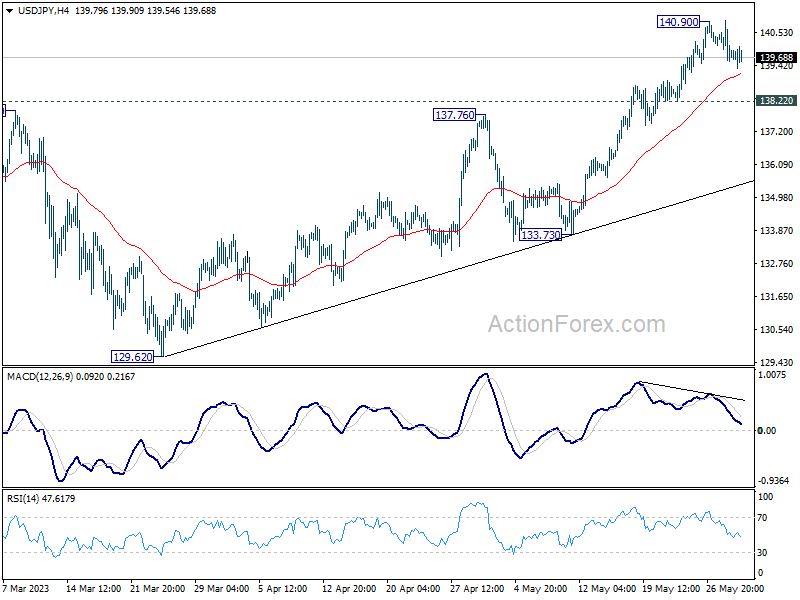
In the bigger picture, rise from 127.20 is seen as the second leg of the corrective pattern from 151.93 high. Stronger rally would be seen to 61.8% retracement of 151.93 to 127.20 at 136.34. Sustained break there will pave the way back to retest 151.93. On the downside, however, break of 133.73 support will argue that the pattern could have started the third leg through 127.20 low.
USD/CHF Mid-Day Outlook
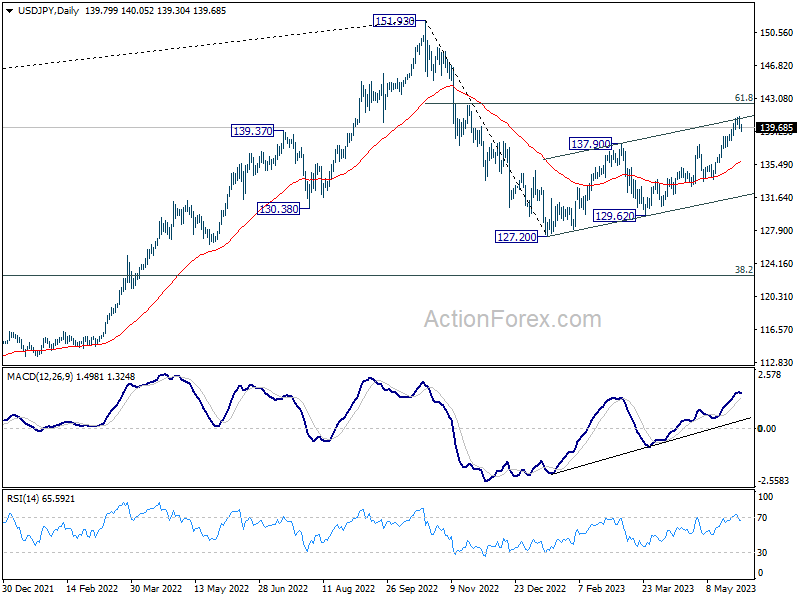
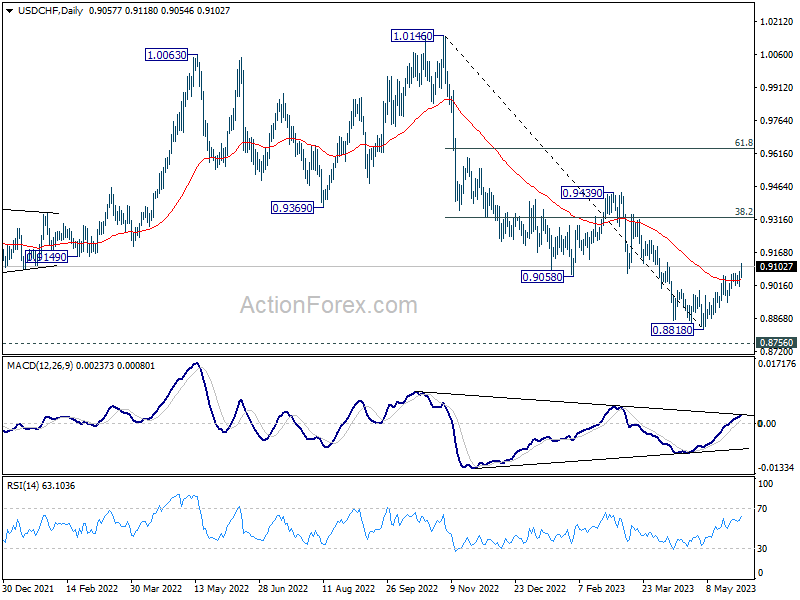
Daily Pivots: (S1) 0.9021; (P) 0.9052; (R1) 0.9091; More...
Intraday bias in USD/CHF stays on the upside for the moment. Rise from 0.8818 is seen as correcting whole down trend from 1.0146. Further rise should then be seen to 38.2% retracement of 1.0146 to 0.8818 at 0.9325. On the downside, below 0.9013 minor support will turn intraday bias neutral first.
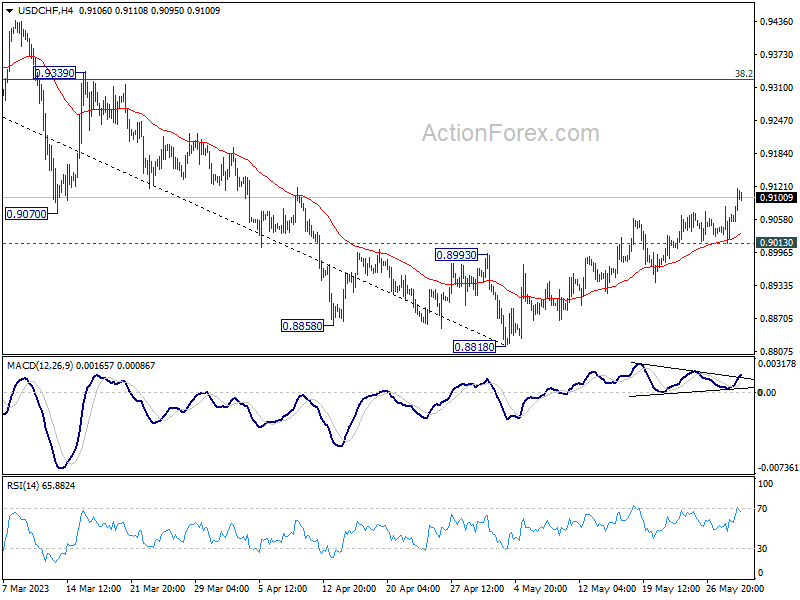
In the bigger picture, fall from 1.1046 (2022 high) is seen as a leg in the long term range pattern from 1.0342 (2016 high). So, downside should be contained by 0.8756 to bring reversal. Sustained break of 0.9058 support turned resistance will be the first sign of medium term bottoming. However, decisive break of 0.8756 will carry larger bearish implications.
GBP/USD Mid-Day Outlook
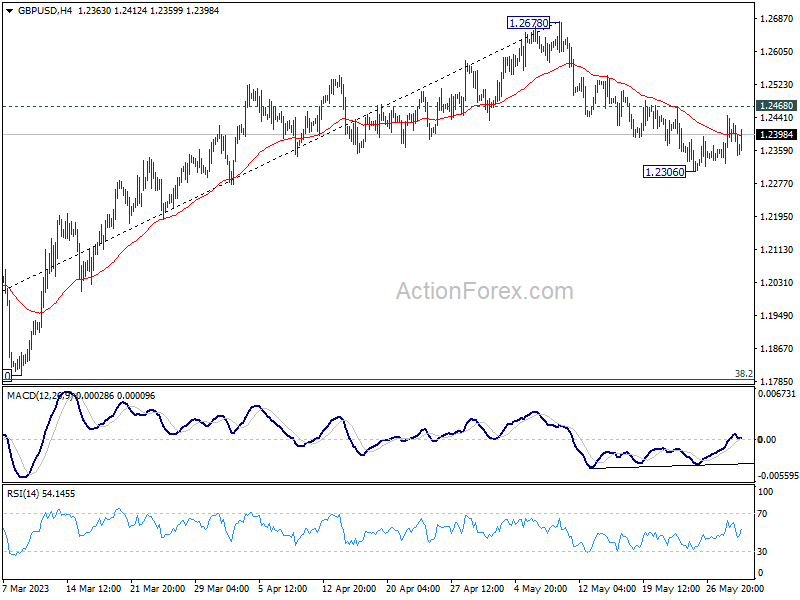
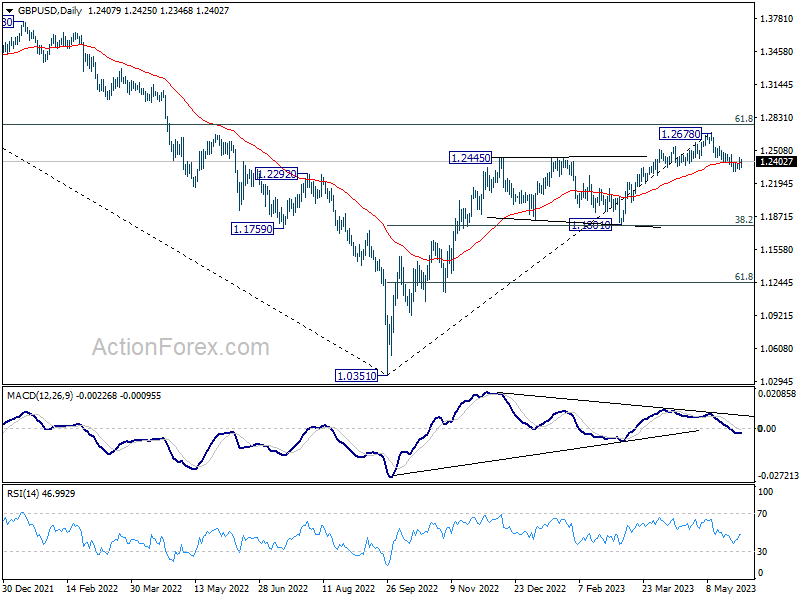
Daily Pivots: (S1) 1.2344; (P) 1.2395; (R1) 1.2463; More...
Range trading continues in GBP/USD above 1.2306 and intraday bias remains neutral. Further decline is expected with 1.2468 minor resistance intact. On the downside, break of 1.2306 will resume the fall from 1.2678, as correcting whole up trend from 1.0351, to 1.1801 cluster support (38.2% retracement of 1.0351 to 1.2678 at 1.1789). On the upside, however, firm break of 1.2468 will turn bias back to the upside for stronger rebound.
In the bigger picture, as long as 1.1801 support holds, rise from 1.0351 medium term bottom (2022 low) is expected to extend further. Sustained break of 61.8% retracement of 1.4248 (2021 high) to 1.0351 at 1.2759 will add to the case of long term bullish trend reversal. However, firm break of 1.1801 will indicate rejection by 1.2759, and bring deeper decline, even as a correction.
EUR/USD Mid-Day Outlook
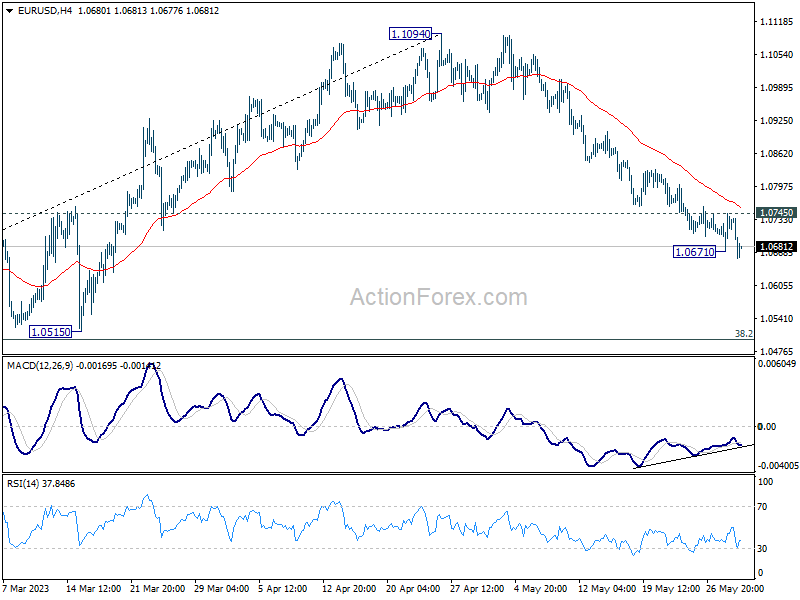
Daily Pivots: (S1) 1.0689; (P) 1.0718; (R1) 1.0763; More...
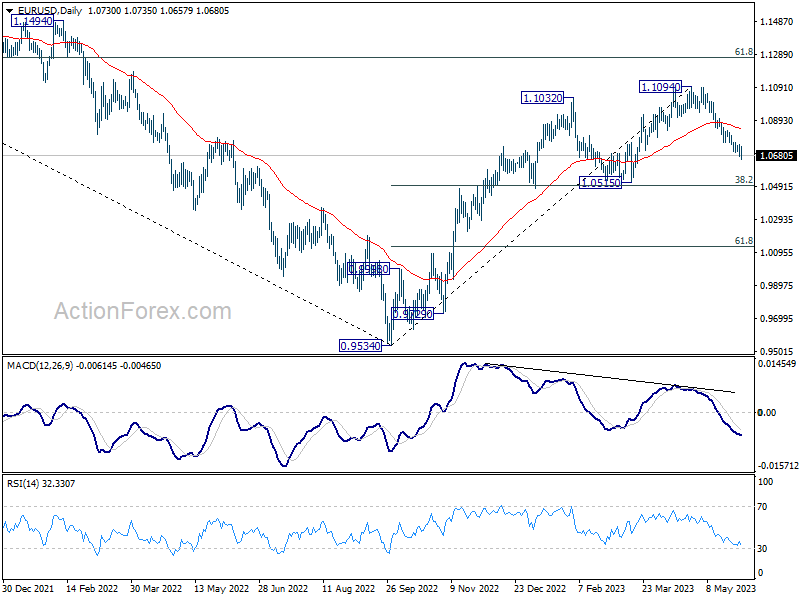
EUR/USD's fall from 1.1094 resumed after brief recovery and intraday bias is back on the downside. Current fall is seen as corrective the whole up trend from 0.9534. Deeper fall should be seen to 1.0515 cluster support, 38.2% retracement of 0.9534 to 1.1094 at 1.0498. On the upside, break of 1.0745 resistance will indicate short term bottoming. Stronger rebound would be seen back to 55 D EMA (now at 1.0836).
In the bigger picture, as long as 1.0515 support holds, rise from 0.9534 (2022 low) would still extend higher. Sustained break of 61.8% retracement of 1.2348 (2021 high) to 0.9534 at 1.1273 will solidify the case of bullish trend reversal and target 1.2348 resistance next (2021 high).
Euro Dips Mildly after France and Germany Inflation, Risk Aversion Continues
Risk aversion is the main theme in the markets today, as selloff in stocks started in Asia following poor data from China, and continued through European session. Dollar and Yen are holding firm as the strongest ones for now. Euro traded a touch lower after lower than expected inflation readings in France and Germany, but downside is so far limited. European majors are still relatively supported by buying against commodity currencies. New Zealand and Australian Dollar are staying as the worst performers.
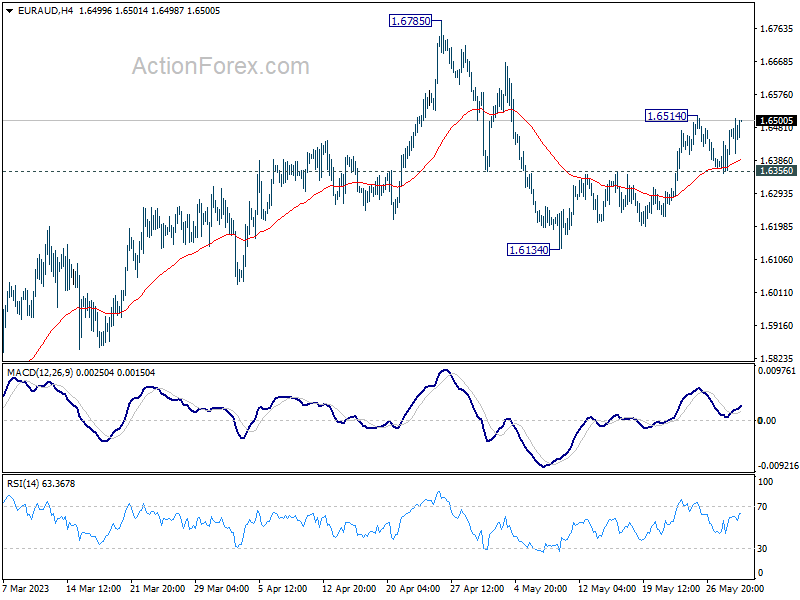
Technically, development in EUR/AUD is worth a watch on whether selloff in Aussie would intensify. Break of 1.6514 temporary top will confirm resumption of whole rebound from 1.6134. This rally is either the second leg of the pattern from 1.6785, or resuming the larger up trend. But in either case, next target will be a test on 1.6785 high.
In Europe, at the time of writing, FTSE is down -0.19%. DAX is down -0.48%. CAC is down -0.81%. Germany 10-year yield is down -0.042 at 2.293. Earlier in Asia, Nikkei dropped -1.41%. Hong Kong HSI dropped -1.94%. China Shanghai SSE dropped -0.61%. Singapore Strait Times dropped -0.90%. Japan 10-year JGB yield dropped -0.0037 to 0.433.
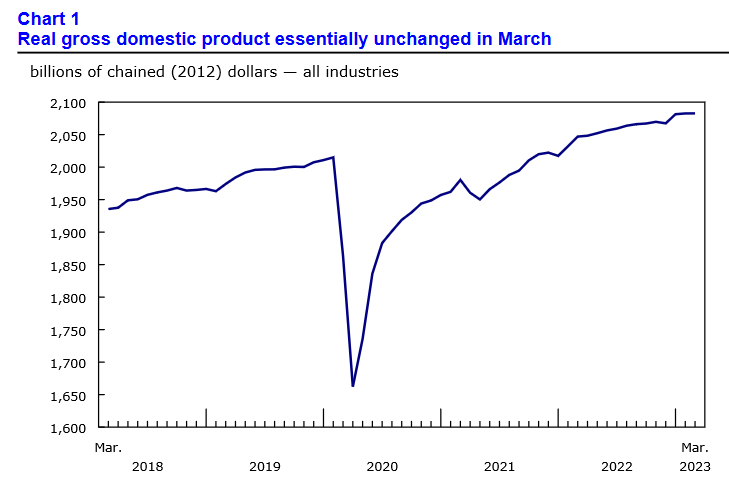
Canada GDP flat in Mar, up 0.8% qoq in Q1
Canada GDP was flat at 0.0% mom in March, slightly above expectation of -0.1% mom. Services-producing industries was flat while goods-producing industries contracted -0.1% mom. Overall, 12 of 20 industrial sectors posted increases in March.
In Q1, GDP grew 0.8% qoq, after posting no change in the previous quarter. That's the fastest pace since Q2 of 2022. Goods-producing industries edged up 0.1%, partially offsetting the decline observed in the final quarter of 2022. Service-producing industries were up 0.9%, rising for a seventh consecutive quarter. Overall, 16 of 20 sectors recorded gains.
ECB's Villeroy foresees declining inflation in France, highlights monetary policy impact"
Francois Villeroy de Galhau, a member of ECB Governing Council, has offered an outlook on inflation in France, stating, "We're very likely there. It's even likely that we've passed the peak and so inflation will come down in France, as we said, between now and the end of the year, even if it won't be sufficient."
Villeroy shed light on the apparent decrease in what's known as 'underlying' inflation. The ECB official posited, "Part of this can doubtless be attributed to the first effects of monetary policy transmission." However, he expressed this viewpoint cautiously, adding, "But I say this with caution."
He further stressed the importance of the duration of current interest rates, stating, "I think this morning's figure is a further sign that, rather than the level of the terminal rate, on which a lot of attention is focused, it's how long we remain there that is essential."
Villeroy's commentary arrived following the release of data indicating that the CPI in France dipped from a 6.9% year-on-year increase to 6.0% in May, a figure that came in below the expected 6.4% rise.
From Germany, CPI slowed from 7.2% yoy to 6.1% yoy in May, below expectation of 6.5% yoy.
China's manufacturing PMI slides to five-month low as economic recovery stumbles
China NBS PMI Manufacturing dropped from 49.2 to 48.8 in May, below expectation of 49.4. That's the lowest level in five months. New orders sub-index followed suit, slipping from 48.8 in April to 48.3 in May, while the new export orders sub-index descended from 47.6 to 47.2.
PMI Non-Manufacturing dropped from 56.4 to 54.5, below expectation of 54.9, lowest growth in four months. The official composite PMI, encapsulating both manufacturing and services activity, fell from 54.4 in April to 52.9 in May.
"China's economic-prosperity level has receded, and the foundation for recovery and development still needs to be consolidated," said NBS senior statistician Zhao Qinghe.
Japan industrial production down -0.4% mom in Apr, retail sales disappoint
Japan's industrial production experienced a contraction of -0.4% mom in April, a significantly worse result than expectation of 1.4% mom growth.
According to survey by the Ministry of Economy, Trade and Industry, manufacturers are forecasting an output increase of 1.9% in May and 1.2% in June. This rise is expected to be driven by an easing in parts shortages, which should lift production in transportation and production machinery.
Despite these projections, a METI official struck a more cautious note, stating, "The current production sentiment is still bearish due to ongoing concerns about the downturn in overseas economies."
Meanwhile, the country's retail sales also delivered disappointing results. They rose 5.0% yoy, falling short of the anticipated 7.1% yoy increase. On a month-on-month basis, retail sales contracted by -1.2% in April, reversing the 0.3% gain recorded in March.
Australia CPI jumped back to 6.8% yoy in Apr, ex-volatile items down to 6.5% yoy
Australia monthly CPI jumped from 6.3% yoy to 6.8% yoy in April, well above expectation of 6.4% yoy. Excluding volatile items of automotive fuel, fruit and vegetables and holiday travel, CPI slowed from 6.9% yoy to 6.5% yoy.
Michelle Marquardt, ABS head of prices statistics, said: "It's important to note that a significant contributor to the increase in the annual movement in April was automotive fuel. The halving of the fuel excise tax in April 2022, which was fully unwound in October 2022, is impacting the annual movement for April 2023."
New Zealand ANZ business confidence rose to -31.1, RBNZ back at hike by year-end
New Zealand's ANZ Business Confidence Index climbed from -43.8 to -31.1 in May, offering some positive news for the economy. Own Activity outlook also edged higher, moving from -7.6 to -4.5.
A more granular look at the data reveals that export intentions went up from -1.5 to 2.0, while investment intentions remained steady at -6.8. However, employment intentions slid from -2.4 to -5.7.
Pricing intentions dipped slightly from 53.7 to 52.4, while cost expectations barely shifted, coming down from 84.2 to 84.1. Profit expectations saw a significant uplift, rising from -37.7 to -27.4. Inflation expectations also moderated, falling from 5.70% to 5.47%.
ANZ commented on the findings, noting that while RBNZ may view the economy as broadly sluggish, the picture isn't entirely clear. In their words, "Things are patchy, certainly, but most activity indicators are well off their lows and rising, while cost and price indicators are inching lower, rather than plunging."
In light of these developments, ANZ continues to predict that RBNZ will resume rate hikes by the end of the year, potentially countering the additional stimulus from robust net migration and higher fiscal spending than anticipated. "We continue to expect that the RBNZ will be back at the hiking table by the end of the year."
EUR/USD Mid-Day Outlook
Daily Pivots: (S1) 1.0689; (P) 1.0718; (R1) 1.0763; More...
EUR/USD's fall from 1.1094 resumed after brief recovery and intraday bias is back on the downside. Current fall is seen as corrective the whole up trend from 0.9534. Deeper fall should be seen to 1.0515 cluster support, 38.2% retracement of 0.9534 to 1.1094 at 1.0498. On the upside, break of 1.0745 resistance will indicate short term bottoming. Stronger rebound would be seen back to 55 D EMA (now at 1.0836).
In the bigger picture, as long as 1.0515 support holds, rise from 0.9534 (2022 low) would still extend higher. Sustained break of 61.8% retracement of 1.2348 (2021 high) to 0.9534 at 1.1273 will solidify the case of bullish trend reversal and target 1.2348 resistance next (2021 high).
Economic Indicators Update
| GMT | Ccy | Events | Actual | Forecast | Previous | Revised |
|---|---|---|---|---|---|---|
| 23:50 | JPY | Industrial Production M/M Apr P | -0.40% | 1.40% | 1.10% | |
| 23:50 | JPY | Retail Trade Y/Y Apr | 5.00% | 7.10% | 7.20% | 6.90% |
| 01:00 | NZD | ANZ Business Confidence May | -31.1 | -43.8 | ||
| 01:30 | AUD | Monthly CPI Y/Y Apr | 6.80% | 6.40% | 6.30% | |
| 01:30 | AUD | Private Sector Credit M/M Apr | 0.60% | 0.30% | 0.30% | 0.20% |
| 01:30 | AUD | Construction Work Done Q1 | 1.80% | 0.60% | -0.40% | 1.00% |
| 01:30 | CNY | NBS Manufacturing PMI May | 48.8 | 49.4 | 49.2 | |
| 01:30 | CNY | Non-Manufacturing PMI May | 54.5 | 54.9 | 56.4 | |
| 05:00 | JPY | Housing Starts Y/Y Apr | -11.90% | -0.90% | -3.20% | |
| 05:00 | JPY | Consumer Confidence Index May | 36 | 36.1 | 35.4 | |
| 06:00 | EUR | Germany Import Price Index M/M Apr | -1.70% | -0.60% | -1.10% | |
| 06:30 | CHF | Real Retail Sales Y/Y Apr | -3.70% | -1.40% | -1.90% | |
| 06:45 | EUR | France Consumer Spending M/M Apr | -1.00% | 0.30% | -1.30% | -0.80% |
| 06:45 | EUR | France GDP Q/Q Q1 | 0.20% | 0.20% | 0.20% | |
| 07:55 | EUR | Germany Unemployment Change Apr | 9K | 15K | 24K | 23k |
| 07:55 | EUR | Germany Unemployment Rate Apr | 5.60% | 5.60% | 5.60% | |
| 08:00 | CHF | Credit Suisse Economic Expectations May | -32.2 | -33.3 | ||
| 12:00 | EUR | Germany CPI M/M May P | -0.10% | 0.30% | 0.40% | |
| 12:00 | EUR | Germany CPI Y/Y May P | 6.10% | 6.50% | 7.20% | |
| 12:30 | CAD | GDP M/M Mar | 0.00% | -0.10% | 0.10% | |
| 13:45 | USD | Chicago PMI May | 47.1 | 48.6 | ||
| 18:00 | USD | Fed's Beige Book |
Canada GDP flat in Mar, up 0.8% qoq in Q1
Canada GDP was flat at 0.0% mom in March, slightly above expectation of -0.1% mom. Services-producing industries was flat while goods-producing industries contracted -0.1% mom. Overall, 12 of 20 industrial sectors posted increases in March.
In Q1, GDP grew 0.8% qoq, after posting no change in the previous quarter. That's the fastest pace since Q2 of 2022. Goods-producing industries edged up 0.1%, partially offsetting the decline observed in the final quarter of 2022. Service-producing industries were up 0.9%, rising for a seventh consecutive quarter. Overall, 16 of 20 sectors recorded gains.
ECB’s Villeroy foresees declining inflation in France, highlights monetary policy impact”
Francois Villeroy de Galhau, a member of ECB Governing Council, has offered an outlook on inflation in France, stating, "We're very likely there. It's even likely that we've passed the peak and so inflation will come down in France, as we said, between now and the end of the year, even if it won't be sufficient."
Villeroy shed light on the apparent decrease in what's known as 'underlying' inflation. The ECB official posited, "Part of this can doubtless be attributed to the first effects of monetary policy transmission." However, he expressed this viewpoint cautiously, adding, "But I say this with caution."
He further stressed the importance of the duration of current interest rates, stating, "I think this morning's figure is a further sign that, rather than the level of the terminal rate, on which a lot of attention is focused, it's how long we remain there that is essential."
Villeroy's commentary arrived following the release of data indicating that the CPI in France dipped from a 6.9% year-on-year increase to 6.0% in May, a figure that came in below the expected 6.4% rise.
Better-than-Expected European Data Failed to Stop Euro’s Decline
Weak Chinese manufacturing data put pressure on the single currency as Europe, particularly Germany, is highly correlated with China.
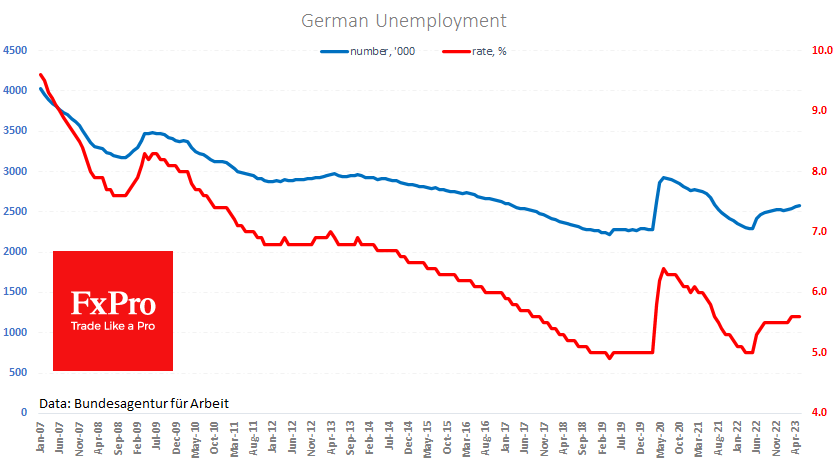
However, the Eurozone’s data is not so bad today. The number of unemployed in Germany rose by 9K, down from 23K and 19K in the previous two months. Unemployment is rising much more slowly than in the recessions of 2009 and 2010, and the unemployment rate (5.6%) is low by historical standards.
Second estimates confirmed a 0.2% q/q and 0.9% y/y rise in French GDP in the first quarter, although private consumption fell by a further 1% in April after a 0.8% decline in the previous two months.
For Italy, the final data pointed to economic growth of 0.6% q/q and 1.9% y/y, 0.1 percentage points higher than previously estimated.
Despite the upbeat economic data, the EURUSD fell to 1.0660 in early European trading, its lowest level since 17 March.
EURGBP Back in Bearish Mode
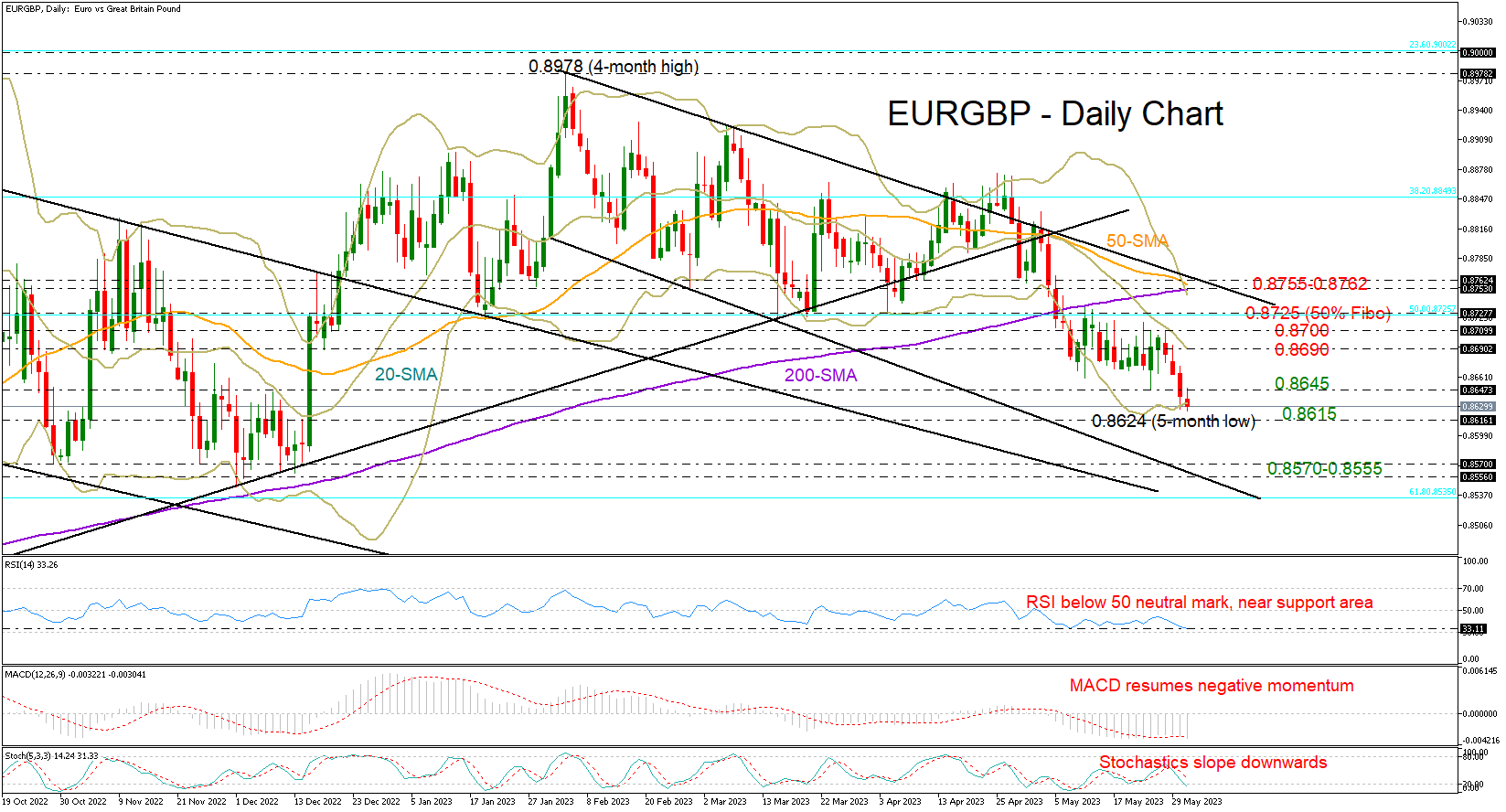
EURGBP resumed its bearish direction after a short period of trading sideways, falling to a new five-month low of 0.8624 on Wednesday.
Market sentiment weakened following the rejection near the 20-day simple moving average (SMA) and there might be more selling activity in the short term given the negative trajectory in the momentum indicators. Still, with the price trading near the lower Bollinger band at 0.8630 and the RSI testing its 2022-2023 lows, a pause in the ongoing bearish action or an upside correction could be possible.
The former constraining zone of 0.8615, which acted both as support and resistance in the second half of 2022, could be the last chance for pivoting higher before the price potentially revisits the lower boundary of the bearish channel and its 2022 lows within the 0.8570-0.8555 zone.
In the event of an upside reversal above 0.8645, the bulls may push towards the 20-day SMA at 0.8690. If they crawl above the 0.8700-0.8725 border too, the door will open for the 200-day SMA and the channel’s upper band at 0.8762.
Note that the 50-day SMA is looking to cross below the 200-day SMA for the first time since January 2021, signaling a continuation of the current negative trend in the price.
In a nutshell, the bearish wave in EURGBP could gain new legs in the short term. Some congestion could emerge around 0.8615 before selling forces resurface.