Sample Category Title
Barkin says Fed flying blind as data blackout ends
Richmond Fed President Thomas Barkin said the U.S. central bank is facing pressure on both sides of its mandate, with inflation still above target and job growth clearly slowing. However, he noted that the picture is not one-directional, as consumers are increasingly resisting price increases while a contraction in labor supply has kept the unemployment rate stable.
Barkin described the Fed’s current environment as akin to “docking a boat at night without a lighthouse,” highlighting the difficulty of judging policy in the absence of timely government data during the shutdown. The upcoming release of delayed reports, he said, will offer much-needed clarity on both inflation and labor market dynamics.
“I think we have a lot to learn between now and then,” Barkin added, suggesting that the December decision remains highly data-dependent as policymakers wait for the first full set of figures since the government reopened.
Gold (XAU) and Silver (XAG) Send Mixed Signals to Doubtful Traders
Markets are getting rocked up and down across asset classes lately.
- Cryptos are getting sold off aggressively (Is the selling done or is it only a first wave?).
- Equities are seeing some record volatility compared to the past few years in frantic +1% up and down moves, as can be seen today.
Even Metals are failing to gather traction after reaching some new records towards the end of last month.
They are holding relatively well compared to the other asset classes that performed great throughout 2025, but the fact that they can't seem to attract inflows during high-range risk-off profit-taking points to a deeply confused market.
The dominant 2025 trend of Stocks, Cryptos, and Metals rallying simultaneously is what has been broadly called the Debasement Trade (a trade rooted in the debasement of the US Dollar and fiat currencies in general).
But when all these anti-fiat assets fall at the same time, what is truly happening?
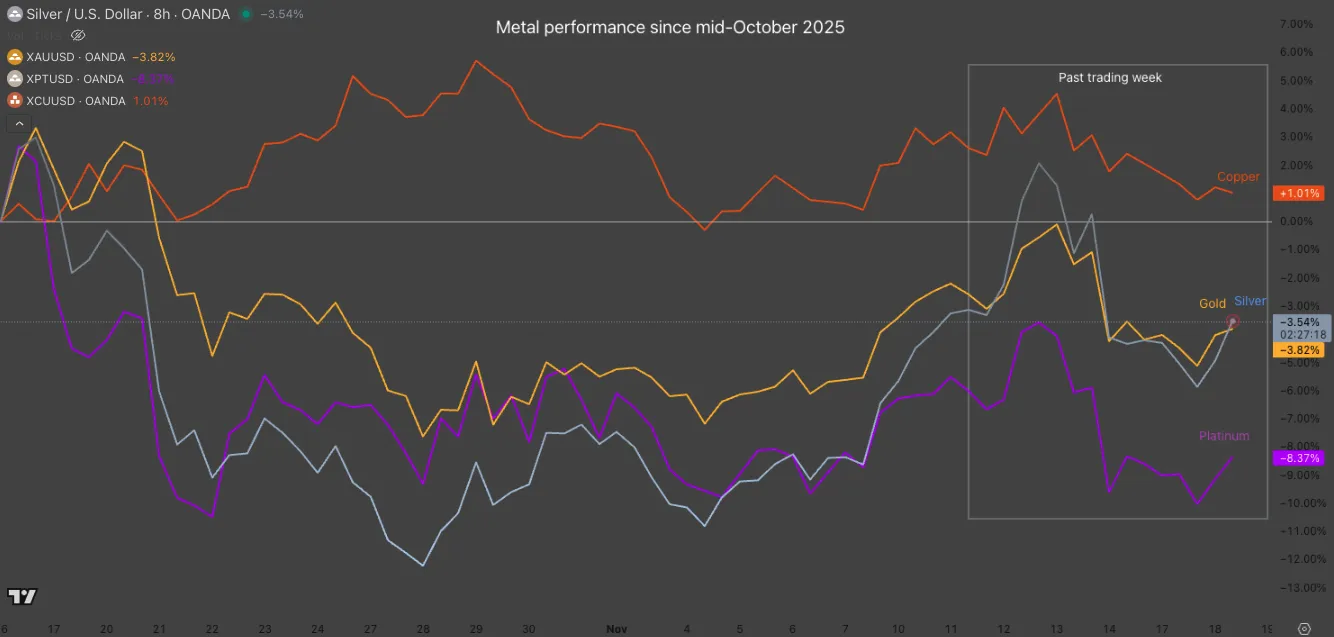
Metal Performance since Mid-October 2025. November 18, 2025 – Source: TradingView
Bank of America has sent out warnings on dangerously low cash levels, which usually doesn't rhyme well with risk asset performance (or any asset, except Treasury bonds).
This flow could signal the start of a trend where massive profit-taking and position closing—a potential Re-basement Trade (contrary to the debasement trade)—takes hold.
In the waiting for such developments to happen (or not), let's dive into two timeframe charts for Gold (XAU/USD) and Silver (XAG/USD) to spot what key levels can come into play for upcoming trading.
Gold maintains its triangle formation
Gold (XAU/USD) Daily Chart
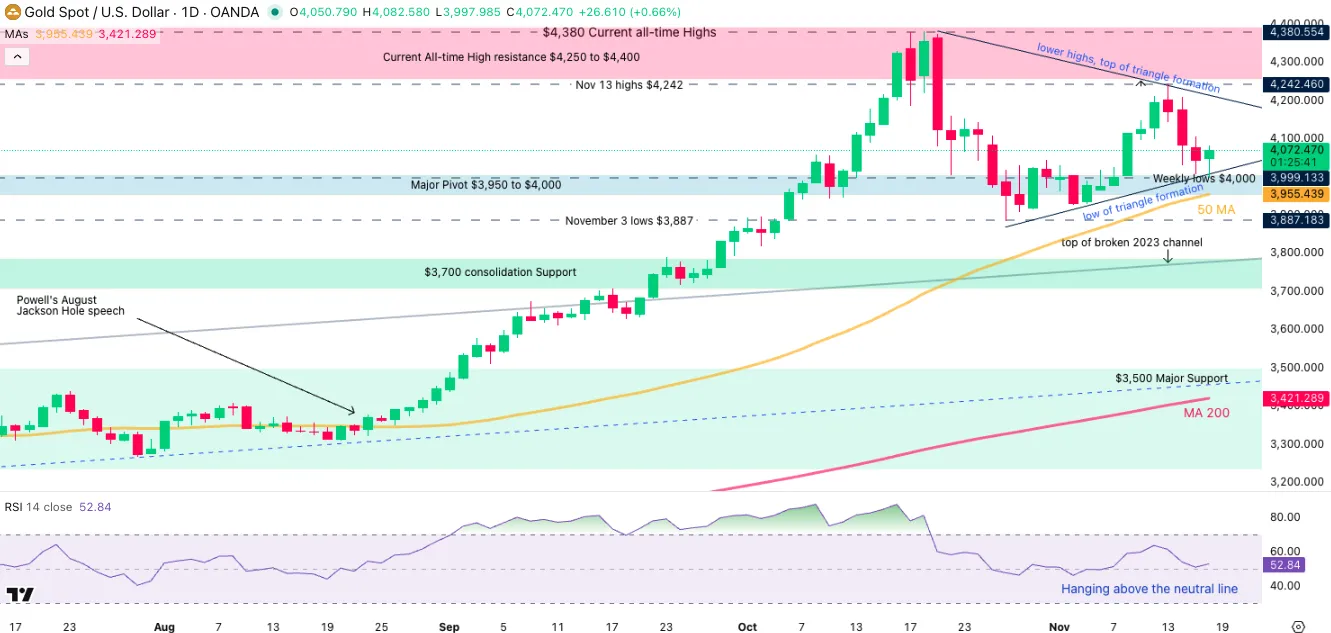
Gold (XAU) Daily Chart, November 18, 2025 – Source: TradingView
Gold has been holding its triangle formation (mentioned in our recent Gold analysis) with precision, indicating that Markets are still more on the mood for consolidation.
To tilt the scales one way however, the Daily RSI has been holding strong above the neutral line, indicating that buyers remain in control. This also corroborates with the price action holding above $4,000 – Keep this level closely in check.
Traders might have to be more patient in order to see a definite breakout (both upside and downside are still possibilities).
In the meantime, the triangle formation is the one key technical aspect to watch.
Gold (XAU/USD) 2H Chart and levels
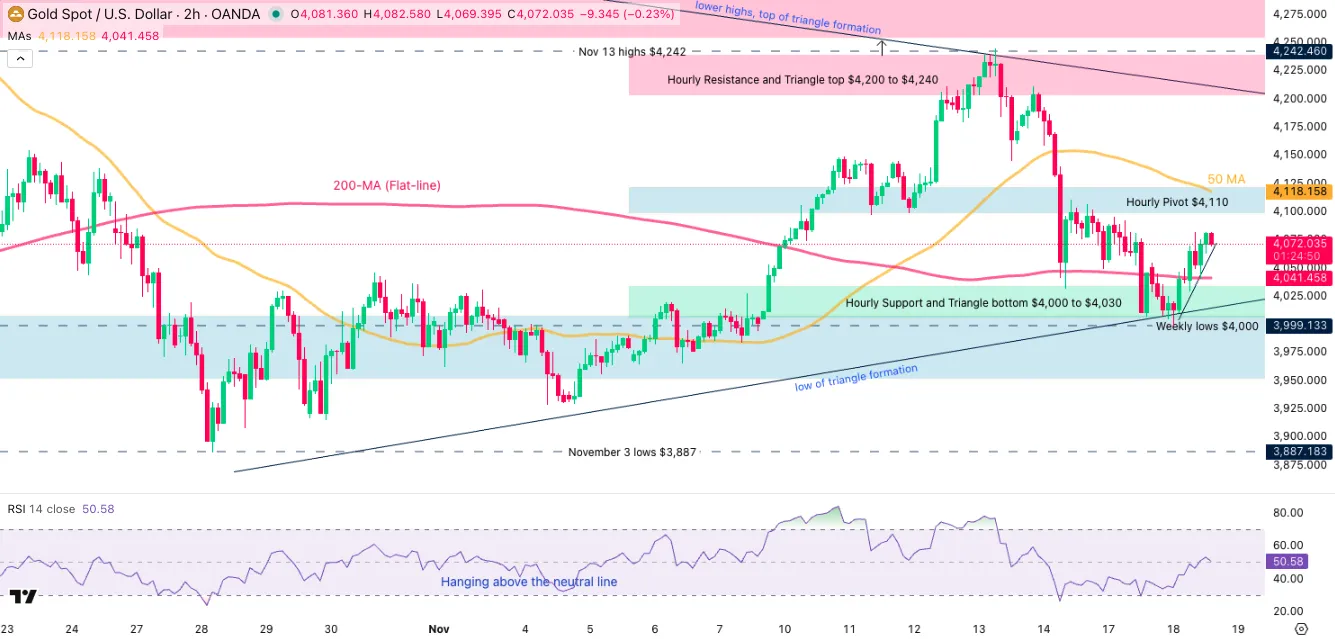
Gold (XAU) 2H Chart, November 18, 2025 – Source: TradingView
Gold is still holding within a $4,000 to $4,240 range but seems to be contracting as things unroll.
The MA 200 largely flatlining confirms this point, therefore watch for a breakout of the Triangle formation if you want to trade a directional price action.
If not, one can look at opportunities within the triangle formation (strong support and resistances are there for now).
Gold technical levels of interest:
Resistance Levels
- Current All-time High resistance $4,250 to $4,400 (ATH $4,380)
- Hourly Resistance and Triangle top $4,200 to $4,240
- Session highs $4,080
Support Levels
- Hourly Support and Triangle bottom $4,000 to $4,030
- Major Pivot $3,950 to $4,000
- $3,700 consolidation Support
- $3,500 Major Support
Silver (XAG) holds a strong range
Silver (XAG/USD) Daily Chart
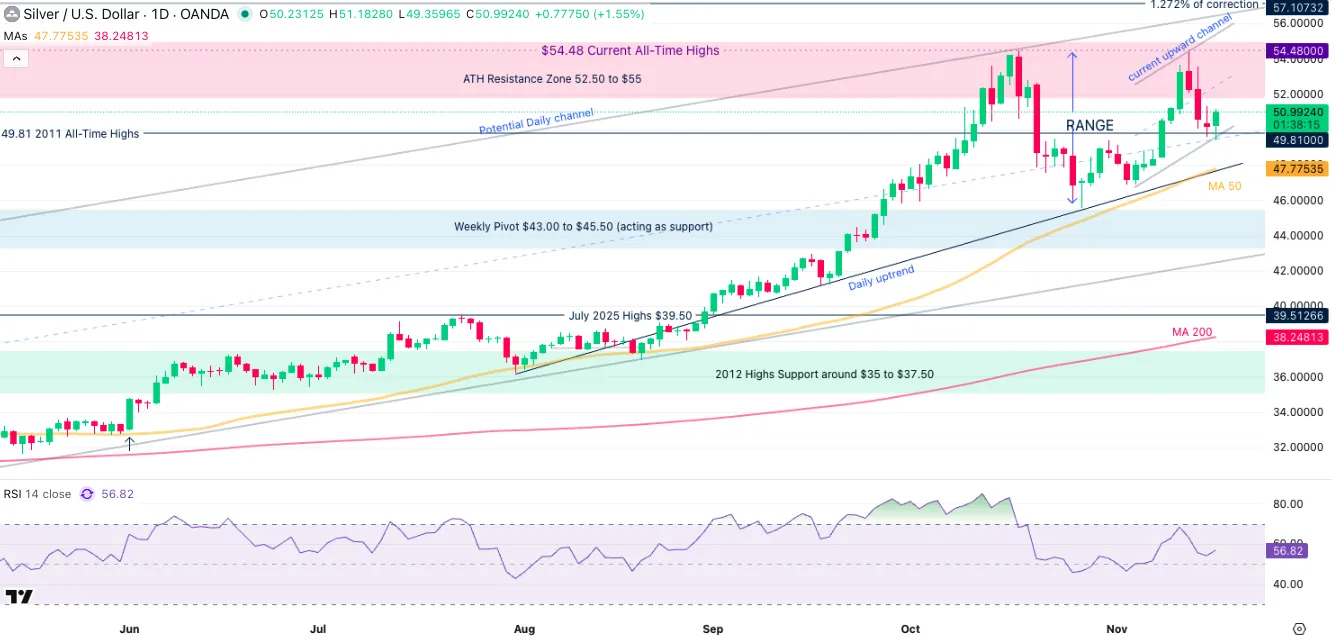
Silver (XAG) Daily Chart, November 18, 2025 – Source: TradingView
Silver has had quite a run to its new all-time highs, even outperforming Gold towards its rise.
However, momentum as calmed down quite suddenly, leading to a $47 to $52 broad range in the past week of action.
The action is more sideways than anything, but bulls are trying to accumulate some momentum as can be seen in the few breakout attempts that need more strength.
Still, some small consistent buying is currently playing out, so watch for any breakouts beyond hourly support and resistance levels – more details on them right below.
Silver (XAG/USD) 4H Chart and levels
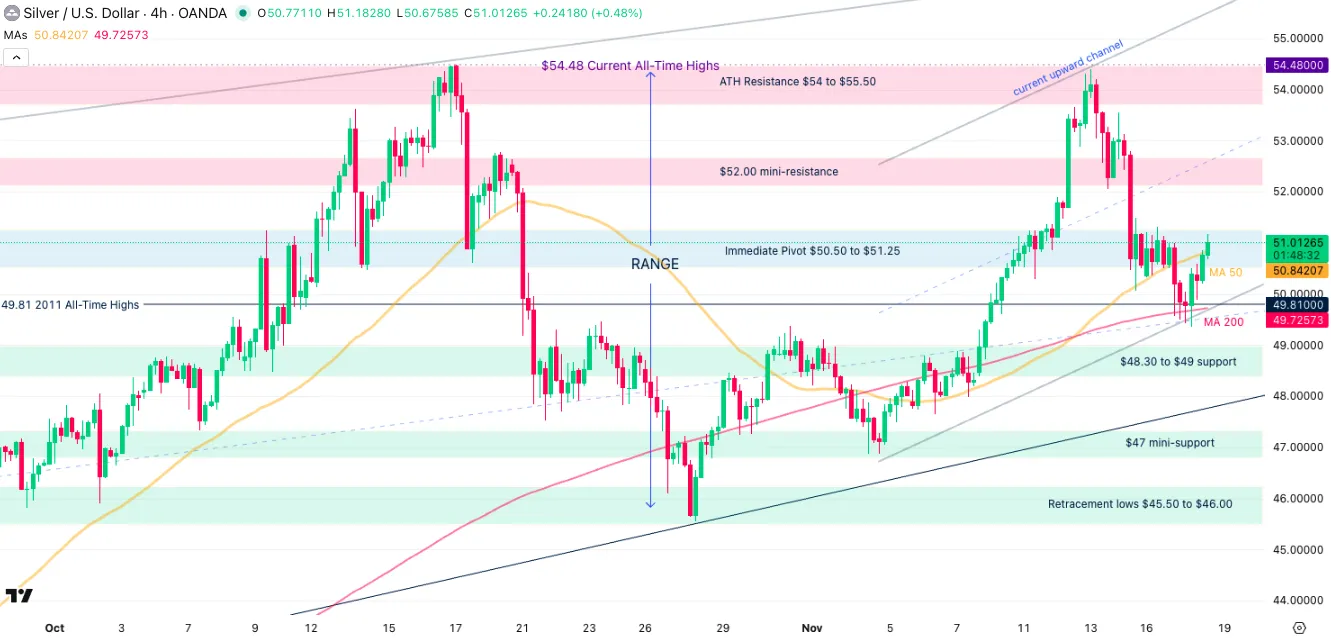
Silver (XAG) 4H Chart, November 18, 2025 – Source: TradingView
Levels to watch for Silver (XAG) trading:
Resistance Levels:
- Immediate Pivot $50.50 to $51.25
- 2025 record $55.48
- $52 to $53 mini-resistance
- $51.18 session highs
- Potential resistance 1 $57.50 to $60 (1.382% from 2022 lows)
- Potential resistance 2 $62 to $65 (1.618 from Impulsive Move)
Support Levels:
- $48.30 to $49 support
- $47 low of potential daily channel
- $45.55 October 28 lows
- $43.00 to $45.00 Weekly pivot
- $39.50 to $40 higher timeframe support
- 2012 Highs Support around $37.50
Safe Trades!
Gold (XAU/USD) Price Technical Outlook: $4000/oz Holds Firm as FOMC Minutes and Labor Data Releases Lie Ahead
Gold prices have had a topsy turvy start to the week but the $4000/oz handle has held firm. Bulls have returned and price has bounced off the confluence area at $4000 but needs acceptance above the $4100/oz handle for the rally to gather steam.
The question on the minds of market participants is whether or not Gold bulls will remain in control after the Fed minutes release and Labor data on Thursday?
Technical Outlook - Gold (XAU/USD)
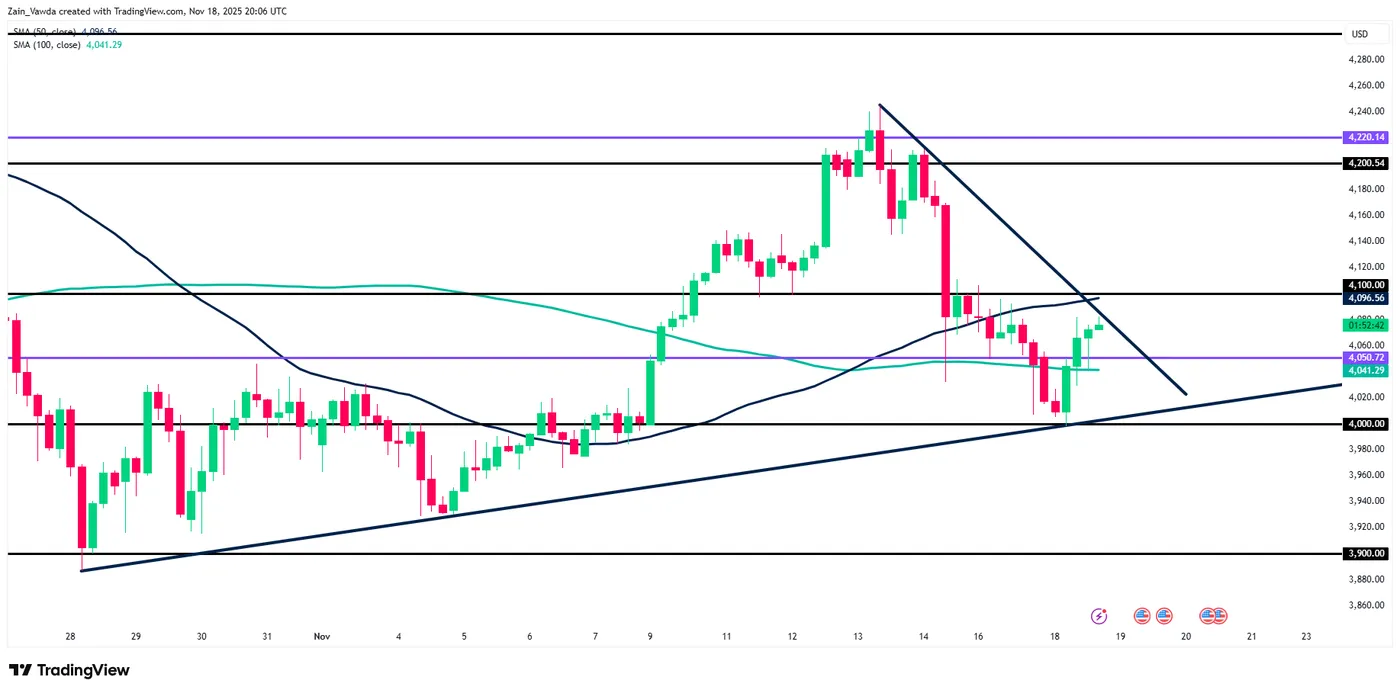
Looking at the four-hour chart below, the technical picture is interesting.
Having bounced off the ascending trendline which lined up with the $4000/oz handle, Gold broke above the 100-day MA and is now testing the descending trendline drawn from the November 13 high around $4245/oz.
A break of the descending trendline and the 50-day MA around the $4096/oz handle could open up a potential rally toward the previous descending trendline touch at $4212/oz.
Of course there is a resistance area around the $4150/oz handle which could prove to be a stumbling block but bulls may be emboldened or if not will be eyeing US labor data and the Fed minutes as a potential catalyst.
To keep the bullish momentum going, the 100-day MA at 4041 is now a crucial near-term support area. If this area holds, it should bode well for bullish momentum.
Gold (XAU/USD) Four-Hour Chart, November 18, 2025
Source: TradingView (click to enlarge)
Market Dynamics and Data Releases
The price of Gold (XAU/USD) has appeared relatively unaffected by the moves in the US Dollar Index of late. However, this does not mean that correlation is no longer something to keep an eye on.
This week's Fed minutes and Labor data releases will play a major role in rate cut expectations which will impact market sentiment and the US Dollar Index. This in turn will play a major role in the movement of Gold prices moving forward.
The aggressive repricing of rate cut probabilities for the Feds December meeting (93.7% probability a month ago vs 51.1% probability at present) has kept Gold gains in check.
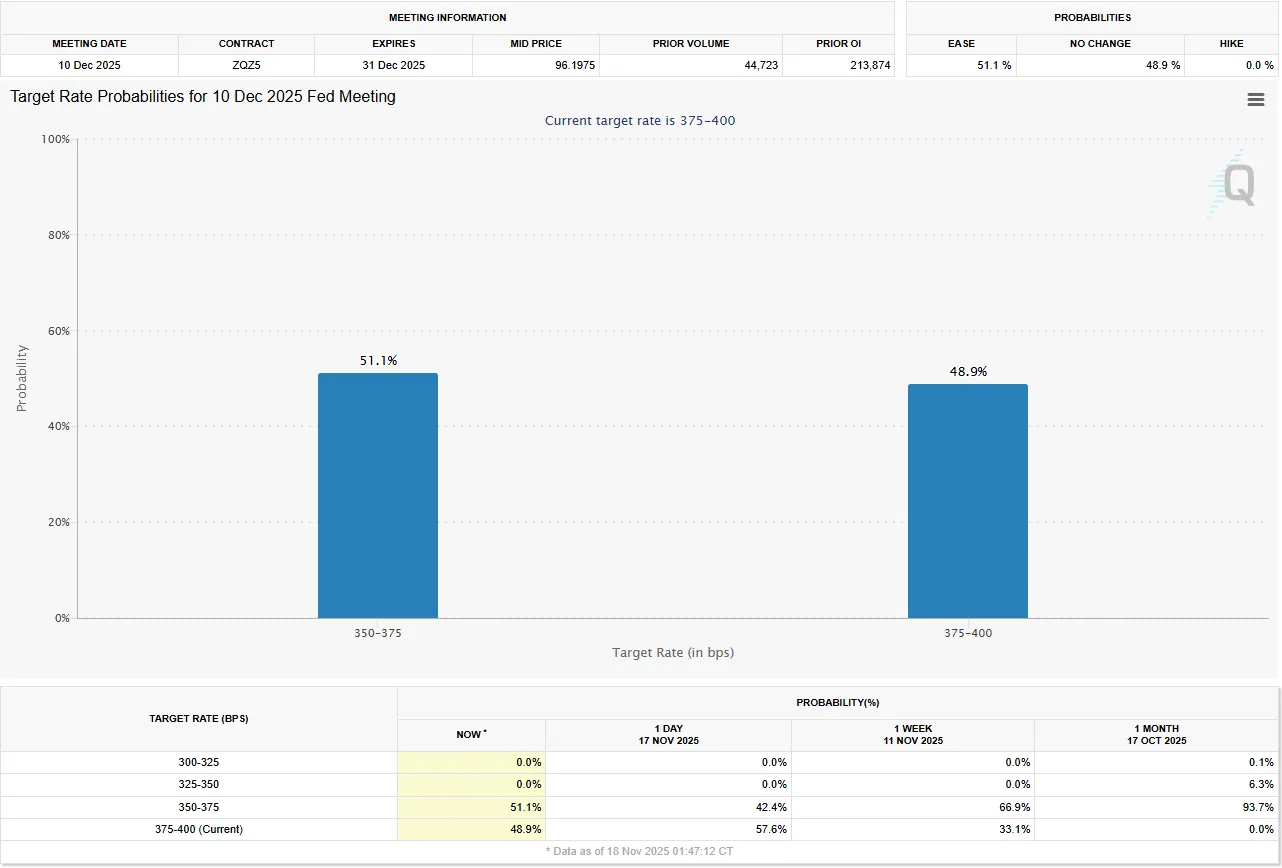
Source: CME FedWatch Tool
However, a weak print on the labor data front could see rate cut expectations spike and thus propel Gold higher once more.
Markets already know broadly what to expect from the Fed minutes release as it was Fed Chair Powell's tone and the 10-2 vote split at the Fed's October meeting that kickstarted the hawkish repricing of rate cut expectations.
Thus the event could be sidelined by market participants in favor of Thursday's labor data release.
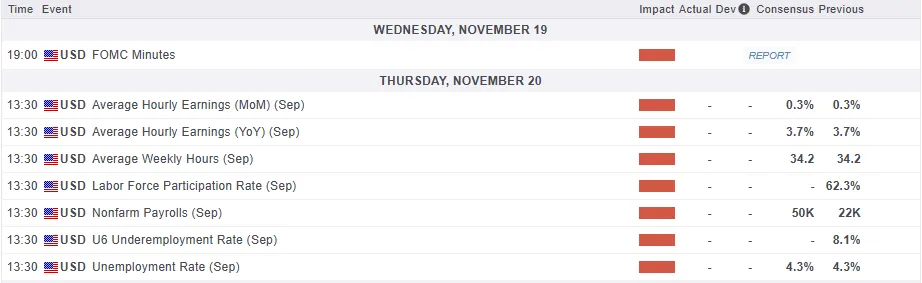
For all market-moving economic releases and events, see the MarketPulse Economic Calendar. (click to enlarge)
Be nimble and trade safe.
Dollar-Franc Looks for Support at Triple Bottom Ahead of FOMC Minutes, Eyes 0.80000
Currently trading at 0.79952, having recovered losses from earlier in today’s session, USD/CHF is up +0.42% in today’s session.
Having recently suffered its worst weekly performance since June, falling by 1.38% in week 46, dollar-franc now looks for support near the key level of 0.8000, having recently formed a triple bottom on the daily timeframe.
Otherwise, markets now eye an all-important FOMC Minutes release tomorrow.
What’s next for USD/CHF?
USD/CHF: Key takeaways 18/11/2025
- Succumbing to bearish pressure in last week's trading, USD/CHF has found some support in the past few sessions and is currently looks to secure a three-day winning streak
- While changing expectations of Fed monetary policy is offering some short-term upside to the dollar, consistent safe haven flows and a recent US-Switzerland trade agreement continue to cement the franc’s position as best-performing major currency year-to-date
- With the next Federal Reserve meeting scheduled only three short weeks from today, markets now turn their attention to tomorrow’s FOMC Minutes release, with markets already readjusting expectations of another 25 BPS cut to end 2025
USD/CHF: Safe haven flows, trade deals & a hawkish Fed
While if I had a franc for every time I’ve mentioned safe-haven flows when talking about USD/CHF this year, I’d probably be able to buy a fair few cups of coffee, the fact remains that geopolitical tensions, dubious sovereign debt levels, and a shake-up to global trade all continue to add to the premium for renowned safe-haven currencies like the Swiss Franc.
While in years previous, much of this demand for more secure and reliable stores of wealth would have split somewhat between different currencies, the dollar and the yen have undeniably fallen by the wayside in favour of the franc in terms of safe-haven appeal.
Case in point: the Swiss franc remains the best-performing major currency year to date, with the euro in a close second place.
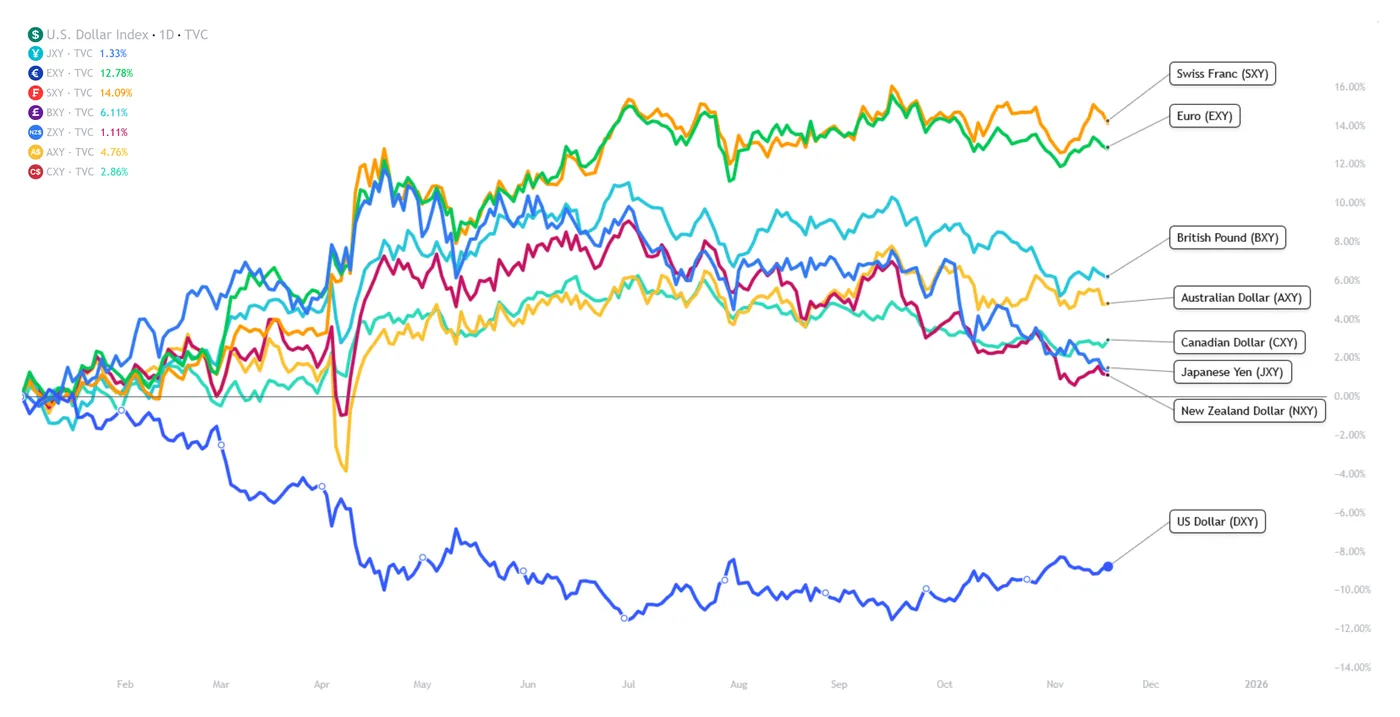
SXY, EXY, BXY, AXY, CXY, JXY, NXY, DXY, TVC, TradingView,18/11/2025
As ever, let’s break down some of the macroeconomic themes at play in USD/CHF markets.
USD/CHF: Fundamental Analysis 18/11/2025
Safe-haven flows continue to benefit the franc: While I have explained this in full as part of previous coverage, it would be remiss not to mention that an increase in safe-haven demand has been the deciding factor in CHF strength throughout 2025.
Between ballooning US government debt, a downgrade of US sovereign credit, global trade tensions, and continued world conflicts, there is clearly no shortage of tailwinds for safe-haven assets, with the rally in precious metal pricing and franc value sharing some common ground.
While deflationary pressures in the Swiss economy, alongside a rumoured return to negative rates, have somewhat called the franc’s status as ultimate safe-haven into question at times this year, the market has clearly voted with its feet in 2025, with falling dollar value compounding this effect further.
US-Switzerland trade deal: Announced earlier this week, the conclusion of a significant tariff agreement between the United States and Switzerland has offered some upside to the Swiss franc, with whispers of a trade deal between the two countries confirmed and finalised.
While I can’t speak for anyone else, when I think of the Swiss economy, I think of pharmaceuticals, luxury watches, and jewelry, which is, as it happens, far from just anecdotal. The Swiss economy consistently ranks highly in terms of the ratio of total exports to total GDP, particularly when compared to its European counterparts.
As such, and with an economy that relies heavily on exports to countries like the US, any notion of positive developments on trade tariffs will disproportionately benefit the franc, as seen in last week’s trading.
Fed’s hawkish repricing: While the above would support a strengthening of the franc over the dollar, recent upside in USD/CHF pricing suggests there’s something more at play.
That fly in the ointment is recent developments in Fed monetary policy, with an almost certain 25-basis-point cut in December, perhaps not so certain after all.
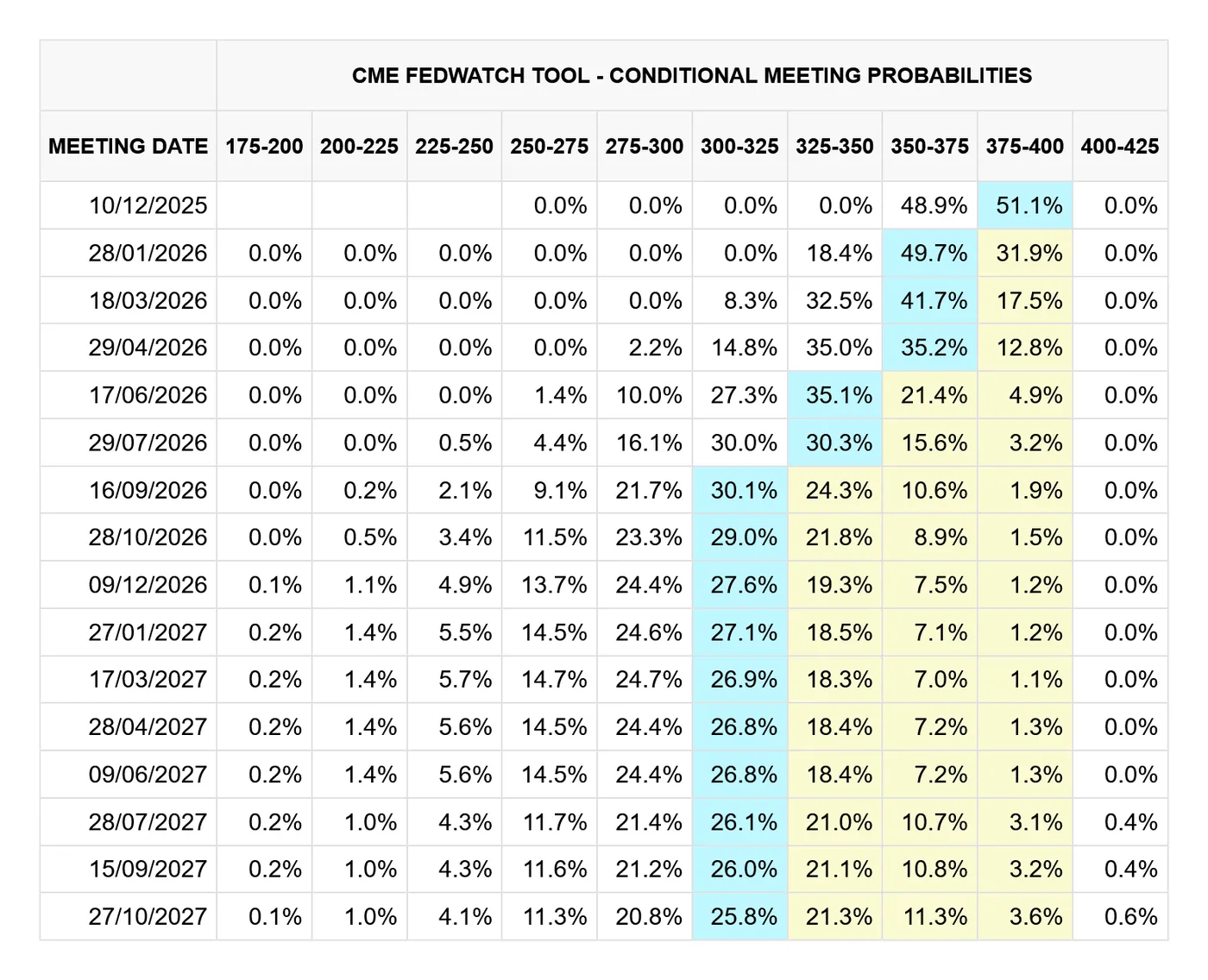
CME FedWatch, 18/11/2025
To add to a pre-existing hawkish tilt from the Federal Reserve, who, to give credit, has consistently attempted to temper market expectations of a rapid easing cycle, Vice Chair Jefferson shared some choice words in a speech yesterday:
“Given that outlook, I supported last month's decision to reduce our policy rate by 1/4 percentage point. That step was appropriate because I see the balance of risks as having shifted in recent months as downside risks to employment have increased. The current policy stance is still somewhat restrictive, but we have moved it closer to its neutral level that neither restricts nor stimulates the economy. The evolving balance of risks underscores the need to proceed slowly as we approach the neutral rate.”
Vice Chair Jefferson, speaking at the the Federal Reserve Bank of Kansas City, Kansas City, Missouri
Fair to say: the Federal Reserve is less dovish than previously thought some weeks ago, primarily on labour market concerns.
As can be expected, a more hawkish Fed is positive for the US dollar, especially considering the SNB currently offers an interest rate of 0.00% compared to the Fed’s 4.00%, marking a significant differential.
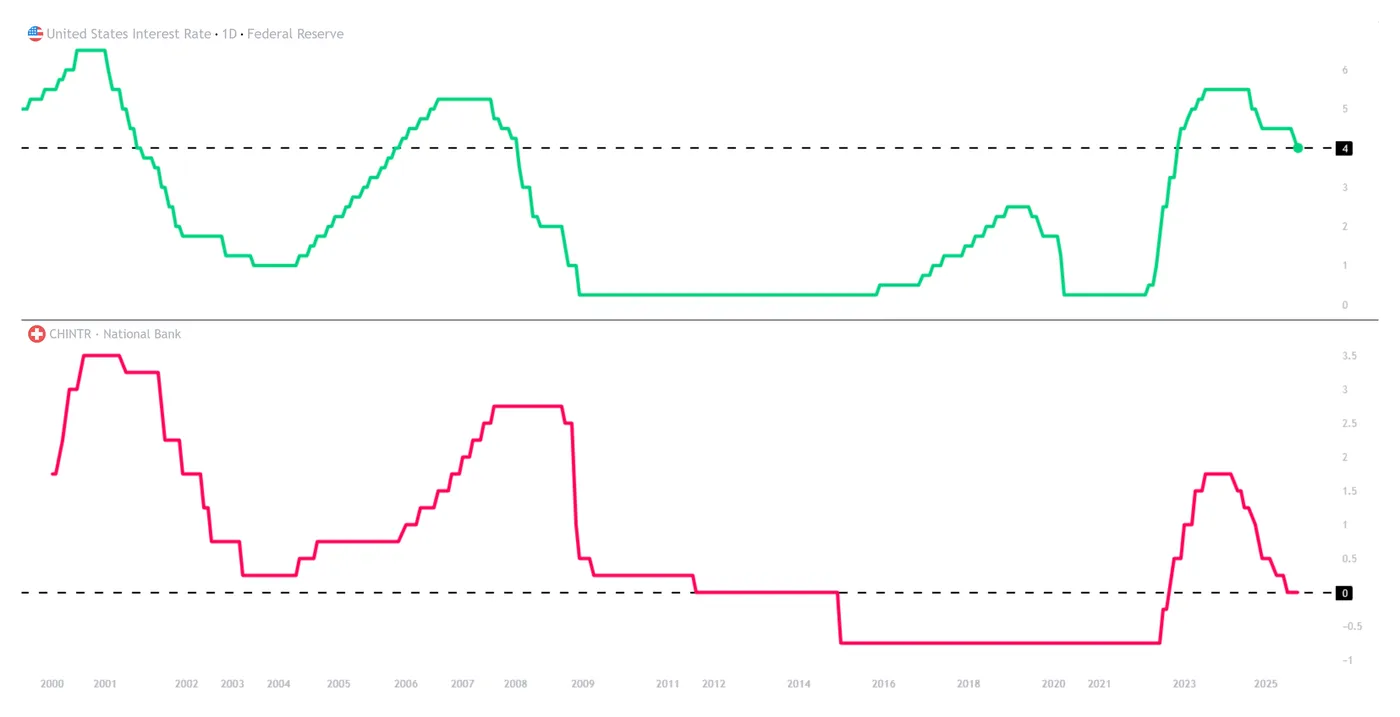
USINTR & CHINTR, TradingView,18/11/2025
Markets, now cast their watchful eye totomorrow’s FOMC Minutes release, and will of course be looking for further clues regarding December’s decision.
- Wednesday, November 19th, US FOMC Minutes, 14:00 EST
USD/CHF: Technical Analysis 04/11/2025
USD/CHF: Daily (D1) chart analysis:
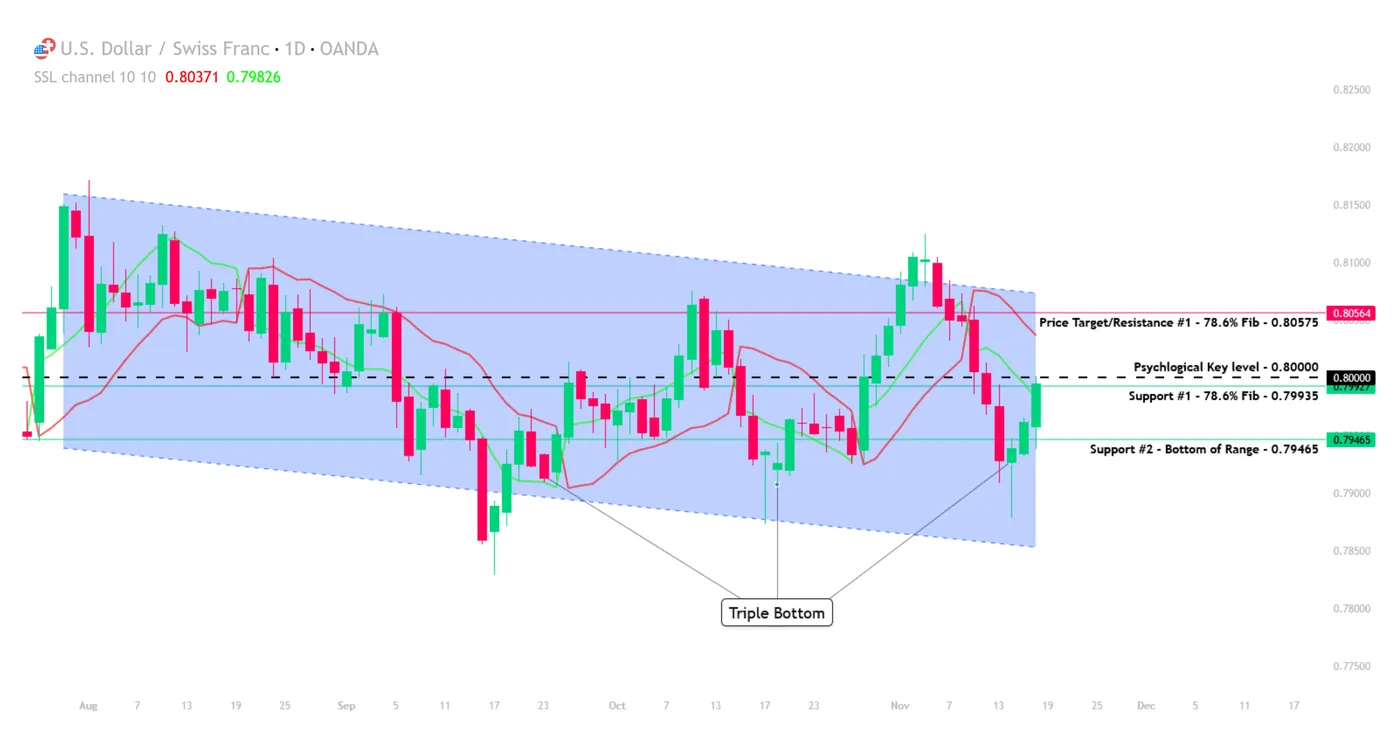
USD/CHF, D1, OANDA, TradingView, 18/11/2025
In the spirit of honesty, I would personally steer clear of trading USD/CHF at the moment, at least until price looks to break out of the current range.
Technically, USD/CHF has traded sideways since late July, but it is also entirely at the mercy of Fed commentary in the minutes tomorrow, so the fundamental picture remains somewhat unclear.
If I had to trade, I would be looking to the upside, especially considering the recent triple bottom and pin bar, but again, I’d want further confirmation. In any case:
Price targets and support/resistance levels:
- Price target/Resistance #1 - $0.80575 - 78.6% Fib from previous analysis
- Support #1 - $0.79935 - 78.6% Fib from previous analysis
- Support #2 - $0.79465 - Bottom of range
CADCHF Wave Analysis
CADCHF: ⬆️ Buy
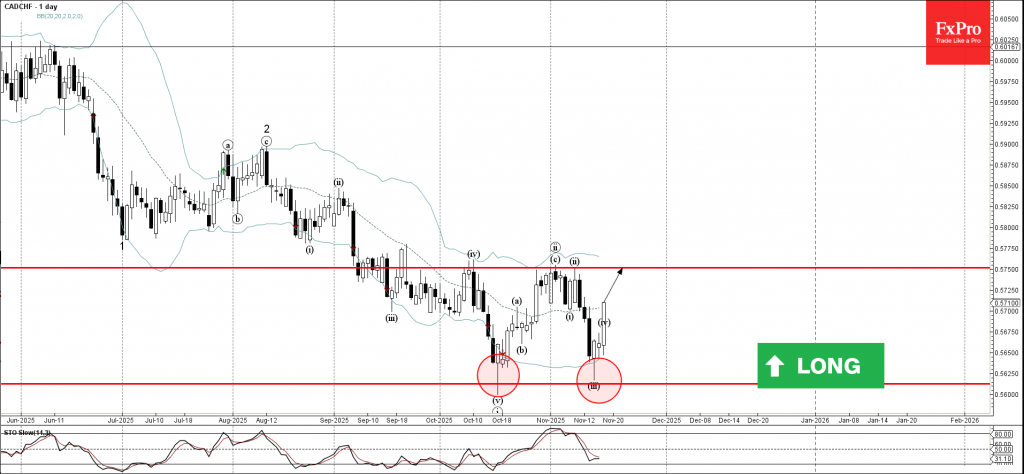
- CADCHF reversed from key support level 0.5600
- Likely to rise to resistance level 0.5750
CADCHF currency pair recently reversed from key support level 0.5600 (which stopped the previous impulse wave i in the middle of October, as can be seen from the daily CADCHF chart below) standing near the lower daily Bollinger band.
The upward reversal from the support level 0.5600 created the daily Japanese candlesticks reversal pattern Hammer.
Sunset Market Commentary
Markets
Risk-off remains the by default bias on global markets today even as there was little in the way of hard economic news to guide trading. High (US tech) valuations and low visibility on Fed policy are most often mentioned. Whatever the reason, yesterday’s selling/risk-off in the US also again spilled over to Asia this morning. In this move Japan was an underperformer in equities (Nikkei -3.21%) but also LT Japanese government bonds again showed signs of stress with several LT yields (40-y 3.68%, 10-y 1.75%) testing/touching multi-year lows. Admittedly political tensions between Japan and China probably are part of the reason for the underperformance of Japanese equities. Even so, it is striking that selling accelerates even as the new government is discussing big additional fiscal stimulus. The lingering debate on fiscal sustainability apparently makes that more fiscal stimulus is no longer a support for local risk assets. Later today, BOJ governor Ueda reported on a meeting with PM Takaichi. He labelled the meeting as candid and good. He indicated that there was no request from the PM on BOJ policy. This suggests that the BOJ can proceed with gradual policy normalization according to what it deems necessary. While confirming the BOJ’s independence, it also is another indication that there is little room for an Abenomics 2.0 policy with both fiscal and monetary stimulus.
Whatever the domestic issues potentially being at work in Japan, the risk-off also again rotated further into European and US equity markets. The EuroStoxx 50 again is ceding 1.7%. The index again trades below the March top, a first technical warning. US indices also again are ceding between 0.5% (S&P) and 1.0% (Dow/Nasdaq). As indicated there was little macro news to ‘explain’ the selling. The weekly US private ADP job report showed an average 2500 of private job losses in the four weeks ended Nov 1, to be compared with a 14.3k average weekly loss in the previous weekly release. The direct impact on global markets was limited. The US curve bull steepens with yields easing between 5.0 bps (2 & 5y) and 1.8 bps (30-y). Also the German/EMU yield curve steepens slightly (2-5-y German yield minus 3 bps; 30-y +0.5 bp). The outperformance at the short end to some extent probably is somewhat of a correction after EMU money markets recently sharply reduced the probability of a final ECB rate cut next year. Still hardly any directional moves in the major USD cross rates. EUR/USD is going nowhere near 1.16. DXY holds near 99.5 (marginal daily decline). The yen still underperforms with USD/JPY trading north of 155 and EUR/JPY even touching all-time record levels at 180+.
News & Views
Usage of the Bank of England’s long-term repo facility (six months) dropped to a three-month low during today’s weekly operation. Financial institutions borrowed around £1.28bn, down from £6bn the week before and the lowest since August 26. The steep drop comes after the BoE raised the cost of drawing on the facility to Bank Rate + 3 bps from 0 bps. That decision was already announced in June and intends “to balance incentives for participants” between the short-term repo and long-term repo facilities. The central bank’s short-term (one week) repo received £92bn of usage last week, the second highest since the BoE introduced it on the same day it started to sell gilts from its portfolio in 2022. Threadneedle Street seeks to shift towards a repo-led model for providing liquidity instead of outright bond buying.
The Hungarian central bank (MNB) kept the policy rate unchanged, once again, at 6.5%. It said that tight monetary conditions remain warranted due to risks to the inflation environment as well as trade and geopolitical tensions, with the latter in particular a risk for HUF weakness. The MNB said that the currency’s strengthening since the beginning of the year is beginning to show in purchase prices and added that FX market stability is of key importance in reducing inflation expectations – which remain elevated among households. Inflation itself stood at 4.3% last month with government price-dampening measures masking actual inflationary pressures. The central bank expects the inflation rate to ease into the 3% +/- 1ppt tolerance range by end-2025 and decrease further in early 2026. Growth should pick up next year amid improving exports and continued strong consumption dynamics. The government’s increased budget deficit (to 5%) in 2025 and 2026, the central bank said, is having a stimulating effect on domestic demand. Today’s expected policy outcome fails to inspire HUF. The forint remains near a 1.5 yr high around EUR/HUF 384.3.
BoE’s Pill: Don’t over-interpret data noises
BoE Chief Economist Huw Pill warned against putting too much emphasize on single data points today.
At a panel, he said, " policymakers should be cautious about over-interpreting the latest news in data, because there is a lot of noise in the data flow, and partly because of some of the challenges our colleagues in the Office for National Statistics have faced."
Pill said admitted that underlying inflation pressure might not be as intense as the 3.8% headline inflation suggested. However, he cautioned that other inflation related data had not slowed as much as expected.
EUR/USD Mid-Day Outlook
Daily Pivots: (S1) 1.1576; (P) 1.1600; (R1) 1.1619; More…
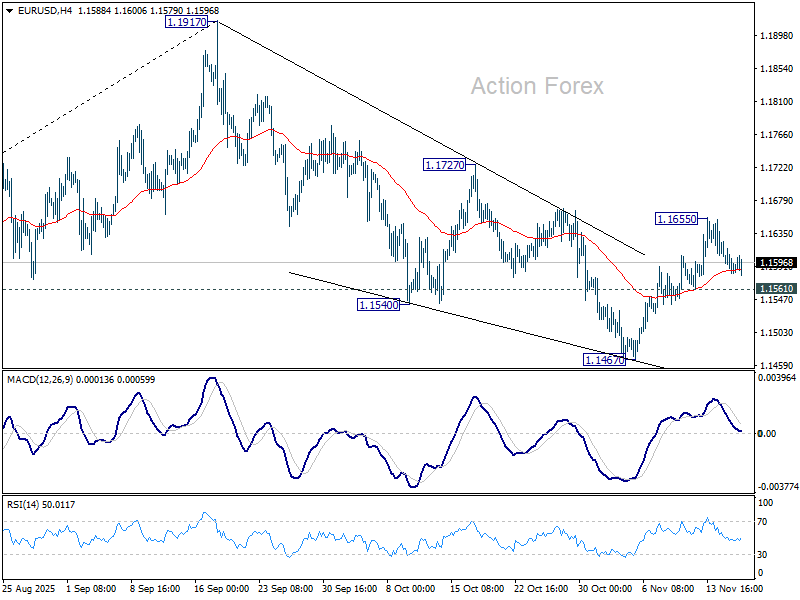
Intraday bias in EUR/USD stays neutral at this point. Fall from 1.1917 could have completed as a three wave correction at 1.1467. Above 1.1655 will target 1.1727 resistance first. Firm break there will solidify this bullish case and bring retest of 1.1917 high. However, break of 1.1561 will revive near term bearishness and target 1.1467 low instead.
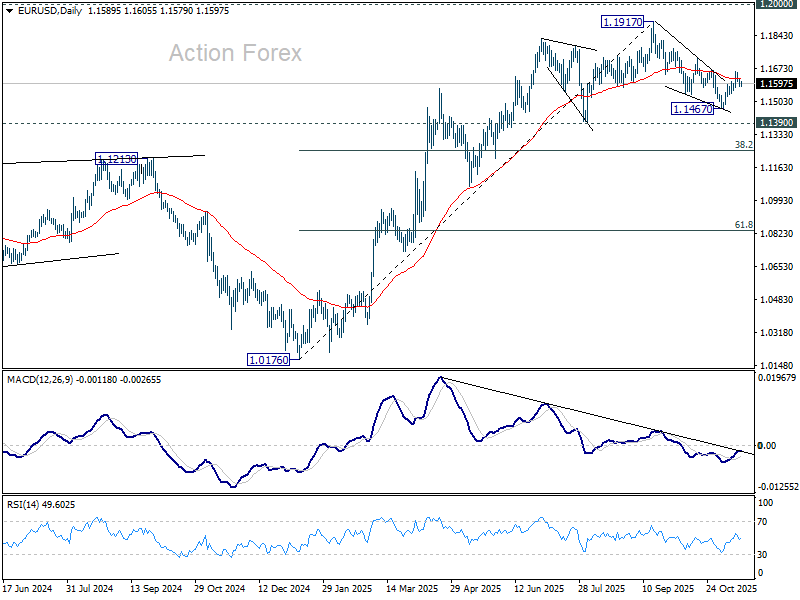
In the bigger picture, considering bearish divergence condition in D MACD, a medium term top is likely in place at 1.1917, just ahead of 1.2 key psychological level. As long as 55 W EMA (now at 1.1328) holds, the up trend from 0.9534 (2022 low) is still in favor to continue. Decisive break of 1.2000 will carry larger bullish implications. However, sustained trading below 55 W EMA will argue that rise from 0.9534 has completed as a three wave corrective bounce, and keep long term outlook bearish.
GBP/USD Mid-Day Outlook
Daily Pivots: (S1) 1.3130; (P) 1.3161; (R1) 1.3187; More...
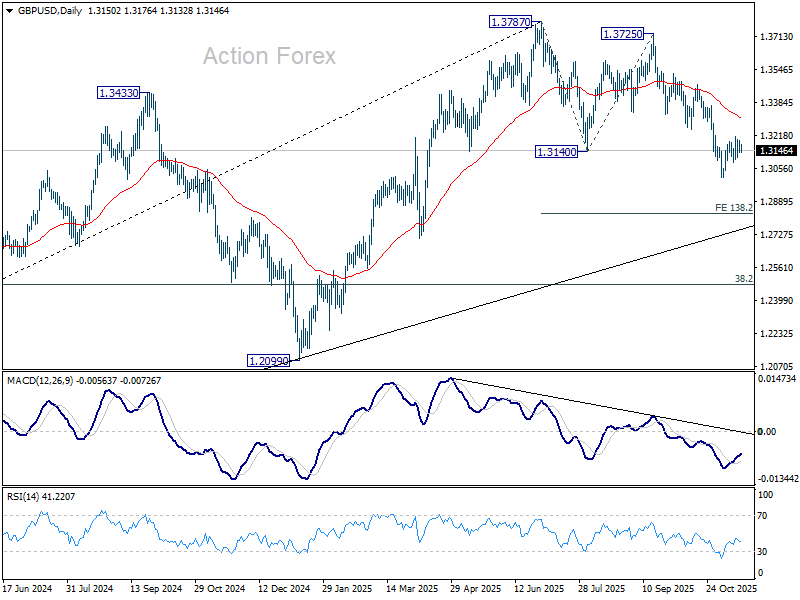
Intraday bias in GBP/USD stays neutral and more consolidations could be seen. Further decline is expected as long as 1.3247 support turned resistance holds. Break of 1.3008 will resume the fall from 1.3787, and target 138.2% projection of 1.3787 to 1.3140 from 1.3725 at 1.2831. Nevertheless, firm break of 1.3247 will suggest that fall from 1.3787 has completed as a corrective move already.
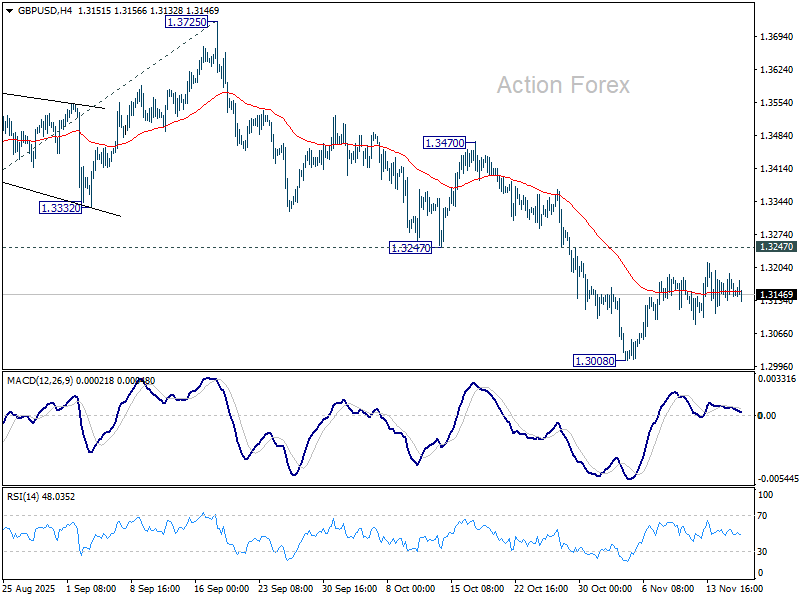
In the bigger picture, the break of 55 W EMA (now at 1.3182) is taken as the first sign that corrective rise from 1.0351 (2022 low) has completed. Decisive break of trend line support (now at 1.2824) will solidify this case and target 38.2% retracement of 1.0351 to 1.3787 at 1.2474 next. Meanwhile, in case of another rise, strong resistance should emerge below 1.4248 (2021 high) to cap upside to preserve the long term down trend.