Sample Category Title
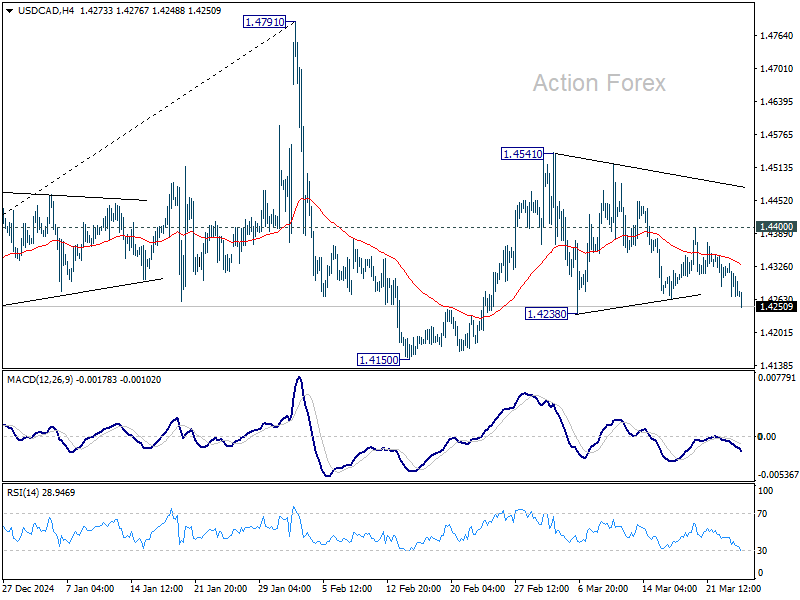
USD/CAD Daily Outlook
Daily Pivots: (S1) 1.4254; (P) 1.4294; (R1) 1.4316; More...
Intraday bias in USD/CAD is mildly on the downside with current fall. Break of 1.4238 support will argue that corrective pattern from 1.4791 has already started the third leg. Deeper decline should be seen to 1.4150 support next. On the upside, above 1.4400 resistance will turn intraday bias neutral again first.
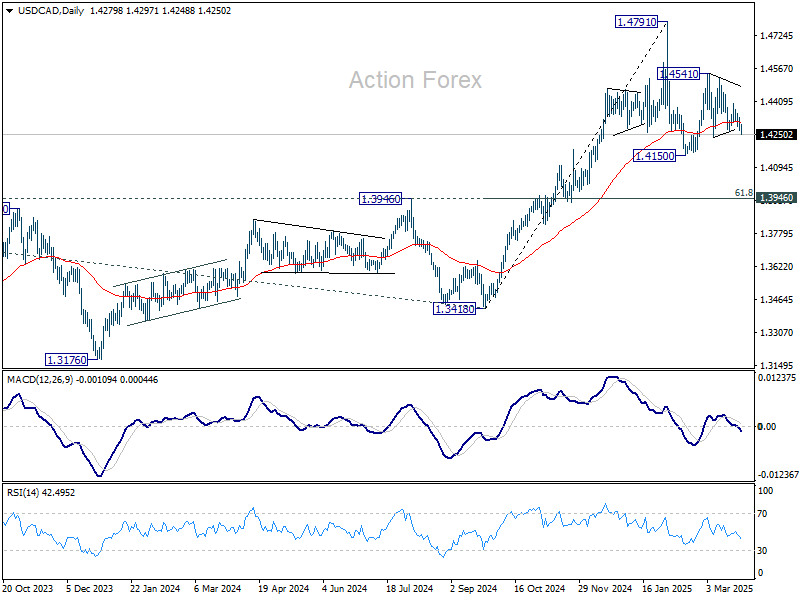
In the bigger picture, long term up trend is tentatively seen as resuming with prior breach of 1.4667/89 key resistance zone (2020/2015 highs). Next target is 100% projection of 1.2401 to 1.3976 from 1.3418 at 1.4993. This will remain the favored case as long as 1.3976 resistance turned support holds (2022 high), even in case of deep pullback.
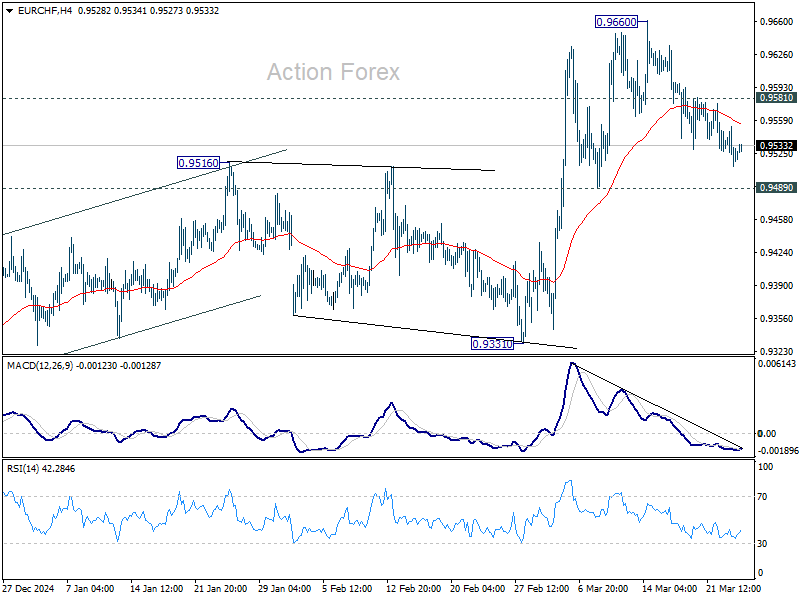
EUR/CHF Daily Outlook
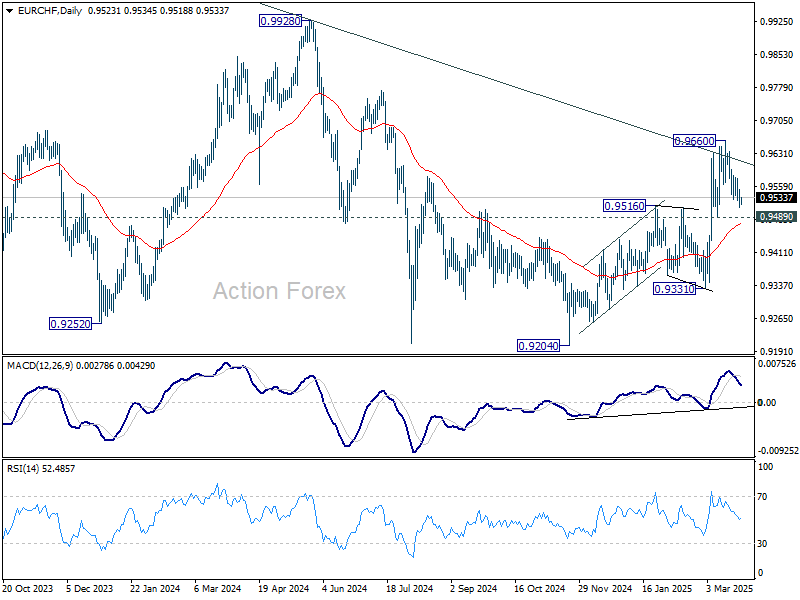
Daily Pivots: (S1) 0.9508; (P) 0.9531; (R1) 0.9549; More....
Intraday bias in EUR/CHF remains neutral for the moment. While pull back from 0.9660 might extend lower, further rally is expected as long as 0.9489 support holds. On the upside, above 0.9581 minor resistance will bring retest of 0.9660 first. Further break there will resume whole rise from 0.9204.
In the bigger picture, prior strong break of 55 W EMA (now at 0.9487) is a medium term bullish sign. Sustained break trading above long-term falling channel resistance (at around 0.9618) would suggest that the downtrend from 1.2004 (2018 high) has bottomed at 0.9204. Stronger rally should then be seen to 0.9928 key resistance at least.
GBP/JPY Daily Outlook
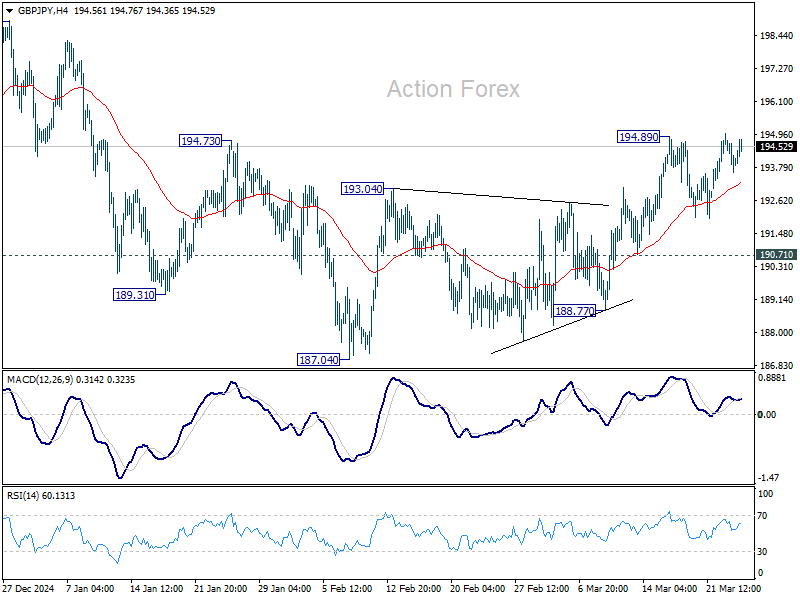
Daily Pivots: (S1) 193.46; (P) 194.24; (R1) 194.84; More...
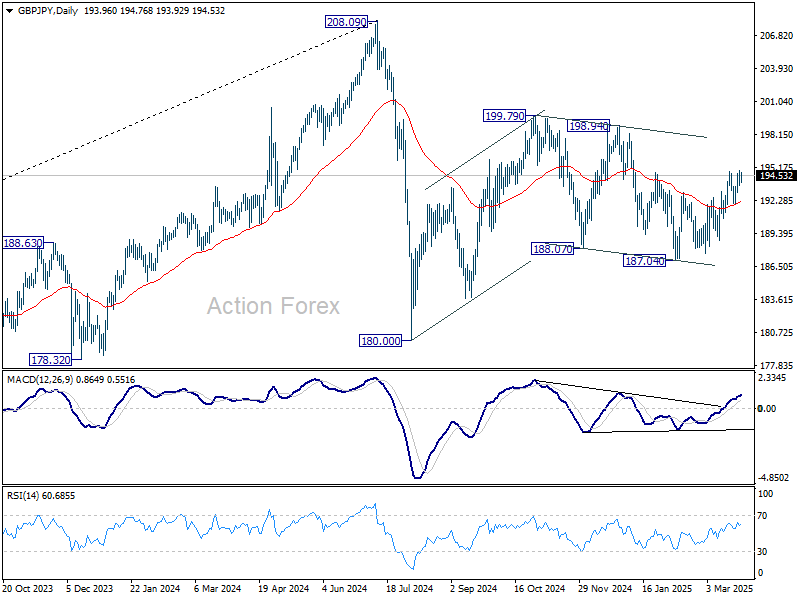
Range trading continues below 194.89 in GBP/JPY and intraday bias stays neutral. On the upside, above 194.89 will resume the rebound from 187.04 towards 198.94 resistance. On the downside, break of 190.71 will bring deeper fall back to 187.04 support. Overall, corrective pattern from 180.00 is still be extending.
In the bigger picture, price actions from 208.09 are seen as a correction to rally from 123.94 (2020 low). Strong support should be seen from 38.2% retracement of 123.94 to 208.09 at 175.94 to contain downside. However, sustained break of 152.11 will bring deeper fall even still as a correction.
EUR/JPY Daily Outlook
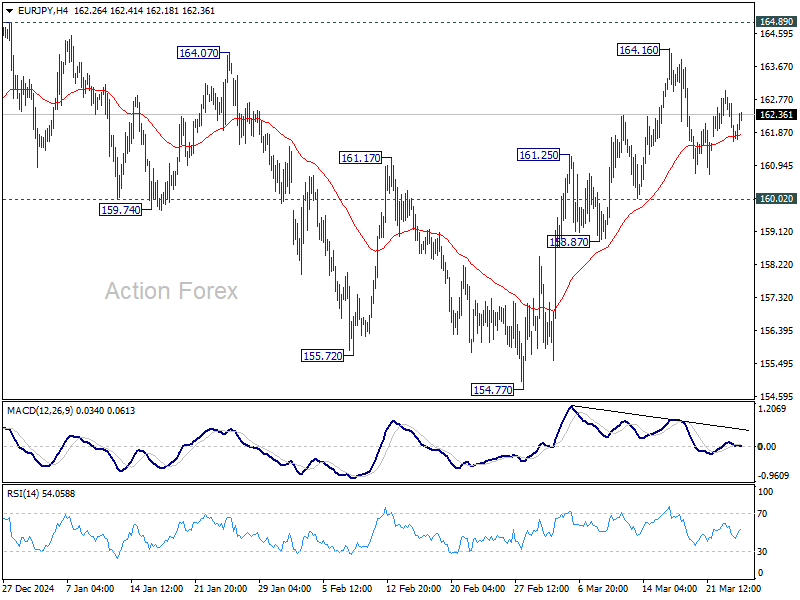
Daily Pivots: (S1) 161.26; (P) 162.15; (R1) 162.67; More...
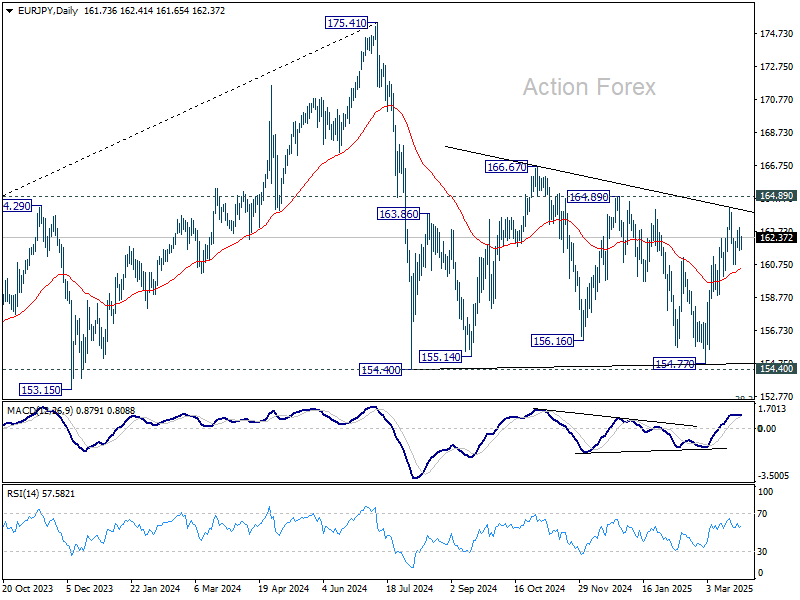
EUR/JPY's consolidation from 164.16 is still extending and intraday bias remains neutral. Further rally remains in favor as long as 160.02 support holds. Above 164.16 will target 164.89 and then 166.67. On the downside, however, break of 160.02 will argue that rise from 154.77 has completed and turn bias to the downside. Overall, sideway consolidation pattern from 154.40 is still extending.
In the bigger picture, price actions from 175.41 are seen as correction to rally from 114.42 (2020 low). Strong support should be seen from 38.2% retracement of 114.42 to 175.41 at 152.11 to contain downside. However, sustained break of 152.11 will bring deeper fall even still as a correction.
EUR/GBP Daily Outlook
Daily Pivots: (S1) 0.8327; (P) 0.8345; (R1) 0.8355; More...
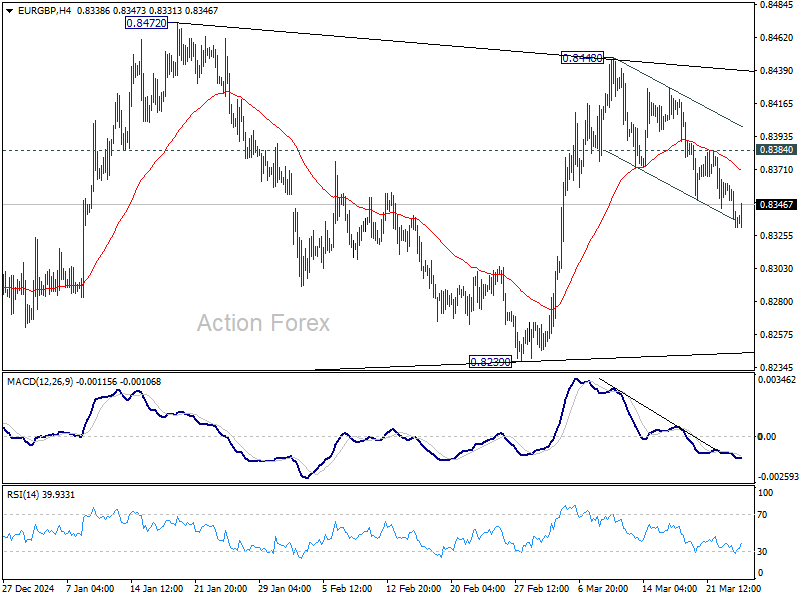
EUR/GBP's fall from 0.8448 continued and the break of 55 D EMA (now at 0.8347) suggest that rise from 0.8239 has completed already. Intraday bias is back on the downside for 0.8239 support next. On the upside, above 0.8384 minor resistance will turn bias back to the upside for 0.8448. Overall, consolidation pattern from 0.8221 is still in progress and could extend further.
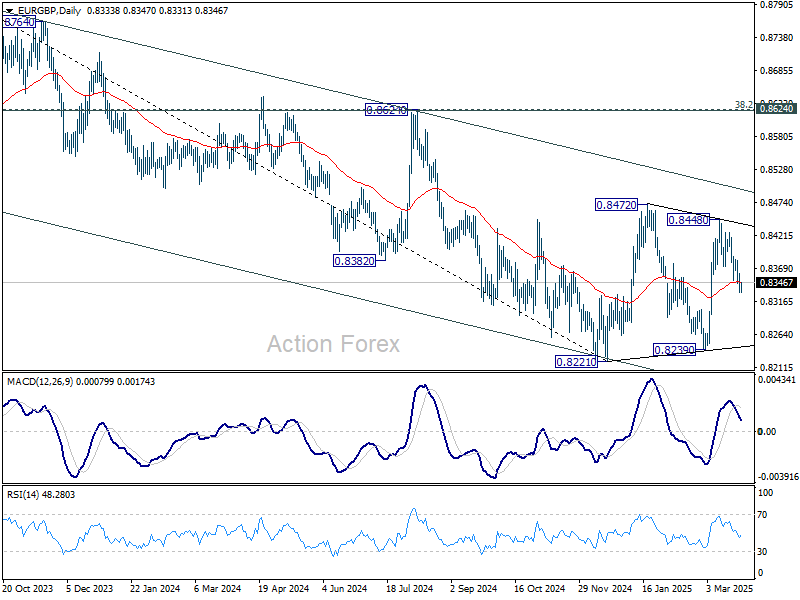
In the bigger picture, EUR/GBP is still bounded inside medium term falling channel. While rebound from 0.8221 might extend higher, it could still develop into a corrective pattern. Overall outlook will be neutral at best and down trend from 0.9267 (2022 high) could extend, at least until decisive break of channel resistance (now at 0.8495).
UK Inflation Slows, All Eyes on Budget
The latest data from the Conference Board came to back the mounting concerns among Americans regarding the future of the economy and inflation that a set of Michigan numbers have already warned about. The consumer confidence in this particular set of data plunged to a four-year low and inflation expectations jumped on tariff uncertainty. The Federal Reserve (Fed) Chair Jerome Powell has recently pointed at the strength of the US data, but the growth forecast are turning sour at a scary speed and waning sentiment will likely impact hard data – growth, employment and inflation – in the foreseeable future. On the other side of the Atlantic Ocean, the German data tells the exact opposite: business optimism in Germany hit the highest levels since last summer as the massive government spending that the German government agreed to unlock brings hope across manufacturers. As such, the convergence in sentiment between the two continents continues to develop, be confirmed by data and back the rotation trade.
The Stoxx 600 index rebounded yesterday after a three-session correction while US equities traded with no clear direction after a strong Monday rebound. The S&P50 closed flat. The doji candle formation typically hints at uncertainty and hesitation about where the US valuations should be headed next. In fact, investors are looking at April 2nd – the Liberation Day - hoping that the tariff announcements will bring more clarity. But April 2nd could be another day of imposing and pulling back tariffs in the continuation of a hectic and unpredictable trade policy that the White House follows since Trump tool office in January.
Valuation-wise, the rebound in European stocks sure narrowed the valuation gap with the US counterparts but the Stoxx 600 prints a PE ratio of around 17 today versus the S&P500 that still prints a PE ratio of near 29. The question is whether we could see a further convergence between the two. The answer is – it depends. One of the major boosters of sentiment since the start of the year was the decision from the European governments to unlock massive spending on infrastructure and security. The latter weighed heavier than the tariff fears and boosted growth expectations. The European spending narrative is still in play but is now widely priced in. Therefore the European investors will be facing the tough reality of the tariff game in the coming weeks and the latter could slow the rally that we saw in the European equities and the euro over the past three months. What Europe needs (what Europe really, really needs) is to turn infrastructure and security spending into growth, while the US growth slows. In summary, the rotation trade is probably not over but could be shaken by a new tariff wave in the short run.
Budget day
In the UK, the tariff fears are amplified by the fact that the UK won’t benefit from the ample budget spending that the continental European peers will. On the contrary, the spending hopes for the UK have been crumbling as borrowing costs keep rising and decrease Rachel Reeves’s fiscal headroom. The impact of tax rises, on the other hand, hit appetite and growth. And the Bank of England (BoE) is not in a hurry to provide relief with rate cuts pointing at global and trade uncertainties. Released this morning, the latest hinted that inflation in the UK came in softer-than-expected, providing a minor relief before today’s Budget Announcement.
But we already know that Rachel Reeves will announce a smaller ‘spending envelope’ later today; she is expected to announce a £10bn cut in day-to-day government spending. The smaller the envelop, the bigger the impact on sterling.
Partial truce?
News of a partial truce between Ukraine and Russia in the Black Sea saw limited reaction from oil traders. In theory, a truce or a partial truce should ease sanctions on Russian oil exports and have an easing effect on oil prices. But oil prices are relatively steady and US crude continues to test the $70pb resistance, hinting that the market is not buying the news for now. Yet the rising hope of a potential truce increases the downside risks and should temper appetite, along with the supply/demand gap pointing at cheaper oil in the medium term.
Elsewhere, copper futures on Comex advanced to an ATH yesterday as US buyers rush to buy copper before tariffs hit. But because copper is a barometer of global growth and the latter is being pressured by an escalating trade war, it’s just a matter of time before we see correction in copper prices.
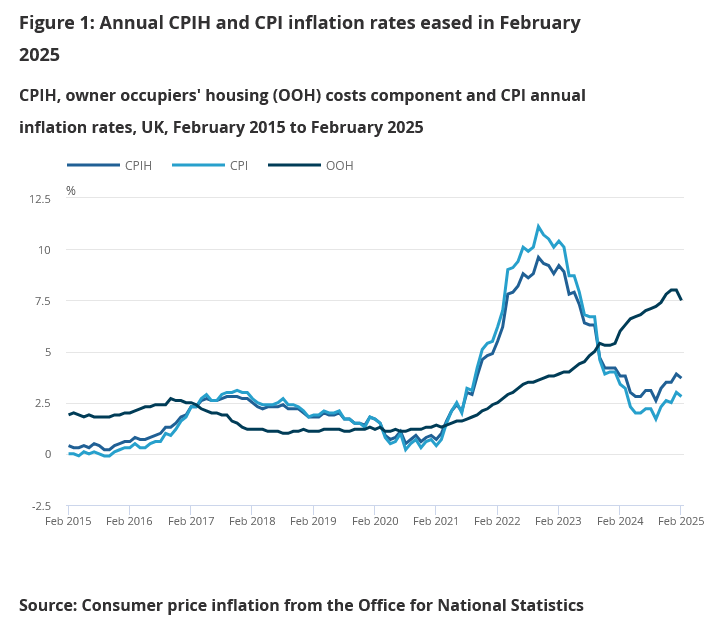
UK CPI slows to 2.8% in Feb, core down to 3.5%
UK CPI slowed from 3.0% yoy to 2.8% yoy in February, below expectation of 2.9% yoy. CPI Core (excluding energy, food, alcohol and tobacco) fell from 3.7% yoy to 3.5% yoy, below expectation of 3.6% yoy.
CPI goods annual rate slowed from 1.0% to 0.8%, while the CPI services annual rate was unchanged at 5.0%.
On a monthly basis, CPI rose by 0.4% mom.
US Strikes Ukraine-Russia Ceasefire
In focus today
In the US, February durable goods orders will be released. In the evening, the Fed's Musalem will be on the wires.
In the UK, the day is packed with action. We get inflation data for February, where focus is on the momentum in core services, which continues to prove remarkably sticky. In the afternoon, Chancellor Reeves will present the Spring Statement, where the Labour government faces some tough choices in meeting its fiscal objective while aiming to improve the UK economy's growth prospects. Previously, such fiscal announcements have proved important for UK markets, with substantial spillover particularly affecting global rates markets.
In Sweden, two key releases are in focus. The latest Economic Tendency Survey from NIER will be published. Our primary focus will be on the price plans within the retail and service sectors, as they will be crucial for the near-term inflation development. Additionally, we will observe whether the recent dip in consumer confidence persists, as this could further relay the consumption-led economic recovery. The minutes from last week's Riksbank meeting are also set to be released. We are particularly interested in the individual board members assessment of the balance of risks between recent high inflation prints and the real economy, and whether the general sentiment supports the latest money-market repricing.
In China, we still await the PBoC policy rate decision, the 1-year Medium-Term Lending Facility rate. We expect it to be unchanged again as we believe the central bank will continue to be sidelined for now until we move closer to another Fed cut.
Economic and market news
What happened overnight
In the US, while Chicago Fed President Goolsbee (dove and voter) stressed that he expects interest rates to be a "fair bit lower" in 12-18 months, he emphasized that it may take longer than expected to reach these levels amid economic uncertainty, favouring a "wait and see"- when facing uncertainty.
In commodity space, oil prices neared a three-week high around USD73.20/bbl in early trading amid supply concerns related to the US' efforts to curb Venezuelan oil exports and a larger-than-expected drop in US crude inventories. The U.S. imposed new sanctions on Venezuelan oil, with Trump authorizing 25% tariffs on imports from any buyer. This stalled Venezuelan oil trade with China as refiners awaited guidance.
What happened yesterday
In Germany, the IFO index rose as expected in March, mirroring the movement seen in yesterday's PMIs. Both the current situation assessment and expectations indices increased, indicating a stabilisation of German activity. While this suggests the decline may be ending, a rebound has yet to be observed. We expect a slow rise in German activity during 2025, supported by lower policy rates and rising real incomes, as evident in the expectations component reaching a five-month high. The rising expectations in March were primarily driven by the manufacturing sector. We expect that the effect from the fiscal package passed last week is likely some years ahead of us, as planning and implementing large infrastructure projects requires time.
In the US, the March Consumer Confidence Index fell short of expectations at 92.9 (cons: 94.0), according to the Conference Board. While economic expectations have reached their lowest since 2013 and inflation expectations tick higher, like the Michigan survey, perceptions of labour market conditions (the Jobs Plentiful index) remain unchanged. Household intentions for major purchases are also unchanged, with an increase in respondents planning vacations, indicating that while concerns exist, they may not be significant enough to alter consumer behaviour.
In Sweden, the February PPI figures came in lower than expected at -0.1% m/m (prior: 1.7%). Looking at the details, there is some relief in for example food prices which seem to be levelling out, at least from the producer side. Since foodstuffs has been perhaps the biggest driver for the topside surprises in Swedish inflation thus far into 2025, this would be a welcome development.
In Hungary, the NBH leaves the base rate unchanged at 6.50% as expected. The rate decision is crucial to anchor inflation expectations and stabilise the currency.
In geopolitics, following the parallel talks in Saudi Arabia, the US brokered maritime and energy ceasefires between Ukraine and Russia on Tuesday. The agreements are the first formal commitment since President Trump took office. However, the outlook for implementation remains uncertain, as it depends on Moscow securing the lifting of sanctions on Russian banks involved in agriculture, along with their reinstatement in the SWIFT messaging system; both of which require EU approval.
Equities: Equities were mostly higher yesterday, in a "no news is good news" manner. Investors locked in another 0.2% to the S&P 500, on top of the Monday rally. We see the rebound in US equities as an effect of volatility coming down. Just look at VIX closing in at 17 yesterday from 28 two weeks ago. Stoxx 600 did some catchup, rising 0.7%. Cyclical growth stocks rebounded in both regions, including most of the Mag 7 names. However, tech stocks shared the outperformance with banks and energy. This is a quite rare combination, but I guess both tech and European bank stocks can be considered "momentum" these days. Defensives sold off with health care and staples some of the few sectors in red. Futures are broadly unchanged this morning.
FI&FX: Back-and-forth headlines over a potential Ukraine-Russia ceasefire made for some choppy price action across asset classes. The US yield curve steepened somewhat, led by a lower front-end following a solid US2y auction. EUR/USD continued consolidation around 1.08 whereas USD/JPY traded lower, defying the risk-on sentiment within FX. UK inflation data will be scrutinized today, as will the Riksbank minutes especially considering current money market pricing and the last session's strong run for the SEK.
Elliott Wave View: CADJPY Looking to Rally in 7 Swing WXY Structure
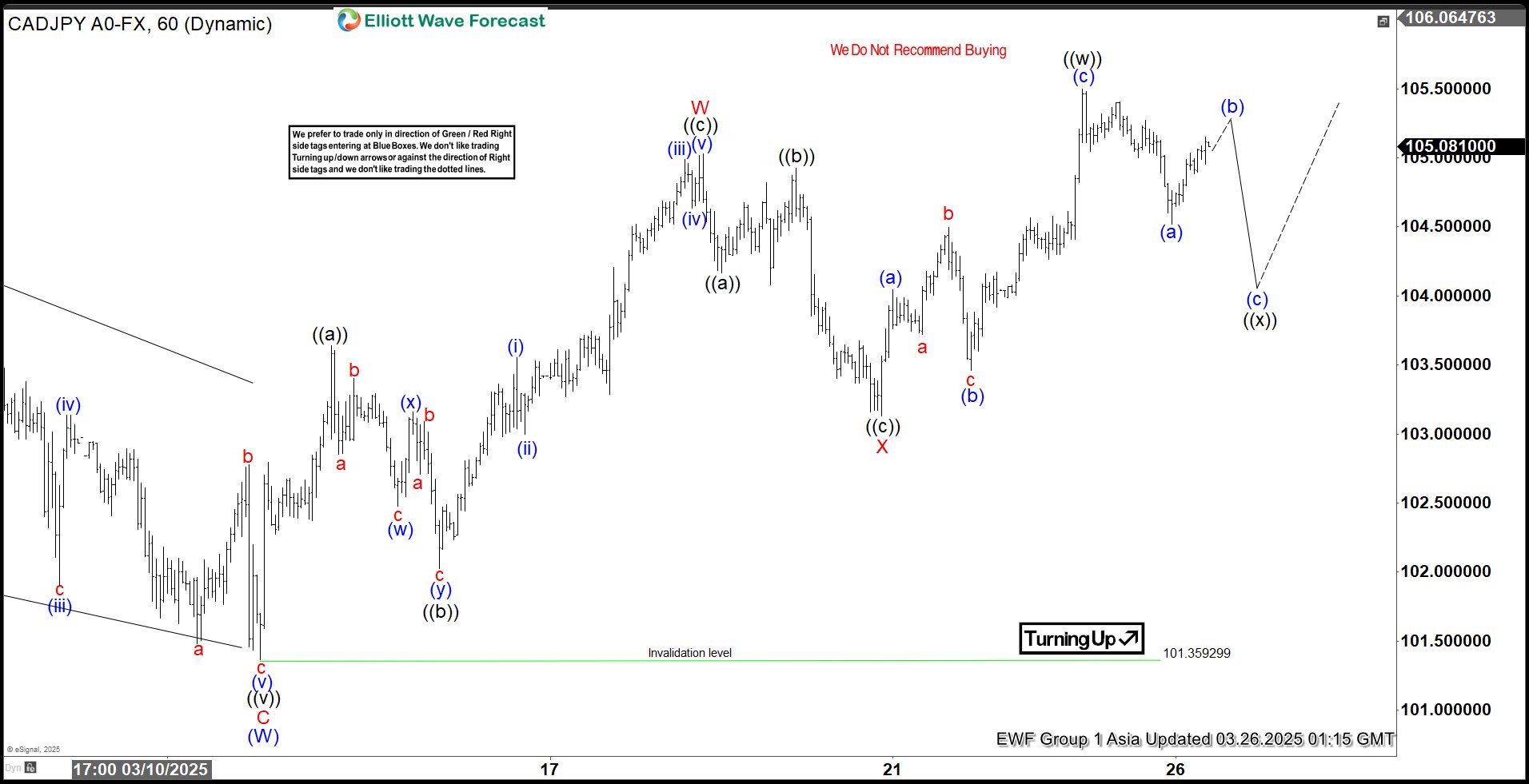
Short Term Elliott Wave view in CADJPY suggests pair ended cycle from 11.20.2024 high in wave (W) at 101.35 as the 1 hour chart below shows. Pair is looking to correct cycle from 11.20.2024 high within wave (X). Internal subdivision of wave (X) is unfolding as a double three Elliott Wave structure. Up from wave (W), wave ((a)) ended at 103.64 and pullback in wave ((b)) ended at 102.02. Wave ((c)) higher ended at 105.029 which completed wave W in higher degree.
Down from there, wave ((a)) ended at 104.16 and wave ((b)) rally ended at 104.92. Wave ((c)) lower ended at 103.13 which completed wave X in higher degree. The pair resumes higher in wave Y with subdivision as a double three structure. Up from wave X, wave ((w)) ended at 105.49. Pullback in wave ((x)) is in progress to correct cycle from 3.20.2025 low before it resumes higher. Near term, as far as pivot at 101.35 low stays intact, expect dips to find buyers in 3, 7, or 11 swing for further upside. Potential target for wave Y higher is 100% – 161.8% Fibonacci extension of wave W. This area comes at 106.75 – 109 area where sellers may appear for further downside.
CADJPY 60 Minutes Elliott Wave Chart
CADJPY Video
https://www.youtube.com/watch?v=BgmlWQZobBI
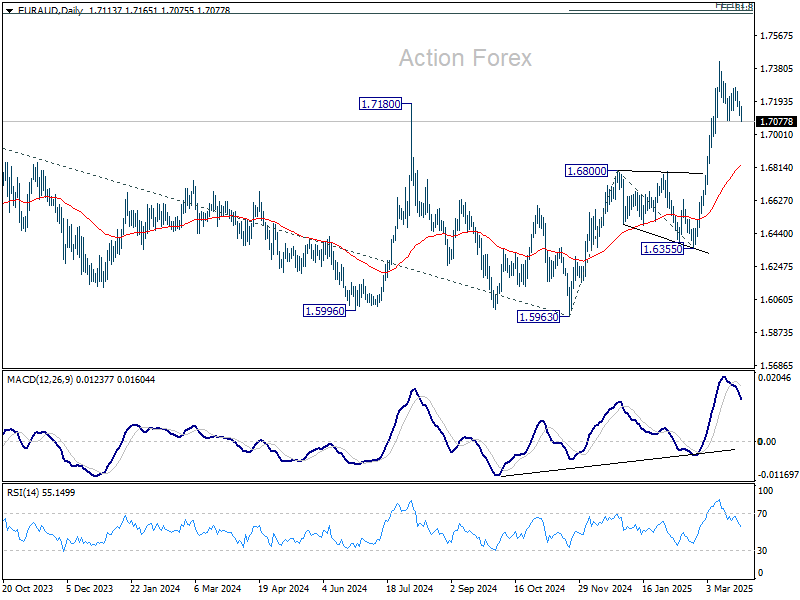
EUR/AUD Daily Outlook
Daily Pivots: (S1) 1.7092; (P) 1.7143; (R1) 1.7173; More...
EUR/AUD's corrective fall from 1.7417 short term top is resuming and intraday bias is mildly on the downside. Still, downside of the pullback should be contained by 1.6990 support to bring rebound. On the upside, above 1.7270 will bring retest of 1.7417 first. Break there will resume rise from 1.6335 to 161.8% projection of 1.5963 to 1.6800 from 1.6355 at 1.7709 next.
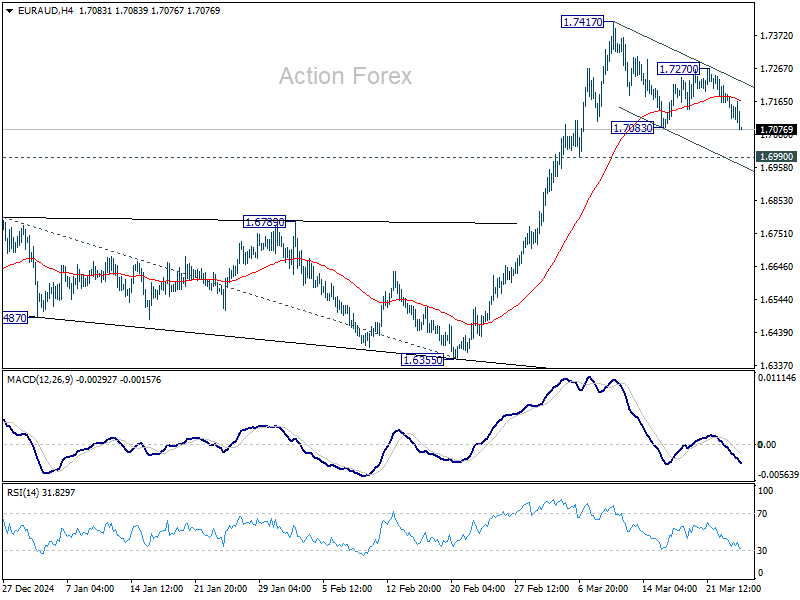
In the bigger picture, the breach of 1.7180 key resistance (2024 high) suggests that up trend from 1.4281 (2022 low) is resuming. Sustained trading above 1.7180 will confirm and target 61.8% projection of 1.4281 to 1.7062 from 1.5963 at 1.7682, which is also close to 61.8% retracement of 1.9799 (2020 high) to 1.4281 at 1.7691. For now, this will remain the favored case as long as 1.6800 resistance turned support holds, even in case of deep pullback.