

Sample Category Title
Loonie Tunes: Playing Second Fiddle to the Greenback
Highlights
- The Loonie has lost substantial ground to the greenback this year, a fate it shares with several other major G10 currencies.
- Wider interest-rate gaps have made U.S. assets more attractive, adding pressure on CAD alongside other advanced-economy currencies.
- The baseline still points to eventual loonie recovery, but that view is vulnerable if U.S. productivity strength keeps rates higher and USD assets more attractive for longer.
The Canadian dollar has weakened materially against the U.S. dollar this year, trading near the bottom of its year-to-date range after falling roughly 3.5% to 4% over the first half of the year. The move has been too broad and too closely tied to the repricing of U.S. assets to be read as a purely Canada-specific story. Instead, CAD weakness looks like one expression of a wider shift back toward U.S. dollar exposure, as markets moved away from earlier expectations that the Fed would be able to ease policy more quickly than other central banks.
That distinction matters for the outlook. If the loonie were simply being marked down on domestic concerns, the path forward would depend mainly on Canadian growth, inflation, and Bank of Canada policy. But if the larger force is renewed demand for U.S. dollar assets, CAD is more exposed to the broader global regime: how investors are pricing U.S. growth, U.S. rates, and the relative appeal of holding dollars versus other currencies. The recent evidence points more strongly to the second interpretation.
Loonie vs. Other Currencies
The cross-currency evidence supports this broader framing, but it is important to distinguish between different ways of measuring the U.S. dollar. DXY, the commonly cited "dollar index," tracks the dollar against a small group of major currencies, with the euro carrying by far the largest weight. That makes it useful as a quick read on dollar strength against major advanced-economy currencies, but less representative of how the dollar is moving against the full set of U.S. trading partners. Chart 1 shows that the latest dollar strength has been concentrated most heavily in the currencies that matter most for DXY, while the Federal Reserve's broader dollar index shows a more mixed pattern across the United States' 26 largest trading partners.
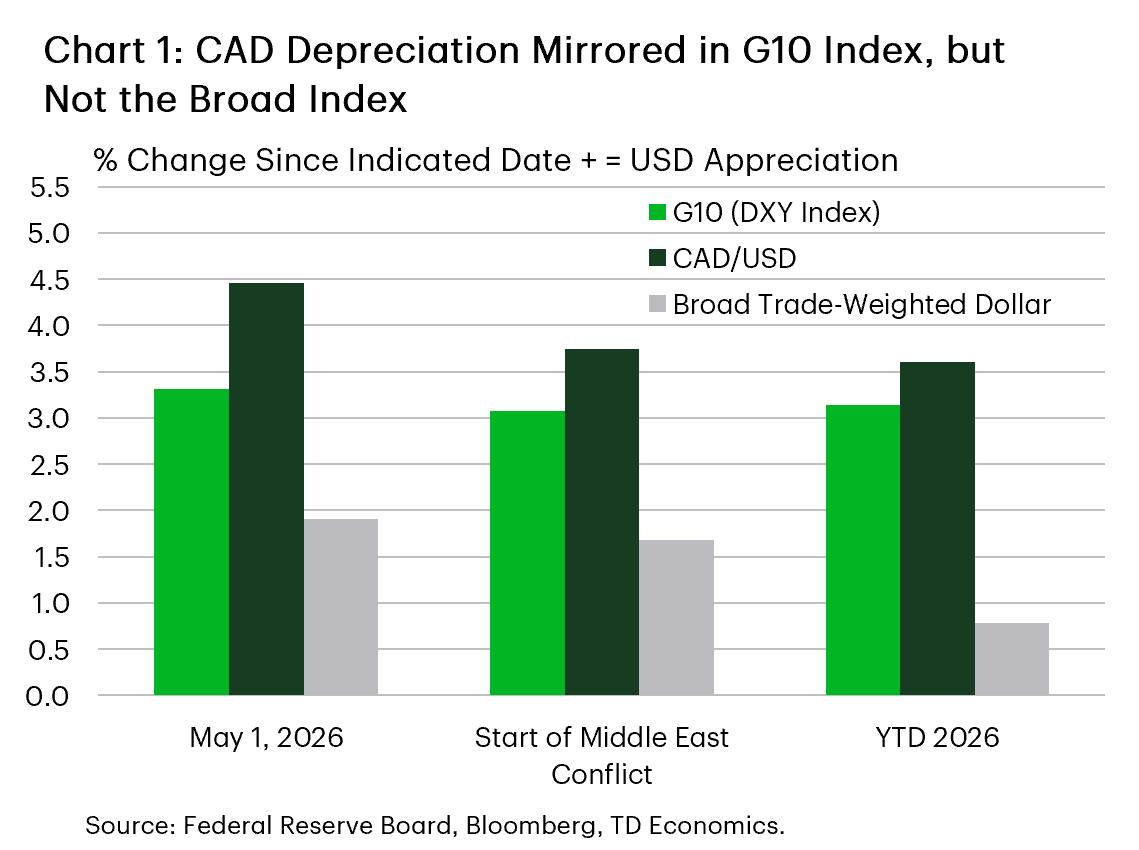
A closer inspection of the currencies in the broad index is offered in Chart 2. There, we can see three groups: the first group contains the currencies that have borne a disproportionate share of the latest dollar move, including the euro, loonie, Korean won, Indian rupee, and the Japanese yen. These are large, liquid currencies that carry meaningful weight in most dollar indexes, so their weakness helps explain why the bilateral CAD move has felt severe even though it is not isolated.
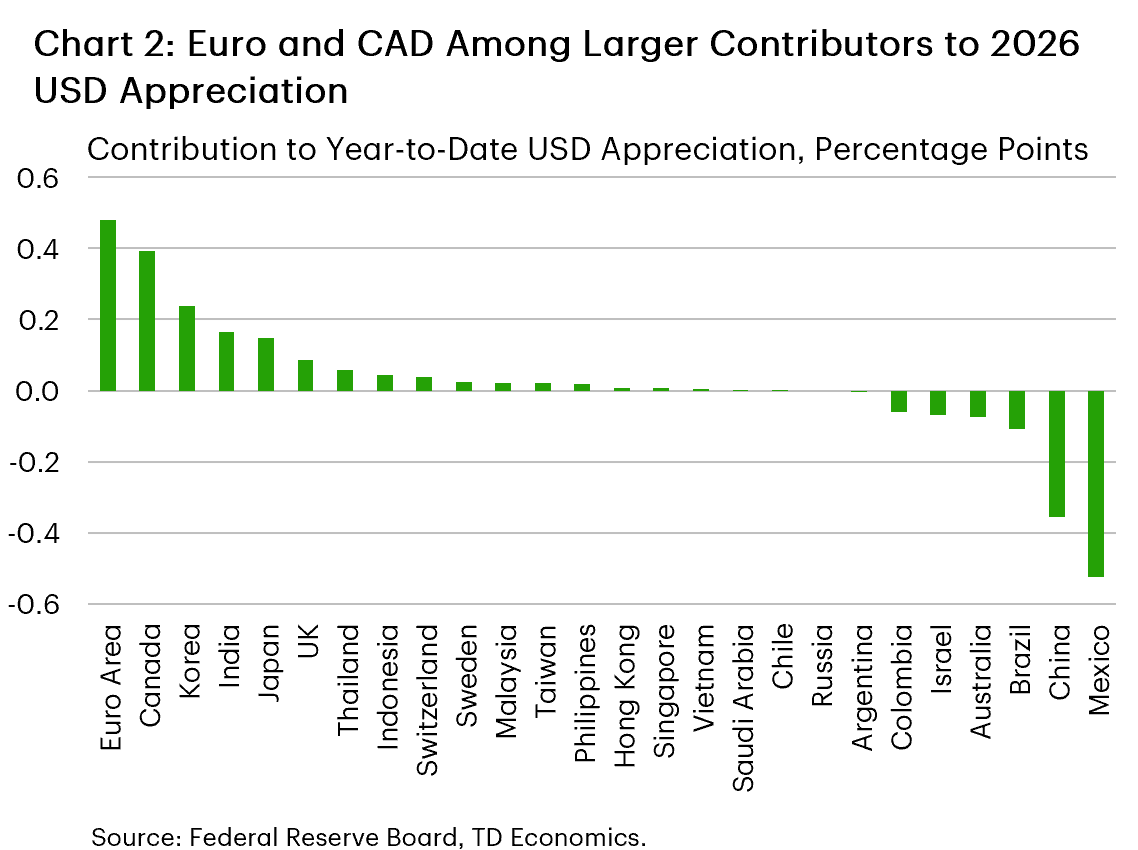
A second group has moved against the broader trend, led by the Mexican peso and Chinese renminbi. The peso is the clearest outlier, supported by high real rates, resilient domestic growth, and optimism around nearshoring, while the renminbi has been steadier than China's soft domestic backdrop would otherwise suggest, helped by policy management and efforts to limit sharp currency moves.
Most remaining currencies sit closer to the middle, moving broadly in line with the aggregate dollar move rather than clearly standing out in either direction.
This split reinforces that CAD has weakened because the dollar backdrop became more supportive, but the intensity of the move also depends on its own mix of growth, rates, policy credibility, and investor positioning. Canada fell into the group where the case for holding local currency became less compelling relative to the U.S. dollar, leaving the loonie more vulnerable once capital began moving back toward USD assets. We consider the usual candidate explanations for this development below.
Signs of Preference for the USD Coming Back
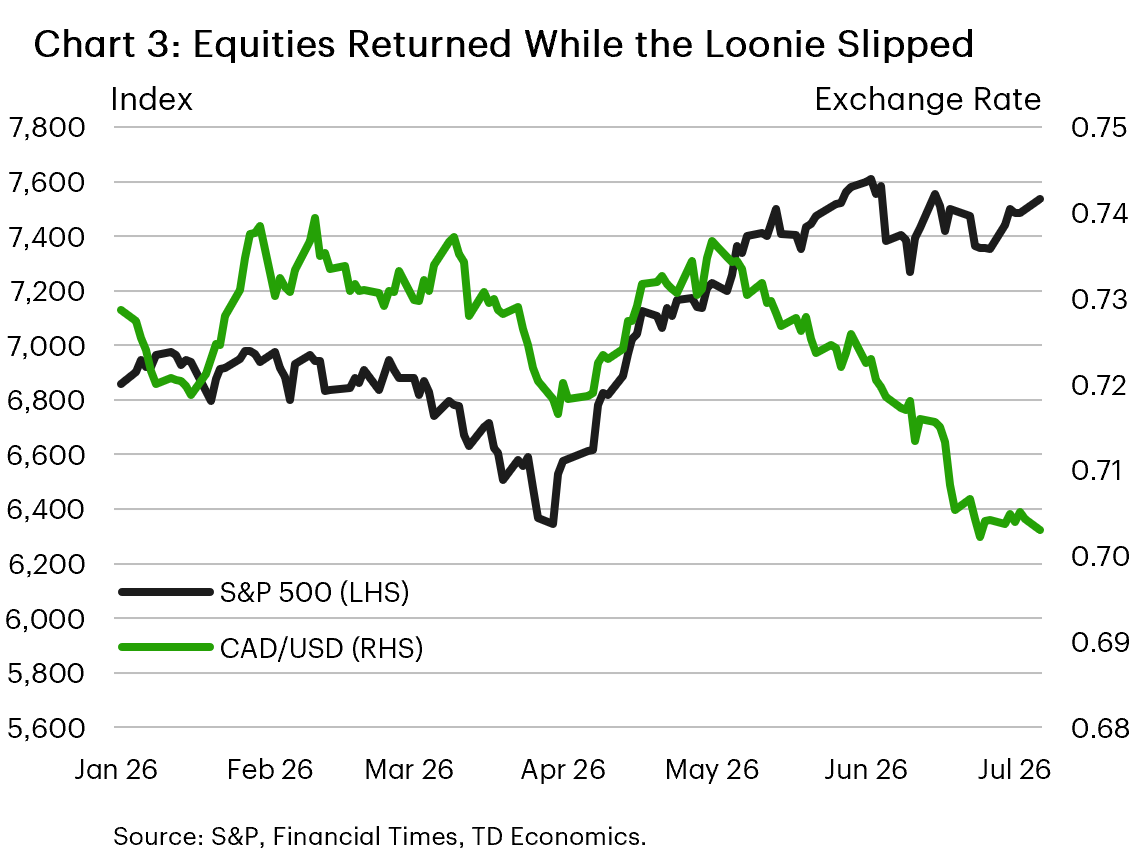
The timing of the move points to renewed preference for U.S. dollar exposure rather than a stand-alone CAD selloff. Chart 3 compares equities with CAD/USD and shows that the loonie started to weaken in May after the U.S. equity markets had recovered. That rebound helped confirm that markets had moved into a more comfortable risk backdrop and capital increasingly gravitated toward the U.S. dollar.
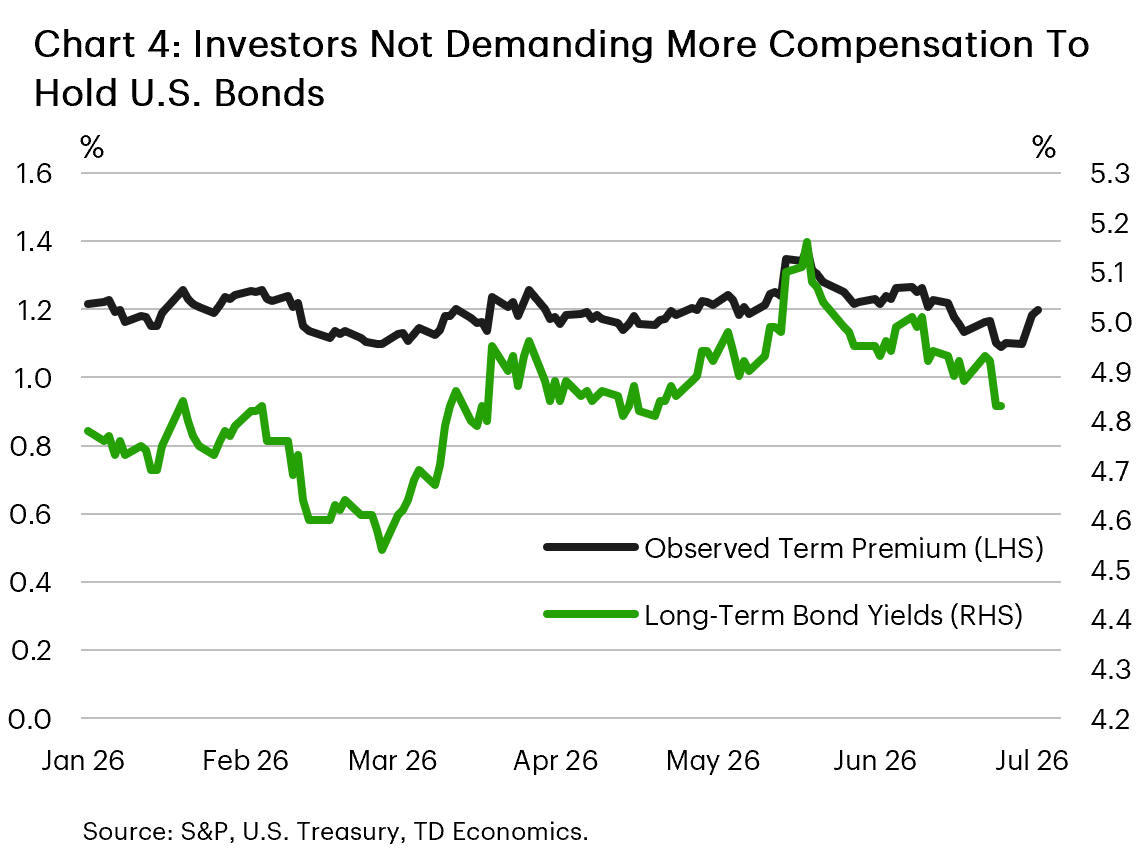
The bond market tells a similar story (Chart 4). Since mid-May, long-term Treasury yields and the observed term premium have moved lower, consistent with renewed demand for U.S. duration and a stronger preference for USD assets. Taken together, the equity and bond signals suggest that the market regime shifted from broad risk repair into a more dollar-centric phase, where investors were willing to take risk but preferred to do so through U.S. assets.
Limited Evidence of a Flight to Safety
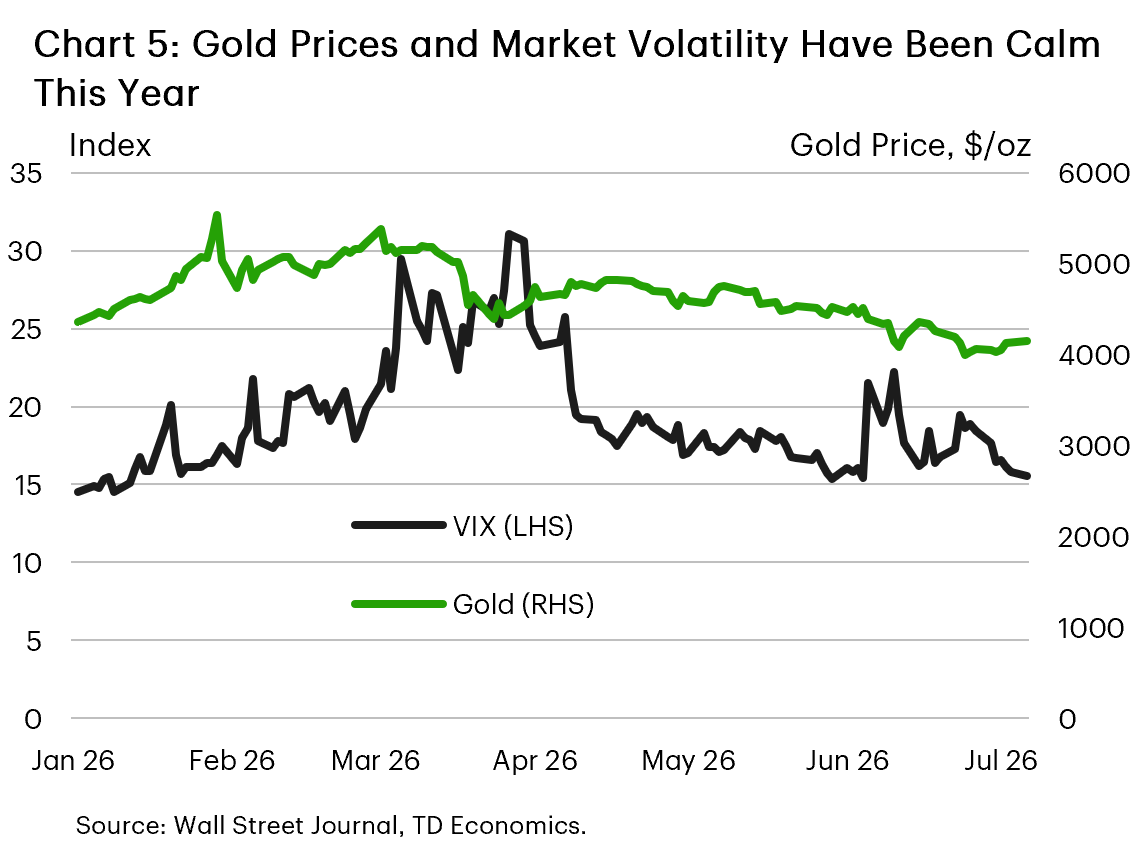
That distinction is important because the evidence for a classic flight-to-safety move is not especially convincing. If investors were simply rushing into safe havens, we would expect to see more persistent stress signals across markets. Instead, as shown in Chart 5, the VIX has retraced its earlier spike and gold prices have fallen over this period, weakening the case that CAD weakness is mainly being driven by generalized risk aversion. Other usual safe-haven currencies such as the euro, Swiss franc, and yen have also depreciated against the U.S. dollar this year. The cleaner interpretation is that investors have not abandoned risk altogether; they have become more selective, with U.S. assets and the dollar standing out as the preferred destination.
That leads naturally to the next driver: interest-rate differentials. The preference for USD assets and widening rate differentials are mutually reinforcing: stronger demand for U.S. exposure helps explain the direction of the move, while the growing U.S. rate advantage has made that preference more durable and intensified the pressure on currencies like the loonie.
Interest Rate Differentials
With the start of the war in the Middle East and the push higher on inflation, market expectations for Fed policy changed sharply, pricing in the possibility of Fed rate hikes. This was a sharp reversal from the prevailing sentiment prior to the conflict that the Fed was going to be the lone central bank reducing interest rates in 2026. This means the prior expectation for spreads on borrowing costs between the U.S. and other countries to narrow quickly reversed. The shift is most evident in short-term interest rate spreads between the U.S. and Canada and Germany (Chart 6).
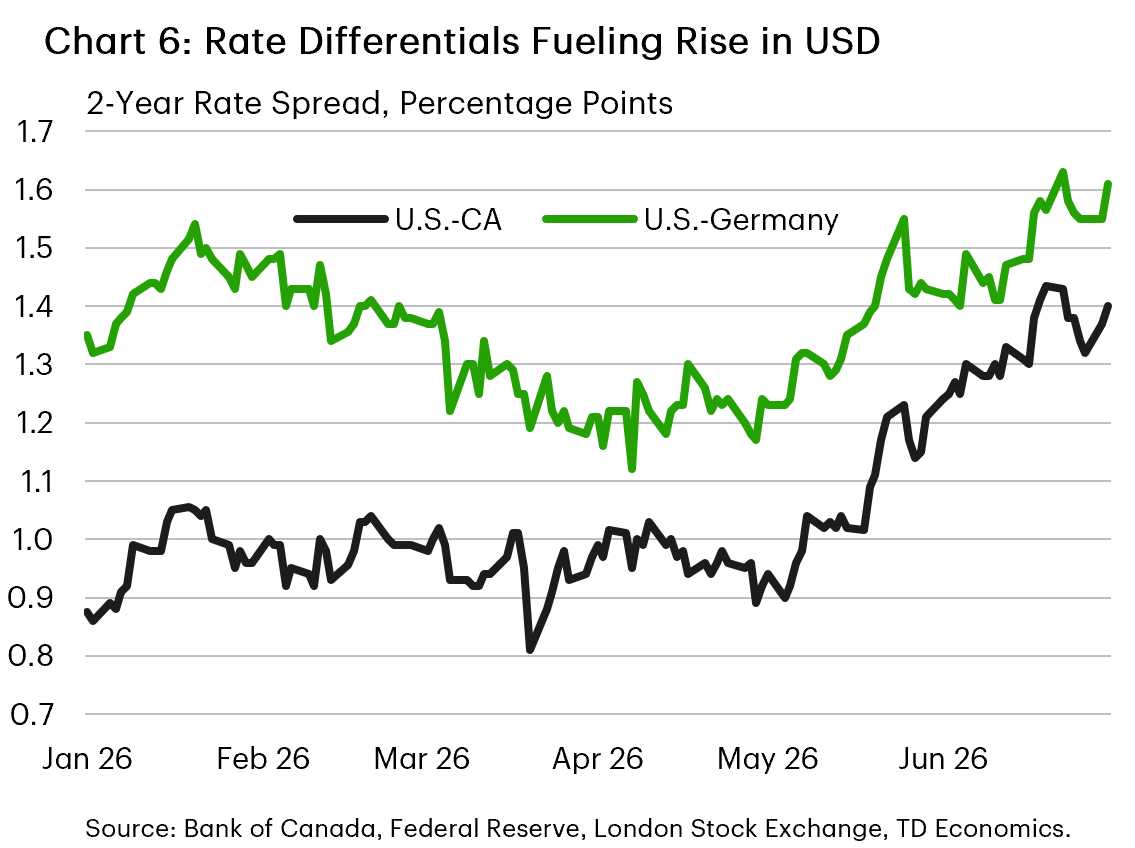
The result of the policy divergence is that spreads vis-à-vis the U.S. on two-year government debt have widened by 25 basis points (bps) and 40 bps for Germany and Canada in the first half of 2026, respectively. The relatively smaller change in Germany is courtesy of a recent hike from the European Central Bank, whereas a dovish Bank of Canada has opted to stay on the sidelines. The widening premium to hold U.S. assets over other countries has helped to lift demand for the dollar, at the expense of other advanced economy currencies like the loonie and euro.
The Path Forward, the Productivity Wildcard and the Loonie
The outlook for the loonie now turns on whether those interest-rate gaps begin to narrow. Our baseline remains that U.S. inflation and growth will moderate in the coming months, allowing the Fed to gradually reduce the fed funds rate to 3.25% in 2027. That would take some pressure off the CAD by lowering the relative return on U.S. dollar assets.
The main risk is that the U.S. economy proves strong enough to keep those rate differentials wider for longer. There are two ways this could happen. The first is a more cyclical scenario, where the energy shock fades but U.S. demand remains firm enough to leave the economy in excess demand. In that case, the Fed would have less room to cut rates without risking renewed inflation pressure.
The second, more structural risk is that the productivity gap between the U.S. and its peers does not narrow back toward historical norms. This matters because stronger productivity growth can allow the U.S. economy to sustain faster growth and higher real rates without generating the same inflation pressure. If that advantage persists, the neutral rate in the U.S. could settle higher than in Canada and other advanced economies.
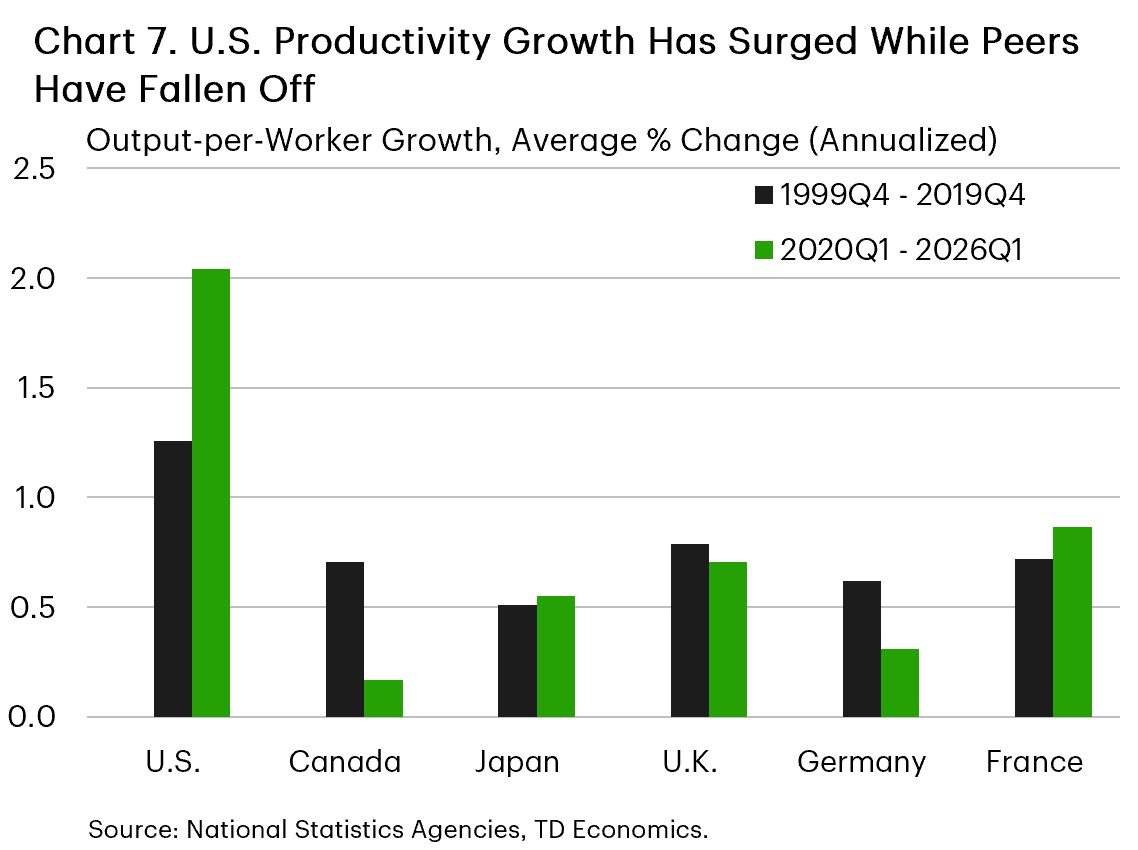
The recent data point in that direction. Since 2020Q1, U.S. output per worker has grown by 2.0% annualized, compared with 1.3% in the 20 years before the pandemic. Canada and other G7 economies have fallen further behind, held back by a mix of weaker capital deepening, softer business investment, and other structural headwinds (Chart 7). Stronger U.S. productivity growth helps explain how the economy has continued to outperform despite materially higher interest rates.
The implication for CAD is straightforward. If stronger U.S. productivity keeps the neutral rate higher, the Fed may not need to deliver as much rate relief as markets currently expect. U.S. short-term rates would remain elevated relative to Canada, preserving the yield advantage that has already helped pull capital toward U.S. assets.
That would leave the loonie vulnerable even if domestic conditions unfold broadly as expected. The baseline still points to some CAD recovery as U.S. rates eventually move lower, but a sustained U.S. productivity advantage would delay that adjustment by keeping rate and growth differentials tilted in favour of the dollar.
Under that scenario, the appreciation expected through the rest of 2026 and into 2027 would likely fail to materialize. Instead, CAD could remain stuck in the 71-72 U.S. cent range into mid-2027, as wider rate and growth differentials continue to make U.S. assets relatively more attractive.
Cliff Notes: Testing Conditions
Key insights from the week that was.
Amid a sparse local data calendar, a speech from RBA Assistant Governor (Economic) Sarah Hunter was scrutinised but had little market impact. The speech focused on supply-side shocks, such as the Middle East conflict, and the conundrum it presents for dual-mandated central banks like the RBA.
Assistant Governor Hunter reiterated the RBA’s perspective that these shocks are harder to ‘look through’ if economic capacity is already tight when the shock occurs, firms can readily pass through costs and/or inflation expectations de-anchor. While the latter is more of a risk than a reality at present, the RBA’s take on recent data suggests concern over capacity and pass-through is warranted, particularly in the construction sector. This is why the Monetary Policy Board telegraphed in its June policy decision that rate hikes remain on the table despite their decision to pause at that meeting following three successive hikes. The future scale and pace of tightening will depend on how the risks around each of these factors evolves in coming months. The upcoming Q2 CPI will prove critical in understanding the best course.
In New Zealand, the RBNZ delivered a 25bp increase at their July meeting, taking the cash rate (OCR) to 2.50%. A key argument for the hike was concern that financial conditions would have eased further if the OCR was left unchanged. The MPC seems to be comfortable with an end-2026 level for the OCR circa 2.75%-3.00% – broadly in line with the May forecasts. Our New Zealand economics team expects follow-up 25bp hikes in September and December and an unchanged sequence of 25bp increases through 2027. That means the peak OCR of 4.00% will now be reached in September 2027 instead of December.
Across in the US, the minutes of the June FOMC meeting showed participants felt a high degree of uncertainty over the outlook and wanted to consider a broad range of incoming information over successive months before determining if policy needs to be adjusted. Remaining on hold and removing previous forward guidance which favoured additional easing from the statement were consensus opinions.
On the balance of risks, the discussion amongst members points to a majority view that price risks had risen and labour market uncertainties receded since April. However, following June’s decision, energy prices jolted lower and nonfarm payrolls growth moderated again. The disconnect between payrolls and household survey employment also continues to grow, the latter in outright decline. Growth in consumer demand is also materially below trend and looks set to remain soft, limiting the ability of firms to pass through cost increases.
Still, price risks remain. Midweek, President Trump stated he believed the ceasefire with Iran was "over" but did not stop negotiators from continuing to engage. This followed strikes on around 80 Iranian military targets by the US in response to 3 ships being hit by projectiles in the Strait. Another 90 sites were hit in a second day of strikes, and Iran retaliated against US military assets in the region on both occasions.
President Trump has made clear he intends to order additional strikes in scale every time Iran threatens shipping on the Omani side of the Strait, which Iran has done to force shipping through the lanes it controls. A renewed blockade of Iranian cargo was also threatened by President Trump, with a view to increasing domestic pressure and restricting Iran’s ability to sell oil into global markets. However, President Trump also felt this escalation would prove short lived. Brent oil rose close to USD81 initially but has since eased back to around USD76. This compares to a low of USD71 early in the week.
Data received in the US and elsewhere in the northern hemisphere this week was secondary in significance and broadly in line with recent trends. Most notable was the ISM services index which reported a deterioration in new orders but also a pairing of input price pressures and improvement in employment, albeit for the latter only to near the 20-year average after three successive contractionary readings.
China's headline and core inflation rates meanwhile stabilised around 1.0%yr in June as producer price inflation edged up to 4.1%yr. Weak domestic demand continues to limit Chinese firms' ability to pass through higher production costs, which have primarily been driven by energy prices. Excess capacity and cautious consumers are likely to restrict consumer inflation in the absence of targeted (and effective) fiscal support.
NZDUSD Wave Analysis
NZDUSD: ⬆️ Buy
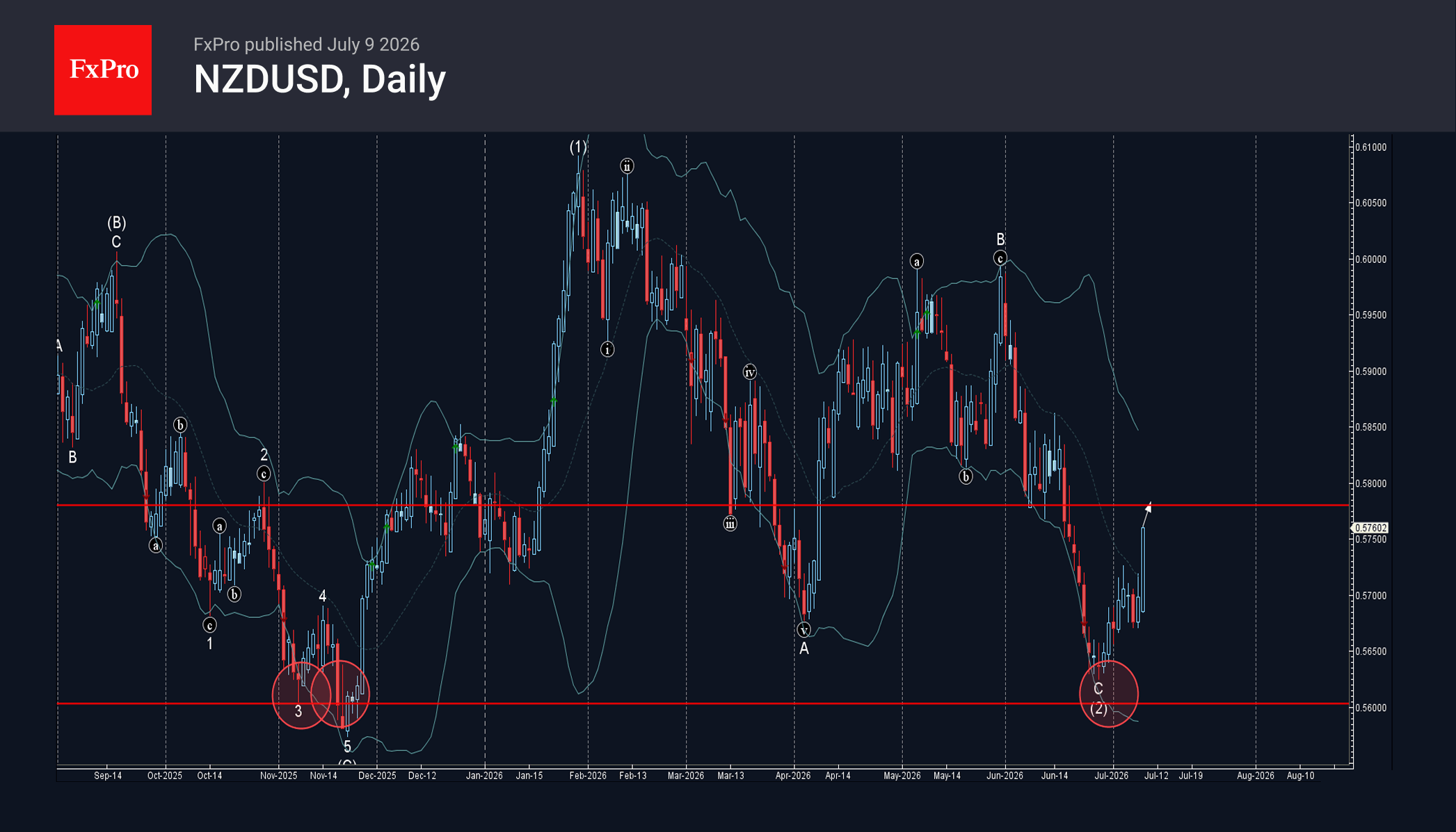
– NZDUSD reversed from support zone
– Likely to rise to resistance level 0.5780
NZDUSD currency pair recently reversed up from the support zone between the long-term support level 0.5600 (which stopped the strong downtrend d in November) and the lower daily Bollinger Band.
The upward reversal from this support zone started the active medium-term impulse sequence (3).
NZDUSD currency pair can be expected to rise further toward the next resistance level 0.5780 (former support from the start of June).
NASDAQ-100 Wave Analysis
Nasdaq-100: ⬆️ Buy
– Nasdaq-100 reversed from support zone
– Likely to rise to resistance level 30770.00
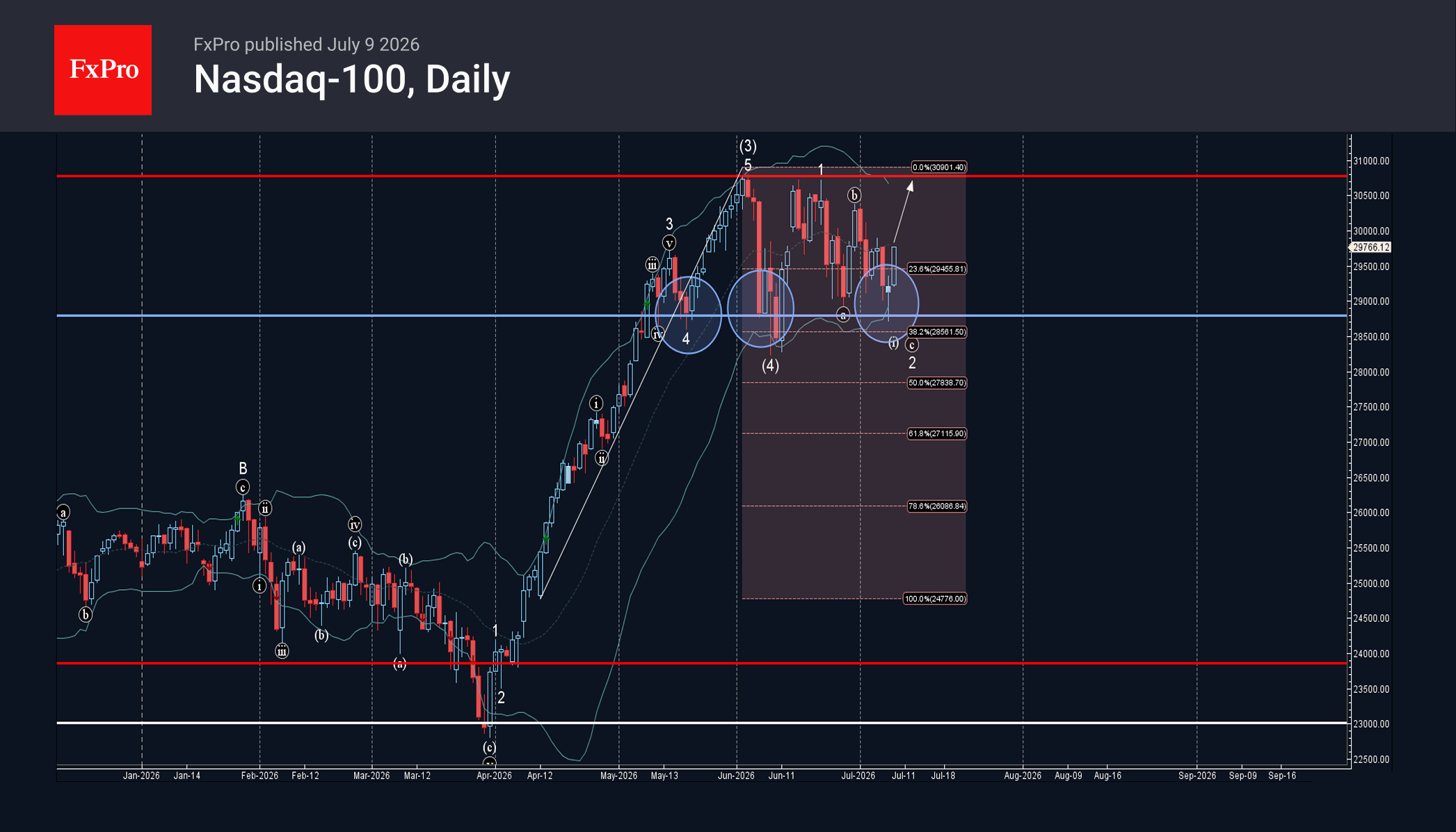
Nasdaq-100 recently reversed up from the support zone between the pivotal support level 28800.00 (which has been reversing the price from May), 38.2% Fibonacci correction of the upward impulse from April and the lower daily Bollinger Band.
The upward reversal from this support zone stopped the previous short-term ABC correction 2.
Given the clear daily uptrend, Nasdaq-100 can be expected to rise further toward the next resistance level 30770.00 (which stopped earlier waves (3) and 1).
Nikkei 225 Index Wave Analysis
Nikkei 225: ⬆️ Buy
– Nikkei 225 reversed from support zone
– Likely to rise to resistance level 72575.00
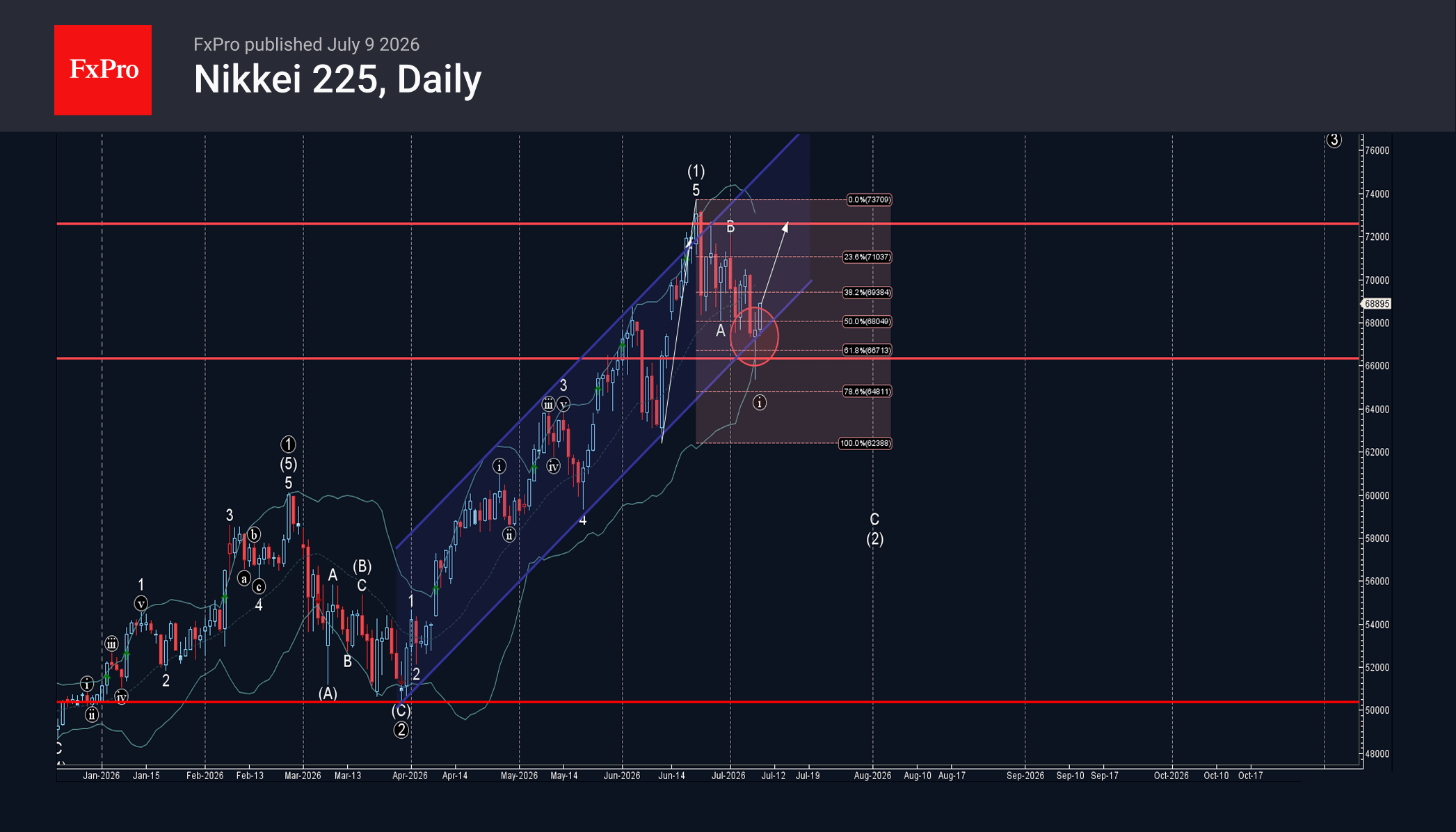
Nikkei 225 index recently reversed up from the support zone between the support level 66000.00, lower daily Bollinger Band and the support trendline of the daily up channel from March.
The upward reversal from this support zone created the daily Japanese candlesticks reversal pattern Lon-Legged Doji.
Given the clear daily uptrend, Nikkei 225 index can be expected to rise further toward the next resistance level 72575.00 (which stopped earlier wave (1)).
Eco Data 7/10/26
| GMT | Ccy | Events | Act | Cons | Prev | Rev |
|---|---|---|---|---|---|---|
| 23:50 | JPY | PPI M/M Jun | 0.40% | 0.30% | 0.90% | 1.10% |
| 23:50 | JPY | PPI Y/Y Jun | 7.10% | 6.80% | 6.30% | 6.60% |
| 06:00 | EUR | Germany CPI M/M Jun F | -0.30% | -0.30% | -0.30% | |
| 06:00 | EUR | Germany CPI Y/Y Jun F | 2.30% | 2.30% | 2.30% | |
| 12:30 | CAD | Net Change in Employment Jun | 18.2K | 10.0K | 87.8K | |
| 12:30 | CAD | Unemployment Rate Jun | 6.50% | 6.60% | 6.60% | |
| 12:30 | CAD | Building Permits M/M May | -1.70% | 1.00% | -7.60% | -6.60% |
| 23:50 | JPY |
| PPI M/M Jun | |
| Actual | 0.40% |
| Consensus | 0.30% |
| Previous | 0.90% |
| Revised | 1.10% |
| 23:50 | JPY |
| PPI Y/Y Jun | |
| Actual | 7.10% |
| Consensus | 6.80% |
| Previous | 6.30% |
| Revised | 6.60% |
| 06:00 | EUR |
| Germany CPI M/M Jun F | |
| Actual | -0.30% |
| Consensus | -0.30% |
| Previous | -0.30% |
| 06:00 | EUR |
| Germany CPI Y/Y Jun F | |
| Actual | 2.30% |
| Consensus | 2.30% |
| Previous | 2.30% |
| 12:30 | CAD |
| Net Change in Employment Jun | |
| Actual | 18.2K |
| Consensus | 10.0K |
| Previous | 87.8K |
| 12:30 | CAD |
| Unemployment Rate Jun | |
| Actual | 6.50% |
| Consensus | 6.60% |
| Previous | 6.60% |
| 12:30 | CAD |
| Building Permits M/M May | |
| Actual | -1.70% |
| Consensus | 1.00% |
| Previous | -7.60% |
| Revised | -6.60% |
Sunset Market Commentary
Markets
Oil remained at the center of attention today, if only because there was little else to inspire markets. The collapse of the ceasefire is not particularly suggesting that the US and Iran are close to a permanent agreement which settles, amongst others, on a safe and unhindered passage through the Strait of Hormuz. That should put a solid bottom below the price of Brent for the time being. A barrel indeed went for lower prices in Asian and early European dealings but found support around $77 pretty soon. It is currently trading near yesterday's close ($78.5). We shouldn't forget about gas prices either. They feature the ECB's discussions as well and have risen towards the €50/MWh barrier, closing in on the Q2 highs seen in March and early June. With energy prices moving quickly from the European central bank's milder scenario back towards the baseline (which assumes 2 to 3 rate hikes), euro area money markets are readjusting their policy views again. An October hike is fully priced in with another one in December given a 50% probability. The central bank itself made it a priority, though, not to signal last month's June to be a one-off nor to be the start of a cycle, today's released minutes of that meeting showed. Vigilance remained warranted nonetheless, with further indirect effects seen in the pipeline and second-round effects remaining a clear possibility. "It was suggested that the evolution of underlying inflation dynamics was indicative of persistent rather than temporary underlying price pressures and therefore a cause for concern." The June deliberations took place prior to the MoU and subsequent oil price drop but hold their relevance because of the developments in these past 48 hours. In terms of yields the lack of a further sharp rise in oil/gas prices took some of the heat at the front end of the curve. German rates ease 4 bps in the 2-yr bucket. The long end ekes out 1 bp still. Treasury yields show a similar curve shift, losing 3 bps at the short end while adding 1 bp at the longest maturity. Gilts outperform after paying the biggest price yesterday, resulting in net daily changes varying between -4 (30-yr) and -6 bps (2-yr). Currency markets trade stoic as ever. EUR/USD is going nowhere around 1.142 with an early attempt for a gentle rise ending in tears. DXY and 101 have been inseparable all week so far. Sterling does go in reverse, allowing EUR/GBP to stage a minor comeback towards 0.853 in technically insignificant trading. Stock markets hold an optimistic view on the conflict. The EuroStoxx50 recoups about half of yesterday's losses. Wall Street opens higher as well, led by tech.
News & Views
A quarterly report of the Bank of Japan on the regional performance painted a constructive picture. The report summarized that 'All nine regions reported that their respective economies had been recovering moderately, picking up, or picking up moderately, although some weakness had been seen in part'. Companies have increasingly secured alternative supply to cope with shortages due to the conflict in the Middle East. (Export) demand and orders related to AI continue to increase. Companies also reported to maintain an active investment stance. Corporate profits remain strong and labor shortages persist. In this respect, companies implemented wage increases in fiscal year 2026 that were as large as those in fiscal year 2025. Consumption (including tourism) mostly is seen as remaining strong. Regarding prices, many businesses continue to pass higher labor and logistics costs on to customers. The report will be (important) input at the next BOJ policy meeting scheduled for July 31. Even so markets still only consider a next BOJ rate hike (chance of +50%) in the final quarter of the year.
Governor Glapinski of the National Bank of Poland commented on yesterday's NBP policy decision. The NBP yesterday left its policy rate unchanged at 3.75%. Inflation in June decreased at the NBP's 2.5% target from 3.1% due to a decline in prices for fuels and food. In new model forecasts the NBP upwardly revised its inflation 2026 CPI forecast to 2.4%-3.3% (from 1.6%-2.9%) and for 2027 to 1.5%-4% (from 1.1%-3.7%). The 2028 forecast was little changed at 0.8%-3.9%. At the same time 2026 and 2027 growth forecasts were slightly downwardly revised (3%-4.4% and 1.8%-3.7% respectively). The NBP in its statement didn't give any concrete 'bias' on its intentions, making next policy steps dependent on incoming information. Governor Glapinski still suggested some tendency. He confirmed that CPI could rise somewhat in the coming quarters but that it is expected to stay within the target range. He also assesses wage growth to be slowing significantly. He assessed the MPC bias as cautiously dovish and personally he even sees a rate cut possible in 2026. The MPC might be less cautious toward rate cuts by mid-2027. The zloty over the previous months underperformed the forint and the Czech koruna. EUR/PLN is at risk of breaking above the 4.30 area that marked the top off a sideways consolidation pattern since April last year.
The Euro: Interest Rates Won’t Do the Trick Alone
- Investors are once again anticipating an ECB rate rise.
- TACO has been the main driver behind the EURUSD growth.
The US dollar failed to capitalise on Brent crude’s rise to two-week highs and the Fed’s concerns about high prices becoming entrenched in the US economy. Investors believe that Donald Trump’s announcement of the termination of the Iran deal is, in fact, part of a negotiating strategy, or TACO (Trump Always Chickens Out), and it has returned to the financial markets. Meanwhile, confidence in a swift de-escalation of the conflict is pushing the DXY down.
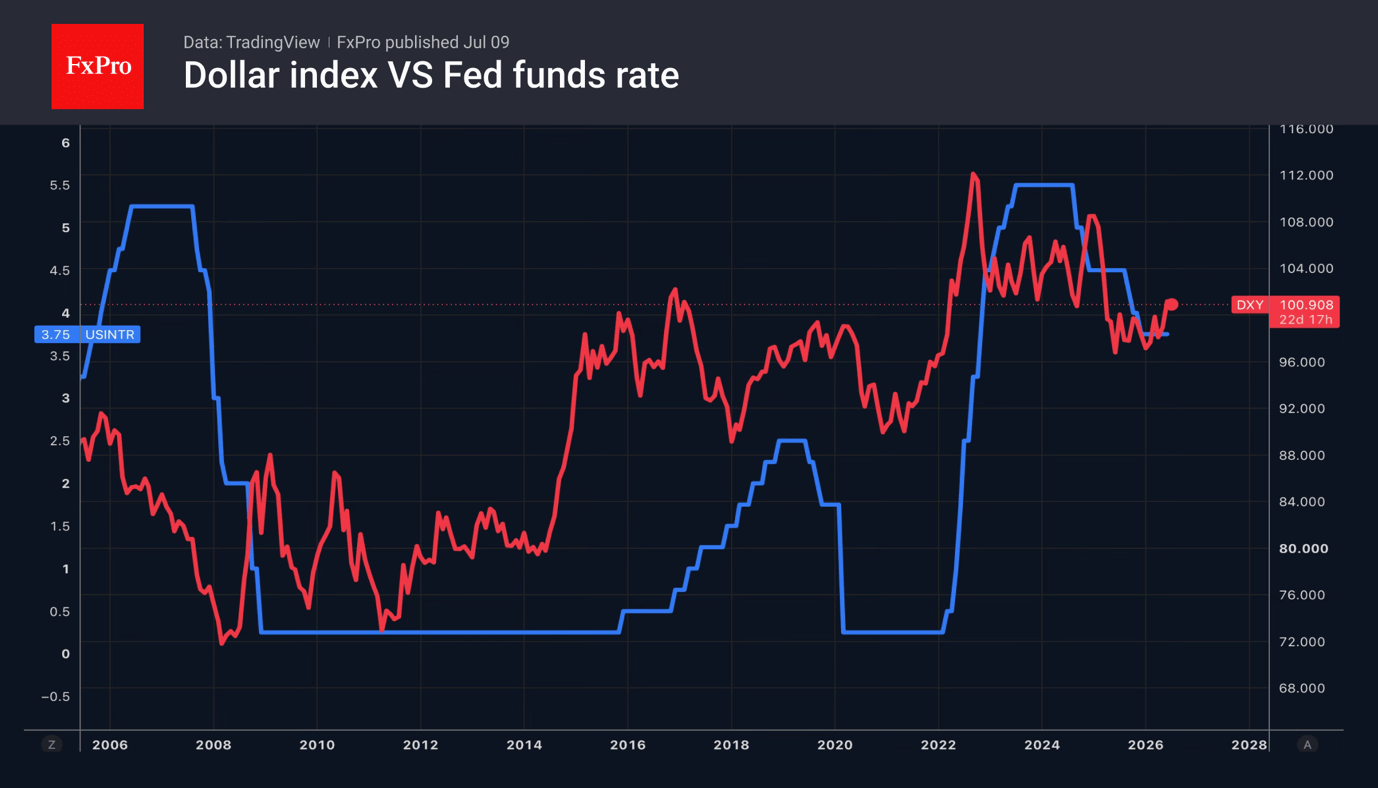
The minutes of the June FOMC meeting revealed officials’ concern that the PCE has remained above the 2% target for too long. Although the labour market is not the main source of inflationary pressure, the Fed is concerned about how it will react to tariffs, the oil shock and, finally, the boom in investment in artificial intelligence technologies. Officials have set out their outlook for the future, and there seem to be few rifts within the Committee, as the mixed forecasts on interest rates might have suggested.
As a result, the market interpreted the FOMC minutes as moderately hawkish, raising the probability of a rate hike in 2026 to 84%. The likelihood of two hikes rose to 45%. However, this did not help the US dollar, nor did the increased demand for hedging against the EURUSD risk. The risk of a reversal in the euro has fallen significantly against the backdrop of the escalating armed conflict in the Middle East. However, the bears’ joy was short-lived.
The rally in Brent crude is likely to negatively impact the eurozone economy, which is dependent on energy imports. The IMF has lowered its GDP forecast for the currency bloc for 2026 from 1.1% to 0.9%, citing higher oil prices compared with last year. On the other hand, the surge in North Sea crude is fuelling inflation and reviving the notion that the ECB will raise rates more aggressively than the Fed. This has been reflected in German bond yields outpacing those of their US counterparts.
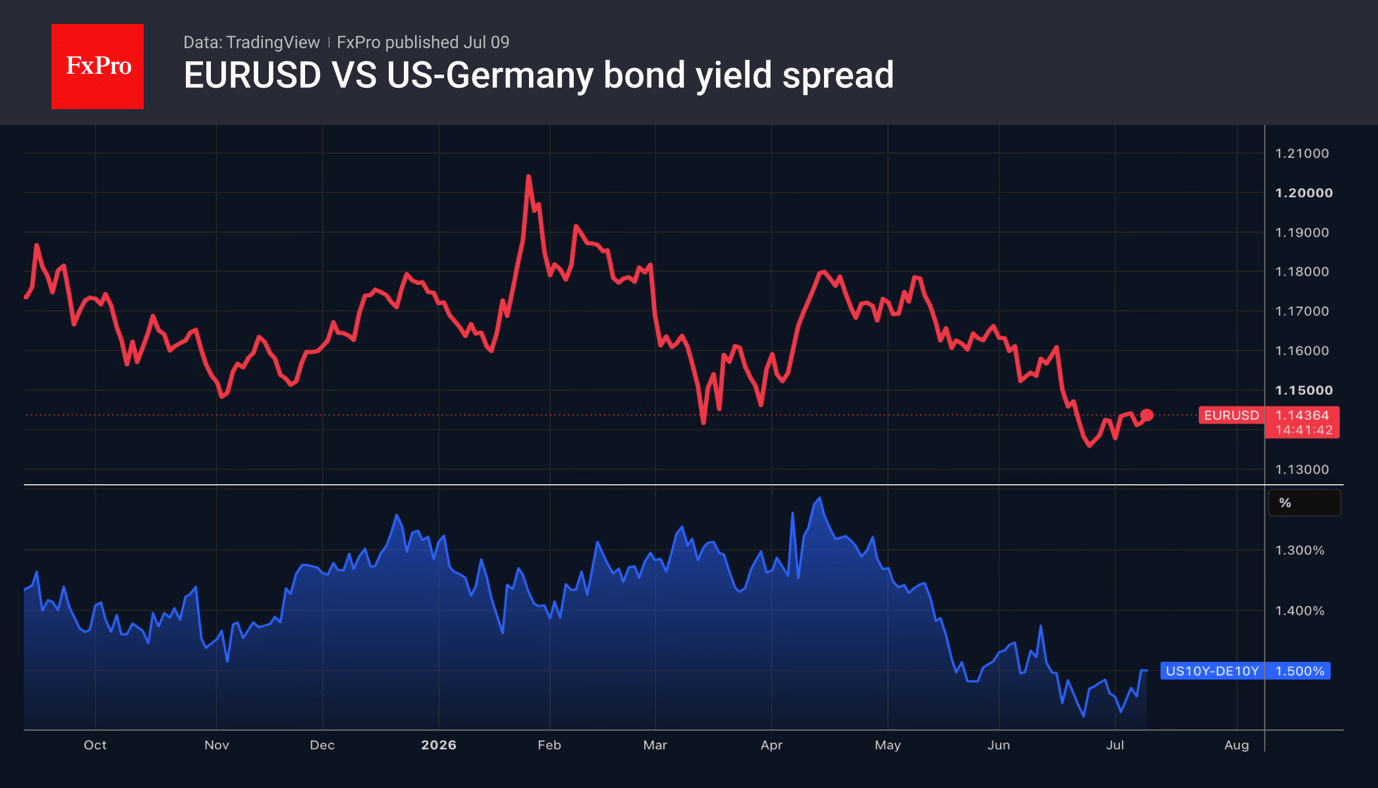
The main drivers behind the rapid recovery of EURUSD were TACO and investors’ belief in a swift de-escalation of the conflict in the Middle East. This was particularly the case as oil prices retreated following reports that traffic through the Strait of Hormuz remained unchanged. According to Kpler, 36 tankers passed through the strait on July 6th and 41 on July 7th, broadly in line with the past week’s daily average of 40.
The FxPro Analyst Team
NZD Leads on Growth Optimism While CAD Awaits Jobs Test
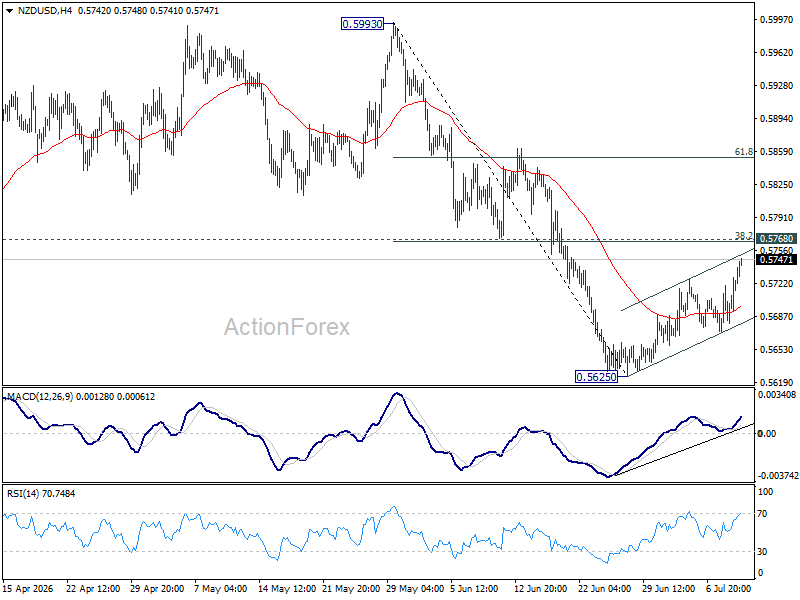
New Zealand Dollar outperformed across the board today after a much stronger-than-expected manufacturing survey reinforced confidence that the economy is gaining momentum following the Reserve Bank of New Zealand's rate hike. At the other end of the spectrum, Canadian Dollar is the weakest major currency despite another sharp rebound in oil prices, underscoring that structural concerns over Canada's economic outlook continue to outweigh support from higher crude prices. Meanwhile, Dollar softened modestly as traders awaited fresh developments on the fragile US-Iran ceasefire, with Brent failing to sustain an early move above the key $80 level.
Kiwi's rally was underpinned by June's impressive BusinessNZ Performance of Manufacturing Index, which surged to 59.7, its highest reading since mid-2021. The improvement was broad-based, with new orders, production, employment and deliveries all strengthening sharply, suggesting the recovery is becoming increasingly self-sustaining. Even BNZ Head of Research Stephen Toplis said he was "staggered" by the magnitude of the rebound, noting that excluding the post-pandemic reopening surge, the latest reading was the strongest since May 2017.
The data also provide strong ex-post validation for the RBNZ's decision to raise the Official Cash Rate to 2.50% yesterday. While policymakers stopped short of signalling another imminent move, the report strengthens the case that policy normalization still has further to run should improving momentum spread beyond manufacturing into the broader economy. Some economists, including Westpac, continue to expect additional rate hikes later this year.
By contrast, the Canadian Dollar struggled even as Brent crude briefly traded above $80. Markets appear focused on Canada's longer-term challenges rather than short-term support from commodity prices. The Trump administration's decision not to automatically extend the USMCA has introduced a fresh uncertainty for investment and trade, reinforcing Bank of Canada Governor Tiff Macklem's repeated assessment that the economy is undergoing a structural adjustment as trade relations with the United States evolve.
That backdrop also helps explain why the BoC has shown little inclination to respond to higher oil prices with a more hawkish policy stance, arguing that temporary energy shocks are unlikely to generate sustained inflation. Attention now turns to Friday's June employment report. A softer-than-expected outcome would reinforce expectations that the BoC remains comfortably on hold and could trigger another round of Canadian Dollar selling.
Oil remains an important macro variable, but today's price action suggests markets are not yet ready to rebuild a full geopolitical risk premium. Brent briefly broke above the psychological $80 mark after renewed US-Iran tensions, but quickly surrendered those gains as investors continued to bet that both sides retain strong incentives to keep the Strait of Hormuz open and negotiations alive.
A sustained move above $80, particularly if accompanied by a break through nearby technical resistance, would indicate that markets are once again pricing a more persistent disruption to global energy supplies. Until then, today's retreat suggests geopolitical concerns remain contained rather than dominant.
GBP/CAD Hits Decade High as USMCA Shock Adds New Driver Ahead of Jobs Data
GBP/CAD has broken to a new decade high, but the story is not just about Sterling strength. Discover why the USMCA review has become a new structural headwind for the Canadian Dollar and why Canada's jobs report could determine whether the rally accelerates further. Read More.
Gold and Silver Bears Need One More Trigger: Brent Above $80
Gold and silver have turned lower again, but bears may need one more confirmation before pressing for a full downside breakout: Brent holding above $80. A sustained oil rally would revive inflation concerns, reinforce Fed tightening risks, and increase pressure on precious metals. Read More.
ECB Minutes: Inflation Damage Already Too Broad to Ignore
The ECB's June rate hike was never just about higher oil prices. The minutes reveal policymakers believed inflation had already spread too far across the economy, making tighter policy necessary even if Middle East tensions had eased. Discover why the Governing Council saw waiting as no longer an option. Read More.
New Zealand Manufacturing PMI Surges to Strongest Since 2021 as Orders Soar
The BusinessNZ PMI surged to a near four-year high in June, surprising even BNZ economists. Find out what fueled the sharp turnaround and why stronger order books could signal a sustained manufacturing recovery. Read More.
China Inflation Cools Further as Consumer Prices Ease, Producer Inflation Hits Three-Year High
China's latest inflation data told two very different stories. Consumer inflation softened again as lower energy prices eased household costs, while producer inflation climbed to its highest level since 2022 on resilient industrial demand. Read More.
USD/CAD Daily Outlook
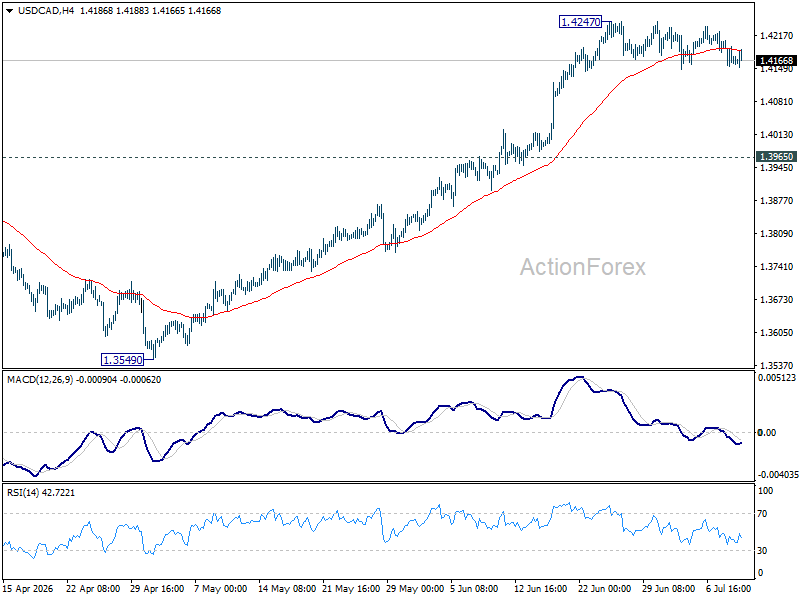
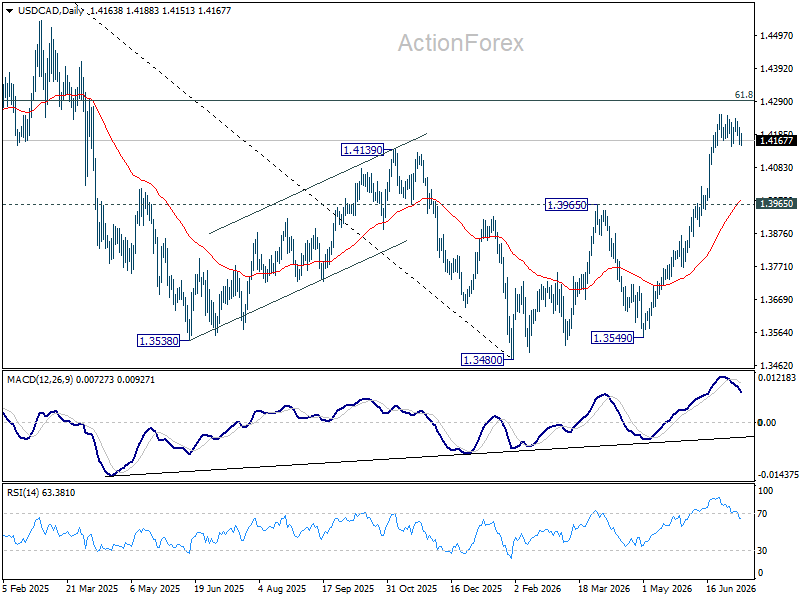
Consolidation continues below 1.4247 and intraday bias remains neutral in USD/CAD. Deeper pullback cannot be ruled out. But downside should be contained above 1.3965 resistance turned support. Above 1.4247 will resume the rally from 1.3480 to 61.8% retracement of 1.4791 to 1.3480 at 1.4290. Firm break there will pave the way back to 1.4791 high.
In the bigger picture, current development suggests that fall from 1.4791 has completed as a three wave correction to 1.3480. It's still early to judge if rise from there a corrective bounce, or resumption of the larger up trend from 1.2005 (2021 low). But in either case, retest of 1.4791 high should be seen next.
ECB Minutes: Inflation Damage Already Too Broad to Ignore
The minutes of the ECB's June meeting reinforced the Governing Council's conviction that inflationary pressures had become too broad and persistent to justify waiting any longer before tightening policy. While all members unanimously backed a 25 basis point rate hike, the discussion showed policymakers had fundamentally reassessed the nature of the Middle East energy shock. Rather than treating it as a temporary supply disruption, members concluded that "the current situation no longer qualified as a case for looking through the shock" and that "the option value of waiting for further information had diminished considerably."
The Governing Council argued that inflation had spread well beyond energy prices. Members noted "increasingly visible and broad-based indirect effects on non-energy inflation," while warning that second-round effects were becoming increasingly likely the longer the energy shock persisted. Core inflation was now projected to remain above the ECB's 2% target throughout the forecast horizon. Significantly, policymakers concluded that even under a milder scenario in which the Middle East conflict eased and energy prices were lower, "a significant portion of the inflationary damage... would already have worked its way into the broader economy." Supply chain disruptions, higher production costs and firms' pricing decisions would not simply reverse alongside lower oil prices, making the June rate increase appropriate across all scenarios considered.
Despite the hawkish assessment of inflation, the minutes reaffirmed the ECB's commitment to a data-dependent and meeting-by-meeting approach. Members stressed that communication should "refrain from giving any guidance regarding the future interest rate path," arguing it should remain neutral rather than implying either a sequence of further hikes or a one-off move. At the same time, the Governing Council reiterated its determination to return inflation sustainably to 2%, emphasizing that policy would remain agile and flexible as it assessed how higher energy costs continue feeding through wages, inflation expectations and broader price-setting across the euro area.