

Sample Category Title
Inflation Data and Fed Verdict Could Set Dollar’s Summer Trend
The US currency is gearing up for the most important trading session of the current week, and possibly even the month. Today, the US Consumer Price Index (CPI) data for May will be released. Additionally, the Federal Reserve (Fed) has a meeting scheduled today where the base interest rate will be announced, along with the regulator's dot plot forecast for the rest of the year. Considering that last Friday's employment data exceeded forecasts, many investors and experts (according to an FT-Chicago Booth survey) believe that:
- The Fed will reduce rates by only a quarter of a percentage point this year;
- Instead of three cuts, economists and traders are pricing in up to two rate cuts by the end of the year.
Naturally, such hawkish market expectations are likely to support the strengthening of the US currency. However, it should be noted that the dollar is currently at medium- and long-term highs, and the likelihood of a pullback and the formation of reversal patterns is quite high.
USD/JPY
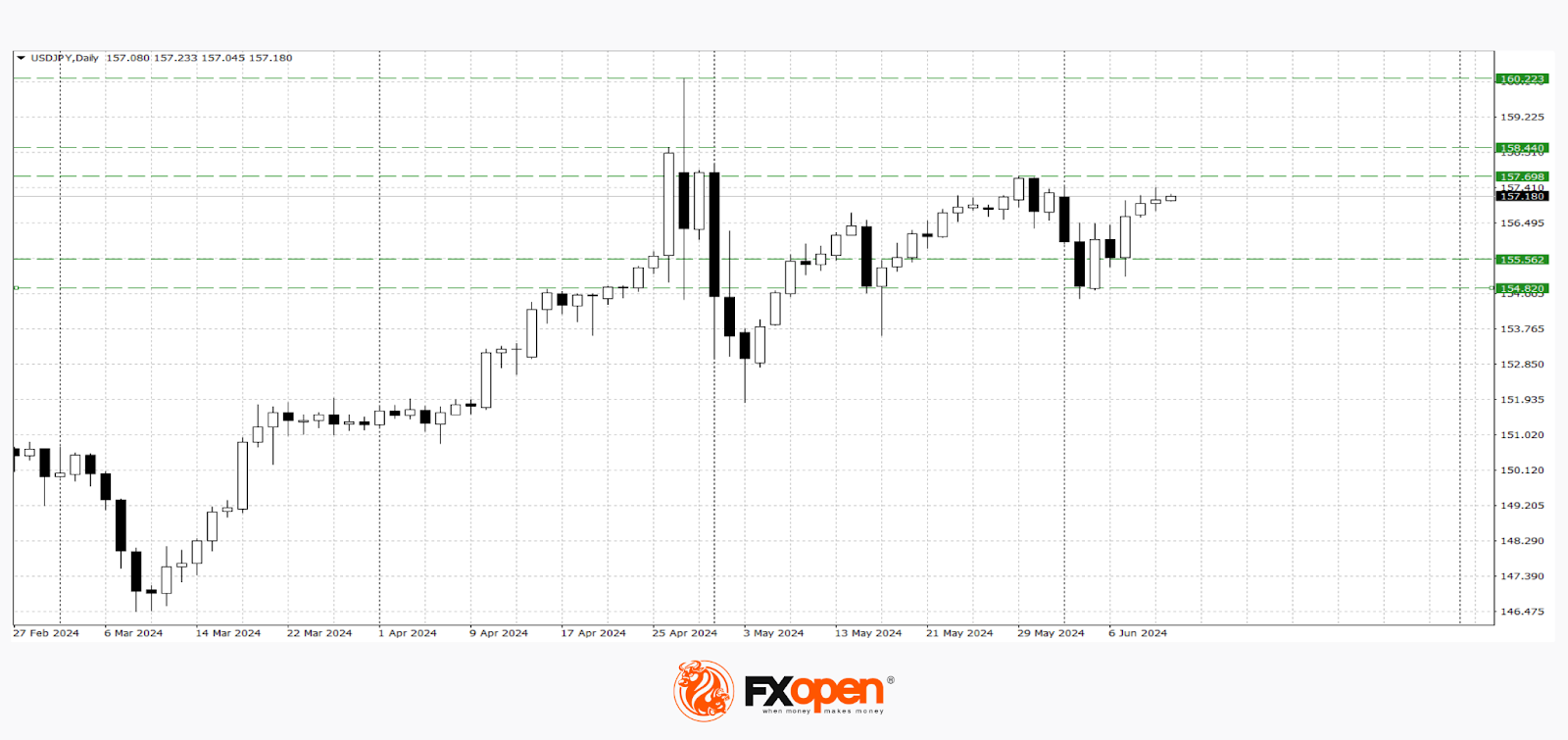
Following the technical analysis of the USD/JPY pair:
- There is a high probability of testing the May high of this year at 157.70;
- Consolidation above 157.70 could contribute to a renewed rise towards the psychological level of 160.00;
- A rebound or a false breakout at 157.70 could contribute to a return to 155.60-154.80.
EUR/USD
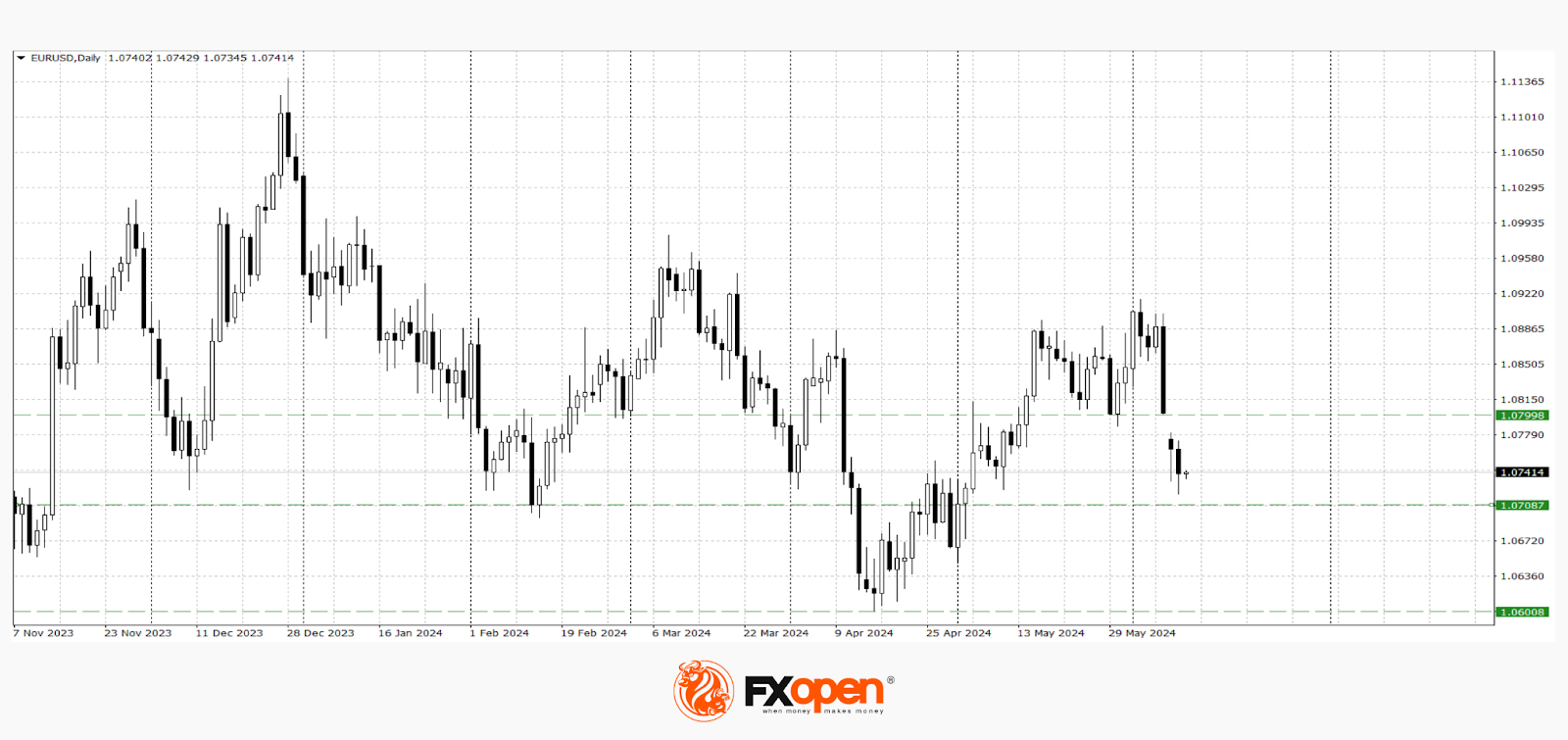
The EUR/USD currency pair is under double pressure. On the one hand, the dollar is strengthening after good labour market data in the US, and on the other hand, there is political uncertainty following the European Parliament elections, the results of which were published at the beginning of the week. Where might the pair head in the upcoming trading sessions?
- In case of weak data for the dollar, the price could attempt to close the "price gap" of Monday at 1.0800;
- A break of the important support level at 1.0710 could contribute to a resumption of the downward movement towards 1.0600.
Trade over 50 forex markets 24 hours a day with FXOpen. Take advantage of low commissions, deep liquidity, and spreads from 0.0 pips. Open your FXOpen account now or learn more about trading forex with FXOpen.
This article represents the opinion of the Companies operating under the FXOpen brand only. It is not to be construed as an offer, solicitation, or recommendation with respect to products and services provided by the Companies operating under the FXOpen brand, nor is it to be considered financial advice.
US in the Spotlights Today
Markets
Market conditions remained sour yesterday. Macron’s political gamble got another layer of uncertainty on rumours that the French president would resign in case of a defeat in the snap elections. While denied later, the genie was out of the bottle. Stocks in Europe remained under pressure. It wasn’t France’s CAC40 (-1.33%) that underperformed this time around, but Borsa Italiana (-1.93%), suggesting spreading market concerns. Both countries as well as Greece saw credit risk premia rising again (both against swap and Germany’s 10-yr) yield). The French spread vs swaps built on Monday’s break above the 2020 high. German bunds attracted a safe haven bid with yields easing between 2 (30-yr) and 6.6 bps (2-yr). US yields traded only a tad lower going into a strong $39bn 10-yr auction which stopped through (4.438% vs 4.458% WI). Bidding metrics were strong with the highest bid-to-cover in more than two years and investors snapping up about 75% of the sale, the most for a 10-yr auction since February 2023. The results contrasted sharply with those for the 3-yr auction on Monday and pushed rates in the US 4.5 to 6.4 bps lower across the curve. Euro weakness prevailed in currency markets. EUR/USD dropped for a third day straight to the lowest since early May (1.074). Some dollar strength was at play too. DXY moved further north of the 105 barrier. EUR/GBP quickly reversed a kneejerk move higher in the wake of the British labour market report to finish at a new YtD low of 0.8418.
The US is in the spotlights today. Tonight’s FOMC meeting is preceded by important CPI numbers. We see upside risks for the headline number (0.1% m/m, 3.4% y/y) and are more neutral on the core reading (0.3%, 3.5%). It serves as some last-minute input for the Fed even though it probably won’t have been factored in into the new projections. The policy rate will remain at an unchanged 5.25-5.5%, directing market’s focus towards the median rate forecasts. The March dot plot projected three rate cuts but that was a close call. We expect that balance to have shifted to two while holding on to the three forecasted for 2025. Markets currently already discount such a combined five cuts and differ only on the timing. In any case, the market reaction may stay muted. Projecting only one cut for 2024 without moving the second to 2025 is a tail risk that may trigger a UST sell-off. It does, however, require a large shift in individual views. We’ll keep a close eye at the long-term projection for the neutral rate, which is likely to have shifted further north. The statement in May adjust to the hawkish side, citing lack of progress towards the 2% inflation target. Eco data since offer few reasons to turn outright dovish with the latest services ISM and payrolls report case in point. But a more balanced tone from chair Powell (e.g. stressing the downturn in manufacturing or the uptick in the unemployment rate) at the presser should even things out a bit. Still, combined with the CPI release we’re more biased towards higher core/US yields. The dollar’s fortunes are at least, if not more, determined by the euro.
News & Views
Bloomberg reports that the US government is considering further restrictions on China’s access to chip technology used for AI, according to people close to the matter. Topic of debate is limiting the ability to use “gate all-around”, a new chip architecture which will be part of the next generation semiconductors to be manufactured withing the next year. There are also early-stage talks about limiting exports of high-bandwidth memory chips, used to train AI software. US Commerce Secretary Raimondo at several occasions stressed that the US will add to existing restrictions as much as needed to keep the most advanced AI technology out of Chinese hands.
Chinese inflation fell by 0.1% M/M on a headline level and by 0.2% M/M for the underlying core series. Both reversed similar increases in April. Consumer goods prices fell for a third month straight with services prices falling into deflation as well in May. Weak consumer demand remains the key reason. In Y/Y-terms, headline and core inflation respectively remained unchanged at 0.3% and slowed from 0.7% to 0.6%. Producer prices recorded a 20th consecutive Y/Y-decline, with the pace slowing though from -2.5% in April to -1.4% in May.
Graphs
GE 10y yield
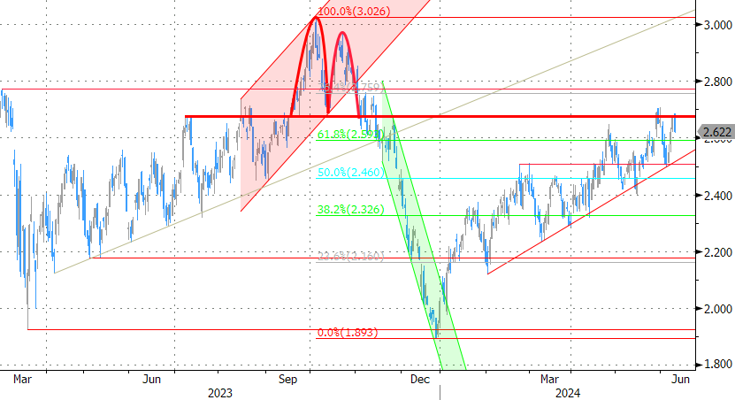
The ECB cut its key policy rates by 25 bps at the June policy meeting. A more bumpy inflation path in H2 2024, the EMU economy gradually regaining traction and the Fed’s higher for longer US strategy make follow-up moves difficult. Markets are coming to terms with that. The German 10y yield set a new YtD top at 2.7%.
US 10y yield
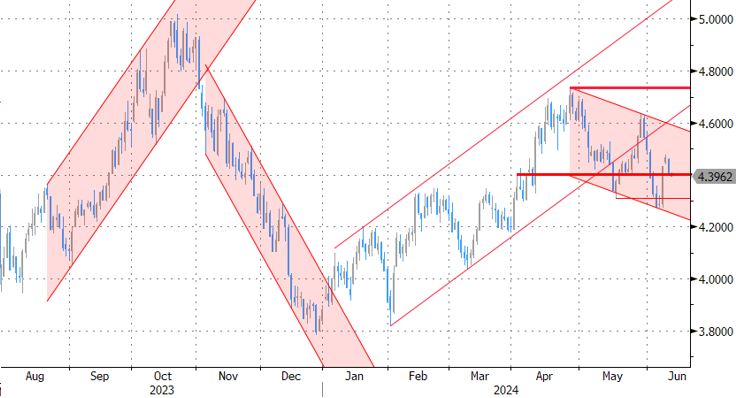
The Fed in May acknowledged the lack of progress towards the 2% inflation objective, but Fed Chair Powell indicated that further tightening was unlikely. However, the FOMC Minutes still showed internal debate on whether policy is restrictive enough. Sticky inflation suggests any rate cut will be a tough balancing act while several policy makers hint at a higher neutral rate. The US 10-y yield is stuck in the 4.3/4.7% trading range.
EUR/USD
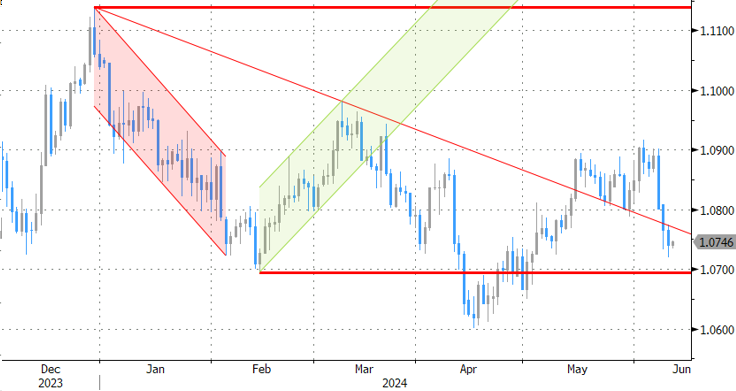
EUR/USD is stuck in the 1.06-1.09 range. The desynchronized rate cut cycle with the ECB exceptionally taking the lead, strong US May payrolls and a swing to the right in European elections pulled the pair away from 1.09 resistance. Focus turns to the US side of the story with May CPI inflation numbers and a more hawkish Fed looming on the horizon.
EUR/GBP
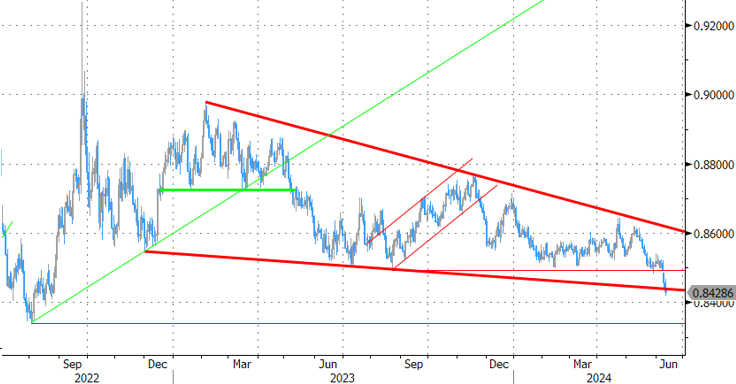
Debate at the Bank of England is focused at the timing of rate cuts. Slower than expected April disinflation and a surprise general election on July 4 suggest that a June cut in line with the ECB looks improbable. Sterling gained momentum with money markets now discounting a Fed-like scenario. EUR/GBP tested the 2023 & 2024 lows near 0.85. Euro weakness eventually pulled the trick after French president Macron called snap elections following a weak showing in EU elections.
US CPI and FOMC Rate Decision Today
In focus today
Today's main events will be the US May CPI at 14.30 CET followed by the FOMC rate decision at 20.00 CET. We expect the Fed to maintain monetary policy unchanged in line with broad consensus and market pricing. The median rate projection on the updated 'dot plot' is likely to signal only two rate cuts this year (prev. three) while economic projections will likely remain little changed, see Research US - Fed preview: No urgency, 7 June. We forecast headline CPI inflation at 0.19% m/m SA (Prior: 0.3%; Cons: 0.3%) and Core CPI at 0.25% m/m SA (Prior: 0.29%; Cons: 0.3%). We see risks tilted towards a dovish market reaction over the course of the day.
In the UK we get the monthly GDP figures for April. After a strong start to the year Q1 growth at 0.6% q/q, consensus expects a more muted print at 0.0% m/m for April.
In Germany, we receive the final inflation figures for May. The monthly increase in services inflation was very strong and the details will show much of this was due to the one-off increase in airfare taxes that increased by 19% on May 1 and how much was broad-based pressures.
Economic and market news
What happened overnight
In China the CPI print came in at 0.3% y/y (Cons: 0.4%, Prior: 0.3%) while the PPI came in at -1.4% (Cons: -1.5%, prior: -2.5%). Overall, the print still shows deflationary pressures in China with m/m change at -0.1%. Weak consumption is still supporting low prices and consumer confidence, despite several rounds of support measures.
What happened yesterday
ECB's Lane said Yesterday that ECB should wait with its next rate cut until uncertainty recedes. Lane argued that the key unknown is wage growth, saying that the bank will need to maintain a restrictive monetary stance. The comment seems in line with President Lagarde's interview on Monday, when she said that ECB could wait more than one meeting between cuts. On the other hand, Villeroy sounded way more dovish saying that there is 'significant leeway' to cut rates and still stay restrictive and that further cuts should be made without haste or procrastination. We expect the ECB to cut interest rates once more in 2024 at the December meeting.
10y French government bond yields widened further vs. 10y German bunds to 60bp, up from 55bp on Monday and 47bp on Friday. The French Cac 40 stock index fell to its lowest point since February. The changes show that markets still worry about future economic policy after President Macron called a snap parliament election. His party gained only around half the votes of primary presidential opponent Le Pen's party Rassemblement National (RN) at Sunday's European Parliament (EP) election. Macron has announced policies to strengthen public finances and reduce government debt. If RN gains majority markets see a risk that the French government will withdraw these actions and increase the budget deficit even more. Often the EP elections have been protest elections in France, not necessarily meaning that the same result will show in national elections. From here we look out for the two elections dates on 30 June and especially second round 7 July, where the final election result is determined.
In the US we got mixed signals from the May edition of NFIB's small business survey. The general optimism and future outlooks edged cautiously higher (albeit from a low level). At the same time, uncertainty rose to the highest level since the previous election month of November 2020. Price plans rose slightly from April but remain below Q1 levels. All-in-all, nothing that should move the markets here.
In the UK, the labour market report for April/May was to the weak side. Wage growth excl. bonus remains at 6.0% 3M/YoY (cons: 6.1%, prior: 6.0%) with the increase in the National Living Wage taking effect in April underpinning wage growth. While the report acts as input, the BoE has highlighted that it looks at a range of indicators to assess the tightness of the labour market noting the poor data quality of the survey.
Market movements
Equities: Global equities ended marginally lower yesterday, with the US pushing higher and ending close to the day's highs, while Europe, led by the peripherals, trended lower. We must admit i'’s surprising for us to see the European Parliament election, the subsequent announcement by Macron, the cut of Frenc credit rating having such a significant market impact. The bond spread between Germany and the peripherals, including France, widened considerably again yesterday, with banks underperforming. It is worth noting that banks were also a notable underperformer in the US yesterday. The politically driven markets are not behaving as we have been advocating for, and both sector and regional rotations are not going in our favour. In the US yesterday, the Dow was down by 0.3%, the S&P 500 was up by 0.3%, the Nasdaq increased by 0.9%, and Russell 2000 decreased by 0.4%. Asian markets are mixed this morning, while both European and US futures are trending higher.
FI: European rates were bid through most of the day driven by dovish comments from Villeroy where he said that there is'‘significant leewa'’ to cut rates and still stay restrictive and that further cuts should be made without haste or procrastination. Earlier in the morning Lagarde said that the'‘appropriate decisio'’ last week'‘does'’t mean interest rates are on a linear declining path. There might be periods where we hold rates agai'’. Bunds ended 5bp lower on the day at 2.62%.
FX: EUR sold off further yesterday against most of G10 amid French political uncertainty with EUR/USD trading close to the 1.07 mark. In this regard, we also note that EUR/CHF and EUR/DKK has dropped in recent days-– an early sign of rising safe-haven demand in currency markets.
USD/CAD Daily Outlook
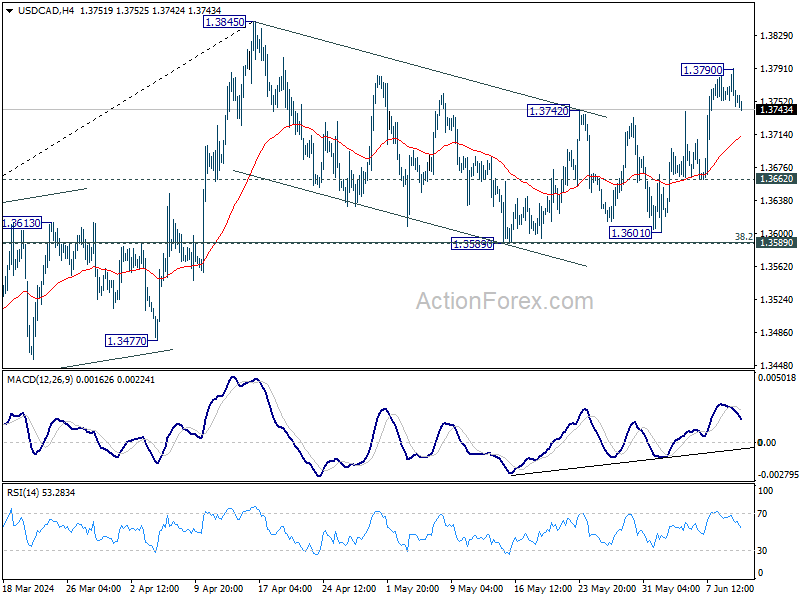
Daily Pivots: (S1) 1.3740; (P) 1.3766; (R1) 1.3784; More...
Intraday bias in USD/CAD is turned neutral with current retreat. Further rise is expected as long as 55 4H EMA (now at 1.3711) holds. Correction from 1.3845 might have completed at 1.3589 already. Above 1.3790 will bring retest of 1.3845 high. However, sustained break of 55 4H EMA will dampen this week and bring deeper fall to 1.3662 support first.
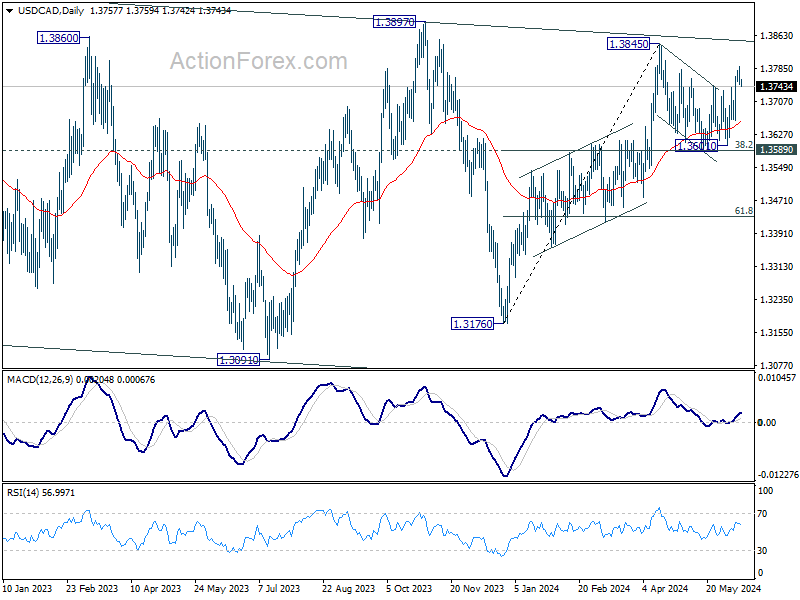
In the bigger picture, price actions from 1.3976 (2022 high) are viewed as a corrective pattern. In case of another fall, strong support should emerge above 1.2947 resistance turned support to bring rebound. Firm break of 1.3976 will confirm up resumption of whole up trend from 1.2005 (2021 low). Next target is 61.8% projection of 1.2401 to 1.3976 from 1.3176 at 1.4149.
AUD/USD Daily Report
Daily Pivots: (S1) 0.6592; (P) 0.6603; (R1) 0.6617; More...
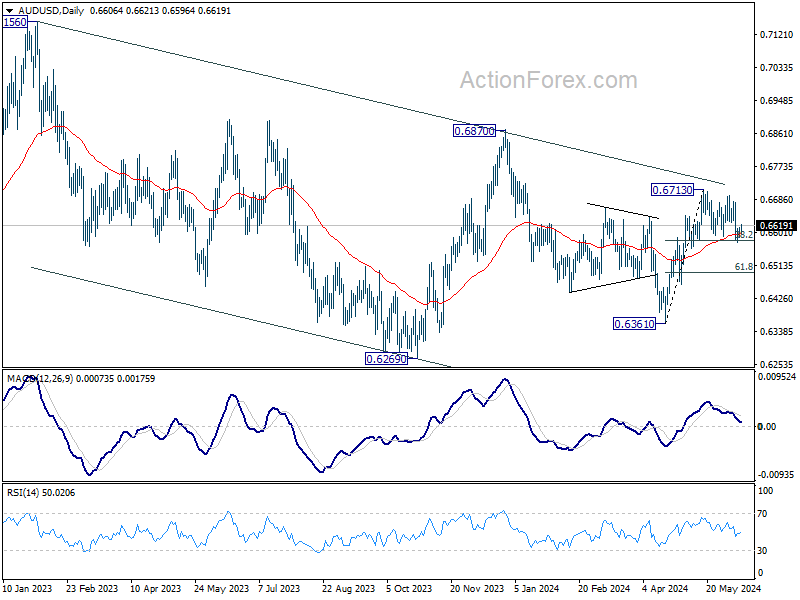
AUD/USD is staying in range below 0.6713 and intraday bias stays neutral. On the upside, firm break of 0.6713 will resume whole rise from 0.6361 to 0.6870 resistance next. However, sustained break of 0.6578 cluster support (38.2% retracement of 0.6361 to 0.6713 at 0.6579) will dampen this bullish view, and bring deeper fall to 61.8% retracement at 0.6495.
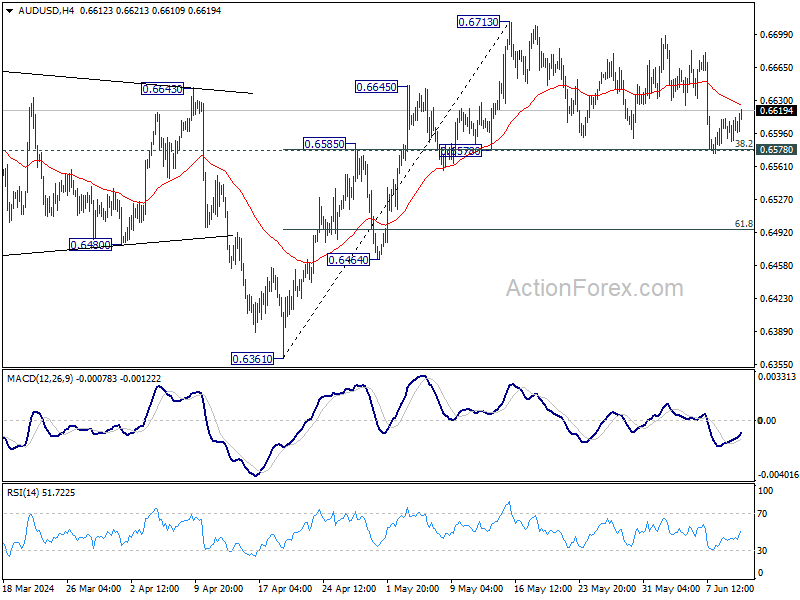
In the bigger picture, price actions from 0.6169 (2022 low) are seen as a medium term corrective pattern to the down trend from 0.8006 (2021 high). Fall from 0.7156 (2023 high) is seen as the second leg, which could have completed at 0.6269 already. Rise from there is seen as the third leg which is now trying to resume through 0.6870 resistance.
EUR/USD Daily Outlook
Daily Pivots: (S1) 1.0715; (P) 1.0745; (R1) 1.0769; More....
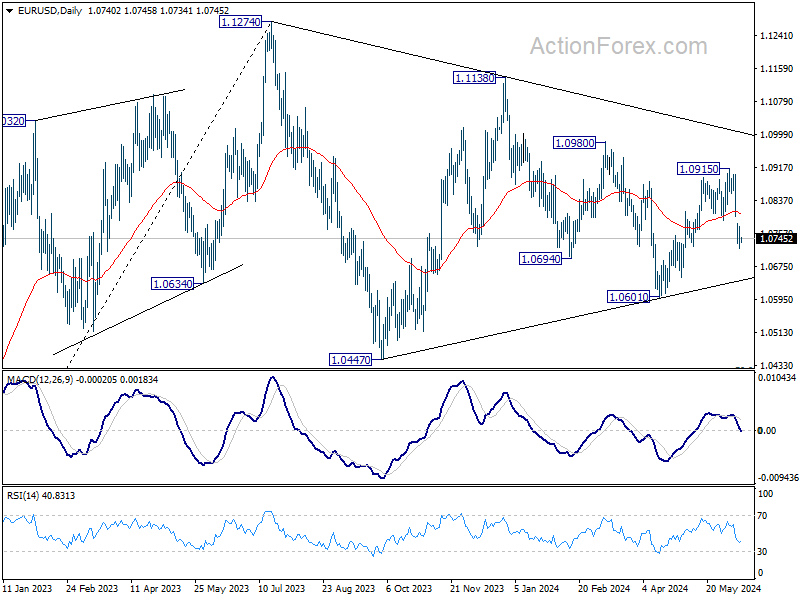
Intraday bias in EUR/USD is turned neutral first with 4H MACD crossed above signal line. Further fall is in favor as long as 55 4H EMA (now at 1.0814) holds. Decline from 1.0915 is seen as another falling leg of the corrective pattern from 1.1274. Break of 1.0718 will target 1.0601 support next. Nevertheless, sustained trading above 55 4H EMA will bring stronger rebound back towards 1.0915 resistance.
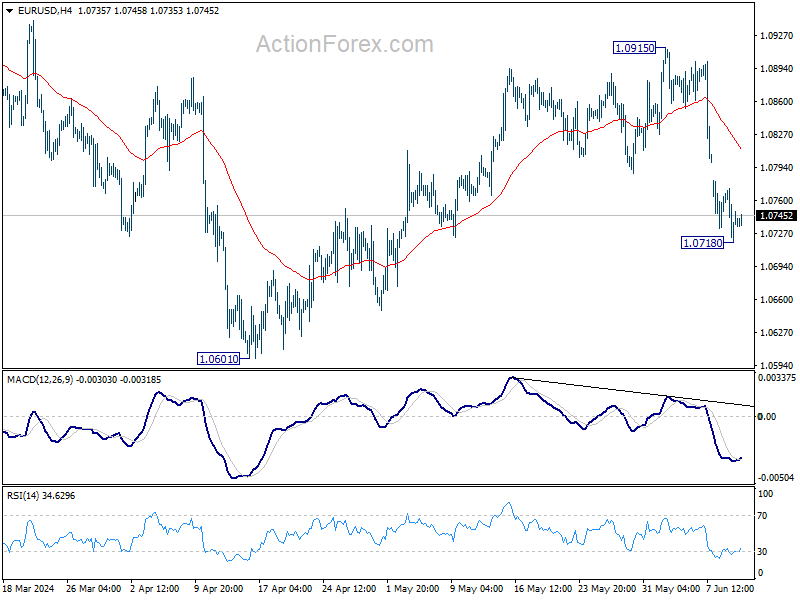
In the bigger picture, price actions from 1.1274 are viewed as a corrective pattern, which might still be in progress. Break of 1.0601 will target 1.0447 support and possibly below. Nevertheless, on the upside, firm break of 1.1138 will argue that larger up trend from 0.9534 (2022 low) is ready to resume through 1.1274 high.
GBP/USD Daily Outlook
Daily Pivots: (S1) 1.2713; (P) 1.2732; (R1) 1.2759; More...
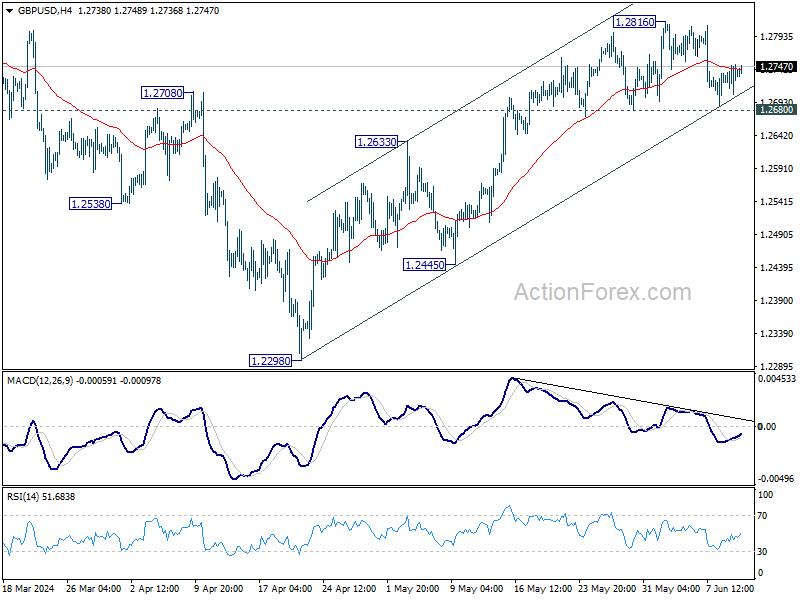
Sideway trading continues in GBP/USD and intraday bias stays neutral. Considering bearish divergence condition in 4H MACD, firm break of 1.2680 support will turn bias back to the downside for 55 D EMA (now at 1.2658) and below. Nevertheless, break of 1.2816 will resume the rise from 1.2298 to 1.2892 resistance.
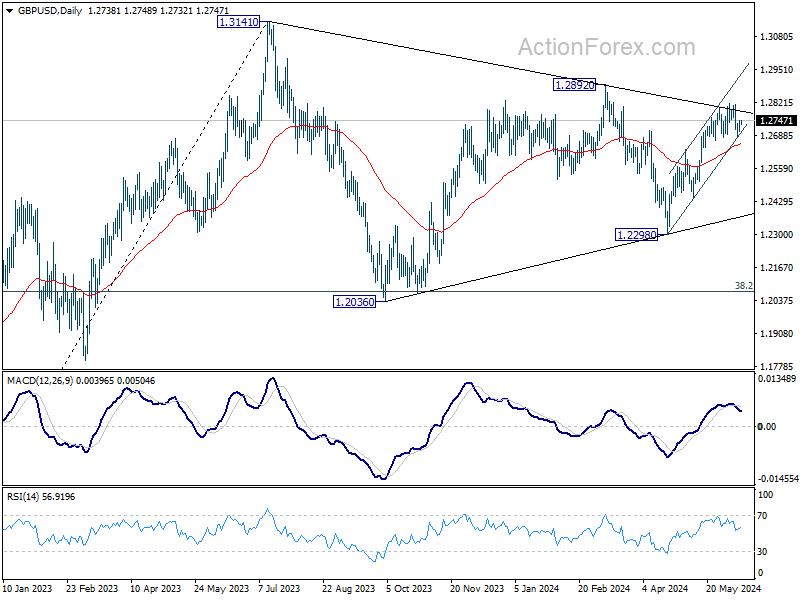
In the bigger picture, price actions from 1.3141 medium term top are seen as a corrective pattern. Fall from 1.2892 is seen as the third leg which might have completed already. Break of 1.2892 resistance will argue that larger up trend from 1.0351(2022 low) is ready to resume through 1.3141. Meanwhile, break of 1.2445 support will extend the corrective pattern with another decline instead.
USD/JPY Daily Outlook
Daily Pivots: (S1) 156.83; (P) 157.12; (R1) 157.43; More...
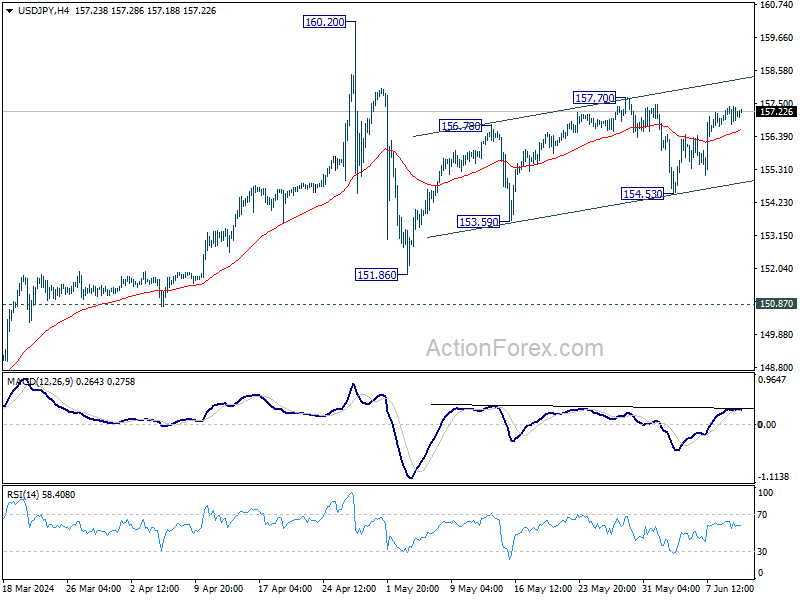
No change in USD/JPY's outlook as range trading continues. On the upside, break of 157.70 will resume the whole rise from 151.86 and target 160.20 high. Nevertheless, break of 154.53 will turn bias to the downside for 151.86 support and possibly below, as the third leg of the corrective pattern from 160.20.
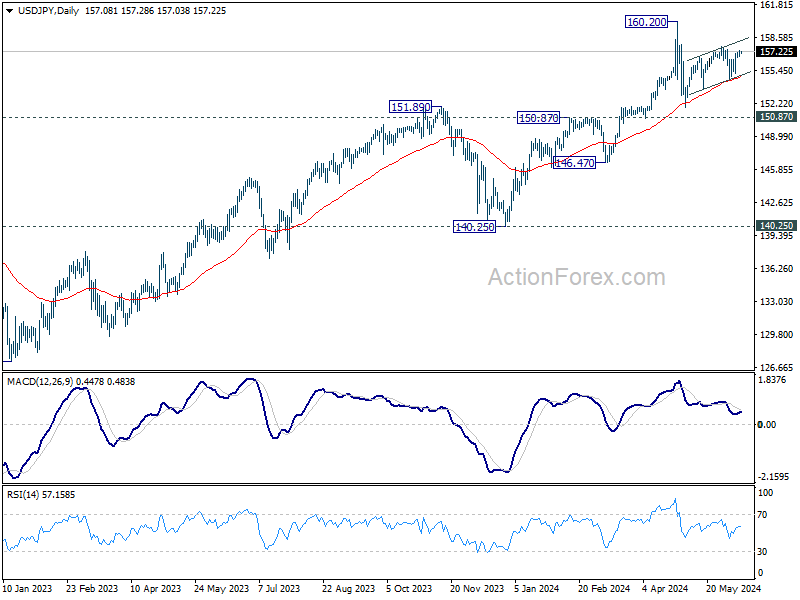
In the bigger picture, a medium term top should be formed at 160.20. As long as 55 W EMA (now at 147.77) holds, fall from 160.20 is seen as correcting the rise from 140.25 only. However, sustained break of 55 W EMA will argue that larger correction is possibly underway, and target 146.47 support next.
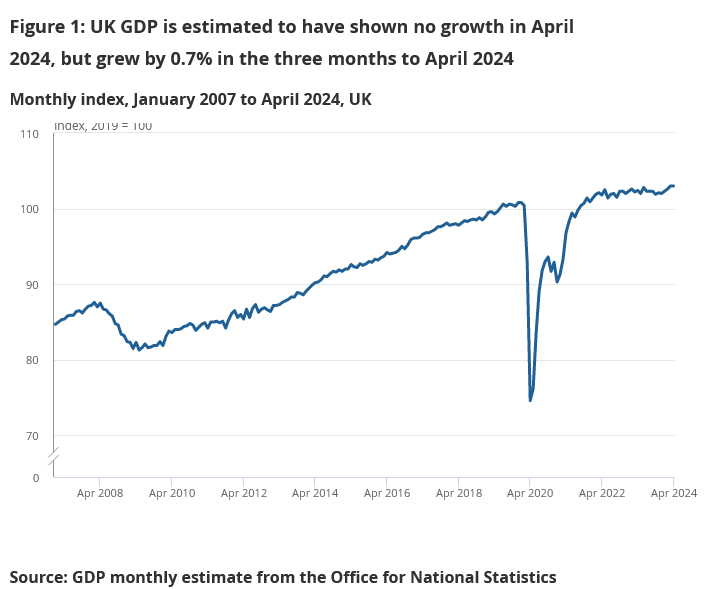
UK GDP holds steady in April as services offset declines in production and construction
UK GDP showed no growth in April, aligning with market expectations. The data reveals a mixed picture, with certain sectors compensating for declines in others.
Services output grew by 0.2% mom, marking its fourth consecutive month of growth, underscoring the resilience of the services sector. Conversely, production output fell by -0.9% mom, reflecting ongoing challenges in the industrial sector. Construction output declined by -1.4% mom, continuing its downward trend for the third straight month.
Looking at the three-month period from February to April compared to the preceding three months from November to January, GDP grew by 0.7%. Within this period, services expanded by 0.9%, driven by consistent monthly gains. Production also showed a positive trend with a 0.7% increase, despite the monthly volatility. However, construction suffered a -2.2% decline, indicating sustained weakness in this sector.
A Meli-Melo of Politics and Economics
We have different moods on different continents this week. The European equities remained under the pressure of heating French political tensions on Tuesday, as the Republican President Ciotto suggested that his party should consider teaming up with Le Pen’s party – a limit that many Republicans still consider as being a thick red line that should never be breached. Some ask Ciotti to resign. Bref, the unrest continues, the French 10-year yield continues to push to the upside, the spread between the French and German 10-year yield went past 60bp, the CAC 40 is at the weakest level since February while the EURUSD remains heavily offered. The pair is preparing to test the 1.07 support to the downside.
Meanwhile, on the other side of the Atlantic Ocean, the major stock indices in the US advanced to fresh records on the back of a strong 10-year auction a day before the latest CPI update and the Federal Reserve (Fed) decision. The US 2-year yield gave back a part of the post-jobs strength, the 10-year yield tipped a toe below 4.40%, the S&P500 advanced to a fresh record, helped by softer yields and a wonderful 7% jump in Apple shares on company’s AI plans that came with a 24-hour delay.
Good news is that the good mood from the US is giving a meagre smile to the European equity futures at the time of writing.
Perhaps the most important day of summer
Today is a big day in terms of economic data and Fed announcement - it could determine the global market mood for the rest of the month, and a good part of summer.
First, the US will reveal its latest CPI update: core CPI is expected to have eased from 3.5% to 3.4% on a yearly basis, but headline CPI is seen steady near 3.4%. These numbers are nowhere near the Fed’s 2% target and are not trending sufficiently fast toward that level, but a surprise to the downside could fuel the Fed cut bets for later this year.
Then, the Fed will announce that it’s not changing its rates today but will release the latest dot plot where the Fed members will plot how many rate cuts they think they could announce in the future. I am confident that the number of median rate cuts projected by the Fed members will be less than three that was plotted back in March. But whether it will be one or two is yet to be seen.
Note that the major US indices’ advance toward fresh ATH levels hides a rising stress on the banks front. In fact, the SPDR’s banks and regional banks indices both declined to the lowest levels since April as Pimco warned of a ‘very high’ concentration of troubled commercial real estate loans on the regional banks’ books. And the more the Fed waits before cutting its rates, the more the commercial real estate troubles could rise to the surface.
While the US yields are giving back the post-jobs advance, and the softer yields echo well across the major indices, the US dollar index remains upbeat by inflation and Fed uncertainties, and the political shenanigans on this side of the Atlantic Ocean.
Labour good for mood?
While the election uncertainty in France doesn’t do much good to the euro, the pound sterling looks much less battered by the idea that the Conservatives will likely say Good Bye to their majority next month. In fact, a recent survey from Bloomberg hinted that a Labour win would be better for both the pound, gilts and stocks – which is unusual. But because Brexit, Truss and endless infighting damaged Tories’ reputation over the years, it’s likely that the end of the normally-market-friendly Tories’ rule resonates well across markets. Cable is holding ground above the minor 23.6% retracement on April to June rebound and the toppish view is mostly due to the US dollar’s strength.
Britain has 22 more days to go until the UK election and Labour holds more than 20 points lead over the Tories, and yesterday’s big claimant count change and the rise of the unemployment rate to 4.4% certainly didn’t help improve Tories popularity, even though the softening inflation has clearly helped Rishi Sunak hold his promise to halve inflation (but we know that falling inflation was mostly due to global dynamics and – partly – to the Bank of England’s (BoE) tight monetary policy). Anyway, this week’s weak jobs data increases the chances of a BoE cut once the election dust settles while the pound sterling is expected to be better off in the scenario of changing government than status quo. Whether Cable could continue to rise, however, depends on where the US dollar is headed. And where the US dollar is headed depends on the US inflation, the health of the US economy and the Fed.