

Sample Category Title
USD/CHF Daily Outlook
Daily Pivots: (S1) 0.8867; (P) 0.8919; (R1) 0.8954; More….
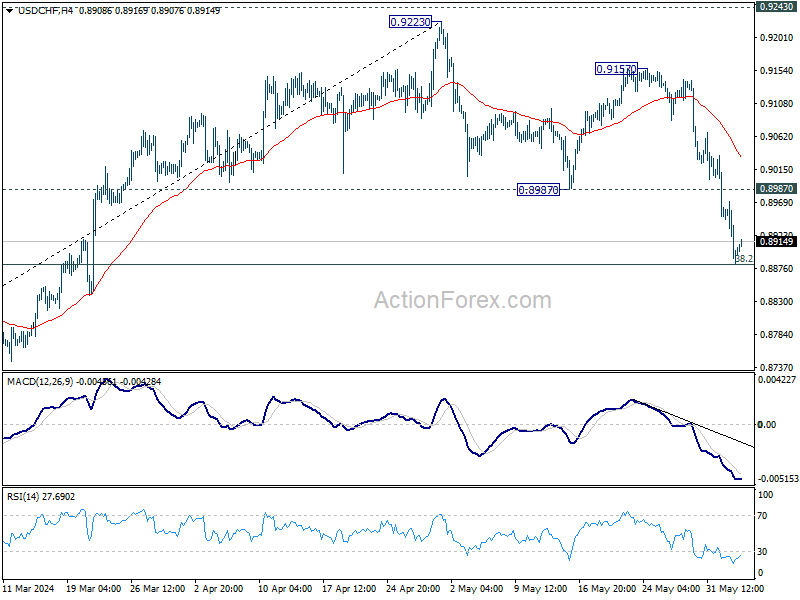
Immediate focus is now on 0.8883 fibonacci level as USD/CHF's fall from 0.9223 extended. Sustained break there will carry larger bearish implications. Nevertheless, strong rebound from current level, followed by break of 0.8987 support turned resistance, will suggest that correction from 0.9223 has completed, and retain near term bullishness.
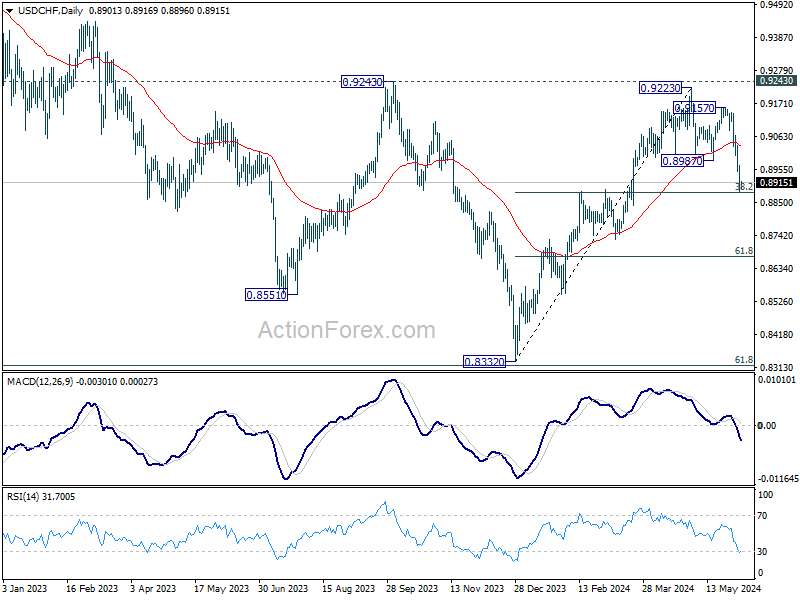
In the bigger picture, price actions from 0.8332 medium term bottom are tentatively seen as developing into a corrective pattern to the down trend from 1.0146 (2022 high). Rejection by 0.9243 resistance, followed by sustained break of 38.2% retracement of 0.8332 to 0.9223 at 0.8883 will strengthen this case, and maintain medium term bearishness. However, decisive break of 0.9243 will argue that the trend has already reversed and turn medium term outlook bullish for 1.0146.
GBP/USD Daily Outlook
Daily Pivots: (S1) 1.2737; (P) 1.2777; (R1) 1.2810; More…..
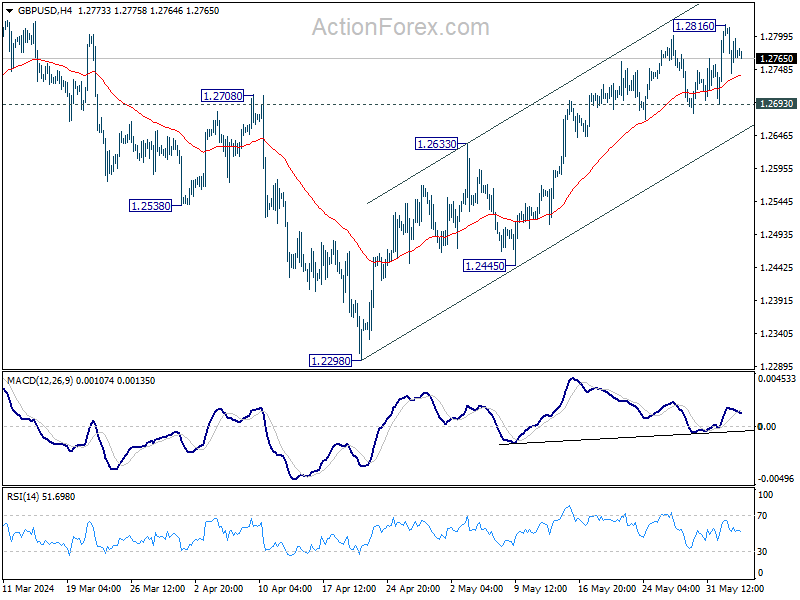
Intraday bias in GBP/USD is turned neutral with current retreat and some consolidations could be seen below 1.2816. Further rise is in favor as long as 1.2693 support holds. Above 1.2816 will resume the rally from 1.2298 to 1.2892 resistance next. On the downside, break of 1.2693 minor support will turn intraday bias to the downside for deeper pullback instead.
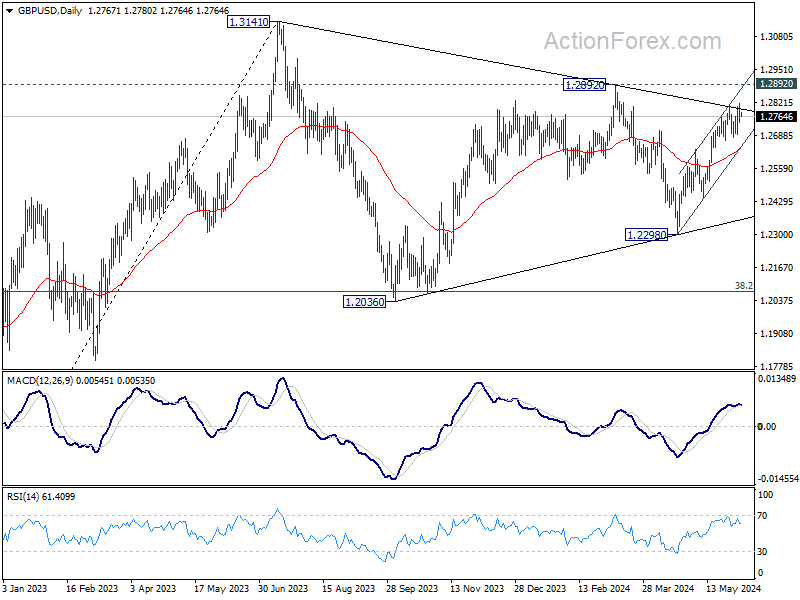
In the bigger picture, price actions from 1.3141 medium term top are seen as a corrective pattern. Fall from 1.2892 is seen as the third leg which might have completed already. Break of 1.2892 resistance will argue that larger up trend from 1.0351(2022 low) is ready to resume through 1.3141. Meanwhile, break of 1.2445 support will extend the corrective pattern with another decline instead.
Oil Consolidates Near Critical Support – BoC to Announce First Rate Cut
Shocker! The exit polls were completely wrong in predicting the outcome of the Indian election. Not only that Narendra Modi’s BJP couldn’t secure a landslide victory in the latest elections – as it was suggested by Monday’s polls, but it couldn’t even win enough seats to secure a majority in the parliament. Its focus on making India a religious and Hindu nation didn’t bod well with the ethnic groups who are not Hindu, the growing inequality within the giant nation was also pointed as a reason for BJP’s fall from grace. Modi will most probably not quit his seat as PM, but the BJP will need coalition to pass reforms in the Parliament and that could prevent the party from passing its business-friendly policies and ambitious reforms concerning labour and land, and slow economic growth – which hit 8% this year. The Nifty 50 fell nearly 6% from a record and remains under pressure this morning while the Indian rupee depreciated as fast as it had jumped on Monday.
US jobs in focus
The JOLTS data from the US showed that job openings in the US fell to around 8 mio jobs in April. The softer-than-expected figure boosted appetite in US treasuries and increased the probability of seeing the first Federal Reserve (Fed) cut in September. The US 2-year yield – which tracks the Fed expectations – eased to 4.75%, and the probability of a September cut rose to around 65%. The US dollar index consolidated and equities eked out small gains. The S&P 500 closed 0.15% higher. Nasdaq gained nearly 0.30% while Nvidia hit a fresh record as its efforts to diversify from other chipmakers and offer not only powerful AI chips but also a software and services continue to pay off.
Today, the ADP report is expected to print around 173K new private job additions to the US economy last month. That’s a soft but not a disastrous figure. If the ADP report comes in line with expectations or softer-than-expected, we may see the Fed doves gain more traction and the US yields ease more. Equities, on the other hand, will likely react positively to a figure that doesn’t look too soft, as a significant negative surprise on the jobs front could fuel recession worries and prevent equity investors from fully benefiting from potentially rising dovish Fed expectations.
US crude consolidates near critical support zone
The US crude consolidates losses near 4-month lows. The sharp fall in oil prices below critical support levels pushed the CTAs – commodity trading advisors - to dramatically rise their short positions. CTAs tend to amplify the market moves as they tend to sell a bear market and buy a bull market. Therefore the latest selloff may be overdone and a correction could also see a support from CTAs, given that we are now approaching a critical support zone on the downside. The rising dovish central bank voices are, in theory, supportive for oil prices in the context of reflation trade, but for the reflation trade to fully benefit to energy and commodities, growth expectations should not erode fast to flash recession. That’s a fine line. Price-wise, the $70/72pb range should act as a solid support zone.
Rate cuts on the menu
The next few hours could bring two rate cut announcements from two major central banks. The Bank of Canada (BoC) and the European Central Bank (ECB) are expected to announce a 25bp cut to their rates today and tomorrow respectively. A 25bp cut from the BoC could throw a floor under the recent pullback in Canadian stocks, while the ECB’s 25bp cut may not suffice to cheer up investors depending on what the Chief Christine Lagarde says at her press conference regarding the bank’s position concerning further cuts. The EURUSD faces a decent resistance near 1.0930, a major Fibonacci resistance on its ytd decline. The ECB should sound sufficiently dovish to let the bulls clear the 1.0930 resistance this week – or the US data should be sufficiently ugly to break the back of the Fed hawks.
EUR/USD Daily Outlook
Daily Pivots: (S1) 1.0853; (P) 1.0885; (R1) 1.0910; More…
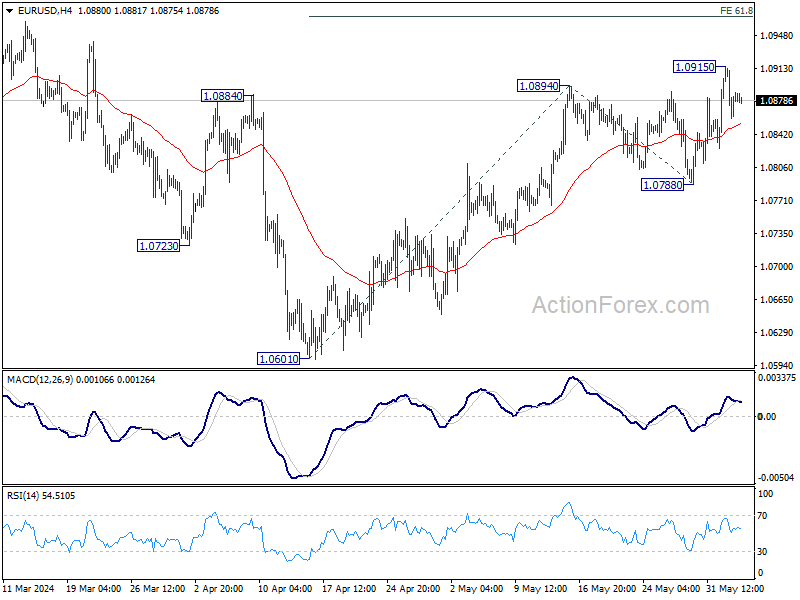
Intraday bias in EUR/USD is turned neutral with current retreat and some consolidations would be seen below 1.0915. Further rally is expected as long as 1.0788 support holds. Break of 1.0915 will resume the rally from 1.0601 to 61.8% projection of 1.0601 to 1.0894 from 1.0788 at 1.0969. However, firm break of 1.0788 will turn bias back to the downside for deeper decline instead.
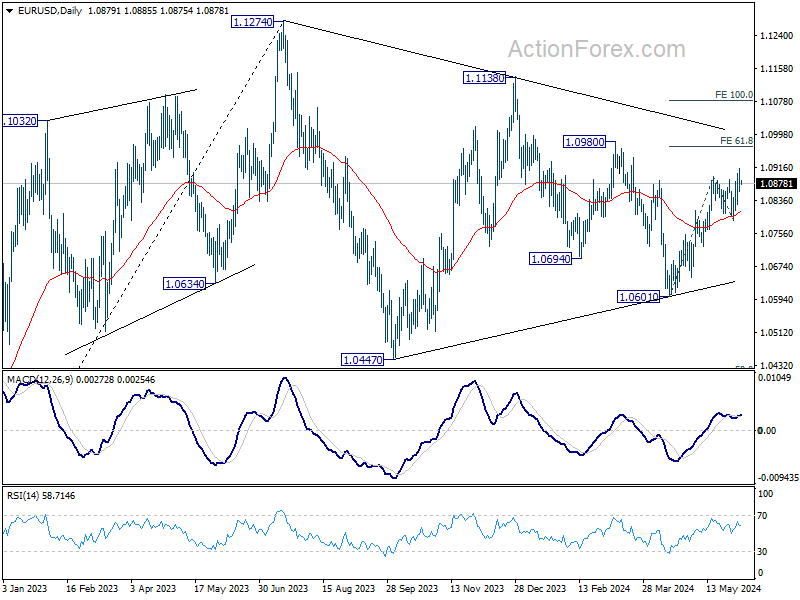
In the bigger picture, price actions from 1.1274 are viewed as a corrective pattern. Fall from 1.1138 is seen as the third leg and could have completed. Firm break of 1.1138 will argue that larger up trend from 0.9534 (2022 low) is ready to resume through 1.1274 high. On the downside, break of 1.0788 support will extend the corrective pattern instead.
Weak Loonie Anticipates BoC, Struggling Dollar Seeks Support from ADP and ISM Services
Forex trading in Asian session today was relatively muted, with market participants holding off on major moves in anticipation of impending key events. The spotlight is on BoC, with traders eagerly awaiting its rate decision. There is considerable speculation on whether the central bank will opt for an interest rate cut at this meeting or defer action until the next session. Canadian Dollar, already the weakest performer of the week, faces the risk of a more pronounced selloff if BoC adopts more dovish than expected stance.
Meanwhile, Dollar is also under pressure, ranking as the second weakest for the week so far, after selloffs triggered by disappointing manufacturing data. Investors are now looking forward to today's release of ADP private employment data for an early indication of May's job market performance. Nevertheless, ISM services data is likely to be a more significant market mover. Meanwhile, Dollar's future direction would also hinge on the broader cues from stock and bond markets, with particular attention on Friday's Non-Farm Payrolls report.
Overall in the currency markets, Swiss Franc and Japanese Yen stand out as the strongest performers, buoyed by the ongoing decline in US and European benchmark treasury yields. New Zealand Dollar follows as the third strongest, while Australian Dollar aligns closer to Dollar and Loonie as the third weakest. Euro and Sterling are positioned in the middle of the pack.
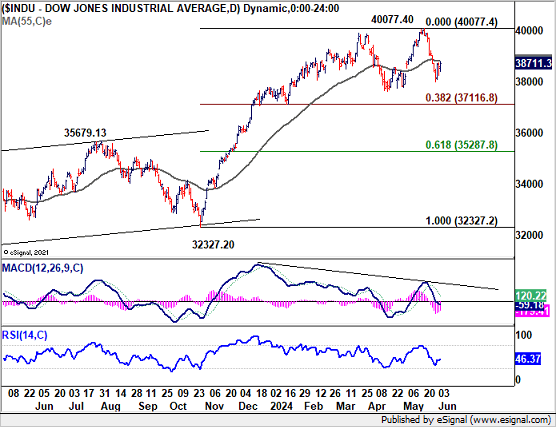
Technically, DOW remains capped by 55 D EMA (now at 38799.44) despite this week's recovery. Fall from 40077.40 is seen as correction to the rise from 32337.20, and further fall is in favor. Break of last week's low of 3800.96 will target 38.2% retracement of 32327.20 to 40077.40 at 37116.82. However, sustained break of 55 D EMA will bring stronger rebound back to retest 40077.40 instead.
In Asia, at the time of writing, Nikkei is down -1.15%. Hong Kong HSI is up 0.36%. China Shanghai SSE is down -0.54%. Singapore Strait Times is up 0.22%. Overnight, DOW rose 0.36%. S&P 500 rose 0.15%. NASDAQ rose 0.17%. 10-year yield fell -0.066 to 4.336.
Japan's nominal labor earnings rise 2.1% yoy, real wages still declining
Japan's nominal labor cash earnings increased by 2.1% yoy in April, surpassing the expected 1.7% and marking the 28th consecutive month of growth. Excluding bonuses and nonscheduled payments, average wages climbed by 2.3% yoy. However, overtime and other allowances were down by -0.6% yoy.
Despite the rise in nominal wages, real wages fell by -0.7% yoy, continuing a 25-month streak of declines, the longest on record. Nonetheless, the rate of decline was smaller than the revised -2.1% yoy drop in March, as many major companies implemented salary increases during the latest spring annual wage negotiations.
Japan's PMI composite hits highest since August 2023
Japan's PMI Services index was finalized at 53.8 in May, slightly lower than April's 54.3. Meanwhile, PMI Composite index rose to 52.6 from 52.3 in April, marking its highest level since August 2023 and staying above 50 neutral mark for the fifth consecutive month.
Trevor Balchin, Economics Director at S&P Global Market Intelligence, noted that the Japanese service sector's "strong upturn was sustained," with only slight easing in growth rates for activity and new work. New export business expanded the most since this metric was introduced in September 2014. Both the future activity and employment indices increased since April and were among the highest on record.
Balchin also highlighted that while costs continued to rise sharply, the strong demand for services led firms to be confident in raising prices. In May, average prices charged for services increased at the third-fastest rate on record, following only April 2014 and April 2024.
RBA's Bullock discusses plan A and two backups amid inflation concerns
RBA Governor Michele Bullock addressed a senate panel today, emphasizing the importance of controlling inflation despite balanced risks. She underscored the necessity of bringing inflation back down to the target band, warning that if inflation doesn't appear to be heading in the right direction, "we'll have to take action.”
In her elaboration on the RBA's rate-setting approach, Bullock described a "Plan A," which involves a data-driven methodology, keeping all options open without committing to a specific course of action prematurely. That is, RBA does “not rule anything in or out.”
She also outlined two contingency "Plan Bs" depending on economic developments: one for persistently high inflation, and another for a significant economic downturn.
"If it turns out that inflation is starting to head higher again or it’s much stickier then we won’t hesitate to move and raise interest rates again," Bullock declared. Conversely, she noted that a weaker-than-expected economy would prompt considerations for easing rates to mitigate deflationary pressures.
Australia's Q1 GDP rises 0.1% qoq, lowest annual growth since late 2020
Australia's GDP grew by 0.1% qoq in Q1, below the anticipated 0.2% growth. On a year-over-year basis, GDP increased by 1.1%.
Katherine Keenan, head of national accounts at ABS, remarked that GDP growth was weak in March, marking the lowest annual growth rate since December 2020. She also highlighted that GDP per capita fell for the fifth consecutive quarter, declining by -0.4% in March and -1.3% over the past year.
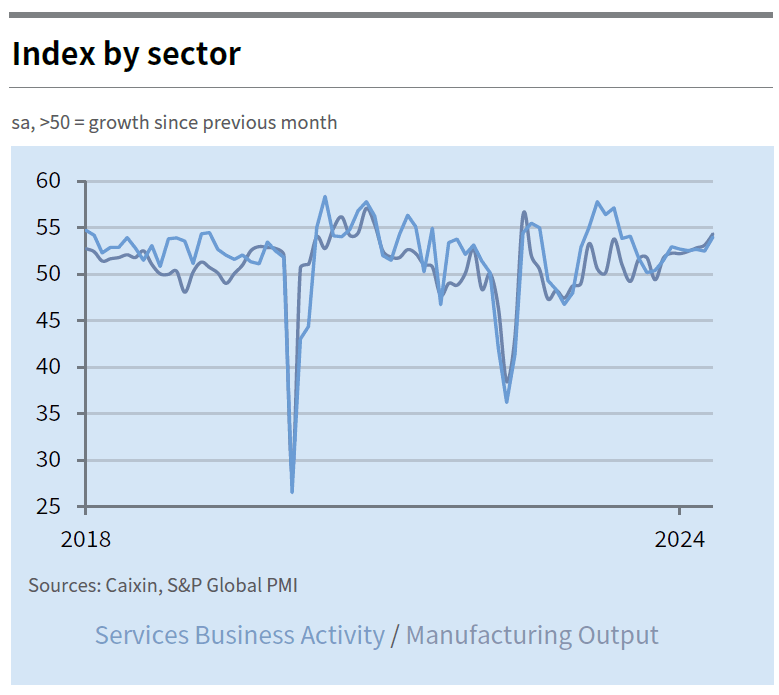
China's Caixin PMI services rises to 54, highest level since July 2023
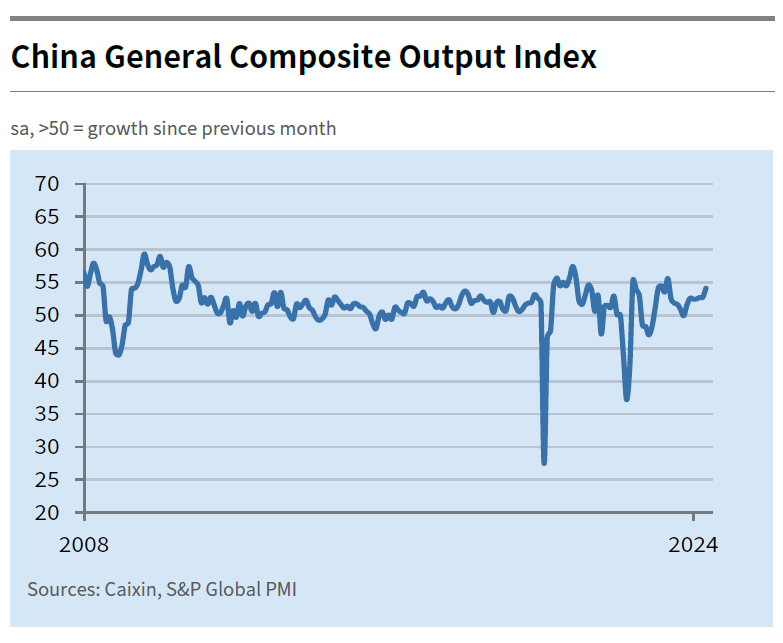
China's Caixin PMI Services index jumped from 52.5 to 54.0 in May, exceeding expectations of 52.6. This marks the 17th consecutive month of expansion and the highest reading since July 2023. Similarly, PMI Composite rose from 52.8 to 54.1, indicating expansion for the 7th straight month and at the fastest pace in a year.
Wang Zhe, Senior Economist at Caixin Insight Group, noted that growth in supply and demand in both the manufacturing and services sectors picked up pace, with a particularly strong increase in services demand. He mentioned that exports in both sectors improved amid market optimism. Additionally, employment in the services industry shifted from a decline to an increase, driving the composite index into expansion for the first time in nine months.
BoC in spotlight, USD/CAD ready for breakout?
BoC rate decision is under the spotlight today. There is palpable readiness within the central bank to commence monetary policy easing especially following unexpectedly weak Q1 GDP data. The primary question being is whether it will take action today or defer until the next meeting in July.
Currently,most economists anticipate that conditions are now conducive for a 25bps rate cut to 4.75% at this meeting. Even if Governor Tiff Macklem opts to hold rates steady today, it is expected that he will signal an imminent rate cut.
Meanwhile, opting to wait until July would enable BoC to present a more comprehensive outline of its easing strategy, coinciding with the release of a new monetary policy report containing updated economic and inflation forecasts. This would provide a clearer framework for understanding the central bank’s expectations and strategic intentions moving forward.
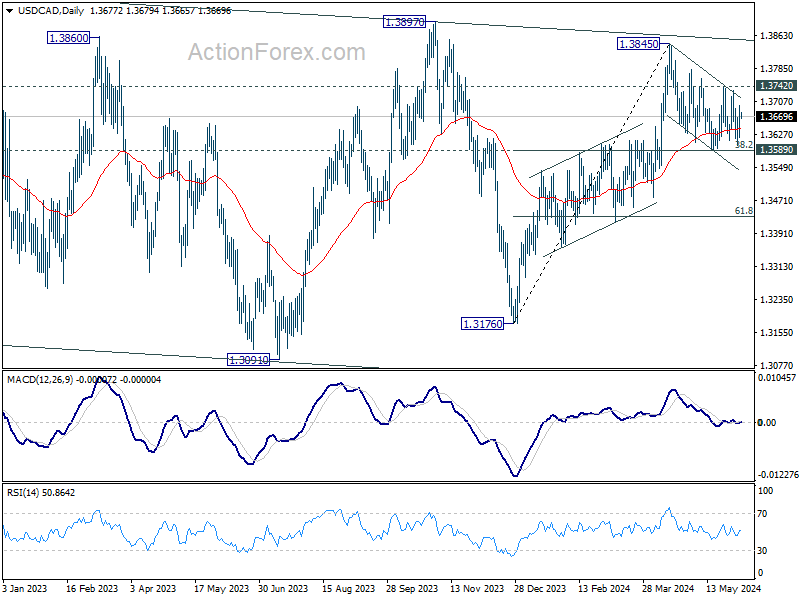
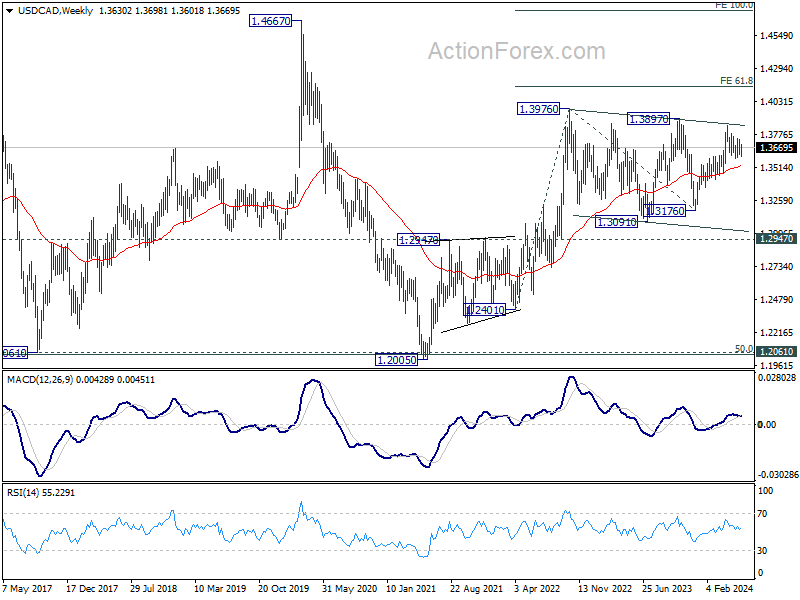
Canadian Dollar is trading as the worst performer of the week at this point, partly dragged down by the extended fall in oil prices. As for USD/CAD, near term outlook stays bullish with 1.3589 cluster support intact (38.2% retracement of 1.3176 to 1.3845 at 1.3589). Break of 1.3742 resistance will be an early sign that rise from 1.3176 is ready to resume through 1.3845.
More importantly, that would put 1.3976 key resistance into focus. Firm break there will resume long term up trend from (1.2005). Next medium term target is 61.8% projection of 1.2401 to 1.3976 from 1.3176 at 1.4149.
Elsehwere
Eurozone will release PMI servies final and PPI in European session, while UK will also publish PMI services final. Later in the day, US will release ADP employment, as well as ISM services.
EUR/USD Daily Outlook
Daily Pivots: (S1) 1.0853; (P) 1.0885; (R1) 1.0910; More…
Intraday bias in EUR/USD is turned neutral with current retreat and some consolidations would be seen below 1.0915. Further rally is expected as long as 1.0788 support holds. Break of 1.0915 will resume the rally from 1.0601 to 61.8% projection of 1.0601 to 1.0894 from 1.0788 at 1.0969. However, firm break of 1.0788 will turn bias back to the downside for deeper decline instead.
In the bigger picture, price actions from 1.1274 are viewed as a corrective pattern. Fall from 1.1138 is seen as the third leg and could have completed. Firm break of 1.1138 will argue that larger up trend from 0.9534 (2022 low) is ready to resume through 1.1274 high. On the downside, break of 1.0788 support will extend the corrective pattern instead.
Economic Indicators Update
| GMT | Ccy | Events | Actual | Forecast | Previous | Revised |
|---|---|---|---|---|---|---|
| 22:45 | NZD | Terms of Trade Index Q1 | 5.10% | 2.80% | -7.80% | |
| 23:30 | JPY | Labor Cash Earnings Y/Y Apr | 2.10% | 1.70% | 0.60% | 1.00% |
| 00:30 | JPY | Services PMI May F | 53.8 | 53.6 | 53.6 | |
| 01:30 | AUD | GDP Q/Q Q1 | 0.10% | 0.20% | 0.20% | 0.30% |
| 01:45 | CNY | Caixin Services PMI May | 54 | 52.6 | 52.5 | |
| 06:45 | EUR | France Industrial Output M/M Apr | 0.50% | -0.30% | ||
| 07:45 | EUR | Italy Services PMI May | 54.5 | 54.3 | ||
| 07:50 | EUR | France Services PMI May F | 49.4 | 49.4 | ||
| 07:55 | EUR | Germany Services PMI May F | 53.9 | 53.9 | ||
| 08:00 | EUR | Eurozone Services PMI May F | 53.3 | 53.3 | ||
| 08:30 | GBP | Services PMI May F | 52.9 | 52.9 | ||
| 09:00 | EUR | Eurozone PPI M/M Apr | -0.50% | -0.40% | ||
| 09:00 | EUR | Eurozone PPI Y/Y Apr | -5.10% | -7.80% | ||
| 12:15 | USD | ADP Employment Change May | 175K | 192K | ||
| 12:30 | CAD | Labor Productivity Q/Q Q1 | 0.40% | 0.40% | ||
| 13:45 | CAD | BoC Interest Rate Decision | 4.75% | 5.00% | ||
| 13:45 | USD | Services PMI May F | 54.8 | 54.8 | ||
| 14:00 | USD | ISM Services PMI May | 51 | 49.4 | ||
| 14:30 | USD | Crude Oil Inventories | -2.1M | -4.2M |
Short Term Elliott Wave Structure in Oil (CL_F) Favors Downside
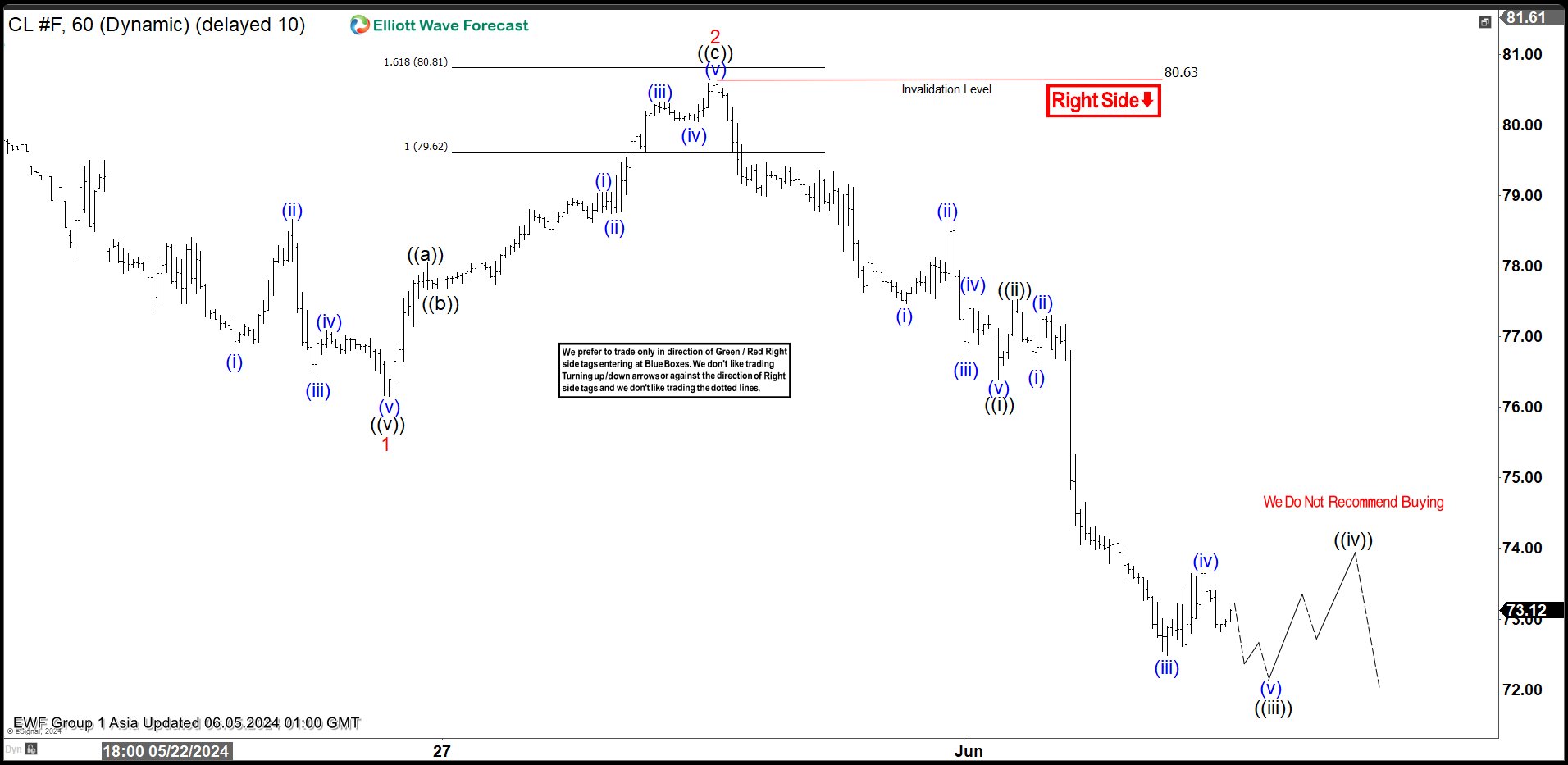
Short Term Elliott Wave in Oil (CL_F) shows incomplete Elliott Wave bearish sequence from 04.12.2024 high. Down from there, wave 1 ended at 76.15 like the 1 hour chart below shows. Rally in wave 2 unfolded in a zig zag Elliott Wave structure. Up from wave 1, wave ((a)) ended at 78.05 and dips in wave ((b)) ended at 77.68. Wave ((c)) higher ended at 80.63 which completed wave 2 in higher degree.
US Oil has resumed lower in wave 3. Down from wave 2, wave ((i)) ended at 76.39 and wave ((ii)) rally ended at 77.52. The CL_F then nested lower with wave (i) of ((iii)) ended at 76.62. Wave (ii) of ((iii)) ended at 77.34. The commodity extended lower in wave (iii) towards 72.48 and wave (iv) ended at 73.69. Wave (v) lower is still developing. As market stays below 73.69 high, we are calling for one more low to wave (v) of ((iii)) and wave ((iii)) in higher degree. Once wave ((iii)) ended, expect near term rally to fail in 3, 7, or 11 swing as wave ((iv)) for further downside.
CL_F 60 Minutes Elliott Wave Chart
CL_F Elliott Wave Video
https://www.youtube.com/watch?v=Wn3--O8lbHU
BoC in spotlight, USD/CAD ready for breakout?
BoC rate decision is under the spotlight today. There is palpable readiness within the central bank to commence monetary policy easing especially following unexpectedly weak Q1 GDP data. The primary question being is whether it will take action today or defer until the next meeting in July.
Currently,most economists anticipate that conditions are now conducive for a 25bps rate cut to 4.75% at this meeting. Even if Governor Tiff Macklem opts to hold rates steady today, it is expected that he will signal an imminent rate cut.
Meanwhile, opting to wait until July would enable BoC to present a more comprehensive outline of its easing strategy, coinciding with the release of a new monetary policy report containing updated economic and inflation forecasts. This would provide a clearer framework for understanding the central bank’s expectations and strategic intentions moving forward.
Canadian Dollar is trading as the worst performer of the week at this point, partly dragged down by the extended fall in oil prices. As for USD/CAD, near term outlook stays bullish with 1.3589 cluster support intact (38.2% retracement of 1.3176 to 1.3845 at 1.3589). Break of 1.3742 resistance will be an early sign that rise from 1.3176 is ready to resume through 1.3845.
More importantly, that would put 1.3976 key resistance into focus. Firm break there will resume long term up trend from (1.2005). Next medium term target is 61.8% projection of 1.2401 to 1.3976 from 1.3176 at 1.4149.
Gold Price At Risk of Additional Losses – Here’s Why
Key Highlights
- Gold declined and tested the $2,315 zone.
- A key declining channel is forming with resistance at $2,345 on the 4-hour chart.
- EUR/USD is holding gains above the 1.0850 level.
- GBP/USD seems to be aiming for more gains above 1.2800.
Gold Price Technical Analysis
Gold prices started a fresh decline from the $2,450 resistance against the US Dollar. It traded below the $2,380 level to move into a short-term bearish zone.
The 4-hour chart of XAU/USD indicates that the price settled below the $2,350 level, the 100 Simple Moving Average (red, 4 hours), and the 200 Simple Moving Average (green, 4 hours).
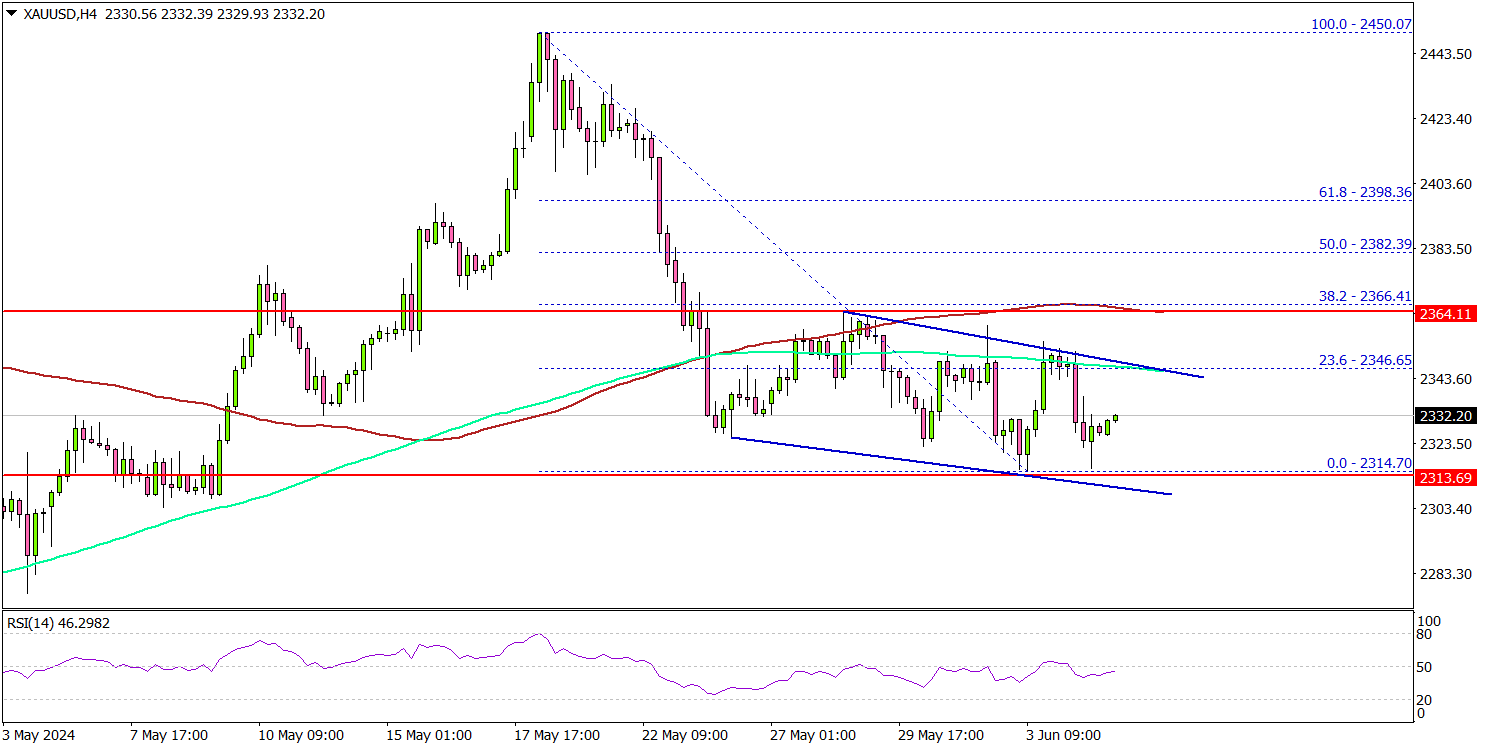
It traded as low as $2,315 and is currently consolidating losses. On the downside, there is a key support forming near the $2,315 level. A downside break below the $2,315 support might call for more downsides.
The next major support is near the $2,300 level. Any more losses might send Gold prices toward $2,280. On the upside, immediate resistance is at $2,340.
The first major resistance is now near $2,345. There is also a key declining channel forming with resistance at $2,345 on the same chart, above which the price could accelerate higher toward the $2,380 level.
Looking at Oil, the bears are still in control, and they could aim for another decline unless there is a move above the $75.00 resistance in the near term.
Economic Releases to Watch Today
- US ISM Services Index for May 2024 – Forecast 50.5, versus 49.4 previous.
- US ADP Employment Change April 2024 - Forecast 173K, versus 192K previous.
China’s Caixin PMI services rises to 54, highest level since July 2023
China's Caixin PMI Services index jumped from 52.5 to 54.0 in May, exceeding expectations of 52.6. This marks the 17th consecutive month of expansion and the highest reading since July 2023. Similarly, PMI Composite rose from 52.8 to 54.1, indicating expansion for the 7th straight month and at the fastest pace in a year.
Wang Zhe, Senior Economist at Caixin Insight Group, noted that growth in supply and demand in both the manufacturing and services sectors picked up pace, with a particularly strong increase in services demand. He mentioned that exports in both sectors improved amid market optimism. Additionally, employment in the services industry shifted from a decline to an increase, driving the composite index into expansion for the first time in nine months.
RBA’s Bullock discusses plan A and two backups amid inflation concerns
RBA Governor Michele Bullock addressed a senate panel today, emphasizing the importance of controlling inflation despite balanced risks. She underscored the necessity of bringing inflation back down to the target band, warning that if inflation doesn't appear to be heading in the right direction, "we'll have to take action.”
In her elaboration on the RBA's rate-setting approach, Bullock described a "Plan A," which involves a data-driven methodology, keeping all options open without committing to a specific course of action prematurely. That is, RBA does “not rule anything in or out.”
She also outlined two contingency "Plan Bs" depending on economic developments: one for persistently high inflation, and another for a significant economic downturn.
"If it turns out that inflation is starting to head higher again or it’s much stickier then we won’t hesitate to move and raise interest rates again," Bullock declared. Conversely, she noted that a weaker-than-expected economy would prompt considerations for easing rates to mitigate deflationary pressures.